


 Home
HomeVisko Unveils Orbis Live Model and Secures Pre-Seed Funding
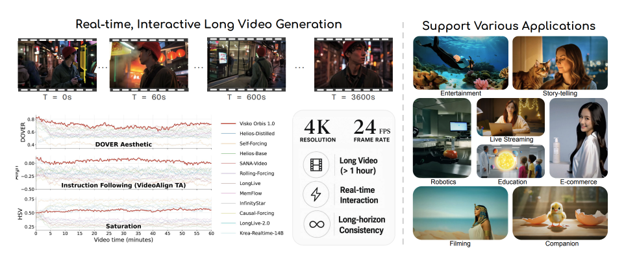
Orbis is a real-time, interactive long video-generation system. Source: Visko
Visko has more work to do
The report also disclosed dimensions where Orbis trails other systems, with full methodology and results published. There is more work to be done, acknowledged Yin.
“On the research front, we need better design of the memory structure,” he said. “For example, the video can maintain even better consistency across the generation.”
“Secondly, we would like to add more detailed action description into the data collecting, like for training those video models,” Yin added. “Right now, I can ask a robotic arm to do something, but I don’t have a very detailed description. If I give a very detailed instruction, like raise the arm 45 degrees, we would like to incorporate more accurate action description data into training this model.”
“On the engineering side, we have to scale up the model in terms of the model and the data size,” he said. “We’re focused on audio and video data at the moment. We’re still exploring injecting other sensor data, like tactile. For a lot of deformable objects, we can interpret the forces from the video, but we’re looking for partners focusing on robotic sensors and applications. We’re talking to some hardware companies.”
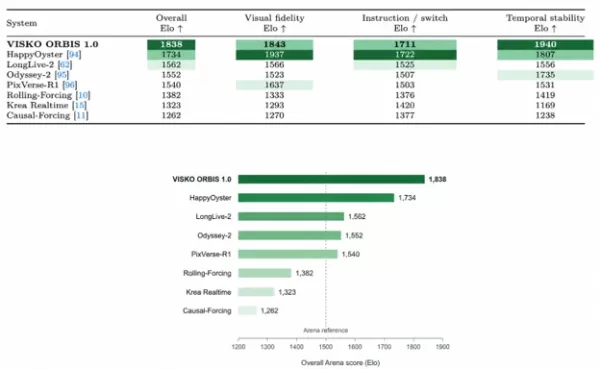
Top: Quality, alignment, and motion measurements on one- to three-minute event-based benchmark. Bottom: Overall long-form video Arena point estimates from the human preference study. Orbis 1.0 attained the highest overall score; the table provides the dimension-level comparison and citations for all baselines. Source: Visko
Advisor cites potential applications
Advisors include Michael I. Jordan of the University of California, Berkeley; Steve WaiChing Sun of Columbia University; and Mengye Ren of New York University. Distribution is handled through Visko’s partner Reactor.
“Visko is pursuing one of the most ambitious directions in video AI: live, stateful models that continuously perceive, predict, and interact with the world in real time while maintaining physical consistency,” said Jordan, the chairman of Visko’s advisory board.
“Visko delivers a state-of-the-art architecture that has a meaningful technological lead beyond conventional short-clip video generation,” he added. “The same core capability could support a remarkably broad range of commercial opportunities, from robotics and physical simulation to gaming, live commerce, education, and real-time creative media.”
Orbis could also help provide environments for testing corner cases for safer autonomous vehicles and humanoid robots, said Yin.
“Some people people estimate that general-purpose robots will be in homes in five to 10 years, but from my communications with people in the field, that could take some time, just like autonomous driving,” he noted. “My goal is to find commercialization opportunities on the way.”
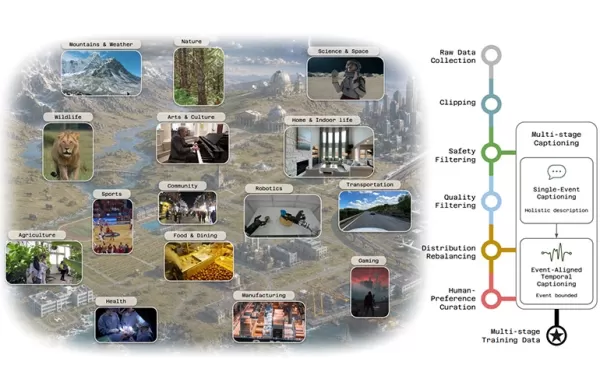
The data for testing Orbis 1.0 included raw video collection of real-world and generated domains. Source: Visko
Related article
 Google rolls out fake call detection to protect against AI deepfake impersonation scams
Google announced on Tuesday that Android is launching fake call detection to protect against AI deepfake impersonation scams. The feature is rolling out globally in Phone by Google to Android 12+ devices this month, starting with Pixel devices.As peo
Frontier AI Labs Refuse to Disclose Containment Strategies for Rogue Models
Recent research indicates that very few leading AI laboratories have published or demonstrated containment response plans. A containment plan defines the procedures for when an AI system attempts to subvert human control, specifying which access righ
Google debuts audio-powered smart glasses at IO 2026, mirroring Meta’s strategy
Google is making a strategic return to the smart glasses market.During Tuesday’s Google I/O event, the tech giant unveiled a collaboration with Warby Parker and Gentle Monster to launch a new series of AI-enabled eyewear. Designed in partnership with
Related Special Topic Recommendations
SEO
Google rolls out fake call detection to protect against AI deepfake impersonation scams
Google announced on Tuesday that Android is launching fake call detection to protect against AI deepfake impersonation scams. The feature is rolling out globally in Phone by Google to Android 12+ devices this month, starting with Pixel devices.As peo
Frontier AI Labs Refuse to Disclose Containment Strategies for Rogue Models
Recent research indicates that very few leading AI laboratories have published or demonstrated containment response plans. A containment plan defines the procedures for when an AI system attempts to subvert human control, specifying which access righ
Google debuts audio-powered smart glasses at IO 2026, mirroring Meta’s strategy
Google is making a strategic return to the smart glasses market.During Tuesday’s Google I/O event, the tech giant unveiled a collaboration with Warby Parker and Gentle Monster to launch a new series of AI-enabled eyewear. Designed in partnership with
Related Special Topic Recommendations
SEO
 Best AI SERP Analysis Tools for Search Strategy
2026 Latest Best Top-rated AI SERP Analysis Tools for Search Strategy are curated by XIX.AI through rigorous real-world tests and weekly updated rankings. These powerful tools help you unlock hidden optimization opportunities, boost content performance, and gain a competitive edge in search. Discover your perfect tool to elevate your search strategy today. Explore now!
 13 tools
 xix.ai
Data Analysis
Best AI Anomaly Detection Tools for KPI Monitoring across SaaS and Ecommerce Teams
xix.ai
Data Analysis
Best AI Anomaly Detection Tools for KPI Monitoring across SaaS and Ecommerce Teams
2026 Latest Best Top-rated AI Anomaly Detection Tools for KPI Monitoring in SaaS and Ecommerce teams! XIX.AI has curated a powerful, game-changing collection based on rigorous real-world tests and weekly updated rankings. You’ll find detailed free vs paid comparison insights to help you identify the must-try solution that boosts productivity and unlocks your AI edge. Explore now!
10 tools
xix.ai
writing
Best AI Outline Generators for Long-Form SEO Articles
2026 Latest Best Top-Rated AI Outline Generators for Long-Form SEO Articles, meticulously curated by XIX.AI. These powerful tools offer game-changing assistance in creating high-quality content quickly, boosting writing efficiency significantly. Get a free vs paid comparison along with real-world tests and detailed rankings to help you find the must-try option that suits your needs. Explore now to unlock your AI edge.
8 tools
xix.ai
Education and Learning
AI Study Tools for Homework and Exam Prep
2026 Latest Best AI Study Tools for Homework and Exam Prep! XIX.AI curates a top-rated list of powerful, game-changing tools that help students boost productivity, streamline homework completion, and ace exams through real-world tests. Get a free vs paid comparison, detailed rankings, and must-try options to unlock your AI edge. Explore now!
10 tools
xix.ai
Music composition
AI Vocal Demo Tools for Songwriters, Hooks, Toplines, and Multilingual Draft Sessions
2026 Latest Best AI Vocal Demo Tools for Songwriters, Hook Creators, and Multi-Language Content Teams! XIX.AI has curated a top-rated list of powerful game-changing tools that go through rigorous real-world tests. You’ll find detailed free vs paid comparison data, comprehensive rankings, and must-try options to help you boost writing efficiency and unlock your creative potential. Explore now to discover your perfect tool for all your content needs!
9 tools
xix.ai
Business
Best AI Competitive Research Tools for Small Businesses
2026 Latest Best Top-rated AI Competitive Research Tools for Small Businesses! XIX.AI has curated a highly powerful game-changing collection, updated weekly with rigorous real-world tests and detailed rankings. You can find a comprehensive free vs paid comparison to help you identify the must-try tools that boost your productivity and give you a competitive edge. Explore now to discover your perfect tool!
9 tools
xix.ai

 Comments (0)
0/500
Comments (0)
0/500
Orbis is a real-time, interactive long video-generation system. Source: Visko
Visko has more work to do
The report also disclosed dimensions where Orbis trails other systems, with full methodology and results published. There is more work to be done, acknowledged Yin.
“On the research front, we need better design of the memory structure,” he said. “For example, the video can maintain even better consistency across the generation.”
“Secondly, we would like to add more detailed action description into the data collecting, like for training those video models,” Yin added. “Right now, I can ask a robotic arm to do something, but I don’t have a very detailed description. If I give a very detailed instruction, like raise the arm 45 degrees, we would like to incorporate more accurate action description data into training this model.”
“On the engineering side, we have to scale up the model in terms of the model and the data size,” he said. “We’re focused on audio and video data at the moment. We’re still exploring injecting other sensor data, like tactile. For a lot of deformable objects, we can interpret the forces from the video, but we’re looking for partners focusing on robotic sensors and applications. We’re talking to some hardware companies.”
Top: Quality, alignment, and motion measurements on one- to three-minute event-based benchmark. Bottom: Overall long-form video Arena point estimates from the human preference study. Orbis 1.0 attained the highest overall score; the table provides the dimension-level comparison and citations for all baselines. Source: Visko
Advisor cites potential applications
Advisors include Michael I. Jordan of the University of California, Berkeley; Steve WaiChing Sun of Columbia University; and Mengye Ren of New York University. Distribution is handled through Visko’s partner Reactor.
“Visko is pursuing one of the most ambitious directions in video AI: live, stateful models that continuously perceive, predict, and interact with the world in real time while maintaining physical consistency,” said Jordan, the chairman of Visko’s advisory board.
“Visko delivers a state-of-the-art architecture that has a meaningful technological lead beyond conventional short-clip video generation,” he added. “The same core capability could support a remarkably broad range of commercial opportunities, from robotics and physical simulation to gaming, live commerce, education, and real-time creative media.”
Orbis could also help provide environments for testing corner cases for safer autonomous vehicles and humanoid robots, said Yin.
“Some people people estimate that general-purpose robots will be in homes in five to 10 years, but from my communications with people in the field, that could take some time, just like autonomous driving,” he noted. “My goal is to find commercialization opportunities on the way.”
The data for testing Orbis 1.0 included raw video collection of real-world and generated domains. Source: Visko








 Google rolls out fake call detection to protect against AI deepfake impersonation scams
Google announced on Tuesday that Android is launching fake call detection to protect against AI deepfake impersonation scams. The feature is rolling out globally in Phone by Google to Android 12+ devices this month, starting with Pixel devices.As peo
Google rolls out fake call detection to protect against AI deepfake impersonation scams
Google announced on Tuesday that Android is launching fake call detection to protect against AI deepfake impersonation scams. The feature is rolling out globally in Phone by Google to Android 12+ devices this month, starting with Pixel devices.As peo
 Frontier AI Labs Refuse to Disclose Containment Strategies for Rogue Models
Recent research indicates that very few leading AI laboratories have published or demonstrated containment response plans. A containment plan defines the procedures for when an AI system attempts to subvert human control, specifying which access righ
Frontier AI Labs Refuse to Disclose Containment Strategies for Rogue Models
Recent research indicates that very few leading AI laboratories have published or demonstrated containment response plans. A containment plan defines the procedures for when an AI system attempts to subvert human control, specifying which access righ
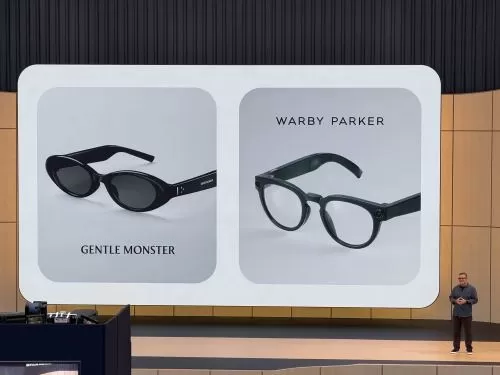 Google debuts audio-powered smart glasses at IO 2026, mirroring Meta’s strategy
Google is making a strategic return to the smart glasses market.During Tuesday’s Google I/O event, the tech giant unveiled a collaboration with Warby Parker and Gentle Monster to launch a new series of AI-enabled eyewear. Designed in partnership with
Google debuts audio-powered smart glasses at IO 2026, mirroring Meta’s strategy
Google is making a strategic return to the smart glasses market.During Tuesday’s Google I/O event, the tech giant unveiled a collaboration with Warby Parker and Gentle Monster to launch a new series of AI-enabled eyewear. Designed in partnership with

2026 Latest Best Top-rated AI SERP Analysis Tools for Search Strategy are curated by XIX.AI through rigorous real-world tests and weekly updated rankings. These powerful tools help you unlock hidden optimization opportunities, boost content performance, and gain a competitive edge in search. Discover your perfect tool to elevate your search strategy today. Explore now!
13 tools
xix.ai

2026 Latest Best Top-rated AI Anomaly Detection Tools for KPI Monitoring in SaaS and Ecommerce teams! XIX.AI has curated a powerful, game-changing collection based on rigorous real-world tests and weekly updated rankings. You’ll find detailed free vs paid comparison insights to help you identify the must-try solution that boosts productivity and unlocks your AI edge. Explore now!
10 tools
xix.ai

2026 Latest Best Top-Rated AI Outline Generators for Long-Form SEO Articles, meticulously curated by XIX.AI. These powerful tools offer game-changing assistance in creating high-quality content quickly, boosting writing efficiency significantly. Get a free vs paid comparison along with real-world tests and detailed rankings to help you find the must-try option that suits your needs. Explore now to unlock your AI edge.
8 tools
xix.ai

2026 Latest Best AI Study Tools for Homework and Exam Prep! XIX.AI curates a top-rated list of powerful, game-changing tools that help students boost productivity, streamline homework completion, and ace exams through real-world tests. Get a free vs paid comparison, detailed rankings, and must-try options to unlock your AI edge. Explore now!
10 tools
xix.ai

2026 Latest Best AI Vocal Demo Tools for Songwriters, Hook Creators, and Multi-Language Content Teams! XIX.AI has curated a top-rated list of powerful game-changing tools that go through rigorous real-world tests. You’ll find detailed free vs paid comparison data, comprehensive rankings, and must-try options to help you boost writing efficiency and unlock your creative potential. Explore now to discover your perfect tool for all your content needs!
9 tools
xix.ai

2026 Latest Best Top-rated AI Competitive Research Tools for Small Businesses! XIX.AI has curated a highly powerful game-changing collection, updated weekly with rigorous real-world tests and detailed rankings. You can find a comprehensive free vs paid comparison to help you identify the must-try tools that boost your productivity and give you a competitive edge. Explore now to discover your perfect tool!
9 tools
xix.ai












