


 Home
Home


Helps TikTok sellers, brands, MCNs, and TAPs discover winning products and find creators.

HelpLook is an AI-powered all-in-one knowledge base tool that helps businesses quickly build knowledge bases, help centers, and...

Your AI Workspace
302.AI is an enterprise-grade AI resource platform with pay-as-you-go pricing, API access to a full range of AI models, and ready-to-use online applications.

剧火AI — AI Screenwriter + Director, a One-Person Short Drama Studio In one sentence, what is it?
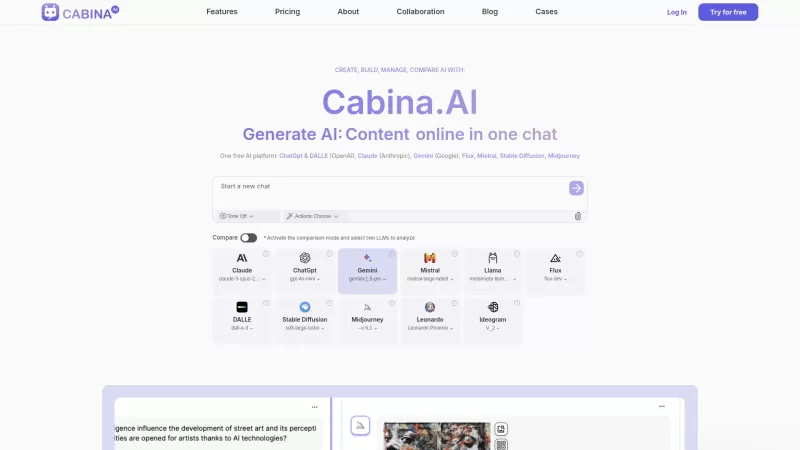
Discover Cabina.AI, the ultimate hub for effortlessly managing and interacting with your favorite chatbots. With Cabina.AI, you can seamlessly switch between different AI models while maintaining a shared context, making your conversations smoother and more productive. Not only can you compare respo
LingoDesk Product Information
When a Spanish-speaking customer asks for a price on Telegram, the usual response is still to copy the message, open a translation tool, and paste the result back into the chat. As the number of conversations grows, that routine becomes slow and error-prone. Messages can be mixed up, sent to the wrong person, or delivered with awkward machine translation still intact.
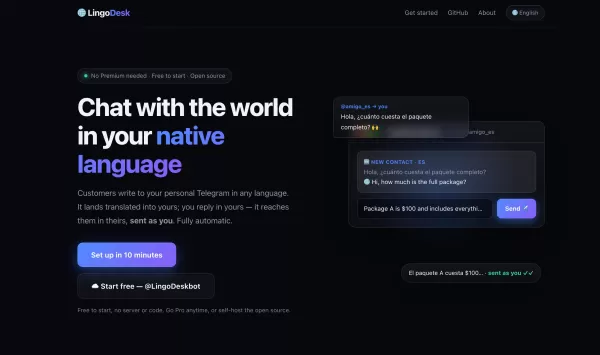
LingoDesk is designed to solve that specific problem. Instead of creating another messaging app, it adds a cross-language workspace between Telegram Business and a translation engine. Customers continue messaging your personal account, while you receive bilingual message cards and reply in your own language. LingoDesk translates your response, lets you review it, and then sends it from your account.
What Exactly Is LingoDesk?
LingoDesk is an automatic translation relay built for Telegram. It uses Telegram Business's official bot connection to receive customer messages sent to a personal account. Each contact is mapped to a separate topic inside a private console group. The original message and its translation appear together, while photos, voice messages, documents, and videos can also be forwarded into the topic and archived.
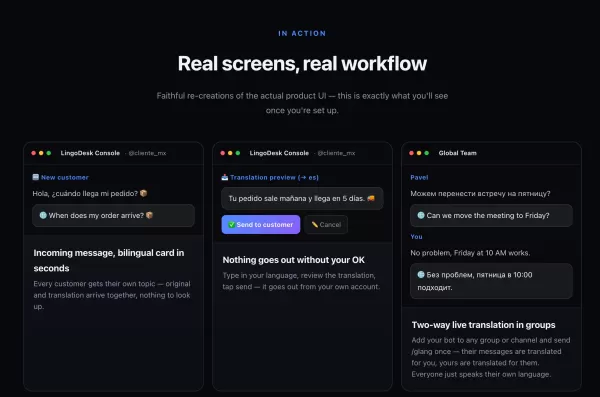
To reply, the operator types in their native language inside the relevant topic. LingoDesk identifies the contact's language, generates a translation, and displays a preview. The message is sent only after the operator confirms it. To the customer, the sender remains the same personal account rather than a bot.
The value goes beyond saving a copy-and-paste step. Separating contacts by topic, reviewing translations before sending, and keeping the original and translated messages together address three common risks in cross-border conversations: mixing up contacts, sending a bad translation, and losing the audit trail afterward.
How a Conversation Moves Through LingoDesk
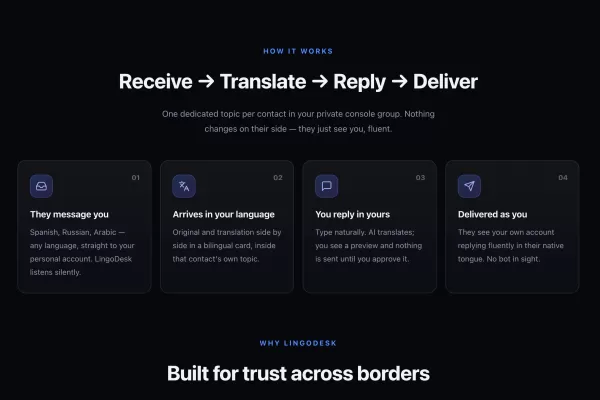
The customer sends a message: They contact your personal Telegram account in any language, without changing their normal messaging habits.
LingoDesk translates it automatically: The message appears in that customer's dedicated topic inside your private console group, with the original and native-language translation shown side by side.
You reply in your native language: LingoDesk translates the response into the customer's language and shows you a preview.
You confirm and send: The translated message is delivered from your personal account. The customer does not need another app and never sees a translation bot in the conversation.
The Practical Problems It Solves
One Topic per Contact Keeps Conversations Separate
The console group uses Telegram's Topics feature, assigning each contact a dedicated topic. For a small team handling inquiries, after-sales support, and order updates at the same time, this is easier to search than a single bot window filled with every translation. It also feels closer to a lightweight customer support desk.
Translations Are Reviewed Before They Are Sent
The biggest danger in automated translation is not inelegant wording. It is sending incorrect information without noticing. LingoDesk puts preview and confirmation directly into the sending flow. If a price, delivery date, product specification, or tone looks wrong, you can revise the original message and translate it again.
It Handles More Than Text
The open-source repository also lists support for forwarding photos, voice messages, documents, and videos; local media archiving; per-contact language locking; and automatic archiving of inactive topics, which are restored when a new message arrives. The interface is available in 15 languages, while translation itself is not limited to those 15 interface languages.
Automatic Failover When the Primary Engine Goes Down
According to the official changelog, the cloud service uses a three-tier translation engine chain: Claude as the primary engine, with OpenAI and DeepSeek as automatic fallbacks. A circuit breaker switches engines during an outage. This should be treated as an availability feature, not an absolute guarantee of translation quality. Contracts, payment details, and legally significant messages still require human review.
You Can Use It Without Telegram Premium, but the Experience Is Different
This is the most important boundary to understand before using LingoDesk. The "invisible relay" that receives messages from customers who contact your personal account and routes them into a private console depends on Telegram Business, so it requires Telegram Premium.
Without Premium, you can still add @LingoDeskbot and use three free modes:
Two-way group interpreting: Add the bot to a group or channel, set the languages with
/glang, and let each participant speak in their own language.Forward-to-translate: Forward a foreign-language message to the bot, receive a translation, and copy the generated reply back into the original chat.
Inline translation: Type
@LingoDeskbotfollowed by your message in any chat, then select the translation to send it from your own account.
These options lower the barrier to trying the product, but they do not fully replace the automatic private-chat relay and per-contact archive available in Premium mode. The real decision is whether you need free translation or a nearly invisible way to manage cross-language customer conversations through your personal account.
Cloud Hosting, Self-Hosting, and Pricing
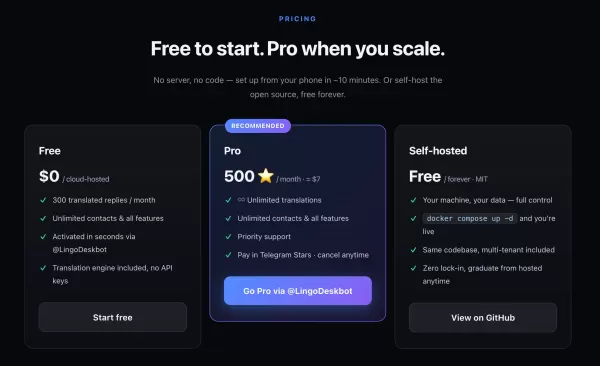
LingoDesk offers three ways to run the service. The plans below were listed on the website in July 2026. Prices and quotas may change, so check the official website before making a final decision.
| Plan | Price | Best For | Main Requirements |
|---|---|---|---|
| Free Cloud Hosting | $0, with 300 translated replies per month | Individual trials and low-volume cross-border communication | Translation engine included; no API key required |
| Pro | 500 Telegram Stars per month, approximately RMB 50 according to the website | Frequent conversations and users who need unlimited translations | Unlimited translations, priority support, and cancellation at any time |
| Self-Hosted | Free software under the MIT License | Teams that prioritize data control or already have operational expertise | Node.js 20 or Docker, a server, and a translation API key |
The cloud-hosted option can be configured from a phone in about 10 minutes and does not require a translation API. The tradeoff is that you must send the Bot Token you created to LingoDesk's official activation bot. The website says the token is stored in encrypted form, the submission message is deleted automatically, and the user can revoke the old token through BotFather at any time. Teams that remain uncomfortable with this step should consider self-hosting.
The self-hosted version is published on GitHub under the MIT License and can be deployed with Docker Compose. The software itself is free, but the server, translation model usage, backups, and ongoing maintenance still have real costs. "Free forever" refers to the software license, not to a zero-cost production environment.
Who Is It For?
Cross-border sellers and international trade professionals who serve overseas customers primarily through Telegram.
Freelancers, consultants, and small service teams handling several customers who speak different languages.
People who do not want to move customers to a new platform but still need a lightweight translation workspace.
Technical teams that want control over the bot, data, and deployment environment and are willing to maintain an open-source service.
If your customers are not concentrated on Telegram, or if your workflow depends on tickets, customer tags, team permissions, service-level agreements, and a complete CRM, LingoDesk is currently better understood as a focused cross-language relay than a mature omnichannel support platform.
Important Limitations to Know Before You Start
The full private-chat relay requires Premium: This is a Telegram Business platform requirement, not a restriction LingoDesk can remove on its own.
The bot may be unable to reply on your behalf to long-inactive contacts: The repository documents Telegram Business's
BUSINESS_PEER_USAGE_MISSINGlimitation. The contact must send a new message to reactivate the conversation, or you must reply manually from your phone once.One Bot Token can run on only one instance worldwide: The same token cannot be used for cloud hosting and self-hosting at the same time, or Telegram will return a
409 Conflicterror.The project is still at an early stage: When checked on July 23, 2026, the public repository showed 51 commits but no published Release, with zero Stars and zero Forks. The website's claim of "360+ real business messages" is self-reported by the team rather than evidence of large-scale public validation.
Is LingoDesk Worth Trying?
The most interesting part of LingoDesk is not that it adds another translation button. It puts translation back inside Telegram's actual conversation flow: customers do not need to change tools, operators do not need to copy messages back and forth, and important translations can be reviewed before they are sent. For people who rely on Telegram for cross-border communication, that is a specific and genuinely useful improvement.
There are still meaningful tradeoffs. Telegram Premium, Bot Token handling, Telegram's platform rules, and the maturity of an early-stage project all deserve careful consideration. The sensible approach is to use the 300-message monthly allowance to test the workflow with real conversations, then decide whether to upgrade to Pro or move to the self-hosted version. LingoDesk's open-source, lock-in-free design at least preserves that choice.
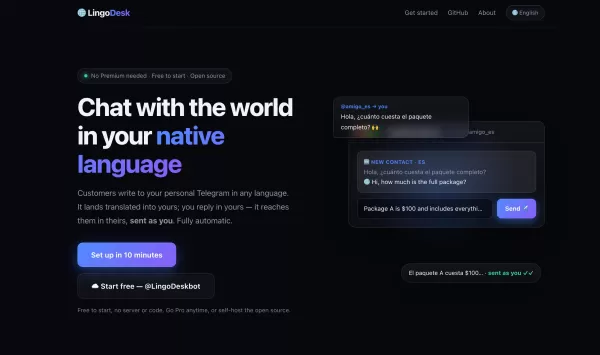
LingoDesk Screenshot

2026 Latest Best Top-rated AI Text to Speech Tools for Online Courses are curated by XIX.AI based on rigorous real-world tests and weekly updated rankings. These powerful tools help creators deliver crystal-clear audio content effortlessly, boosting writing efficiency and streamlining course production. Check out the free vs paid comparison to find your perfect fit. Explore now to unlock your AI edge in online education.
 10 tools
 xix.ai

2026 Latest Best Top-Rated AI Blog Title Tools for Higher Click Through Rates! XIX.AI has carefully curated a powerful, game-changing collection of top tools that go through rigorous real-world tests. You’ll find a free vs paid comparison, weekly updated rankings, and detailed insights to help you boost your blog’s traffic efficiently. Must-try options are highlighted to help you unlock your AI edge. Explore now!
10 tools
xix.ai
2026 Latest Best Top-rated AI Task Routing Tools for Support Workflows! XIX.AI has curated a highly powerful game-changing collection of must-try solutions, all undergoing rigorous real-world tests and updated weekly. These tools streamline workflows, boost productivity, and help teams deliver faster, more efficient support. Explore now to discover your perfect tool and unlock your AI edge!
17 tools
xix.ai
2026 Latest Best Top-Rated AI Citation and Paper Summary Tools Curated by XIX.AI. Get powerful game-changing solutions for quick content creation, improved writing efficiency, and boosting productivity. We offer a free vs paid comparison along with real-world tests and weekly updated rankings to help you find the must-try tool that fits your needs perfectly. Explore now to Unlock your AI edge.
10 tools
xix.ai

2026 Latest Best Top-Rated AI Productivity Tools for Daily Work! XIX.AI has curated a powerful, game-changing selection based on rigorous weekly updated rankings and real-world tests. You’ll find must-try options that boost writing efficiency, streamline content creation, and help you overcome daily work challenges. Get a free vs paid comparison to find the perfect fit for your needs. Explore now to unlock your AI edge!
9 tools
xix.ai
2026 Latest Best Top-Rated AI Systematic Review Tools for Research Screening are here on XIX.AI! This curated collection includes powerful, game-changing solutions that go through rigorous real-world tests to deliver accurate results. We also offer a free vs paid comparison along with weekly updated rankings to help you find the must-try option that boosts your research efficiency significantly. Explore now to unlock your AI edge in academic work!
11 tools
xix.ai


