


 Home
HomeBrain-inspired AI architecture boosts speed while slashing power consumption
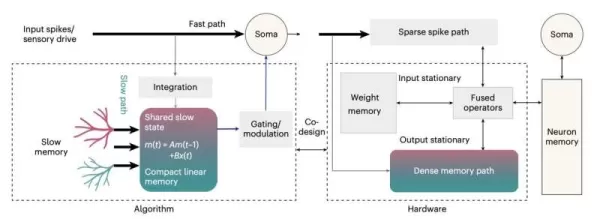
Dual memory pathway abstraction. At the algorithmic level, each layer maintains a shared, low-dimensional state that captures slow contextual dynamics and modulates fast spiking activity. On the hardware side, this separation is mirrored by a heterogeneous accelerator that keeps the compact state on-chip and fuses sparse and dense computations for efficient execution. Credit: Sun et al.
Spiking neural networks (SNNs) are AI models inspired by how biological neurons communicate. Unlike biological neurons that exchange information through electrical impulses, SNNs rely on brief signals known as spikes.
SNNs have shown promise for reducing power consumption because developers can ensure they process information only when meaningful changes occur, rather than continuously. This is a significant advantage, given that current AI systems consume substantial energy.
Although some earlier SNNs achieved encouraging results, they often struggle to retain useful context over long periods. This challenge becomes especially pronounced when the models have limited data storage or operate under energy constraints.
Researchers at Imperial College London and ETH Zurich recently introduced co-designed hardware and software that could overcome this limitation. Their architecture, described in a paper published in Nature Machine Intelligence, effectively handles long-sequence tasks while being energy-efficient and reducing data storage needs.
"Spiking neural networks excel at event-driven sensing," wrote Pengfei Sun, Zhe Su, and their colleagues. "Yet maintaining task-relevant context over long timescales, both algorithmically and in hardware, while respecting tight energy and memory budgets, remains a core challenge. We address this through an algorithm–hardware co-design effort."
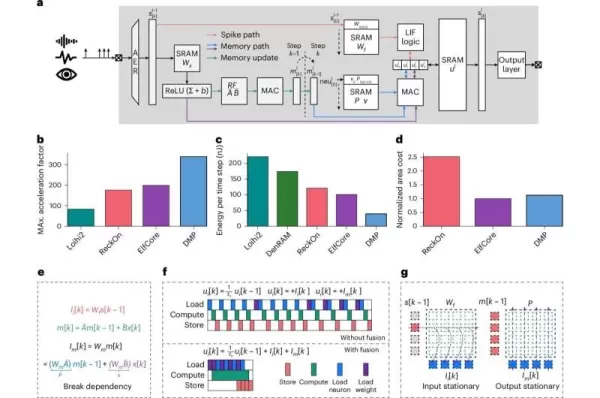
Hardware design for the DMP architecture. Credit: Nature Machine Intelligence (2026). DOI: 10.1038/s42256-026-01255-3
A novel brain-inspired dual memory system
Previous studies have shown that some neural processes are extremely fast while others are slower, allowing the brain to retain information for longer. The architecture developed by Sun, Su, and their colleagues mimics this combination of fast and slow neural processes.
The team co-designed software and hardware components that complement each other, drawing on principles from the brain's fast-slow organization. The software consists of a multilayered SNN that combines a slow memory pathway with fast spiking activity.
"At the algorithm level, inspired by the cortical fast–slow organization in the brain, we introduce a neural network with an explicit slow memory pathway that, combined with fast spiking activity, enables a dual memory pathway architecture. In this architecture, each layer maintains a compact low-dimensional state that summarizes recent activity and modulates spiking dynamics," wrote the authors.
"This explicit memory stabilizes learning while preserving event-driven sparsity, achieving competitive accuracy on long-sequence benchmarks with 40–60% fewer parameters than equivalent state-of-the-art spiking neural networks."
A key advantage of the dual-memory architecture is that it efficiently processes incoming data while retaining important task-relevant information in a compact form. The team also designed specialized hardware optimized for running their SNN.
"At the hardware level, we introduce a near-memory-compute architecture that fully leverages the advantages of the dual memory pathway architecture by retaining its compact shared state while optimizing data flow across heterogeneous sparse-spike and dense-memory pathways," wrote Sun, Su, and their colleagues.
Initial results and possible real-world applications
The researchers evaluated their SNN and co-designed hardware through a series of initial tests. They measured the speed of completing long-sequence tasks (processing long streams of data), energy consumption, and data throughput within a fixed time.
"Experimental results demonstrate more than a fourfold increase in throughput and over a fivefold improvement in energy efficiency compared with state-of-the-art implementations," wrote the authors. "Together, these contributions show that biological principles can guide functional abstractions that are both algorithmically effective and hardware-efficient, establishing a scalable co-design framework for real-time neuromorphic computation and learning."
The new SNN and hardware developed by Sun, Su, and their colleagues could be further refined and tested on a broader range of tasks. In the future, they could enable rapid analysis of large amounts of data in real time under energy constraints. This would be valuable for applications such as robotics, wearable devices, edge AI, and networks of multiple connected sensors.
Written by our author Ingrid Fadelli, edited by Gaby Clark, and fact-checked and reviewed by Robert Egan—this article is the result of careful human work. We rely on readers like you to keep independent science journalism alive. If this reporting matters to you, please consider a donation (especially monthly). You'll get an ad-free account as a thank-you.
Related article
 Swedish AI Startup Lovable Eyes $13.2 Billion Valuation After Major Funding Round
As AI-driven coding tools gain traction, Swedish startup Lovable has secured a major funding round. The company aims to raise $3 billion, potentially boosting its valuation to $13.2 billion—double the $6.6 billion recorded last December. Menlo Ventur
Google Tests Remy AI Agent for Gemini as Focus Shifts to User Control
According to Business Insider, Google is testing Remy, a new AI personal agent for Gemini. This tool aims to execute tasks on behalf of users, streamlining both professional workflows and daily routines.Currently, Remy is undergoing testing in an int
How to fix Core Web Vitals for better SEO rankings
Streamline Report Card Comments with AI ToolsIntroductionAI Tools for Generating Report Card CommentsMagic SchoolAlmanac AIChat GPTUsing Magic School to Generate Report Card CommentsLogging into Magic SchoolSelecting the Report Card Comments ToolCust
Related Special Topic Recommendations
writing
Swedish AI Startup Lovable Eyes $13.2 Billion Valuation After Major Funding Round
As AI-driven coding tools gain traction, Swedish startup Lovable has secured a major funding round. The company aims to raise $3 billion, potentially boosting its valuation to $13.2 billion—double the $6.6 billion recorded last December. Menlo Ventur
Google Tests Remy AI Agent for Gemini as Focus Shifts to User Control
According to Business Insider, Google is testing Remy, a new AI personal agent for Gemini. This tool aims to execute tasks on behalf of users, streamlining both professional workflows and daily routines.Currently, Remy is undergoing testing in an int
How to fix Core Web Vitals for better SEO rankings
Streamline Report Card Comments with AI ToolsIntroductionAI Tools for Generating Report Card CommentsMagic SchoolAlmanac AIChat GPTUsing Magic School to Generate Report Card CommentsLogging into Magic SchoolSelecting the Report Card Comments ToolCust
Related Special Topic Recommendations
writing
 Best AI Outline Generators for Long-Form SEO Articles
2026 Latest Best Top-Rated AI Outline Generators for Long-Form SEO Articles, meticulously curated by XIX.AI. These powerful tools offer game-changing assistance in creating high-quality content quickly, boosting writing efficiency significantly. Get a free vs paid comparison along with real-world tests and detailed rankings to help you find the must-try option that suits your needs. Explore now to unlock your AI edge.
 8 tools
 xix.ai
Education and Learning
AI Study Tools for Homework and Exam Prep
xix.ai
Education and Learning
AI Study Tools for Homework and Exam Prep
2026 Latest Best AI Study Tools for Homework and Exam Prep! XIX.AI curates a top-rated list of powerful, game-changing tools that help students boost productivity, streamline homework completion, and ace exams through real-world tests. Get a free vs paid comparison, detailed rankings, and must-try options to unlock your AI edge. Explore now!
10 tools
xix.ai
Music composition
AI Vocal Demo Tools for Songwriters, Hooks, Toplines, and Multilingual Draft Sessions
2026 Latest Best AI Vocal Demo Tools for Songwriters, Hook Creators, and Multi-Language Content Teams! XIX.AI has curated a top-rated list of powerful game-changing tools that go through rigorous real-world tests. You’ll find detailed free vs paid comparison data, comprehensive rankings, and must-try options to help you boost writing efficiency and unlock your creative potential. Explore now to discover your perfect tool for all your content needs!
9 tools
xix.ai
Business
Best AI Competitive Research Tools for Small Businesses
2026 Latest Best Top-rated AI Competitive Research Tools for Small Businesses! XIX.AI has curated a highly powerful game-changing collection, updated weekly with rigorous real-world tests and detailed rankings. You can find a comprehensive free vs paid comparison to help you identify the must-try tools that boost your productivity and give you a competitive edge. Explore now to discover your perfect tool!
9 tools
xix.ai
Image editing
Photoshop AI Retouch Tools for Ecommerce Apparel, Skin Cleanup, and Color Consistency
2026 Latest Best Photoshop AI retouch tools for ecommerce apparel, skin cleanup, and color consistency! This top-rated curated list features powerful game-changing solutions that help you boost writing efficiency, streamline content creation, and achieve perfect visual results effortlessly. Each tool has undergone real-world tests through weekly updated rankings, complete with free vs paid comparison details. Backed by XIX.AI, it’s the must-try guide for anyone aiming to unlock your AI edge. Explore now!
10 tools
xix.ai
Prompt
Best AI Prompt Libraries for ChatGPT Workflows
2026 Latest Best Top-Rated AI Prompt Libraries for optimizing all types of ChatGPT workflows. XIX.AI has curated a powerful, game-changing collection that goes through rigorous real-world tests to ensure top performance. You can find detailed free vs paid comparisons and expert rankings to help you choose the must-try tools that boost your productivity and unlock your AI edge. Explore now!
11 tools
xix.ai

 Comments (0)
0/500
Comments (0)
0/500
Dual memory pathway abstraction. At the algorithmic level, each layer maintains a shared, low-dimensional state that captures slow contextual dynamics and modulates fast spiking activity. On the hardware side, this separation is mirrored by a heterogeneous accelerator that keeps the compact state on-chip and fuses sparse and dense computations for efficient execution. Credit: Sun et al.
Spiking neural networks (SNNs) are AI models inspired by how biological neurons communicate. Unlike biological neurons that exchange information through electrical impulses, SNNs rely on brief signals known as spikes.
SNNs have shown promise for reducing power consumption because developers can ensure they process information only when meaningful changes occur, rather than continuously. This is a significant advantage, given that current AI systems consume substantial energy.
Although some earlier SNNs achieved encouraging results, they often struggle to retain useful context over long periods. This challenge becomes especially pronounced when the models have limited data storage or operate under energy constraints.
Researchers at Imperial College London and ETH Zurich recently introduced co-designed hardware and software that could overcome this limitation. Their architecture, described in a paper published in Nature Machine Intelligence, effectively handles long-sequence tasks while being energy-efficient and reducing data storage needs.
"Spiking neural networks excel at event-driven sensing," wrote Pengfei Sun, Zhe Su, and their colleagues. "Yet maintaining task-relevant context over long timescales, both algorithmically and in hardware, while respecting tight energy and memory budgets, remains a core challenge. We address this through an algorithm–hardware co-design effort."
Hardware design for the DMP architecture. Credit: Nature Machine Intelligence (2026). DOI: 10.1038/s42256-026-01255-3
A novel brain-inspired dual memory system
Previous studies have shown that some neural processes are extremely fast while others are slower, allowing the brain to retain information for longer. The architecture developed by Sun, Su, and their colleagues mimics this combination of fast and slow neural processes.
The team co-designed software and hardware components that complement each other, drawing on principles from the brain's fast-slow organization. The software consists of a multilayered SNN that combines a slow memory pathway with fast spiking activity.
"At the algorithm level, inspired by the cortical fast–slow organization in the brain, we introduce a neural network with an explicit slow memory pathway that, combined with fast spiking activity, enables a dual memory pathway architecture. In this architecture, each layer maintains a compact low-dimensional state that summarizes recent activity and modulates spiking dynamics," wrote the authors.
"This explicit memory stabilizes learning while preserving event-driven sparsity, achieving competitive accuracy on long-sequence benchmarks with 40–60% fewer parameters than equivalent state-of-the-art spiking neural networks."
A key advantage of the dual-memory architecture is that it efficiently processes incoming data while retaining important task-relevant information in a compact form. The team also designed specialized hardware optimized for running their SNN.
"At the hardware level, we introduce a near-memory-compute architecture that fully leverages the advantages of the dual memory pathway architecture by retaining its compact shared state while optimizing data flow across heterogeneous sparse-spike and dense-memory pathways," wrote Sun, Su, and their colleagues.
Initial results and possible real-world applications
The researchers evaluated their SNN and co-designed hardware through a series of initial tests. They measured the speed of completing long-sequence tasks (processing long streams of data), energy consumption, and data throughput within a fixed time.
"Experimental results demonstrate more than a fourfold increase in throughput and over a fivefold improvement in energy efficiency compared with state-of-the-art implementations," wrote the authors. "Together, these contributions show that biological principles can guide functional abstractions that are both algorithmically effective and hardware-efficient, establishing a scalable co-design framework for real-time neuromorphic computation and learning."
The new SNN and hardware developed by Sun, Su, and their colleagues could be further refined and tested on a broader range of tasks. In the future, they could enable rapid analysis of large amounts of data in real time under energy constraints. This would be valuable for applications such as robotics, wearable devices, edge AI, and networks of multiple connected sensors.
Written by our author Ingrid Fadelli, edited by Gaby Clark, and fact-checked and reviewed by Robert Egan—this article is the result of careful human work. We rely on readers like you to keep independent science journalism alive. If this reporting matters to you, please consider a donation (especially monthly). You'll get an ad-free account as a thank-you.








 Swedish AI Startup Lovable Eyes $13.2 Billion Valuation After Major Funding Round
As AI-driven coding tools gain traction, Swedish startup Lovable has secured a major funding round. The company aims to raise $3 billion, potentially boosting its valuation to $13.2 billion—double the $6.6 billion recorded last December. Menlo Ventur
Google Tests Remy AI Agent for Gemini as Focus Shifts to User Control
According to Business Insider, Google is testing Remy, a new AI personal agent for Gemini. This tool aims to execute tasks on behalf of users, streamlining both professional workflows and daily routines.Currently, Remy is undergoing testing in an int
Swedish AI Startup Lovable Eyes $13.2 Billion Valuation After Major Funding Round
As AI-driven coding tools gain traction, Swedish startup Lovable has secured a major funding round. The company aims to raise $3 billion, potentially boosting its valuation to $13.2 billion—double the $6.6 billion recorded last December. Menlo Ventur
Google Tests Remy AI Agent for Gemini as Focus Shifts to User Control
According to Business Insider, Google is testing Remy, a new AI personal agent for Gemini. This tool aims to execute tasks on behalf of users, streamlining both professional workflows and daily routines.Currently, Remy is undergoing testing in an int
 How to fix Core Web Vitals for better SEO rankings
Streamline Report Card Comments with AI ToolsIntroductionAI Tools for Generating Report Card CommentsMagic SchoolAlmanac AIChat GPTUsing Magic School to Generate Report Card CommentsLogging into Magic SchoolSelecting the Report Card Comments ToolCust
How to fix Core Web Vitals for better SEO rankings
Streamline Report Card Comments with AI ToolsIntroductionAI Tools for Generating Report Card CommentsMagic SchoolAlmanac AIChat GPTUsing Magic School to Generate Report Card CommentsLogging into Magic SchoolSelecting the Report Card Comments ToolCust

2026 Latest Best Top-Rated AI Outline Generators for Long-Form SEO Articles, meticulously curated by XIX.AI. These powerful tools offer game-changing assistance in creating high-quality content quickly, boosting writing efficiency significantly. Get a free vs paid comparison along with real-world tests and detailed rankings to help you find the must-try option that suits your needs. Explore now to unlock your AI edge.
8 tools
xix.ai

2026 Latest Best AI Study Tools for Homework and Exam Prep! XIX.AI curates a top-rated list of powerful, game-changing tools that help students boost productivity, streamline homework completion, and ace exams through real-world tests. Get a free vs paid comparison, detailed rankings, and must-try options to unlock your AI edge. Explore now!
10 tools
xix.ai

2026 Latest Best AI Vocal Demo Tools for Songwriters, Hook Creators, and Multi-Language Content Teams! XIX.AI has curated a top-rated list of powerful game-changing tools that go through rigorous real-world tests. You’ll find detailed free vs paid comparison data, comprehensive rankings, and must-try options to help you boost writing efficiency and unlock your creative potential. Explore now to discover your perfect tool for all your content needs!
9 tools
xix.ai

2026 Latest Best Top-rated AI Competitive Research Tools for Small Businesses! XIX.AI has curated a highly powerful game-changing collection, updated weekly with rigorous real-world tests and detailed rankings. You can find a comprehensive free vs paid comparison to help you identify the must-try tools that boost your productivity and give you a competitive edge. Explore now to discover your perfect tool!
9 tools
xix.ai

2026 Latest Best Photoshop AI retouch tools for ecommerce apparel, skin cleanup, and color consistency! This top-rated curated list features powerful game-changing solutions that help you boost writing efficiency, streamline content creation, and achieve perfect visual results effortlessly. Each tool has undergone real-world tests through weekly updated rankings, complete with free vs paid comparison details. Backed by XIX.AI, it’s the must-try guide for anyone aiming to unlock your AI edge. Explore now!
10 tools
xix.ai

2026 Latest Best Top-Rated AI Prompt Libraries for optimizing all types of ChatGPT workflows. XIX.AI has curated a powerful, game-changing collection that goes through rigorous real-world tests to ensure top performance. You can find detailed free vs paid comparisons and expert rankings to help you choose the must-try tools that boost your productivity and unlock your AI edge. Explore now!
11 tools
xix.ai












