


 Home
HomeUS Claims ASML’s Key Chip Tool Is in China, ASML Disputes
Bloomberg reports that U.S. Commerce Secretary Howard Lutnick recently warned ASML’s top executives about the possibility that one of the company’s extreme ultraviolet (EUV) lithography machines has reached China. These systems are currently the only equipment capable of manufacturing the most advanced semiconductor patterns, and their presence in China would violate export restrictions enforced since the first Trump administration.
U.S. officials claim to have evidence that ASML shipped EUV-related components and transport equipment to China, though they have refused to share these details with Bloomberg or ASML. The company maintains that no such machine exists in China and never has. The Commerce Department did not respond to inquiries regarding whether it possesses proof of an EUV system on Chinese soil.
While this may seem irrelevant to those outside the semiconductor sector, it is critical. ASML, a Dutch firm largely unknown to the general public, holds a dominant position in the global AI infrastructure buildout, distinct from Nvidia and major cloud providers. It manufactures the sole equipment capable of EUV lithography, the process required to print the microscopic circuit patterns that define cutting-edge chips.
Every high-end processor produced by TSMC, the foundry supplying chips for Nvidia and Apple, relies on ASML tools. These systems required two decades and billions of dollars to develop, and no alternative supplier currently exists. This monopoly has made ASML Europe’s most valuable publicly traded company, with a market capitalization hovering around $700 billion, driven by surging demand for AI chips.
The potential presence of an EUV machine in China is significant because it would represent a major failure of U.S. export controls designed to prevent advanced AI capabilities from strengthening Beijing’s military and industrial sectors.
Six weeks ago, prior to these reports, I spoke with ASML CEO Christophe Fouquet about the situation.
Fouquet stated that ASML tracks every machine it has shipped, confirming they are either in use by monitored customers or have been dismantled and returned. He explained that the company established an internal security firewall years ago, separating employees with access to EUV technology from those without. Chinese staff are intentionally excluded from this access. He emphasized that building an EUV machine was possible only because 80% of the technology was derived from decades of prior knowledge, with the remaining 20%—generating EUV light itself—taking another 20 years to solve. His argument was that reverse-engineering is impossible without prior possession, and no such machine has ever been in China.
Commercial logic also suggests ASML would not risk its export license to secretly supply a Chinese customer. The company sells older deep ultraviolet (DUV) tools to China, a practice it has maintained for a decade. Fouquet described this as a strategic decision to maintain a generational gap, allowing business operations without creating future competitors. ASML expects about 20% of its 2026 revenue to come from these permitted sales. Risking the EUV ban over a single illegal sale would jeopardize this revenue and its status as Europe’s most valuable industrial monopoly.
These points do not definitively disprove the allegations. The government has not yet released its evidence, and judgment should be withheld until that information becomes public.
Under Lutnick’s leadership, the Commerce Department agreed late last year to invest up to $150 million in xLight, a startup developing next-generation light-source technology that could challenge ASML’s EUV monopoly. xLight’s CEO previously described the company as a future partner to ASML, creating hardware to integrate with existing systems rather than replace them. When I raised this with Fouquet in May, he was polite but unconvinced, indicating ASML does not view xLight’s technology as a threat to its leadership.
It remains unclear if Lutnick’s pressure on ASML is related to this investment. There is no public connection, and the two issues may be unrelated. However, it is worth examining whether a federal official scrutinizing a monopoly while his agency funds a startup aiming to disrupt that monopoly’s core technology has a conflict of interest.
xLight is not the only competitor in lithography. Peter Thiel, who has longstanding ties to Trump’s political circle, has backed Substrate, a startup pursuing EUV-rival technology with more direct competitive ambitions than xLight.
As Bloomberg reported, a bipartisan bill currently in Congress proposes banning all ASML deep ultraviolet (DUV) shipments to China, which account for roughly 20% of the company’s expected 2026 revenue. The bill passed a key committee in April, and the Trump administration has not yet taken an official stance.
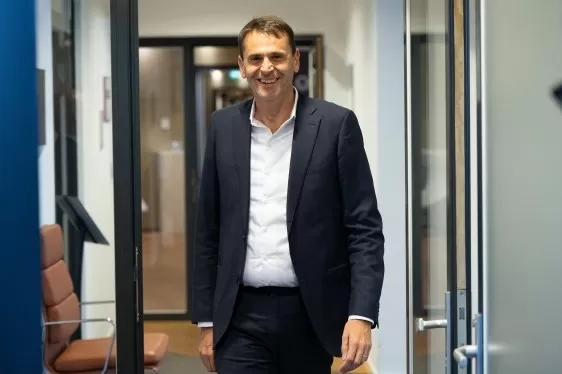
Pictured above: ASML CEO Christophe Fouquet
Related article
 U.S. Stocks Hit Historic Milestone as AI and Aerospace Giants Prepare for Trillion-Dollar Debut
Elon Musk, Sam Altman, and Dario Amodei, three titans of the technology sector, are advancing toward initial public offerings for their respective ventures. With SpaceX, OpenAI, and Anthropic—three industry behemoths nearing trillion-dollar valuation
Swedish AI Startup Lovable Eyes $13.2 Billion Valuation After Major Funding Round
As AI-driven coding tools gain traction, Swedish startup Lovable has secured a major funding round. The company aims to raise $3 billion, potentially boosting its valuation to $13.2 billion—double the $6.6 billion recorded last December. Menlo Ventur
Google Tests Remy AI Agent for Gemini as Focus Shifts to User Control
According to Business Insider, Google is testing Remy, a new AI personal agent for Gemini. This tool aims to execute tasks on behalf of users, streamlining both professional workflows and daily routines.Currently, Remy is undergoing testing in an int
Related Special Topic Recommendations
Data Analysis
U.S. Stocks Hit Historic Milestone as AI and Aerospace Giants Prepare for Trillion-Dollar Debut
Elon Musk, Sam Altman, and Dario Amodei, three titans of the technology sector, are advancing toward initial public offerings for their respective ventures. With SpaceX, OpenAI, and Anthropic—three industry behemoths nearing trillion-dollar valuation
Swedish AI Startup Lovable Eyes $13.2 Billion Valuation After Major Funding Round
As AI-driven coding tools gain traction, Swedish startup Lovable has secured a major funding round. The company aims to raise $3 billion, potentially boosting its valuation to $13.2 billion—double the $6.6 billion recorded last December. Menlo Ventur
Google Tests Remy AI Agent for Gemini as Focus Shifts to User Control
According to Business Insider, Google is testing Remy, a new AI personal agent for Gemini. This tool aims to execute tasks on behalf of users, streamlining both professional workflows and daily routines.Currently, Remy is undergoing testing in an int
Related Special Topic Recommendations
Data Analysis
 Best AI Anomaly Detection Tools for KPI Monitoring across SaaS and Ecommerce Teams
2026 Latest Best Top-rated AI Anomaly Detection Tools for KPI Monitoring in SaaS and Ecommerce teams! XIX.AI has curated a powerful, game-changing collection based on rigorous real-world tests and weekly updated rankings. You’ll find detailed free vs paid comparison insights to help you identify the must-try solution that boosts productivity and unlocks your AI edge. Explore now!
 10 tools
 xix.ai
writing
Best AI Outline Generators for Long-Form SEO Articles
xix.ai
writing
Best AI Outline Generators for Long-Form SEO Articles
2026 Latest Best Top-Rated AI Outline Generators for Long-Form SEO Articles, meticulously curated by XIX.AI. These powerful tools offer game-changing assistance in creating high-quality content quickly, boosting writing efficiency significantly. Get a free vs paid comparison along with real-world tests and detailed rankings to help you find the must-try option that suits your needs. Explore now to unlock your AI edge.
8 tools
xix.ai
Education and Learning
AI Study Tools for Homework and Exam Prep
2026 Latest Best AI Study Tools for Homework and Exam Prep! XIX.AI curates a top-rated list of powerful, game-changing tools that help students boost productivity, streamline homework completion, and ace exams through real-world tests. Get a free vs paid comparison, detailed rankings, and must-try options to unlock your AI edge. Explore now!
10 tools
xix.ai
Music composition
AI Vocal Demo Tools for Songwriters, Hooks, Toplines, and Multilingual Draft Sessions
2026 Latest Best AI Vocal Demo Tools for Songwriters, Hook Creators, and Multi-Language Content Teams! XIX.AI has curated a top-rated list of powerful game-changing tools that go through rigorous real-world tests. You’ll find detailed free vs paid comparison data, comprehensive rankings, and must-try options to help you boost writing efficiency and unlock your creative potential. Explore now to discover your perfect tool for all your content needs!
9 tools
xix.ai
Business
Best AI Competitive Research Tools for Small Businesses
2026 Latest Best Top-rated AI Competitive Research Tools for Small Businesses! XIX.AI has curated a highly powerful game-changing collection, updated weekly with rigorous real-world tests and detailed rankings. You can find a comprehensive free vs paid comparison to help you identify the must-try tools that boost your productivity and give you a competitive edge. Explore now to discover your perfect tool!
9 tools
xix.ai
Image editing
Photoshop AI Retouch Tools for Ecommerce Apparel, Skin Cleanup, and Color Consistency
2026 Latest Best Photoshop AI retouch tools for ecommerce apparel, skin cleanup, and color consistency! This top-rated curated list features powerful game-changing solutions that help you boost writing efficiency, streamline content creation, and achieve perfect visual results effortlessly. Each tool has undergone real-world tests through weekly updated rankings, complete with free vs paid comparison details. Backed by XIX.AI, it’s the must-try guide for anyone aiming to unlock your AI edge. Explore now!
10 tools
xix.ai

 Comments (0)
0/500
Comments (0)
0/500
Bloomberg reports that U.S. Commerce Secretary Howard Lutnick recently warned ASML’s top executives about the possibility that one of the company’s extreme ultraviolet (EUV) lithography machines has reached China. These systems are currently the only equipment capable of manufacturing the most advanced semiconductor patterns, and their presence in China would violate export restrictions enforced since the first Trump administration.
U.S. officials claim to have evidence that ASML shipped EUV-related components and transport equipment to China, though they have refused to share these details with Bloomberg or ASML. The company maintains that no such machine exists in China and never has. The Commerce Department did not respond to inquiries regarding whether it possesses proof of an EUV system on Chinese soil.
While this may seem irrelevant to those outside the semiconductor sector, it is critical. ASML, a Dutch firm largely unknown to the general public, holds a dominant position in the global AI infrastructure buildout, distinct from Nvidia and major cloud providers. It manufactures the sole equipment capable of EUV lithography, the process required to print the microscopic circuit patterns that define cutting-edge chips.
Every high-end processor produced by TSMC, the foundry supplying chips for Nvidia and Apple, relies on ASML tools. These systems required two decades and billions of dollars to develop, and no alternative supplier currently exists. This monopoly has made ASML Europe’s most valuable publicly traded company, with a market capitalization hovering around $700 billion, driven by surging demand for AI chips.
The potential presence of an EUV machine in China is significant because it would represent a major failure of U.S. export controls designed to prevent advanced AI capabilities from strengthening Beijing’s military and industrial sectors.
Six weeks ago, prior to these reports, I spoke with ASML CEO Christophe Fouquet about the situation.
Fouquet stated that ASML tracks every machine it has shipped, confirming they are either in use by monitored customers or have been dismantled and returned. He explained that the company established an internal security firewall years ago, separating employees with access to EUV technology from those without. Chinese staff are intentionally excluded from this access. He emphasized that building an EUV machine was possible only because 80% of the technology was derived from decades of prior knowledge, with the remaining 20%—generating EUV light itself—taking another 20 years to solve. His argument was that reverse-engineering is impossible without prior possession, and no such machine has ever been in China.
Commercial logic also suggests ASML would not risk its export license to secretly supply a Chinese customer. The company sells older deep ultraviolet (DUV) tools to China, a practice it has maintained for a decade. Fouquet described this as a strategic decision to maintain a generational gap, allowing business operations without creating future competitors. ASML expects about 20% of its 2026 revenue to come from these permitted sales. Risking the EUV ban over a single illegal sale would jeopardize this revenue and its status as Europe’s most valuable industrial monopoly.
These points do not definitively disprove the allegations. The government has not yet released its evidence, and judgment should be withheld until that information becomes public.
Under Lutnick’s leadership, the Commerce Department agreed late last year to invest up to $150 million in xLight, a startup developing next-generation light-source technology that could challenge ASML’s EUV monopoly. xLight’s CEO previously described the company as a future partner to ASML, creating hardware to integrate with existing systems rather than replace them. When I raised this with Fouquet in May, he was polite but unconvinced, indicating ASML does not view xLight’s technology as a threat to its leadership.
It remains unclear if Lutnick’s pressure on ASML is related to this investment. There is no public connection, and the two issues may be unrelated. However, it is worth examining whether a federal official scrutinizing a monopoly while his agency funds a startup aiming to disrupt that monopoly’s core technology has a conflict of interest.
xLight is not the only competitor in lithography. Peter Thiel, who has longstanding ties to Trump’s political circle, has backed Substrate, a startup pursuing EUV-rival technology with more direct competitive ambitions than xLight.
As Bloomberg reported, a bipartisan bill currently in Congress proposes banning all ASML deep ultraviolet (DUV) shipments to China, which account for roughly 20% of the company’s expected 2026 revenue. The bill passed a key committee in April, and the Trump administration has not yet taken an official stance.
Pictured above: ASML CEO Christophe Fouquet








 U.S. Stocks Hit Historic Milestone as AI and Aerospace Giants Prepare for Trillion-Dollar Debut
Elon Musk, Sam Altman, and Dario Amodei, three titans of the technology sector, are advancing toward initial public offerings for their respective ventures. With SpaceX, OpenAI, and Anthropic—three industry behemoths nearing trillion-dollar valuation
U.S. Stocks Hit Historic Milestone as AI and Aerospace Giants Prepare for Trillion-Dollar Debut
Elon Musk, Sam Altman, and Dario Amodei, three titans of the technology sector, are advancing toward initial public offerings for their respective ventures. With SpaceX, OpenAI, and Anthropic—three industry behemoths nearing trillion-dollar valuation
 Swedish AI Startup Lovable Eyes $13.2 Billion Valuation After Major Funding Round
As AI-driven coding tools gain traction, Swedish startup Lovable has secured a major funding round. The company aims to raise $3 billion, potentially boosting its valuation to $13.2 billion—double the $6.6 billion recorded last December. Menlo Ventur
Google Tests Remy AI Agent for Gemini as Focus Shifts to User Control
According to Business Insider, Google is testing Remy, a new AI personal agent for Gemini. This tool aims to execute tasks on behalf of users, streamlining both professional workflows and daily routines.Currently, Remy is undergoing testing in an int
Swedish AI Startup Lovable Eyes $13.2 Billion Valuation After Major Funding Round
As AI-driven coding tools gain traction, Swedish startup Lovable has secured a major funding round. The company aims to raise $3 billion, potentially boosting its valuation to $13.2 billion—double the $6.6 billion recorded last December. Menlo Ventur
Google Tests Remy AI Agent for Gemini as Focus Shifts to User Control
According to Business Insider, Google is testing Remy, a new AI personal agent for Gemini. This tool aims to execute tasks on behalf of users, streamlining both professional workflows and daily routines.Currently, Remy is undergoing testing in an int

2026 Latest Best Top-rated AI Anomaly Detection Tools for KPI Monitoring in SaaS and Ecommerce teams! XIX.AI has curated a powerful, game-changing collection based on rigorous real-world tests and weekly updated rankings. You’ll find detailed free vs paid comparison insights to help you identify the must-try solution that boosts productivity and unlocks your AI edge. Explore now!
10 tools
xix.ai

2026 Latest Best Top-Rated AI Outline Generators for Long-Form SEO Articles, meticulously curated by XIX.AI. These powerful tools offer game-changing assistance in creating high-quality content quickly, boosting writing efficiency significantly. Get a free vs paid comparison along with real-world tests and detailed rankings to help you find the must-try option that suits your needs. Explore now to unlock your AI edge.
8 tools
xix.ai

2026 Latest Best AI Study Tools for Homework and Exam Prep! XIX.AI curates a top-rated list of powerful, game-changing tools that help students boost productivity, streamline homework completion, and ace exams through real-world tests. Get a free vs paid comparison, detailed rankings, and must-try options to unlock your AI edge. Explore now!
10 tools
xix.ai

2026 Latest Best AI Vocal Demo Tools for Songwriters, Hook Creators, and Multi-Language Content Teams! XIX.AI has curated a top-rated list of powerful game-changing tools that go through rigorous real-world tests. You’ll find detailed free vs paid comparison data, comprehensive rankings, and must-try options to help you boost writing efficiency and unlock your creative potential. Explore now to discover your perfect tool for all your content needs!
9 tools
xix.ai

2026 Latest Best Top-rated AI Competitive Research Tools for Small Businesses! XIX.AI has curated a highly powerful game-changing collection, updated weekly with rigorous real-world tests and detailed rankings. You can find a comprehensive free vs paid comparison to help you identify the must-try tools that boost your productivity and give you a competitive edge. Explore now to discover your perfect tool!
9 tools
xix.ai

2026 Latest Best Photoshop AI retouch tools for ecommerce apparel, skin cleanup, and color consistency! This top-rated curated list features powerful game-changing solutions that help you boost writing efficiency, streamline content creation, and achieve perfect visual results effortlessly. Each tool has undergone real-world tests through weekly updated rankings, complete with free vs paid comparison details. Backed by XIX.AI, it’s the must-try guide for anyone aiming to unlock your AI edge. Explore now!
10 tools
xix.ai












