


 Home
HomeTALUS Set to Enhance U.S. Army Logistics Through Autonomous Supply Solutions
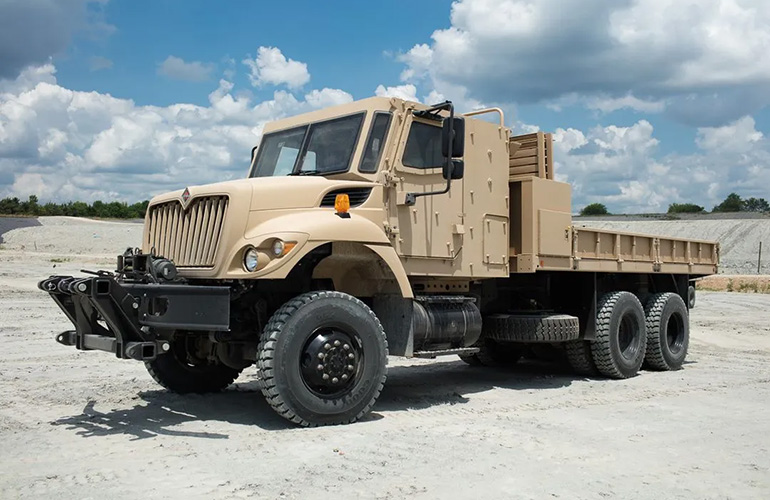
The Armored Cab was created to address the growing demands of troops operating in combat zones, offering enhanced protection for crew members while being built on a MILCOTS platform. | Credit: ND Defense
The U.S. Army has contracted an industry consortium led by Stratom Inc. to develop the Tactical Autonomous Logistics Utility System, also known as TALUS. This modular autonomous delivery system is designed to supply isolated units in high-threat environments.
“This announcement marks the first public reveal of TALUS,” said Mark Gordon, president and CEO of Stratom, in an interview with The Robot Report. “TALUS represents the integrated solution our team is advancing under the Project Sustainment initiative. It addresses the Army’s need for autonomous supply distribution across various operational scenarios.”
Founded in 2001, Stratom combines mobility technologies, autonomy features, robotic cargo handling systems, and manipulation solutions to transport essential supplies, goods, and operational energy. As a Service-Disabled Veteran-Owned Small Business based in Boulder, Colorado, the company claims its systems improve safety, expand operational reach, and boost mission efficiency at the tactical level.
TALUS aims to boost logistics resilience
According to the U.S. Army, future maneuver units will require systems that can handle autonomous supply delivery even under challenging conditions in contested areas. By minimizing soldiers’ exposure to threats while ensuring a continuous supply flow, TALUS is expected to extend operational reach and enhance overall logistics resilience.
Stratom states that TALUS was developed to fill logistical gaps between brigade support areas and dispersed forward units. The multi-purpose system leverages proven commercial off-the-shelf technologies adapted for military use, which helps accelerate deployment and reduces development risks.
“TALUS will incorporate Stratom’s existing autonomous logistics and operational solutions, along with capabilities contributed by its partner teams,” Gordon explained. “Stratom is responsible for integrating these technologies into the full TALUS system. We cannot disclose specific technical details at this time, but we plan to share more updates as development moves forward.”
TALUS features a modular design that allows it to support multiple logistics and operational tasks across different domains. It can handle various types of payloads and evolve to meet changing Army requirements, according to Stratom.
“Project Sustainment is an 18-month prototype program,” Gordon added. “The goal is to refine and mature this capability before handing it over to soldiers for practical testing, including use in the Transformation in Contact unit’s Combat Training Center rotations. The Army will use these tests to evaluate performance and determine next steps for broader deployment.”
Stratom partners with unconventional suppliers
“The Army doesn’t just need another autonomous vehicle — it requires a fully integrated logistics solution that can adapt to mission needs, operate effectively in high-threat environments, and be deployed quickly,” Gordon said. “TALUS is designed to deliver exactly that integrated capability.”
“We assembled a team of nontraditional defense contractors and small businesses because each contributes specialized expertise that has already been proven effective,” he continued. “Together, we’re creating a practical solution that meets the real-world demands of military personnel and addresses the urgency of current missions.”
The total estimated value of this project is $15.9 million, according to Gordon. Stratom’s partners include ND Defense, Forterra, GS Engineering, and Waltonen Engineering. Stratom leads the overall integration process and provides expertise in robotics and autonomous logistics.
GS Engineering brings advanced model-based systems engineering methods along with rigorous testing protocols, while ND Defense supplies existing military platforms and production capabilities.
“TALUS combines the right mix of mobility, autonomy, and system integration to solve a critical logistical need for the Army,” said Timothy George, vice president of sales and marketing at ND Defense. “ND Defense contributes a proven military vehicle foundation and scalable manufacturing capacity that support a smooth path from integration and testing to eventual field deployment.”
Forterra provides a government-validated autonomy stack, while Waltonen Engineering offers expertise in hardware design, fabrication, and system integration. All partners say they will leverage their specialized skills, efficient execution methods, and scalable delivery capabilities to create a solution ready for immediate deployment, built using proven defense and commercial technologies.
“Autonomy solutions for logistics in high-threat environments must be reliable, adaptable, and capable of performing well as mission conditions change,” said Pat Acox, vice president of defense at Forterra. “By integrating AutoDrive with the team’s proven mobility, logistics, and engineering capabilities, TALUS will give the Army a solid foundation for autonomous supply delivery even in the most complex operational settings.”
Related article
 Swedish AI Startup Lovable Eyes $13.2 Billion Valuation After Major Funding Round
As AI-driven coding tools gain traction, Swedish startup Lovable has secured a major funding round. The company aims to raise $3 billion, potentially boosting its valuation to $13.2 billion—double the $6.6 billion recorded last December. Menlo Ventur
Google Tests Remy AI Agent for Gemini as Focus Shifts to User Control
According to Business Insider, Google is testing Remy, a new AI personal agent for Gemini. This tool aims to execute tasks on behalf of users, streamlining both professional workflows and daily routines.Currently, Remy is undergoing testing in an int
How to fix Core Web Vitals for better SEO rankings
Streamline Report Card Comments with AI ToolsIntroductionAI Tools for Generating Report Card CommentsMagic SchoolAlmanac AIChat GPTUsing Magic School to Generate Report Card CommentsLogging into Magic SchoolSelecting the Report Card Comments ToolCust
Related Special Topic Recommendations
writing
Swedish AI Startup Lovable Eyes $13.2 Billion Valuation After Major Funding Round
As AI-driven coding tools gain traction, Swedish startup Lovable has secured a major funding round. The company aims to raise $3 billion, potentially boosting its valuation to $13.2 billion—double the $6.6 billion recorded last December. Menlo Ventur
Google Tests Remy AI Agent for Gemini as Focus Shifts to User Control
According to Business Insider, Google is testing Remy, a new AI personal agent for Gemini. This tool aims to execute tasks on behalf of users, streamlining both professional workflows and daily routines.Currently, Remy is undergoing testing in an int
How to fix Core Web Vitals for better SEO rankings
Streamline Report Card Comments with AI ToolsIntroductionAI Tools for Generating Report Card CommentsMagic SchoolAlmanac AIChat GPTUsing Magic School to Generate Report Card CommentsLogging into Magic SchoolSelecting the Report Card Comments ToolCust
Related Special Topic Recommendations
writing
 Best AI Outline Generators for Long-Form SEO Articles
2026 Latest Best Top-Rated AI Outline Generators for Long-Form SEO Articles, meticulously curated by XIX.AI. These powerful tools offer game-changing assistance in creating high-quality content quickly, boosting writing efficiency significantly. Get a free vs paid comparison along with real-world tests and detailed rankings to help you find the must-try option that suits your needs. Explore now to unlock your AI edge.
 8 tools
 xix.ai
Education and Learning
AI Study Tools for Homework and Exam Prep
xix.ai
Education and Learning
AI Study Tools for Homework and Exam Prep
2026 Latest Best AI Study Tools for Homework and Exam Prep! XIX.AI curates a top-rated list of powerful, game-changing tools that help students boost productivity, streamline homework completion, and ace exams through real-world tests. Get a free vs paid comparison, detailed rankings, and must-try options to unlock your AI edge. Explore now!
10 tools
xix.ai
Music composition
AI Vocal Demo Tools for Songwriters, Hooks, Toplines, and Multilingual Draft Sessions
2026 Latest Best AI Vocal Demo Tools for Songwriters, Hook Creators, and Multi-Language Content Teams! XIX.AI has curated a top-rated list of powerful game-changing tools that go through rigorous real-world tests. You’ll find detailed free vs paid comparison data, comprehensive rankings, and must-try options to help you boost writing efficiency and unlock your creative potential. Explore now to discover your perfect tool for all your content needs!
9 tools
xix.ai
Business
Best AI Competitive Research Tools for Small Businesses
2026 Latest Best Top-rated AI Competitive Research Tools for Small Businesses! XIX.AI has curated a highly powerful game-changing collection, updated weekly with rigorous real-world tests and detailed rankings. You can find a comprehensive free vs paid comparison to help you identify the must-try tools that boost your productivity and give you a competitive edge. Explore now to discover your perfect tool!
9 tools
xix.ai
Image editing
Photoshop AI Retouch Tools for Ecommerce Apparel, Skin Cleanup, and Color Consistency
2026 Latest Best Photoshop AI retouch tools for ecommerce apparel, skin cleanup, and color consistency! This top-rated curated list features powerful game-changing solutions that help you boost writing efficiency, streamline content creation, and achieve perfect visual results effortlessly. Each tool has undergone real-world tests through weekly updated rankings, complete with free vs paid comparison details. Backed by XIX.AI, it’s the must-try guide for anyone aiming to unlock your AI edge. Explore now!
10 tools
xix.ai
Prompt
Best AI Prompt Libraries for ChatGPT Workflows
2026 Latest Best Top-Rated AI Prompt Libraries for optimizing all types of ChatGPT workflows. XIX.AI has curated a powerful, game-changing collection that goes through rigorous real-world tests to ensure top performance. You can find detailed free vs paid comparisons and expert rankings to help you choose the must-try tools that boost your productivity and unlock your AI edge. Explore now!
11 tools
xix.ai

 Comments (0)
0/500
Comments (0)
0/500
The Armored Cab was created to address the growing demands of troops operating in combat zones, offering enhanced protection for crew members while being built on a MILCOTS platform. | Credit: ND Defense
The U.S. Army has contracted an industry consortium led by Stratom Inc. to develop the Tactical Autonomous Logistics Utility System, also known as TALUS. This modular autonomous delivery system is designed to supply isolated units in high-threat environments.
“This announcement marks the first public reveal of TALUS,” said Mark Gordon, president and CEO of Stratom, in an interview with The Robot Report. “TALUS represents the integrated solution our team is advancing under the Project Sustainment initiative. It addresses the Army’s need for autonomous supply distribution across various operational scenarios.”
Founded in 2001, Stratom combines mobility technologies, autonomy features, robotic cargo handling systems, and manipulation solutions to transport essential supplies, goods, and operational energy. As a Service-Disabled Veteran-Owned Small Business based in Boulder, Colorado, the company claims its systems improve safety, expand operational reach, and boost mission efficiency at the tactical level.
TALUS aims to boost logistics resilience
According to the U.S. Army, future maneuver units will require systems that can handle autonomous supply delivery even under challenging conditions in contested areas. By minimizing soldiers’ exposure to threats while ensuring a continuous supply flow, TALUS is expected to extend operational reach and enhance overall logistics resilience.
Stratom states that TALUS was developed to fill logistical gaps between brigade support areas and dispersed forward units. The multi-purpose system leverages proven commercial off-the-shelf technologies adapted for military use, which helps accelerate deployment and reduces development risks.
“TALUS will incorporate Stratom’s existing autonomous logistics and operational solutions, along with capabilities contributed by its partner teams,” Gordon explained. “Stratom is responsible for integrating these technologies into the full TALUS system. We cannot disclose specific technical details at this time, but we plan to share more updates as development moves forward.”
TALUS features a modular design that allows it to support multiple logistics and operational tasks across different domains. It can handle various types of payloads and evolve to meet changing Army requirements, according to Stratom.
“Project Sustainment is an 18-month prototype program,” Gordon added. “The goal is to refine and mature this capability before handing it over to soldiers for practical testing, including use in the Transformation in Contact unit’s Combat Training Center rotations. The Army will use these tests to evaluate performance and determine next steps for broader deployment.”
Stratom partners with unconventional suppliers
“The Army doesn’t just need another autonomous vehicle — it requires a fully integrated logistics solution that can adapt to mission needs, operate effectively in high-threat environments, and be deployed quickly,” Gordon said. “TALUS is designed to deliver exactly that integrated capability.”
“We assembled a team of nontraditional defense contractors and small businesses because each contributes specialized expertise that has already been proven effective,” he continued. “Together, we’re creating a practical solution that meets the real-world demands of military personnel and addresses the urgency of current missions.”
The total estimated value of this project is $15.9 million, according to Gordon. Stratom’s partners include ND Defense, Forterra, GS Engineering, and Waltonen Engineering. Stratom leads the overall integration process and provides expertise in robotics and autonomous logistics.
GS Engineering brings advanced model-based systems engineering methods along with rigorous testing protocols, while ND Defense supplies existing military platforms and production capabilities.
“TALUS combines the right mix of mobility, autonomy, and system integration to solve a critical logistical need for the Army,” said Timothy George, vice president of sales and marketing at ND Defense. “ND Defense contributes a proven military vehicle foundation and scalable manufacturing capacity that support a smooth path from integration and testing to eventual field deployment.”
Forterra provides a government-validated autonomy stack, while Waltonen Engineering offers expertise in hardware design, fabrication, and system integration. All partners say they will leverage their specialized skills, efficient execution methods, and scalable delivery capabilities to create a solution ready for immediate deployment, built using proven defense and commercial technologies.
“Autonomy solutions for logistics in high-threat environments must be reliable, adaptable, and capable of performing well as mission conditions change,” said Pat Acox, vice president of defense at Forterra. “By integrating AutoDrive with the team’s proven mobility, logistics, and engineering capabilities, TALUS will give the Army a solid foundation for autonomous supply delivery even in the most complex operational settings.”








 Swedish AI Startup Lovable Eyes $13.2 Billion Valuation After Major Funding Round
As AI-driven coding tools gain traction, Swedish startup Lovable has secured a major funding round. The company aims to raise $3 billion, potentially boosting its valuation to $13.2 billion—double the $6.6 billion recorded last December. Menlo Ventur
Google Tests Remy AI Agent for Gemini as Focus Shifts to User Control
According to Business Insider, Google is testing Remy, a new AI personal agent for Gemini. This tool aims to execute tasks on behalf of users, streamlining both professional workflows and daily routines.Currently, Remy is undergoing testing in an int
Swedish AI Startup Lovable Eyes $13.2 Billion Valuation After Major Funding Round
As AI-driven coding tools gain traction, Swedish startup Lovable has secured a major funding round. The company aims to raise $3 billion, potentially boosting its valuation to $13.2 billion—double the $6.6 billion recorded last December. Menlo Ventur
Google Tests Remy AI Agent for Gemini as Focus Shifts to User Control
According to Business Insider, Google is testing Remy, a new AI personal agent for Gemini. This tool aims to execute tasks on behalf of users, streamlining both professional workflows and daily routines.Currently, Remy is undergoing testing in an int
 How to fix Core Web Vitals for better SEO rankings
Streamline Report Card Comments with AI ToolsIntroductionAI Tools for Generating Report Card CommentsMagic SchoolAlmanac AIChat GPTUsing Magic School to Generate Report Card CommentsLogging into Magic SchoolSelecting the Report Card Comments ToolCust
How to fix Core Web Vitals for better SEO rankings
Streamline Report Card Comments with AI ToolsIntroductionAI Tools for Generating Report Card CommentsMagic SchoolAlmanac AIChat GPTUsing Magic School to Generate Report Card CommentsLogging into Magic SchoolSelecting the Report Card Comments ToolCust

2026 Latest Best Top-Rated AI Outline Generators for Long-Form SEO Articles, meticulously curated by XIX.AI. These powerful tools offer game-changing assistance in creating high-quality content quickly, boosting writing efficiency significantly. Get a free vs paid comparison along with real-world tests and detailed rankings to help you find the must-try option that suits your needs. Explore now to unlock your AI edge.
8 tools
xix.ai

2026 Latest Best AI Study Tools for Homework and Exam Prep! XIX.AI curates a top-rated list of powerful, game-changing tools that help students boost productivity, streamline homework completion, and ace exams through real-world tests. Get a free vs paid comparison, detailed rankings, and must-try options to unlock your AI edge. Explore now!
10 tools
xix.ai

2026 Latest Best AI Vocal Demo Tools for Songwriters, Hook Creators, and Multi-Language Content Teams! XIX.AI has curated a top-rated list of powerful game-changing tools that go through rigorous real-world tests. You’ll find detailed free vs paid comparison data, comprehensive rankings, and must-try options to help you boost writing efficiency and unlock your creative potential. Explore now to discover your perfect tool for all your content needs!
9 tools
xix.ai

2026 Latest Best Top-rated AI Competitive Research Tools for Small Businesses! XIX.AI has curated a highly powerful game-changing collection, updated weekly with rigorous real-world tests and detailed rankings. You can find a comprehensive free vs paid comparison to help you identify the must-try tools that boost your productivity and give you a competitive edge. Explore now to discover your perfect tool!
9 tools
xix.ai

2026 Latest Best Photoshop AI retouch tools for ecommerce apparel, skin cleanup, and color consistency! This top-rated curated list features powerful game-changing solutions that help you boost writing efficiency, streamline content creation, and achieve perfect visual results effortlessly. Each tool has undergone real-world tests through weekly updated rankings, complete with free vs paid comparison details. Backed by XIX.AI, it’s the must-try guide for anyone aiming to unlock your AI edge. Explore now!
10 tools
xix.ai
2026 Latest Best Top-Rated AI Prompt Libraries for optimizing all types of ChatGPT workflows. XIX.AI has curated a powerful, game-changing collection that goes through rigorous real-world tests to ensure top performance. You can find detailed free vs paid comparisons and expert rankings to help you choose the must-try tools that boost your productivity and unlock your AI edge. Explore now!
11 tools
xix.ai












