


 Home
HomeDoorDash earns FAA approval to launch independent drone delivery service
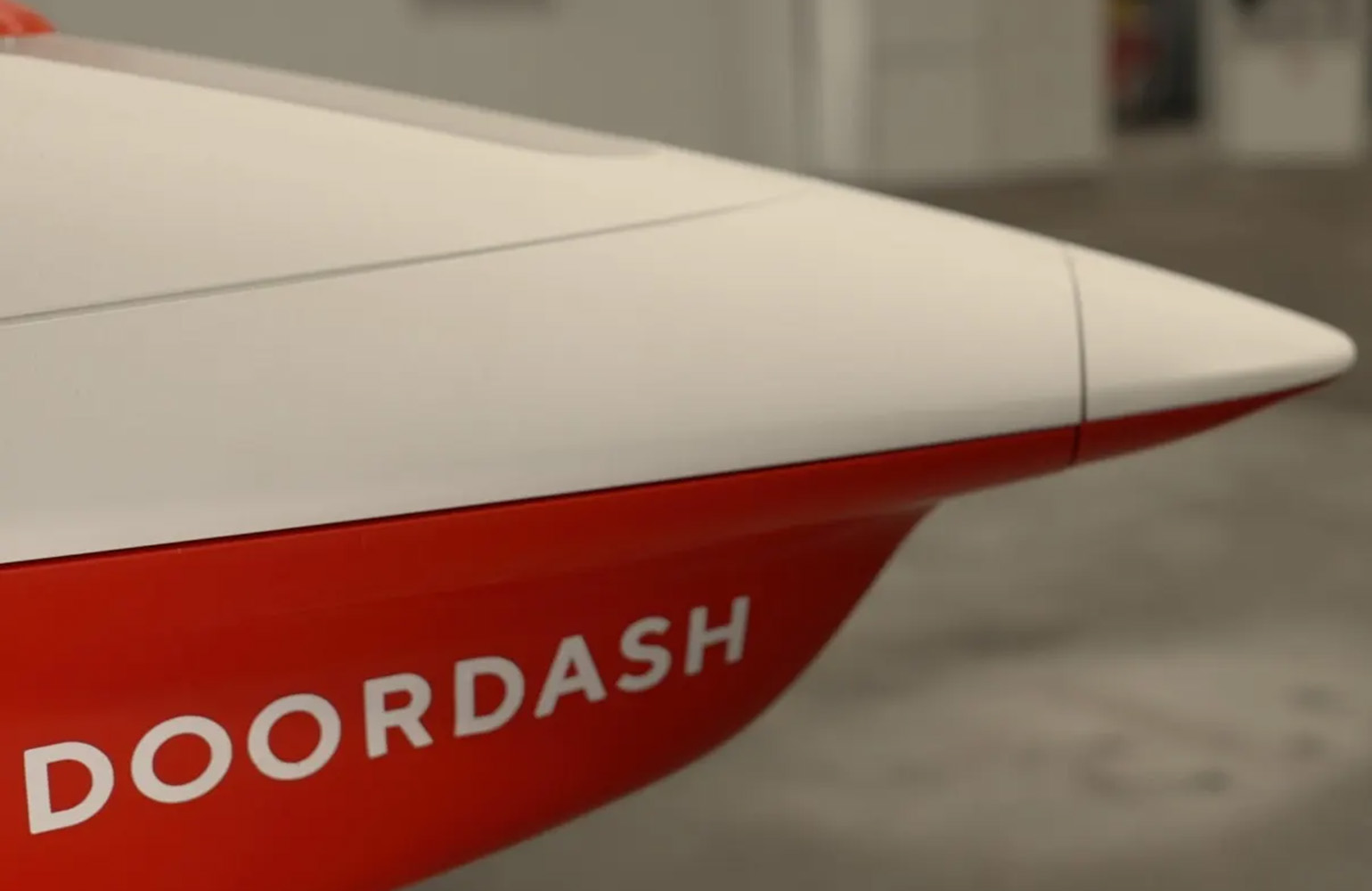
DoorDash’s expanding drone network targets mid-range deliveries, a segment often overlooked by human Dashers. | Source: DoorDash
Drone deliveries are rapidly gaining altitude. DoorDash announced yesterday that it has obtained Part 135 air carrier certification from the Federal Aviation Administration (FAA). This regulatory milestone marks the official launch of DoorDash Air, the company’s proprietary drone delivery initiative.
DoorDash has been heavily investing in automation over recent years, aiming to develop its delivery infrastructure internally. Last year, the company introduced Dot, its first autonomous delivery robot designed to navigate bike lanes, roads, sidewalks, and driveways for local deliveries.
With the FAA’s certification, DoorDash, headquartered in San Francisco, is now legally authorized to operate as an air carrier.
“Our goal is to make drone delivery accessible to every merchant, regardless of location,” stated Harrison Shih, head of DoorDash Air. “We are developing the complete stack, from ground infrastructure to the drones themselves and the handoff systems that ensure seamless integration.”
“Breakthroughs in hardware, computing power, and AI are unlocking new possibilities for local commerce. Becoming a certified air carrier accelerates our entire development roadmap,” he added.
DoorDash navigates the FAA’s stringent certification requirements
DoorDash highlighted that achieving FAA Part 135 certification involves a rigorous testing protocol with high safety standards. Operators must successfully complete a comprehensive five-stage evaluation to verify aircraft airworthiness, maintenance protocols, and safety procedures.
“This certification is the result of years of collaboration with the FAA,” a DoorDash spokesperson told The Robot Report. “The process entails a rigorous, multi-stage safety review that authorizes us to conduct commercial operations as a licensed air carrier.”
“We had to clear a five-stage federal process, including airworthiness testing, detailed flight operations and maintenance documentation reviewed by the FAA, an FAA-accepted safety management system, a hazardous materials program, and more,” the spokesperson explained. “We are proud to be among only eight drone operators in the United States to have successfully completed this process.”
Why DoorDash is developing its drone network internally
DoorDash currently partners with Wing for drone deliveries. However, the company is building its drone program within DoorDash Labs, its internal robotics and autonomy division.
“Our program rests on three pillars: first, our Autonomous Delivery Platform, which is the software layer that routes each order to the most efficient delivery mode—whether that’s a Dasher, Dot, drone, autonomous vehicle (AV), or sidewalk robot across our third-party partners,” the spokesperson explained. “We believe the best way to help local businesses scale with growing consumer demand is through a multimodal delivery network powered by more operators, not fewer.”
“Second, the ground infrastructure we are building for merchant handoff is designed to be interoperable across different drone providers,” DoorDash stated. “Our ambition is to develop a merchant handoff solution that supports the entire industry.”
“Third, this Part 135 certification allows us to operate, fly, and maintain our own drones,” the spokesperson added. “Together, these elements make drone delivery viable at scale for local commerce, not just for our own aircraft, but also for drones built by others.”
DoorDash stated it is designing its uncrewed aerial vehicles (UAVs) to address gaps in local commerce. The company also plans to design and manufacture its drones in the U.S., utilizing primarily American-made components.
Delivery systems undergo testing in select regions
DoorDash has already tested its drone delivery service with pilot partners. The company did not specify which cities were involved in these tests.
In 2025, DoorDash estimated that its drones completed deliveries in an average of just 25 minutes. In fact, some locations participating in drone partner pilots saw DoorDash order volume increase by approximately 30%, with the lift sustained for nine weeks following the pilot launch.
The company stated it hopes drones can fill gaps in its broader delivery network. More than 20% of orders on the DoorDash platform in 2025 traveled between three and five miles. These orders took nearly 25% longer on average than shorter deliveries, largely because finding the right ground-based Dasher is more challenging for mid-range trips, the company noted.
Routing mid-range deliveries to drones allows Dashers to focus on shorter deliveries that can be completed quickly. This enables Dashers to remain near high concentrations of merchants for optimal routing efficiency.
DoorDash did not disclose specific rollout locations or timelines for DoorDash Air. However, the company announced it plans to share more details at its Dash Forward event this September.
Related article
 DoorDash deploys AI to accelerate merchant onboarding and dish photo editing
On Monday, DoorDash introduced new AI-powered tools that help merchants accelerate onboarding, refine dish photos, and build websites from their app listings.This onboarding tool functions much like the one Amazon released in 2024. Merchants direct i
DoorDash Tasks app pays couriers for submitting videos to train AI
DoorDash announced on Thursday that it is launching a new, standalone “Tasks” app, which allows the company to pay its delivery couriers for completing assignments designed to improve AI and robotic systems. Couriers can earn money by filming everyda
Pudu Robotics Secures $150 Million Funding for Industrial Expansion
Pudu provides a variety of robots for service delivery, commercial cleaning, industrial logistics, and general embodied AI applications. | Source: Pudu RoboticsPudu Technology Inc. announced today that it has secured nearly $150 million in a new fund
Related Special Topic Recommendations
automation
DoorDash deploys AI to accelerate merchant onboarding and dish photo editing
On Monday, DoorDash introduced new AI-powered tools that help merchants accelerate onboarding, refine dish photos, and build websites from their app listings.This onboarding tool functions much like the one Amazon released in 2024. Merchants direct i
DoorDash Tasks app pays couriers for submitting videos to train AI
DoorDash announced on Thursday that it is launching a new, standalone “Tasks” app, which allows the company to pay its delivery couriers for completing assignments designed to improve AI and robotic systems. Couriers can earn money by filming everyda
Pudu Robotics Secures $150 Million Funding for Industrial Expansion
Pudu provides a variety of robots for service delivery, commercial cleaning, industrial logistics, and general embodied AI applications. | Source: Pudu RoboticsPudu Technology Inc. announced today that it has secured nearly $150 million in a new fund
Related Special Topic Recommendations
automation
 AI Invoice Processing Tools for AP Automation, Approval Routing, and ERP Sync Workflows
2026 Latest Best AI Invoice Processing Tools for AP Automation, Approval Routing, and ERP Sync Workflows! XIX.AI curates top-rated, powerful solutions that pass rigorous real-world tests to boost productivity dramatically. Get a free vs paid comparison, see detailed rankings, and discover must-try options to streamline your finance operations. Explore now to unlock your AI edge!
 9 tools
 xix.ai
writing
AI Technical Documentation Tools for Developer Teams
xix.ai
writing
AI Technical Documentation Tools for Developer Teams
2026 Latest Best Top-rated AI Technical Documentation Tools for Developer Teams! XIX.AI has curated a powerful, game-changing collection of must-try tools that go through rigorous real-world tests and weekly updated rankings. These top-rated solutions help teams boost productivity dramatically by streamlining content creation, fixing documentation errors, and accelerating coding workflows across all projects. Explore now to Discover your perfect tool for unlocking your AI edge!
13 tools
xix.ai
Software Development
AI Bug Triage Assistants: Rank Issues by Severity and User Impact
2026 Latest Best Top-rated AI Bug Triage Assistants Ranked! This curated collection showcases powerful game-changing tools that help teams quickly sort bugs by severity and user impact, saving valuable time. XIX.AI offers a free vs paid comparison along with real-world tests to help you find the must-try solution that boosts productivity significantly. Explore now to Discover your perfect tool for streamlining development workflows!
10 tools
xix.ai
code
Best AI Coding Tools for Python and JavaScript
2026 Latest Best Top-Rated AI Coding Tools for Python and JavaScript are here on XIX.AI’s curated list. These powerful game-changing tools have undergone rigorous real-world tests to deliver exceptional results for writing efficient code, fixing bugs, and boosting productivity. Get a free vs paid comparison and see which options suit your needs. Explore now to Discover your perfect coding tool and Unlock your AI edge.
10 tools
xix.ai
Academic Research
Best AI Citation Mapping Tools for Research Discovery
2026 Latest Best Top-Rated AI Citation Mapping Tools for Research Discovery! XIX.AI has curated a powerful, game-changing collection of must-try tools that go through rigorous real-world tests to deliver accurate results. You’ll find detailed free vs paid comparisons, weekly updated rankings, and insights to help you boost your research efficiency and uncover valuable data faster. Explore now to discover your perfect tool for academic work! 238 characters
11 tools
xix.ai
SEO
AI Meta Tag Tools for Faster On Page SEO
2026 Latest Best Top-rated AI Meta Tag Tools for Faster On Page SEO! XIX.AI has curated a powerful, game-changing collection of highly reliable tools that undergo rigorous real-world tests. You’ll find a free vs paid comparison along with detailed rankings to help you choose the perfect option for boosting your content’s search visibility and improving writing efficiency. Explore now to Unlock your AI edge!
9 tools
xix.ai

 Comments (0)
0/500
Comments (0)
0/500
DoorDash’s expanding drone network targets mid-range deliveries, a segment often overlooked by human Dashers. | Source: DoorDash
Drone deliveries are rapidly gaining altitude. DoorDash announced yesterday that it has obtained Part 135 air carrier certification from the Federal Aviation Administration (FAA). This regulatory milestone marks the official launch of DoorDash Air, the company’s proprietary drone delivery initiative.
DoorDash has been heavily investing in automation over recent years, aiming to develop its delivery infrastructure internally. Last year, the company introduced Dot, its first autonomous delivery robot designed to navigate bike lanes, roads, sidewalks, and driveways for local deliveries.
With the FAA’s certification, DoorDash, headquartered in San Francisco, is now legally authorized to operate as an air carrier.
“Our goal is to make drone delivery accessible to every merchant, regardless of location,” stated Harrison Shih, head of DoorDash Air. “We are developing the complete stack, from ground infrastructure to the drones themselves and the handoff systems that ensure seamless integration.”
“Breakthroughs in hardware, computing power, and AI are unlocking new possibilities for local commerce. Becoming a certified air carrier accelerates our entire development roadmap,” he added.
DoorDash navigates the FAA’s stringent certification requirements
DoorDash highlighted that achieving FAA Part 135 certification involves a rigorous testing protocol with high safety standards. Operators must successfully complete a comprehensive five-stage evaluation to verify aircraft airworthiness, maintenance protocols, and safety procedures.
“This certification is the result of years of collaboration with the FAA,” a DoorDash spokesperson told The Robot Report. “The process entails a rigorous, multi-stage safety review that authorizes us to conduct commercial operations as a licensed air carrier.”
“We had to clear a five-stage federal process, including airworthiness testing, detailed flight operations and maintenance documentation reviewed by the FAA, an FAA-accepted safety management system, a hazardous materials program, and more,” the spokesperson explained. “We are proud to be among only eight drone operators in the United States to have successfully completed this process.”
Why DoorDash is developing its drone network internally
DoorDash currently partners with Wing for drone deliveries. However, the company is building its drone program within DoorDash Labs, its internal robotics and autonomy division.
“Our program rests on three pillars: first, our Autonomous Delivery Platform, which is the software layer that routes each order to the most efficient delivery mode—whether that’s a Dasher, Dot, drone, autonomous vehicle (AV), or sidewalk robot across our third-party partners,” the spokesperson explained. “We believe the best way to help local businesses scale with growing consumer demand is through a multimodal delivery network powered by more operators, not fewer.”
“Second, the ground infrastructure we are building for merchant handoff is designed to be interoperable across different drone providers,” DoorDash stated. “Our ambition is to develop a merchant handoff solution that supports the entire industry.”
“Third, this Part 135 certification allows us to operate, fly, and maintain our own drones,” the spokesperson added. “Together, these elements make drone delivery viable at scale for local commerce, not just for our own aircraft, but also for drones built by others.”
DoorDash stated it is designing its uncrewed aerial vehicles (UAVs) to address gaps in local commerce. The company also plans to design and manufacture its drones in the U.S., utilizing primarily American-made components.
Delivery systems undergo testing in select regions
DoorDash has already tested its drone delivery service with pilot partners. The company did not specify which cities were involved in these tests.
In 2025, DoorDash estimated that its drones completed deliveries in an average of just 25 minutes. In fact, some locations participating in drone partner pilots saw DoorDash order volume increase by approximately 30%, with the lift sustained for nine weeks following the pilot launch.
The company stated it hopes drones can fill gaps in its broader delivery network. More than 20% of orders on the DoorDash platform in 2025 traveled between three and five miles. These orders took nearly 25% longer on average than shorter deliveries, largely because finding the right ground-based Dasher is more challenging for mid-range trips, the company noted.
Routing mid-range deliveries to drones allows Dashers to focus on shorter deliveries that can be completed quickly. This enables Dashers to remain near high concentrations of merchants for optimal routing efficiency.
DoorDash did not disclose specific rollout locations or timelines for DoorDash Air. However, the company announced it plans to share more details at its Dash Forward event this September.








 DoorDash deploys AI to accelerate merchant onboarding and dish photo editing
On Monday, DoorDash introduced new AI-powered tools that help merchants accelerate onboarding, refine dish photos, and build websites from their app listings.This onboarding tool functions much like the one Amazon released in 2024. Merchants direct i
DoorDash deploys AI to accelerate merchant onboarding and dish photo editing
On Monday, DoorDash introduced new AI-powered tools that help merchants accelerate onboarding, refine dish photos, and build websites from their app listings.This onboarding tool functions much like the one Amazon released in 2024. Merchants direct i
 DoorDash Tasks app pays couriers for submitting videos to train AI
DoorDash announced on Thursday that it is launching a new, standalone “Tasks” app, which allows the company to pay its delivery couriers for completing assignments designed to improve AI and robotic systems. Couriers can earn money by filming everyda
DoorDash Tasks app pays couriers for submitting videos to train AI
DoorDash announced on Thursday that it is launching a new, standalone “Tasks” app, which allows the company to pay its delivery couriers for completing assignments designed to improve AI and robotic systems. Couriers can earn money by filming everyda
 Pudu Robotics Secures $150 Million Funding for Industrial Expansion
Pudu provides a variety of robots for service delivery, commercial cleaning, industrial logistics, and general embodied AI applications. | Source: Pudu RoboticsPudu Technology Inc. announced today that it has secured nearly $150 million in a new fund
Pudu Robotics Secures $150 Million Funding for Industrial Expansion
Pudu provides a variety of robots for service delivery, commercial cleaning, industrial logistics, and general embodied AI applications. | Source: Pudu RoboticsPudu Technology Inc. announced today that it has secured nearly $150 million in a new fund

2026 Latest Best AI Invoice Processing Tools for AP Automation, Approval Routing, and ERP Sync Workflows! XIX.AI curates top-rated, powerful solutions that pass rigorous real-world tests to boost productivity dramatically. Get a free vs paid comparison, see detailed rankings, and discover must-try options to streamline your finance operations. Explore now to unlock your AI edge!
9 tools
xix.ai

2026 Latest Best Top-rated AI Technical Documentation Tools for Developer Teams! XIX.AI has curated a powerful, game-changing collection of must-try tools that go through rigorous real-world tests and weekly updated rankings. These top-rated solutions help teams boost productivity dramatically by streamlining content creation, fixing documentation errors, and accelerating coding workflows across all projects. Explore now to Discover your perfect tool for unlocking your AI edge!
13 tools
xix.ai

2026 Latest Best Top-rated AI Bug Triage Assistants Ranked! This curated collection showcases powerful game-changing tools that help teams quickly sort bugs by severity and user impact, saving valuable time. XIX.AI offers a free vs paid comparison along with real-world tests to help you find the must-try solution that boosts productivity significantly. Explore now to Discover your perfect tool for streamlining development workflows!
10 tools
xix.ai

2026 Latest Best Top-Rated AI Coding Tools for Python and JavaScript are here on XIX.AI’s curated list. These powerful game-changing tools have undergone rigorous real-world tests to deliver exceptional results for writing efficient code, fixing bugs, and boosting productivity. Get a free vs paid comparison and see which options suit your needs. Explore now to Discover your perfect coding tool and Unlock your AI edge.
10 tools
xix.ai

2026 Latest Best Top-Rated AI Citation Mapping Tools for Research Discovery! XIX.AI has curated a powerful, game-changing collection of must-try tools that go through rigorous real-world tests to deliver accurate results. You’ll find detailed free vs paid comparisons, weekly updated rankings, and insights to help you boost your research efficiency and uncover valuable data faster. Explore now to discover your perfect tool for academic work! 238 characters
11 tools
xix.ai

2026 Latest Best Top-rated AI Meta Tag Tools for Faster On Page SEO! XIX.AI has curated a powerful, game-changing collection of highly reliable tools that undergo rigorous real-world tests. You’ll find a free vs paid comparison along with detailed rankings to help you choose the perfect option for boosting your content’s search visibility and improving writing efficiency. Explore now to Unlock your AI edge!
9 tools
xix.ai












