


 Home
HomeGoogle Translate Adds 110 New Languages
Google Translate is all about breaking down language barriers and helping folks connect and understand the world better. We're always on the hunt for the latest tech to make this tool more accessible. Back in 2022, we added 24 new languages using Zero-Shot Machine Translation, where a machine learning model learns to translate into another language without ever seeing an example. Plus, we kicked off the 1,000 Languages Initiative, aiming to build AI models that support the 1,000 most spoken languages worldwide.
Now, we're using AI to expand the variety of languages we support even further. Thanks to our PaLM 2 large language model, we're rolling out 110 new languages to Google Translate, which is our biggest expansion yet.
Translation support for more than half a billion people
-------------------------------------------------------
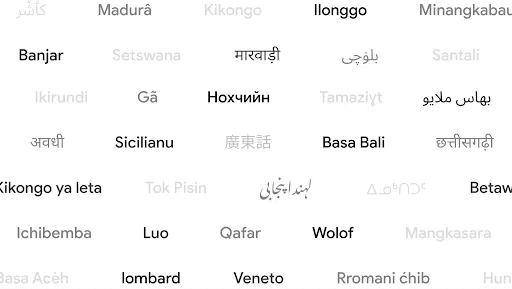
From Cantonese to Qʼeqchiʼ, these new languages cover over 614 million speakers, opening up translations for about 8% of the world's population. Some are big world languages with over 100 million speakers, while others are spoken by small Indigenous communities. A few are even being actively revived despite having almost no native speakers left. About a quarter of these new languages are from Africa, marking our largest expansion of African languages yet, including Fon, Kikongo, Luo, Ga, Swati, Venda, and Wolof.
Here are some of the newly supported languages in Google Translate:
- Afar, a tonal language spoken in Djibouti, Eritrea, and Ethiopia, had the most volunteer community contributions of all the languages in this launch.
- Cantonese, long one of the most requested languages for Google Translate, is tricky to handle because it often overlaps with Mandarin in writing, making it hard to find data and train models.
- Manx, the Celtic language of the Isle of Man, was nearly extinct after the last native speaker passed away in 1974. But thanks to a revival movement, there are now thousands of speakers.
- NKo, a standardized form of the West African Manding languages, unifies many dialects into a common language. Its unique alphabet was invented in 1949, and it has an active research community today.
- Punjabi (Shahmukhi), the variety of Punjabi written in Perso-Arabic script, is the most spoken language in Pakistan.
- Tamazight (Amazigh), a Berber language spoken across North Africa, has many dialects but a generally mutually understandable written form. It's written in both Latin and Tifinagh scripts, both supported by Google Translate.
- Tok Pisin, an English-based creole and the lingua franca of Papua New Guinea, might be understandable to English speakers when translated.
How we choose language varieties
Adding new languages to Translate involves a lot of thought, from choosing which varieties to include to deciding on specific spellings.
Languages have tons of variation: regional varieties, dialects, different spelling standards. Many don't have a single standard form, so picking the "right" variety is tough. We focus on the most commonly used varieties. For example, Romani has many dialects across Europe. Our models produce text closest to Southern Vlax Romani, a commonly used variety online, but also mix in elements from others like Northern Vlax and Balkan Romani.
PaLM 2 was crucial in helping Translate learn languages that are closely related, like those near Hindi, such as Awadhi and Marwadi, and French creoles like Seychellois Creole and Mauritian Creole. As tech advances and we keep working with expert linguists and native speakers, we'll support even more language varieties and spelling conventions over time.
Check out the Help Center to learn more about these newly supported languages. And start translating at translate.google.com or on the Google Translate app on Android and iOS.
Related article
 Google Tests Remy AI Agent for Gemini as Focus Shifts to User Control
According to Business Insider, Google is testing Remy, a new AI personal agent for Gemini. This tool aims to execute tasks on behalf of users, streamlining both professional workflows and daily routines.Currently, Remy is undergoing testing in an int
Ollie bets privacy focus to win AI assistant race
To be genuinely helpful, an AI assistant must understand its user deeply. Ollie, a personal assistant designed for daily life, operates on the premise that this doesn’t require surrendering your data or compromising your privacy.While certain enterpr
How AI LIVE: London Will Explore AI & Industrial Automation
The summit will convene C-suite executives from around the globe to address pressing challenges in global industries, ranging from AI-driven disruption to economic volatility.AI LIVE: The London Summit will gather over 2,000 international leaders und
Related Special Topic Recommendations
SEO
Google Tests Remy AI Agent for Gemini as Focus Shifts to User Control
According to Business Insider, Google is testing Remy, a new AI personal agent for Gemini. This tool aims to execute tasks on behalf of users, streamlining both professional workflows and daily routines.Currently, Remy is undergoing testing in an int
Ollie bets privacy focus to win AI assistant race
To be genuinely helpful, an AI assistant must understand its user deeply. Ollie, a personal assistant designed for daily life, operates on the premise that this doesn’t require surrendering your data or compromising your privacy.While certain enterpr
How AI LIVE: London Will Explore AI & Industrial Automation
The summit will convene C-suite executives from around the globe to address pressing challenges in global industries, ranging from AI-driven disruption to economic volatility.AI LIVE: The London Summit will gather over 2,000 international leaders und
Related Special Topic Recommendations
SEO
 Best AI SERP Analysis Tools for Search Strategy
2026 Latest Best Top-rated AI SERP Analysis Tools for Search Strategy are curated by XIX.AI through rigorous real-world tests and weekly updated rankings. These powerful tools help you unlock hidden optimization opportunities, boost content performance, and gain a competitive edge in search. Discover your perfect tool to elevate your search strategy today. Explore now!
 13 tools
 xix.ai
Data Analysis
Best AI Anomaly Detection Tools for KPI Monitoring across SaaS and Ecommerce Teams
xix.ai
Data Analysis
Best AI Anomaly Detection Tools for KPI Monitoring across SaaS and Ecommerce Teams
2026 Latest Best Top-rated AI Anomaly Detection Tools for KPI Monitoring in SaaS and Ecommerce teams! XIX.AI has curated a powerful, game-changing collection based on rigorous real-world tests and weekly updated rankings. You’ll find detailed free vs paid comparison insights to help you identify the must-try solution that boosts productivity and unlocks your AI edge. Explore now!
10 tools
xix.ai
writing
Best AI Outline Generators for Long-Form SEO Articles
2026 Latest Best Top-Rated AI Outline Generators for Long-Form SEO Articles, meticulously curated by XIX.AI. These powerful tools offer game-changing assistance in creating high-quality content quickly, boosting writing efficiency significantly. Get a free vs paid comparison along with real-world tests and detailed rankings to help you find the must-try option that suits your needs. Explore now to unlock your AI edge.
8 tools
xix.ai
Education and Learning
AI Study Tools for Homework and Exam Prep
2026 Latest Best AI Study Tools for Homework and Exam Prep! XIX.AI curates a top-rated list of powerful, game-changing tools that help students boost productivity, streamline homework completion, and ace exams through real-world tests. Get a free vs paid comparison, detailed rankings, and must-try options to unlock your AI edge. Explore now!
10 tools
xix.ai
Music composition
AI Vocal Demo Tools for Songwriters, Hooks, Toplines, and Multilingual Draft Sessions
2026 Latest Best AI Vocal Demo Tools for Songwriters, Hook Creators, and Multi-Language Content Teams! XIX.AI has curated a top-rated list of powerful game-changing tools that go through rigorous real-world tests. You’ll find detailed free vs paid comparison data, comprehensive rankings, and must-try options to help you boost writing efficiency and unlock your creative potential. Explore now to discover your perfect tool for all your content needs!
9 tools
xix.ai
Business
Best AI Competitive Research Tools for Small Businesses
2026 Latest Best Top-rated AI Competitive Research Tools for Small Businesses! XIX.AI has curated a highly powerful game-changing collection, updated weekly with rigorous real-world tests and detailed rankings. You can find a comprehensive free vs paid comparison to help you identify the must-try tools that boost your productivity and give you a competitive edge. Explore now to discover your perfect tool!
9 tools
xix.ai

 Comments (31)
0/500
Comments (31)
0/500
![BrianMartinez]()
Wow, 110 new languages on Google Translate? That's like opening a door to a whole new world of conversations! 🌍 I wonder how accurate the translations are for lesser-known dialects—might try it out with some obscure phrases!
![MatthewHill]()
Wow, 110 new languages is a game-changer! Google Translate keeps pushing boundaries, making the world feel smaller. Curious how well it handles rare dialects though—any quirky mistranslations yet? 😄
![JackHernández]()
Wow, 110 new languages is wild! Google Translate's really stepping up, making the world feel smaller. Wonder how accurate these new additions are though? 😄
![BillyGreen]()
Wow, 110 new languages on Google Translate? That's like opening a door to a whole new world of conversations! 🌍 I’m curious how accurate the translations are for lesser-known dialects. Anyone tried it yet?
![ArthurBrown]()
Wow, 110 new languages is a game-changer for Google Translate! It's like opening a door to countless cultures. Can't wait to try chatting with someone in a rare dialect 😎. Wonder how accurate the translations are for these new additions, though?
![KevinDavis]()
Super cool to see Google Translate expanding with 110 new languages! 🌍 It’s wild how tech keeps connecting us across borders. Anyone tried translating some obscure dialects yet?
Google Translate is all about breaking down language barriers and helping folks connect and understand the world better. We're always on the hunt for the latest tech to make this tool more accessible. Back in 2022, we added 24 new languages using Zero-Shot Machine Translation, where a machine learning model learns to translate into another language without ever seeing an example. Plus, we kicked off the 1,000 Languages Initiative, aiming to build AI models that support the 1,000 most spoken languages worldwide.
Now, we're using AI to expand the variety of languages we support even further. Thanks to our PaLM 2 large language model, we're rolling out 110 new languages to Google Translate, which is our biggest expansion yet.
From Cantonese to Qʼeqchiʼ, these new languages cover over 614 million speakers, opening up translations for about 8% of the world's population. Some are big world languages with over 100 million speakers, while others are spoken by small Indigenous communities. A few are even being actively revived despite having almost no native speakers left. About a quarter of these new languages are from Africa, marking our largest expansion of African languages yet, including Fon, Kikongo, Luo, Ga, Swati, Venda, and Wolof.
Here are some of the newly supported languages in Google Translate:
- Afar, a tonal language spoken in Djibouti, Eritrea, and Ethiopia, had the most volunteer community contributions of all the languages in this launch.
- Cantonese, long one of the most requested languages for Google Translate, is tricky to handle because it often overlaps with Mandarin in writing, making it hard to find data and train models.
- Manx, the Celtic language of the Isle of Man, was nearly extinct after the last native speaker passed away in 1974. But thanks to a revival movement, there are now thousands of speakers.
- NKo, a standardized form of the West African Manding languages, unifies many dialects into a common language. Its unique alphabet was invented in 1949, and it has an active research community today.
- Punjabi (Shahmukhi), the variety of Punjabi written in Perso-Arabic script, is the most spoken language in Pakistan.
- Tamazight (Amazigh), a Berber language spoken across North Africa, has many dialects but a generally mutually understandable written form. It's written in both Latin and Tifinagh scripts, both supported by Google Translate.
- Tok Pisin, an English-based creole and the lingua franca of Papua New Guinea, might be understandable to English speakers when translated.
How we choose language varieties
Adding new languages to Translate involves a lot of thought, from choosing which varieties to include to deciding on specific spellings.
Languages have tons of variation: regional varieties, dialects, different spelling standards. Many don't have a single standard form, so picking the "right" variety is tough. We focus on the most commonly used varieties. For example, Romani has many dialects across Europe. Our models produce text closest to Southern Vlax Romani, a commonly used variety online, but also mix in elements from others like Northern Vlax and Balkan Romani.
PaLM 2 was crucial in helping Translate learn languages that are closely related, like those near Hindi, such as Awadhi and Marwadi, and French creoles like Seychellois Creole and Mauritian Creole. As tech advances and we keep working with expert linguists and native speakers, we'll support even more language varieties and spelling conventions over time.
Check out the Help Center to learn more about these newly supported languages. And start translating at translate.google.com or on the Google Translate app on Android and iOS.







 Google Tests Remy AI Agent for Gemini as Focus Shifts to User Control
According to Business Insider, Google is testing Remy, a new AI personal agent for Gemini. This tool aims to execute tasks on behalf of users, streamlining both professional workflows and daily routines.Currently, Remy is undergoing testing in an int
Google Tests Remy AI Agent for Gemini as Focus Shifts to User Control
According to Business Insider, Google is testing Remy, a new AI personal agent for Gemini. This tool aims to execute tasks on behalf of users, streamlining both professional workflows and daily routines.Currently, Remy is undergoing testing in an int
 Ollie bets privacy focus to win AI assistant race
To be genuinely helpful, an AI assistant must understand its user deeply. Ollie, a personal assistant designed for daily life, operates on the premise that this doesn’t require surrendering your data or compromising your privacy.While certain enterpr
Ollie bets privacy focus to win AI assistant race
To be genuinely helpful, an AI assistant must understand its user deeply. Ollie, a personal assistant designed for daily life, operates on the premise that this doesn’t require surrendering your data or compromising your privacy.While certain enterpr
 How AI LIVE: London Will Explore AI & Industrial Automation
The summit will convene C-suite executives from around the globe to address pressing challenges in global industries, ranging from AI-driven disruption to economic volatility.AI LIVE: The London Summit will gather over 2,000 international leaders und
How AI LIVE: London Will Explore AI & Industrial Automation
The summit will convene C-suite executives from around the globe to address pressing challenges in global industries, ranging from AI-driven disruption to economic volatility.AI LIVE: The London Summit will gather over 2,000 international leaders und

2026 Latest Best Top-rated AI SERP Analysis Tools for Search Strategy are curated by XIX.AI through rigorous real-world tests and weekly updated rankings. These powerful tools help you unlock hidden optimization opportunities, boost content performance, and gain a competitive edge in search. Discover your perfect tool to elevate your search strategy today. Explore now!
13 tools
xix.ai

2026 Latest Best Top-rated AI Anomaly Detection Tools for KPI Monitoring in SaaS and Ecommerce teams! XIX.AI has curated a powerful, game-changing collection based on rigorous real-world tests and weekly updated rankings. You’ll find detailed free vs paid comparison insights to help you identify the must-try solution that boosts productivity and unlocks your AI edge. Explore now!
10 tools
xix.ai

2026 Latest Best Top-Rated AI Outline Generators for Long-Form SEO Articles, meticulously curated by XIX.AI. These powerful tools offer game-changing assistance in creating high-quality content quickly, boosting writing efficiency significantly. Get a free vs paid comparison along with real-world tests and detailed rankings to help you find the must-try option that suits your needs. Explore now to unlock your AI edge.
8 tools
xix.ai

2026 Latest Best AI Study Tools for Homework and Exam Prep! XIX.AI curates a top-rated list of powerful, game-changing tools that help students boost productivity, streamline homework completion, and ace exams through real-world tests. Get a free vs paid comparison, detailed rankings, and must-try options to unlock your AI edge. Explore now!
10 tools
xix.ai

2026 Latest Best AI Vocal Demo Tools for Songwriters, Hook Creators, and Multi-Language Content Teams! XIX.AI has curated a top-rated list of powerful game-changing tools that go through rigorous real-world tests. You’ll find detailed free vs paid comparison data, comprehensive rankings, and must-try options to help you boost writing efficiency and unlock your creative potential. Explore now to discover your perfect tool for all your content needs!
9 tools
xix.ai

2026 Latest Best Top-rated AI Competitive Research Tools for Small Businesses! XIX.AI has curated a highly powerful game-changing collection, updated weekly with rigorous real-world tests and detailed rankings. You can find a comprehensive free vs paid comparison to help you identify the must-try tools that boost your productivity and give you a competitive edge. Explore now to discover your perfect tool!
9 tools
xix.ai

Wow, 110 new languages on Google Translate? That's like opening a door to a whole new world of conversations! 🌍 I wonder how accurate the translations are for lesser-known dialects—might try it out with some obscure phrases!
Wow, 110 new languages is a game-changer! Google Translate keeps pushing boundaries, making the world feel smaller. Curious how well it handles rare dialects though—any quirky mistranslations yet? 😄
Wow, 110 new languages is wild! Google Translate's really stepping up, making the world feel smaller. Wonder how accurate these new additions are though? 😄
Wow, 110 new languages on Google Translate? That's like opening a door to a whole new world of conversations! 🌍 I’m curious how accurate the translations are for lesser-known dialects. Anyone tried it yet?
Wow, 110 new languages is a game-changer for Google Translate! It's like opening a door to countless cultures. Can't wait to try chatting with someone in a rare dialect 😎. Wonder how accurate the translations are for these new additions, though?
Super cool to see Google Translate expanding with 110 new languages! 🌍 It’s wild how tech keeps connecting us across borders. Anyone tried translating some obscure dialects yet?












