


 Home
HomeOllie bets privacy focus to win AI assistant race
To be genuinely helpful, an AI assistant must understand its user deeply. Ollie, a personal assistant designed for daily life, operates on the premise that this doesn’t require surrendering your data or compromising your privacy.
While certain enterprise-grade AI tools offer data privacy safeguards, Ollie stands out as one of the first mainstream, family-oriented AI services to achieve SOC 2 compliance. This framework allows companies to prove through independent audits that they maintain formal controls to protect customer data and operate their systems securely.
Reaching this milestone was crucial for Ollie’s team, signaling to prospective users that the assistant does not harvest personal information for secondary purposes, such as training other AI models.
“We fundamentally believe that trust and privacy are non-negotiable, which is why our business model relies on subscriptions. We want users to know that Ollie works exclusively for them,” Ollie co-founder and CEO Bill Lennon told TechCrunch. “We do not share your data with third parties,” he emphasized.
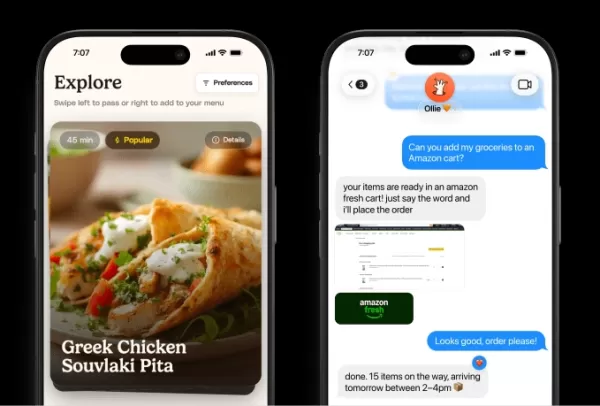
Image Credits:Ollie
Many personal AI assistants are positioning themselves as consumer-friendly solutions that integrate into daily routines via text messaging. In this crowded landscape, Ollie’s emphasis on privacy could serve as a key differentiator.
Currently, Ollie competes with text-based assistants such as Poke (acquired by Cognition), Fambot, Ohai, Folk, Saner.ai, and Tomo. The market also includes work-focused assistants like Town, Lindy, and Reclaim.ai, which specialize in calendar management and email. Additionally, there is Instinct, an AI assistant that recently secured $350 million in funding at a $2.5 billion valuation prior to its launch.
The competition in this sector is intensifying rapidly.
In contrast, San Diego-based Ollie has raised a more modest $7.5 million seed round, primarily from Khosla Ventures, along with AI House.
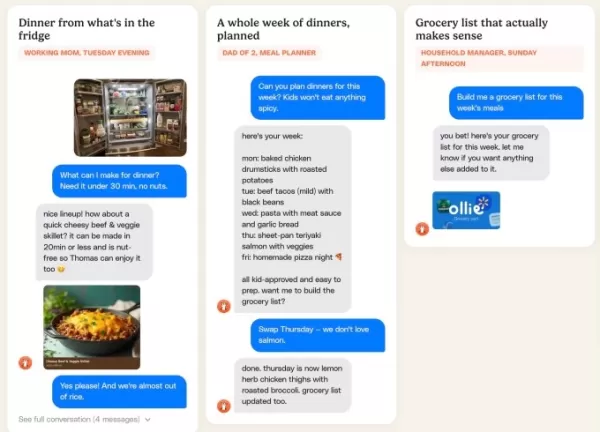
Image Credits:Ollie
Despite the utility these assistants offer, consumers remain concerned about the extent of privacy and personal data they must surrender. Instinct, for instance, faced backlash for its broad Terms of Service and privacy policy, which granted it a “perpetual and irrevocable” license to “access, use, host, cache, store, reproduce, transmit, display, publish, distribute, and modify” user materials, including for AI training. Such terms raise significant red flags.
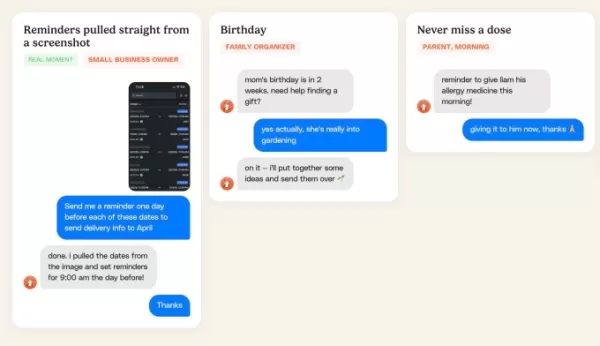
Lennon is adopting a different strategy with Ollie. This family assistant currently integrates with calendars and email to organize schedules and keep users informed about their day. It also provides tools for meal planning, grocery shopping, to-do tracking, appointment booking, and bill payments through group chats. Future updates may include household budget management.
However, this level of access requires trust, which Ollie claims is its primary advantage over competitors. “We do not share your data with anyone. This is critical, and it is essential for earning user trust,” Lennon stated.
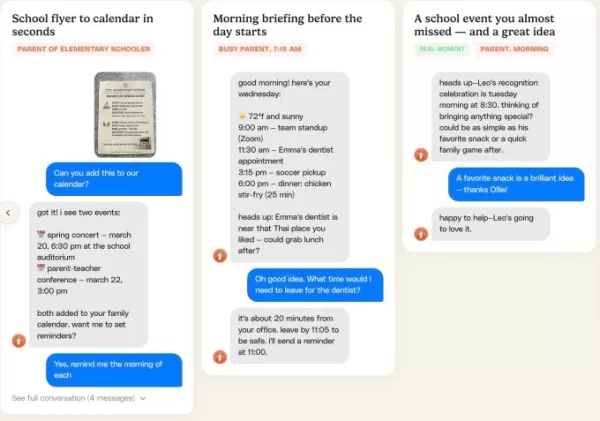
Image Credits:Ollie
Beyond SOC 2 compliance, Ollie does not request user usernames or passwords to perform tasks. When logging into a website on behalf of the user, Ollie uses its own cloud-based browser and provides the user with a link to a remote session. This process is similar when the assistant handles payments or purchases.
While this approach enhances security, it requires users to log in for certain tasks. Lennon believes that technology will eventually streamline this experience.
“This is uncharted territory. In the future, we anticipate implementing secure hard tokenization, eliminating the need to re-enter information repeatedly,” he explained. “This is frontier technology. Our goal is to find the optimal user experience that balances convenience with trust.”
Establishing this trust is vital before users feel comfortable allowing Ollie to access sensitive information, such as bank accounts, even via connectors like Plaid.
Lennon, who holds a Ph.D. in AI, also has a fintech background, having sold his previous startup, Groundwork—a neobank for nonprofits—in 2021. This experience may prove valuable as Ollie expands into financial management.
ScreenshotImage Credits:Ollie
Nevertheless, it remains uncertain whether consumers desire such assistance.
Lennon remains optimistic, noting that Ollie’s retention rates align with leading AI subscription services regarding paid subscribers. He declined to disclose specific user or customer numbers, citing the competitive nature of the industry.
These systems can still be inconsistent. Despite the hype surrounding Instinct, early tests revealed inaccuracies in hotel pricing and booking. Similarly, Ollie experienced an infrastructure outage with its text provider during testing, causing it to stop responding.
When asked how Ollie addresses these issues, given that consumers often give new technology only one chance, Lennon acknowledged the broader challenges of AI.
Lennon agreed that this is a systemic issue with AI. “This is the fundamental challenge with LLMs: because they are stochastic, they are inherently unreliable,” he said. “We must build defensive agent harnesses to catch and prevent these errors… It’s like solving 1,000 small problems before we can move forward.”
Related article
 How AI LIVE: London Will Explore AI & Industrial Automation
The summit will convene C-suite executives from around the globe to address pressing challenges in global industries, ranging from AI-driven disruption to economic volatility.AI LIVE: The London Summit will gather over 2,000 international leaders und
Anthropic Enters AI Legal Tech Market as Competition Intensifies
Anthropic unveiled a suite of new chatbot capabilities on Tuesday, aimed at delivering automated support to legal practices. These enhancements expand upon Claude for Legal, the firm-specific platform introduced earlier this year, by adding specializ
Spotify Expands AI Remix and Covers Project With Merlin Partnership
Spotify reiterated plans for a new AI-powered feature during its second-quarter earnings call, enabling fans to create covers and remixes of music with explicit artist permission.Independent licensing partner Merlin has joined Universal Music Group (
Related Special Topic Recommendations
Text-to-speech
How AI LIVE: London Will Explore AI & Industrial Automation
The summit will convene C-suite executives from around the globe to address pressing challenges in global industries, ranging from AI-driven disruption to economic volatility.AI LIVE: The London Summit will gather over 2,000 international leaders und
Anthropic Enters AI Legal Tech Market as Competition Intensifies
Anthropic unveiled a suite of new chatbot capabilities on Tuesday, aimed at delivering automated support to legal practices. These enhancements expand upon Claude for Legal, the firm-specific platform introduced earlier this year, by adding specializ
Spotify Expands AI Remix and Covers Project With Merlin Partnership
Spotify reiterated plans for a new AI-powered feature during its second-quarter earnings call, enabling fans to create covers and remixes of music with explicit artist permission.Independent licensing partner Merlin has joined Universal Music Group (
Related Special Topic Recommendations
Text-to-speech
 Best AI Text to Speech Tools for Online Courses
2026 Latest Best Top-rated AI Text to Speech Tools for Online Courses are curated by XIX.AI based on rigorous real-world tests and weekly updated rankings. These powerful tools help creators deliver crystal-clear audio content effortlessly, boosting writing efficiency and streamlining course production. Check out the free vs paid comparison to find your perfect fit. Explore now to unlock your AI edge in online education.
 10 tools
 xix.ai
writing
AI Blog Title Tools for Higher Click Through Rates
xix.ai
writing
AI Blog Title Tools for Higher Click Through Rates
2026 Latest Best Top-Rated AI Blog Title Tools for Higher Click Through Rates! XIX.AI has carefully curated a powerful, game-changing collection of top tools that go through rigorous real-world tests. You’ll find a free vs paid comparison, weekly updated rankings, and detailed insights to help you boost your blog’s traffic efficiently. Must-try options are highlighted to help you unlock your AI edge. Explore now!
10 tools
xix.ai
automation
Best AI Task Routing Tools for Support Workflows
2026 Latest Best Top-rated AI Task Routing Tools for Support Workflows! XIX.AI has curated a highly powerful game-changing collection of must-try solutions, all undergoing rigorous real-world tests and updated weekly. These tools streamline workflows, boost productivity, and help teams deliver faster, more efficient support. Explore now to discover your perfect tool and unlock your AI edge!
17 tools
xix.ai
Academic Research
AI Citation and Paper Summary Tools
2026 Latest Best Top-Rated AI Citation and Paper Summary Tools Curated by XIX.AI. Get powerful game-changing solutions for quick content creation, improved writing efficiency, and boosting productivity. We offer a free vs paid comparison along with real-world tests and weekly updated rankings to help you find the must-try tool that fits your needs perfectly. Explore now to Unlock your AI edge.
10 tools
xix.ai
Productivity
Best AI Productivity Tools for Daily Work
2026 Latest Best Top-Rated AI Productivity Tools for Daily Work! XIX.AI has curated a powerful, game-changing selection based on rigorous weekly updated rankings and real-world tests. You’ll find must-try options that boost writing efficiency, streamline content creation, and help you overcome daily work challenges. Get a free vs paid comparison to find the perfect fit for your needs. Explore now to unlock your AI edge!
9 tools
xix.ai
Academic Research
AI Systematic Review Tools for Research Screening
2026 Latest Best Top-Rated AI Systematic Review Tools for Research Screening are here on XIX.AI! This curated collection includes powerful, game-changing solutions that go through rigorous real-world tests to deliver accurate results. We also offer a free vs paid comparison along with weekly updated rankings to help you find the must-try option that boosts your research efficiency significantly. Explore now to unlock your AI edge in academic work!
11 tools
xix.ai

 Comments (0)
0/500
Comments (0)
0/500
To be genuinely helpful, an AI assistant must understand its user deeply. Ollie, a personal assistant designed for daily life, operates on the premise that this doesn’t require surrendering your data or compromising your privacy.
While certain enterprise-grade AI tools offer data privacy safeguards, Ollie stands out as one of the first mainstream, family-oriented AI services to achieve SOC 2 compliance. This framework allows companies to prove through independent audits that they maintain formal controls to protect customer data and operate their systems securely.
Reaching this milestone was crucial for Ollie’s team, signaling to prospective users that the assistant does not harvest personal information for secondary purposes, such as training other AI models.
“We fundamentally believe that trust and privacy are non-negotiable, which is why our business model relies on subscriptions. We want users to know that Ollie works exclusively for them,” Ollie co-founder and CEO Bill Lennon told TechCrunch. “We do not share your data with third parties,” he emphasized.
Image Credits:Ollie
Many personal AI assistants are positioning themselves as consumer-friendly solutions that integrate into daily routines via text messaging. In this crowded landscape, Ollie’s emphasis on privacy could serve as a key differentiator.
Currently, Ollie competes with text-based assistants such as Poke (acquired by Cognition), Fambot, Ohai, Folk, Saner.ai, and Tomo. The market also includes work-focused assistants like Town, Lindy, and Reclaim.ai, which specialize in calendar management and email. Additionally, there is Instinct, an AI assistant that recently secured $350 million in funding at a $2.5 billion valuation prior to its launch.
The competition in this sector is intensifying rapidly.
In contrast, San Diego-based Ollie has raised a more modest $7.5 million seed round, primarily from Khosla Ventures, along with AI House.
Image Credits:Ollie
Despite the utility these assistants offer, consumers remain concerned about the extent of privacy and personal data they must surrender. Instinct, for instance, faced backlash for its broad Terms of Service and privacy policy, which granted it a “perpetual and irrevocable” license to “access, use, host, cache, store, reproduce, transmit, display, publish, distribute, and modify” user materials, including for AI training. Such terms raise significant red flags.
Lennon is adopting a different strategy with Ollie. This family assistant currently integrates with calendars and email to organize schedules and keep users informed about their day. It also provides tools for meal planning, grocery shopping, to-do tracking, appointment booking, and bill payments through group chats. Future updates may include household budget management.
However, this level of access requires trust, which Ollie claims is its primary advantage over competitors. “We do not share your data with anyone. This is critical, and it is essential for earning user trust,” Lennon stated.
Image Credits:Ollie
Beyond SOC 2 compliance, Ollie does not request user usernames or passwords to perform tasks. When logging into a website on behalf of the user, Ollie uses its own cloud-based browser and provides the user with a link to a remote session. This process is similar when the assistant handles payments or purchases.
While this approach enhances security, it requires users to log in for certain tasks. Lennon believes that technology will eventually streamline this experience.
“This is uncharted territory. In the future, we anticipate implementing secure hard tokenization, eliminating the need to re-enter information repeatedly,” he explained. “This is frontier technology. Our goal is to find the optimal user experience that balances convenience with trust.”
Establishing this trust is vital before users feel comfortable allowing Ollie to access sensitive information, such as bank accounts, even via connectors like Plaid.
Lennon, who holds a Ph.D. in AI, also has a fintech background, having sold his previous startup, Groundwork—a neobank for nonprofits—in 2021. This experience may prove valuable as Ollie expands into financial management.
ScreenshotImage Credits:Ollie
Nevertheless, it remains uncertain whether consumers desire such assistance.
Lennon remains optimistic, noting that Ollie’s retention rates align with leading AI subscription services regarding paid subscribers. He declined to disclose specific user or customer numbers, citing the competitive nature of the industry.
These systems can still be inconsistent. Despite the hype surrounding Instinct, early tests revealed inaccuracies in hotel pricing and booking. Similarly, Ollie experienced an infrastructure outage with its text provider during testing, causing it to stop responding.
When asked how Ollie addresses these issues, given that consumers often give new technology only one chance, Lennon acknowledged the broader challenges of AI.
Lennon agreed that this is a systemic issue with AI. “This is the fundamental challenge with LLMs: because they are stochastic, they are inherently unreliable,” he said. “We must build defensive agent harnesses to catch and prevent these errors… It’s like solving 1,000 small problems before we can move forward.”








 How AI LIVE: London Will Explore AI & Industrial Automation
The summit will convene C-suite executives from around the globe to address pressing challenges in global industries, ranging from AI-driven disruption to economic volatility.AI LIVE: The London Summit will gather over 2,000 international leaders und
How AI LIVE: London Will Explore AI & Industrial Automation
The summit will convene C-suite executives from around the globe to address pressing challenges in global industries, ranging from AI-driven disruption to economic volatility.AI LIVE: The London Summit will gather over 2,000 international leaders und
 Anthropic Enters AI Legal Tech Market as Competition Intensifies
Anthropic unveiled a suite of new chatbot capabilities on Tuesday, aimed at delivering automated support to legal practices. These enhancements expand upon Claude for Legal, the firm-specific platform introduced earlier this year, by adding specializ
Anthropic Enters AI Legal Tech Market as Competition Intensifies
Anthropic unveiled a suite of new chatbot capabilities on Tuesday, aimed at delivering automated support to legal practices. These enhancements expand upon Claude for Legal, the firm-specific platform introduced earlier this year, by adding specializ
 Spotify Expands AI Remix and Covers Project With Merlin Partnership
Spotify reiterated plans for a new AI-powered feature during its second-quarter earnings call, enabling fans to create covers and remixes of music with explicit artist permission.Independent licensing partner Merlin has joined Universal Music Group (
Spotify Expands AI Remix and Covers Project With Merlin Partnership
Spotify reiterated plans for a new AI-powered feature during its second-quarter earnings call, enabling fans to create covers and remixes of music with explicit artist permission.Independent licensing partner Merlin has joined Universal Music Group (

2026 Latest Best Top-rated AI Text to Speech Tools for Online Courses are curated by XIX.AI based on rigorous real-world tests and weekly updated rankings. These powerful tools help creators deliver crystal-clear audio content effortlessly, boosting writing efficiency and streamlining course production. Check out the free vs paid comparison to find your perfect fit. Explore now to unlock your AI edge in online education.
10 tools
xix.ai

2026 Latest Best Top-Rated AI Blog Title Tools for Higher Click Through Rates! XIX.AI has carefully curated a powerful, game-changing collection of top tools that go through rigorous real-world tests. You’ll find a free vs paid comparison, weekly updated rankings, and detailed insights to help you boost your blog’s traffic efficiently. Must-try options are highlighted to help you unlock your AI edge. Explore now!
10 tools
xix.ai

2026 Latest Best Top-rated AI Task Routing Tools for Support Workflows! XIX.AI has curated a highly powerful game-changing collection of must-try solutions, all undergoing rigorous real-world tests and updated weekly. These tools streamline workflows, boost productivity, and help teams deliver faster, more efficient support. Explore now to discover your perfect tool and unlock your AI edge!
17 tools
xix.ai
2026 Latest Best Top-Rated AI Citation and Paper Summary Tools Curated by XIX.AI. Get powerful game-changing solutions for quick content creation, improved writing efficiency, and boosting productivity. We offer a free vs paid comparison along with real-world tests and weekly updated rankings to help you find the must-try tool that fits your needs perfectly. Explore now to Unlock your AI edge.
10 tools
xix.ai

2026 Latest Best Top-Rated AI Productivity Tools for Daily Work! XIX.AI has curated a powerful, game-changing selection based on rigorous weekly updated rankings and real-world tests. You’ll find must-try options that boost writing efficiency, streamline content creation, and help you overcome daily work challenges. Get a free vs paid comparison to find the perfect fit for your needs. Explore now to unlock your AI edge!
9 tools
xix.ai

2026 Latest Best Top-Rated AI Systematic Review Tools for Research Screening are here on XIX.AI! This curated collection includes powerful, game-changing solutions that go through rigorous real-world tests to deliver accurate results. We also offer a free vs paid comparison along with weekly updated rankings to help you find the must-try option that boosts your research efficiency significantly. Explore now to unlock your AI edge in academic work!
11 tools
xix.ai












