


 Home
HomeThiel-backed startup claims AI can judge journalism, despite risks to whistleblowers
Following his role in the lawsuit that led to Gawker’s bankruptcy, Aron D’Souza identified a critical flaw in the American media landscape: individuals harmed by coverage lacked effective means to respond.
His answer is technology. D’Souza’s new venture, Objection, utilizes AI to evaluate journalistic accuracy. For a fee of $2,000, users can challenge a story, initiating a public review of its claims. (D’Souza also founded the Enhanced Games, an Olympic-style event permitting performance-enhancing drugs, launching in Las Vegas next month.)
Objection launched Wednesday with multi-million dollar seed funding from Peter Thiel, Balaji Srinivasan, Social Impact Capital, and Off Piste Capital.
Thiel, who partially funded the Gawker lawsuit to protect individual privacy, has long criticized mainstream media. D’Souza aims to restore trust in the Fourth Estate, arguing it has eroded over decades. However, critics, including media attorneys, warn Objection could hinder reporting on powerful institutions, especially when relying on confidential sources.
Anonymous sources have been instrumental in award-winning investigations into corruption and corporate misconduct. These individuals often face job loss or retaliation for sharing critical information. Journalists, alongside editors, peers, and legal counsel, are responsible for verifying source reliability and ensuring the information is not driven by malice.
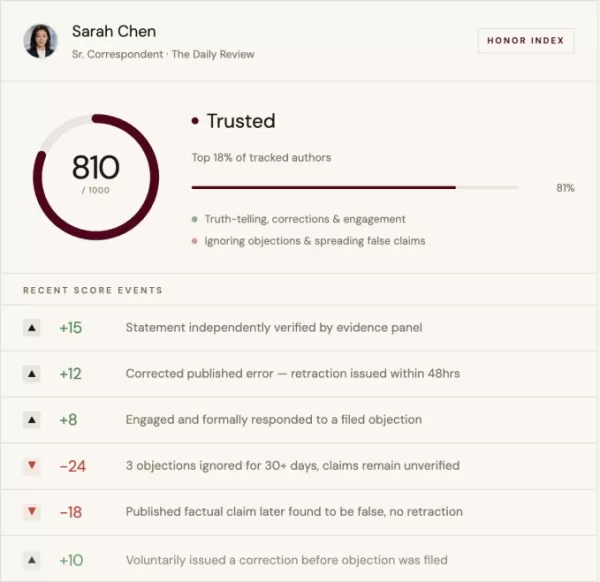
Image Credits:Objection AI
D’Souza argues that relying solely on unverified, fully anonymous sources lowers a story’s evidence and trust score on Objection. The platform prioritizes primary records, such as regulatory filings and official emails, while ranking anonymous whistleblower claims near the bottom. Freelancers, including former law enforcement agents and investigative journalists, gather these inputs, which feed into the “Honor Index”—a numerical score reflecting a reporter’s integrity, accuracy, and track record.
“Protecting a source’s identity is vital for telling important stories, but it creates a significant power imbalance,” D’Souza told TechCrunch in an exclusive interview. “The subject is reported on, yet there is no mechanism to critique the source.”

Image Credits:Objection AI
Even when Objection finds no issues with a story, its companion feature, “Fire Blanket,” can still cast doubt on its credibility. Active on X via platform APIs, this tool flags disputed claims in real time by posting warnings, effectively injecting “under investigation” labels into public discourse while claims remain under review.
Eugene Volokh, a First Amendment scholar at UCLA, stated that the platform itself likely does not violate free speech protections, viewing it as part of the broader ecosystem of criticism surrounding journalism. He compared the concept to opposition research targeting reporters rather than politicians, dismissing concerns about a chilling effect on whistleblowers.
“All criticism creates a chilling effect,” he told TechCrunch.
The platform’s impact—whether widely adopted or ignored—will determine if Objection reshapes journalism or fades into the growing array of tools attempting to do so.
As Kirtley noted: “Why assume AI provides more reliable information about truth or falsity than a journalist who has researched and written the story? I wouldn’t make that assumption at all.”
Editor’s note: Given D’Souza’s focus on transparency and accountability, we have published a link to the full transcript, edited lightly for length and clarity.
Related article
 Former Infosys Chief’s AI Startup Secures Another $53M
Hang Ten Systems, an AI startup established by former Infosys CEO Vishal Sikka just four months ago, has secured an additional $53 million in seed funding. This latest investment round was finalized merely five weeks after the initial $32 million see
Crypto exchange OKX aims to empower AI agents to hire and pay each other
As AI agents start serving individuals and collaborating with each other, they require mechanisms to locate tasks, compensate for services, and establish credibility. Crypto exchange OKX anticipates this future is arriving sooner than anticipated, in
Prentis, New AI Lab Co-Founded by Reid Hoffman and Marc Pincus, in Talks to Raise $100M
Prentis, an emerging AI research lab specializing in computer-use models, is co-founded by serial entrepreneur Ritankar Das alongside tech industry leaders Reid Hoffman and Marc Pincus. According to two individuals familiar with the matter, the compa
Related Special Topic Recommendations
Image editing
Former Infosys Chief’s AI Startup Secures Another $53M
Hang Ten Systems, an AI startup established by former Infosys CEO Vishal Sikka just four months ago, has secured an additional $53 million in seed funding. This latest investment round was finalized merely five weeks after the initial $32 million see
Crypto exchange OKX aims to empower AI agents to hire and pay each other
As AI agents start serving individuals and collaborating with each other, they require mechanisms to locate tasks, compensate for services, and establish credibility. Crypto exchange OKX anticipates this future is arriving sooner than anticipated, in
Prentis, New AI Lab Co-Founded by Reid Hoffman and Marc Pincus, in Talks to Raise $100M
Prentis, an emerging AI research lab specializing in computer-use models, is co-founded by serial entrepreneur Ritankar Das alongside tech industry leaders Reid Hoffman and Marc Pincus. According to two individuals familiar with the matter, the compa
Related Special Topic Recommendations
Image editing
 AI Object Removal Editors: Clean Up Portraits, Travel, and Product Shots
2026 Latest Best Top-rated AI Object Removal Editors for portraits travel product shots! XIX.AI curates a powerful game-changing collection regularly updated with weekly rankings. These tools offer real-world tests to help you quickly remove unwanted elements, boost content quality, and save tons of time without compromising results. Must-try for anyone aiming to unlock their AI creation edge. Explore now!
 10 tools
 xix.ai
Text-to-speech
Best AI Text to Speech Tools for Online Courses
xix.ai
Text-to-speech
Best AI Text to Speech Tools for Online Courses
2026 Latest Best Top-rated AI Text to Speech Tools for Online Courses are curated by XIX.AI based on rigorous real-world tests and weekly updated rankings. These powerful tools help creators deliver crystal-clear audio content effortlessly, boosting writing efficiency and streamlining course production. Check out the free vs paid comparison to find your perfect fit. Explore now to unlock your AI edge in online education.
10 tools
xix.ai
writing
AI Blog Title Tools for Higher Click Through Rates
2026 Latest Best Top-Rated AI Blog Title Tools for Higher Click Through Rates! XIX.AI has carefully curated a powerful, game-changing collection of top tools that go through rigorous real-world tests. You’ll find a free vs paid comparison, weekly updated rankings, and detailed insights to help you boost your blog’s traffic efficiently. Must-try options are highlighted to help you unlock your AI edge. Explore now!
10 tools
xix.ai
automation
Best AI Task Routing Tools for Support Workflows
2026 Latest Best Top-rated AI Task Routing Tools for Support Workflows! XIX.AI has curated a highly powerful game-changing collection of must-try solutions, all undergoing rigorous real-world tests and updated weekly. These tools streamline workflows, boost productivity, and help teams deliver faster, more efficient support. Explore now to discover your perfect tool and unlock your AI edge!
17 tools
xix.ai
Academic Research
AI Citation and Paper Summary Tools
2026 Latest Best Top-Rated AI Citation and Paper Summary Tools Curated by XIX.AI. Get powerful game-changing solutions for quick content creation, improved writing efficiency, and boosting productivity. We offer a free vs paid comparison along with real-world tests and weekly updated rankings to help you find the must-try tool that fits your needs perfectly. Explore now to Unlock your AI edge.
10 tools
xix.ai
Productivity
Best AI Productivity Tools for Daily Work
2026 Latest Best Top-Rated AI Productivity Tools for Daily Work! XIX.AI has curated a powerful, game-changing selection based on rigorous weekly updated rankings and real-world tests. You’ll find must-try options that boost writing efficiency, streamline content creation, and help you overcome daily work challenges. Get a free vs paid comparison to find the perfect fit for your needs. Explore now to unlock your AI edge!
9 tools
xix.ai

 Comments (0)
0/500
Comments (0)
0/500
Following his role in the lawsuit that led to Gawker’s bankruptcy, Aron D’Souza identified a critical flaw in the American media landscape: individuals harmed by coverage lacked effective means to respond.
His answer is technology. D’Souza’s new venture, Objection, utilizes AI to evaluate journalistic accuracy. For a fee of $2,000, users can challenge a story, initiating a public review of its claims. (D’Souza also founded the Enhanced Games, an Olympic-style event permitting performance-enhancing drugs, launching in Las Vegas next month.)
Objection launched Wednesday with multi-million dollar seed funding from Peter Thiel, Balaji Srinivasan, Social Impact Capital, and Off Piste Capital.
Thiel, who partially funded the Gawker lawsuit to protect individual privacy, has long criticized mainstream media. D’Souza aims to restore trust in the Fourth Estate, arguing it has eroded over decades. However, critics, including media attorneys, warn Objection could hinder reporting on powerful institutions, especially when relying on confidential sources.
Anonymous sources have been instrumental in award-winning investigations into corruption and corporate misconduct. These individuals often face job loss or retaliation for sharing critical information. Journalists, alongside editors, peers, and legal counsel, are responsible for verifying source reliability and ensuring the information is not driven by malice.
Image Credits:Objection AI
D’Souza argues that relying solely on unverified, fully anonymous sources lowers a story’s evidence and trust score on Objection. The platform prioritizes primary records, such as regulatory filings and official emails, while ranking anonymous whistleblower claims near the bottom. Freelancers, including former law enforcement agents and investigative journalists, gather these inputs, which feed into the “Honor Index”—a numerical score reflecting a reporter’s integrity, accuracy, and track record.
“Protecting a source’s identity is vital for telling important stories, but it creates a significant power imbalance,” D’Souza told TechCrunch in an exclusive interview. “The subject is reported on, yet there is no mechanism to critique the source.”
Image Credits:Objection AI
Even when Objection finds no issues with a story, its companion feature, “Fire Blanket,” can still cast doubt on its credibility. Active on X via platform APIs, this tool flags disputed claims in real time by posting warnings, effectively injecting “under investigation” labels into public discourse while claims remain under review.
Eugene Volokh, a First Amendment scholar at UCLA, stated that the platform itself likely does not violate free speech protections, viewing it as part of the broader ecosystem of criticism surrounding journalism. He compared the concept to opposition research targeting reporters rather than politicians, dismissing concerns about a chilling effect on whistleblowers.
“All criticism creates a chilling effect,” he told TechCrunch.
The platform’s impact—whether widely adopted or ignored—will determine if Objection reshapes journalism or fades into the growing array of tools attempting to do so.
As Kirtley noted: “Why assume AI provides more reliable information about truth or falsity than a journalist who has researched and written the story? I wouldn’t make that assumption at all.”
Editor’s note: Given D’Souza’s focus on transparency and accountability, we have published a link to the full transcript, edited lightly for length and clarity.








 Former Infosys Chief’s AI Startup Secures Another $53M
Hang Ten Systems, an AI startup established by former Infosys CEO Vishal Sikka just four months ago, has secured an additional $53 million in seed funding. This latest investment round was finalized merely five weeks after the initial $32 million see
Former Infosys Chief’s AI Startup Secures Another $53M
Hang Ten Systems, an AI startup established by former Infosys CEO Vishal Sikka just four months ago, has secured an additional $53 million in seed funding. This latest investment round was finalized merely five weeks after the initial $32 million see
 Crypto exchange OKX aims to empower AI agents to hire and pay each other
As AI agents start serving individuals and collaborating with each other, they require mechanisms to locate tasks, compensate for services, and establish credibility. Crypto exchange OKX anticipates this future is arriving sooner than anticipated, in
Crypto exchange OKX aims to empower AI agents to hire and pay each other
As AI agents start serving individuals and collaborating with each other, they require mechanisms to locate tasks, compensate for services, and establish credibility. Crypto exchange OKX anticipates this future is arriving sooner than anticipated, in
 Prentis, New AI Lab Co-Founded by Reid Hoffman and Marc Pincus, in Talks to Raise $100M
Prentis, an emerging AI research lab specializing in computer-use models, is co-founded by serial entrepreneur Ritankar Das alongside tech industry leaders Reid Hoffman and Marc Pincus. According to two individuals familiar with the matter, the compa
Prentis, New AI Lab Co-Founded by Reid Hoffman and Marc Pincus, in Talks to Raise $100M
Prentis, an emerging AI research lab specializing in computer-use models, is co-founded by serial entrepreneur Ritankar Das alongside tech industry leaders Reid Hoffman and Marc Pincus. According to two individuals familiar with the matter, the compa
2026 Latest Best Top-rated AI Object Removal Editors for portraits travel product shots! XIX.AI curates a powerful game-changing collection regularly updated with weekly rankings. These tools offer real-world tests to help you quickly remove unwanted elements, boost content quality, and save tons of time without compromising results. Must-try for anyone aiming to unlock their AI creation edge. Explore now!
10 tools
xix.ai

2026 Latest Best Top-rated AI Text to Speech Tools for Online Courses are curated by XIX.AI based on rigorous real-world tests and weekly updated rankings. These powerful tools help creators deliver crystal-clear audio content effortlessly, boosting writing efficiency and streamlining course production. Check out the free vs paid comparison to find your perfect fit. Explore now to unlock your AI edge in online education.
10 tools
xix.ai

2026 Latest Best Top-Rated AI Blog Title Tools for Higher Click Through Rates! XIX.AI has carefully curated a powerful, game-changing collection of top tools that go through rigorous real-world tests. You’ll find a free vs paid comparison, weekly updated rankings, and detailed insights to help you boost your blog’s traffic efficiently. Must-try options are highlighted to help you unlock your AI edge. Explore now!
10 tools
xix.ai

2026 Latest Best Top-rated AI Task Routing Tools for Support Workflows! XIX.AI has curated a highly powerful game-changing collection of must-try solutions, all undergoing rigorous real-world tests and updated weekly. These tools streamline workflows, boost productivity, and help teams deliver faster, more efficient support. Explore now to discover your perfect tool and unlock your AI edge!
17 tools
xix.ai
2026 Latest Best Top-Rated AI Citation and Paper Summary Tools Curated by XIX.AI. Get powerful game-changing solutions for quick content creation, improved writing efficiency, and boosting productivity. We offer a free vs paid comparison along with real-world tests and weekly updated rankings to help you find the must-try tool that fits your needs perfectly. Explore now to Unlock your AI edge.
10 tools
xix.ai
2026 Latest Best Top-Rated AI Productivity Tools for Daily Work! XIX.AI has curated a powerful, game-changing selection based on rigorous weekly updated rankings and real-world tests. You’ll find must-try options that boost writing efficiency, streamline content creation, and help you overcome daily work challenges. Get a free vs paid comparison to find the perfect fit for your needs. Explore now to unlock your AI edge!
9 tools
xix.ai












