


 Home
HomeNeurable moves to license its 'mind-reading' tech for consumer wearables
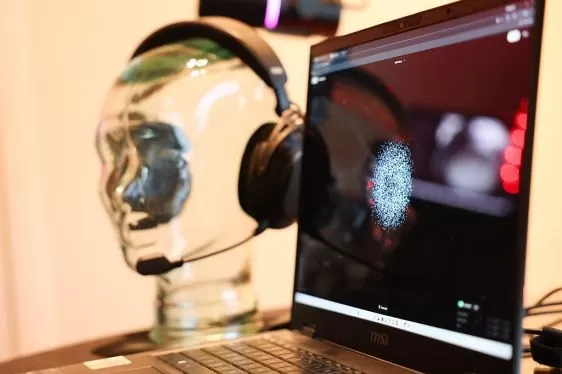
BCI (brain-computer interface) technology, which routes neural signals from a person’s head to a computer, once belonged to science fiction. Today, it represents a fiercely competitive sector in the tech industry. Among the companies racing to commercialize BCI is Neurable, which recently announced plans to license its “mind-reading” technology to consumer wearables.
Neurable specializes in non-invasive BCI, setting it apart from firms like Neuralink—the Elon Musk-founded startup known for implanting computer chips directly into human skulls. Unlike Neuralink, Neurable’s product does not require users to undergo brain surgery to benefit from it.
Neurable’s technology combines EEG sensors and signal processing to scan brain activity, analyze it with AI, and deliver insights into a person’s cognitive performance.
In December, Neurable raised $35 million in a Series A round, which it plans to use to scale commercialization. This week, the company announced it is seeking to license its technology to a range of consumer-facing companies as part of its expansion efforts.
The idea is that mind-reading technology—which can provide detailed data on how a person’s brain functions during various activities—could be integrated into wearables across multiple industries, including health and athletic products, productivity tools, and gaming. “Through Neurable’s licensing platform, OEMs can directly integrate its AI-powered brain-sensing technology into existing hardware, such as headphones, hats, glasses, and headbands, while maintaining full control over product design, user experience, and distribution,” the company stated in a Tuesday press release.
Neurable has already partnered with several companies to test its effectiveness. This includes HP Inc.’s HyperX, a gaming brand, with which it created a headset designed to help gamers “level up their game play by optimizing focus and performance.” It has also partnered with iMotions, a software platform specializing in human behavior research, to support the company’s research initiatives.
In an interview, Neurable’s CEO Ramses Alcaide declined to disclose new partnerships in the works but said the company is looking to expand its reach across a wide range of domains.
“In the past, we were very specific about our partnerships,” Alcaide said, noting that Neurable tended to focus on one company at a time to prove that a unique commercial application was worthwhile. Now that they know expectations can be met on multiple fronts, the startup is focused on scaling, he added.
“What we’re doing now is we’re basically saying, ‘Hey, we’ve demonstrated that we’re getting great traction,’” Alcaide said. “Let’s make this as ubiquitous as heart rate sensors on your wrist, right?”
Despite the “non-invasive” label, brain data is arguably more intimate than information from a heart rate sensor. So what kind of privacy protections does a company like Neurable provide?
Alcaide said the company ensures user data is “protected and anonymized.” Neurable’s privacy policy outlines various guidelines for when and how user data may be accessed and used. “We make sure we follow HIPAA standards—we’ve gone above and beyond where a lot of startups would be at our stage to make sure that we protect the data, we encrypt it, and that we anonymize it,” Alcaide said.
Does Neurable leverage a user’s neural data to train its AI software? “We can with user consent, right?” Alcaide said. “But we do it in a very specific way.” That specific way involves asking the user whether their data can be used for particular experiments, Alcaide explained. “We are not collecting the data, just training on it willy nilly,” he said. In other words, this kind of data usage is quite targeted.
Alcaide said the industry is at an “inflection point”—one where there finally exists “a real business model in neuro-technology that is scalable.” What comes after that inflection point is the big question.
Related article
 Google Tests Remy AI Agent for Gemini as Focus Shifts to User Control
According to Business Insider, Google is testing Remy, a new AI personal agent for Gemini. This tool aims to execute tasks on behalf of users, streamlining both professional workflows and daily routines.Currently, Remy is undergoing testing in an int
Ollie bets privacy focus to win AI assistant race
To be genuinely helpful, an AI assistant must understand its user deeply. Ollie, a personal assistant designed for daily life, operates on the premise that this doesn’t require surrendering your data or compromising your privacy.While certain enterpr
How AI LIVE: London Will Explore AI & Industrial Automation
The summit will convene C-suite executives from around the globe to address pressing challenges in global industries, ranging from AI-driven disruption to economic volatility.AI LIVE: The London Summit will gather over 2,000 international leaders und
Related Special Topic Recommendations
Design & Art
Google Tests Remy AI Agent for Gemini as Focus Shifts to User Control
According to Business Insider, Google is testing Remy, a new AI personal agent for Gemini. This tool aims to execute tasks on behalf of users, streamlining both professional workflows and daily routines.Currently, Remy is undergoing testing in an int
Ollie bets privacy focus to win AI assistant race
To be genuinely helpful, an AI assistant must understand its user deeply. Ollie, a personal assistant designed for daily life, operates on the premise that this doesn’t require surrendering your data or compromising your privacy.While certain enterpr
How AI LIVE: London Will Explore AI & Industrial Automation
The summit will convene C-suite executives from around the globe to address pressing challenges in global industries, ranging from AI-driven disruption to economic volatility.AI LIVE: The London Summit will gather over 2,000 international leaders und
Related Special Topic Recommendations
Design & Art
 AI Visual Style Reference Tools for Character Sheets, Moodboards, and Pitch Decks
2026 Latest Best AI Visual Style Reference Tools for Character Sheets, Moodboards, and Pitch Decks are here on XIX.AI! This curated top-rated list features powerful game-changing tools that go through rigorous real-world tests. You’ll find a free vs paid comparison, detailed rankings, and must-try options to help you boost creativity and streamline your workflow. Explore now to discover your perfect tool for boosting productivity!
 11 tools
 xix.ai
SEO
Best AI SERP Analysis Tools for Search Strategy
xix.ai
SEO
Best AI SERP Analysis Tools for Search Strategy
2026 Latest Best Top-rated AI SERP Analysis Tools for Search Strategy are curated by XIX.AI through rigorous real-world tests and weekly updated rankings. These powerful tools help you unlock hidden optimization opportunities, boost content performance, and gain a competitive edge in search. Discover your perfect tool to elevate your search strategy today. Explore now!
13 tools
xix.ai
Data Analysis
Best AI Anomaly Detection Tools for KPI Monitoring across SaaS and Ecommerce Teams
2026 Latest Best Top-rated AI Anomaly Detection Tools for KPI Monitoring in SaaS and Ecommerce teams! XIX.AI has curated a powerful, game-changing collection based on rigorous real-world tests and weekly updated rankings. You’ll find detailed free vs paid comparison insights to help you identify the must-try solution that boosts productivity and unlocks your AI edge. Explore now!
10 tools
xix.ai
writing
Best AI Outline Generators for Long-Form SEO Articles
2026 Latest Best Top-Rated AI Outline Generators for Long-Form SEO Articles, meticulously curated by XIX.AI. These powerful tools offer game-changing assistance in creating high-quality content quickly, boosting writing efficiency significantly. Get a free vs paid comparison along with real-world tests and detailed rankings to help you find the must-try option that suits your needs. Explore now to unlock your AI edge.
8 tools
xix.ai
Education and Learning
AI Study Tools for Homework and Exam Prep
2026 Latest Best AI Study Tools for Homework and Exam Prep! XIX.AI curates a top-rated list of powerful, game-changing tools that help students boost productivity, streamline homework completion, and ace exams through real-world tests. Get a free vs paid comparison, detailed rankings, and must-try options to unlock your AI edge. Explore now!
10 tools
xix.ai
Music composition
AI Vocal Demo Tools for Songwriters, Hooks, Toplines, and Multilingual Draft Sessions
2026 Latest Best AI Vocal Demo Tools for Songwriters, Hook Creators, and Multi-Language Content Teams! XIX.AI has curated a top-rated list of powerful game-changing tools that go through rigorous real-world tests. You’ll find detailed free vs paid comparison data, comprehensive rankings, and must-try options to help you boost writing efficiency and unlock your creative potential. Explore now to discover your perfect tool for all your content needs!
9 tools
xix.ai

 Comments (1)
0/500
Comments (1)
0/500
![JasonHarris]()
Neurable licensing BCI tech? Finally, maybe we'll see non-medical brain interfaces in everyday wearables. Though I'm still skeptical about privacy risks with neural data being commodified. 🧠💻
BCI (brain-computer interface) technology, which routes neural signals from a person’s head to a computer, once belonged to science fiction. Today, it represents a fiercely competitive sector in the tech industry. Among the companies racing to commercialize BCI is Neurable, which recently announced plans to license its “mind-reading” technology to consumer wearables.
Neurable specializes in non-invasive BCI, setting it apart from firms like Neuralink—the Elon Musk-founded startup known for implanting computer chips directly into human skulls. Unlike Neuralink, Neurable’s product does not require users to undergo brain surgery to benefit from it.
Neurable’s technology combines EEG sensors and signal processing to scan brain activity, analyze it with AI, and deliver insights into a person’s cognitive performance.
In December, Neurable raised $35 million in a Series A round, which it plans to use to scale commercialization. This week, the company announced it is seeking to license its technology to a range of consumer-facing companies as part of its expansion efforts.
The idea is that mind-reading technology—which can provide detailed data on how a person’s brain functions during various activities—could be integrated into wearables across multiple industries, including health and athletic products, productivity tools, and gaming. “Through Neurable’s licensing platform, OEMs can directly integrate its AI-powered brain-sensing technology into existing hardware, such as headphones, hats, glasses, and headbands, while maintaining full control over product design, user experience, and distribution,” the company stated in a Tuesday press release.
Neurable has already partnered with several companies to test its effectiveness. This includes HP Inc.’s HyperX, a gaming brand, with which it created a headset designed to help gamers “level up their game play by optimizing focus and performance.” It has also partnered with iMotions, a software platform specializing in human behavior research, to support the company’s research initiatives.
In an interview, Neurable’s CEO Ramses Alcaide declined to disclose new partnerships in the works but said the company is looking to expand its reach across a wide range of domains.
“In the past, we were very specific about our partnerships,” Alcaide said, noting that Neurable tended to focus on one company at a time to prove that a unique commercial application was worthwhile. Now that they know expectations can be met on multiple fronts, the startup is focused on scaling, he added.
“What we’re doing now is we’re basically saying, ‘Hey, we’ve demonstrated that we’re getting great traction,’” Alcaide said. “Let’s make this as ubiquitous as heart rate sensors on your wrist, right?”
Despite the “non-invasive” label, brain data is arguably more intimate than information from a heart rate sensor. So what kind of privacy protections does a company like Neurable provide?
Alcaide said the company ensures user data is “protected and anonymized.” Neurable’s privacy policy outlines various guidelines for when and how user data may be accessed and used. “We make sure we follow HIPAA standards—we’ve gone above and beyond where a lot of startups would be at our stage to make sure that we protect the data, we encrypt it, and that we anonymize it,” Alcaide said.
Does Neurable leverage a user’s neural data to train its AI software? “We can with user consent, right?” Alcaide said. “But we do it in a very specific way.” That specific way involves asking the user whether their data can be used for particular experiments, Alcaide explained. “We are not collecting the data, just training on it willy nilly,” he said. In other words, this kind of data usage is quite targeted.
Alcaide said the industry is at an “inflection point”—one where there finally exists “a real business model in neuro-technology that is scalable.” What comes after that inflection point is the big question.







 Google Tests Remy AI Agent for Gemini as Focus Shifts to User Control
According to Business Insider, Google is testing Remy, a new AI personal agent for Gemini. This tool aims to execute tasks on behalf of users, streamlining both professional workflows and daily routines.Currently, Remy is undergoing testing in an int
Google Tests Remy AI Agent for Gemini as Focus Shifts to User Control
According to Business Insider, Google is testing Remy, a new AI personal agent for Gemini. This tool aims to execute tasks on behalf of users, streamlining both professional workflows and daily routines.Currently, Remy is undergoing testing in an int
 Ollie bets privacy focus to win AI assistant race
To be genuinely helpful, an AI assistant must understand its user deeply. Ollie, a personal assistant designed for daily life, operates on the premise that this doesn’t require surrendering your data or compromising your privacy.While certain enterpr
Ollie bets privacy focus to win AI assistant race
To be genuinely helpful, an AI assistant must understand its user deeply. Ollie, a personal assistant designed for daily life, operates on the premise that this doesn’t require surrendering your data or compromising your privacy.While certain enterpr
 How AI LIVE: London Will Explore AI & Industrial Automation
The summit will convene C-suite executives from around the globe to address pressing challenges in global industries, ranging from AI-driven disruption to economic volatility.AI LIVE: The London Summit will gather over 2,000 international leaders und
How AI LIVE: London Will Explore AI & Industrial Automation
The summit will convene C-suite executives from around the globe to address pressing challenges in global industries, ranging from AI-driven disruption to economic volatility.AI LIVE: The London Summit will gather over 2,000 international leaders und

2026 Latest Best AI Visual Style Reference Tools for Character Sheets, Moodboards, and Pitch Decks are here on XIX.AI! This curated top-rated list features powerful game-changing tools that go through rigorous real-world tests. You’ll find a free vs paid comparison, detailed rankings, and must-try options to help you boost creativity and streamline your workflow. Explore now to discover your perfect tool for boosting productivity!
11 tools
xix.ai

2026 Latest Best Top-rated AI SERP Analysis Tools for Search Strategy are curated by XIX.AI through rigorous real-world tests and weekly updated rankings. These powerful tools help you unlock hidden optimization opportunities, boost content performance, and gain a competitive edge in search. Discover your perfect tool to elevate your search strategy today. Explore now!
13 tools
xix.ai

2026 Latest Best Top-rated AI Anomaly Detection Tools for KPI Monitoring in SaaS and Ecommerce teams! XIX.AI has curated a powerful, game-changing collection based on rigorous real-world tests and weekly updated rankings. You’ll find detailed free vs paid comparison insights to help you identify the must-try solution that boosts productivity and unlocks your AI edge. Explore now!
10 tools
xix.ai

2026 Latest Best Top-Rated AI Outline Generators for Long-Form SEO Articles, meticulously curated by XIX.AI. These powerful tools offer game-changing assistance in creating high-quality content quickly, boosting writing efficiency significantly. Get a free vs paid comparison along with real-world tests and detailed rankings to help you find the must-try option that suits your needs. Explore now to unlock your AI edge.
8 tools
xix.ai

2026 Latest Best AI Study Tools for Homework and Exam Prep! XIX.AI curates a top-rated list of powerful, game-changing tools that help students boost productivity, streamline homework completion, and ace exams through real-world tests. Get a free vs paid comparison, detailed rankings, and must-try options to unlock your AI edge. Explore now!
10 tools
xix.ai

2026 Latest Best AI Vocal Demo Tools for Songwriters, Hook Creators, and Multi-Language Content Teams! XIX.AI has curated a top-rated list of powerful game-changing tools that go through rigorous real-world tests. You’ll find detailed free vs paid comparison data, comprehensive rankings, and must-try options to help you boost writing efficiency and unlock your creative potential. Explore now to discover your perfect tool for all your content needs!
9 tools
xix.ai

Neurable licensing BCI tech? Finally, maybe we'll see non-medical brain interfaces in everyday wearables. Though I'm still skeptical about privacy risks with neural data being commodified. 🧠💻












