


 Home
HomeHumanX Conference Buzz Centers on Claude

At the HumanX AI conference in San Francisco this week, thousands of tech professionals gathered at the Moscone Center, where the conversation centered on how agentic AI is transforming the business landscape. These agents, which automate business and coding tasks, are now being deployed across industries—primarily through enterprise and consumer chatbots.
Unsurprisingly, I was curious which chatbot had the most traction, and one name kept coming up: Claude.
Anthropic received numerous mentions in panels throughout the week, and it also came up in conversations with vendors I spoke to on the convention floor. The chatbot that barely got a mention? ChatGPT. One vendor specifically told me his team relied heavily on Claude, adding that he felt ChatGPT and OpenAI had declined—or, as the internet puts it, “fell off.”
Recently, that sentiment seems far from unique. Despite a recent $122 billion funding round and an upcoming IPO, OpenAI appears to have lost its footing—or at least seems uncertain about its next move—and it's unclear how to change that perception.
A contributing factor might be the perception that the company lacks direction. Last month, OpenAI dropped several long-simmering side projects—including its AI video generator Sora and a troubled plan to launch a “sexy” version of ChatGPT—and instead doubled down on business and coding services. Meanwhile, a recent New Yorker piece questioning CEO Sam Altman's trustworthiness, along with other developments, has generated negative buzz around the company. Its work with the Trump administration hasn’t won it any friends either, nor has the decision to inject advertising into ChatGPT.
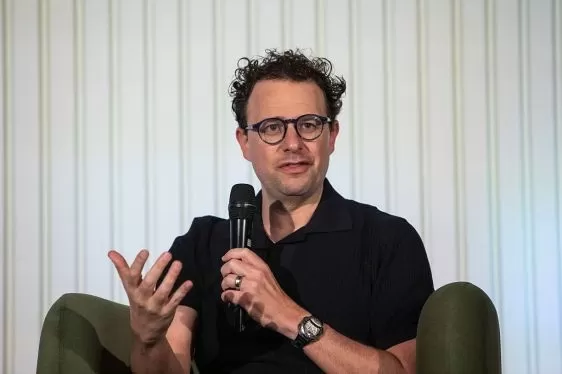
In one HumanX session, Sierra co-founder and CEO Bret Taylor—who also chairs OpenAI’s board—defended Altman when Alex Heath asked about the New Yorker profile. “I think Sam is one of the most visible leaders and executives in the world,” said Taylor. “If you want to seek out detractors for him, you’ll find them, and they’ll be very vocal about it,” he added. “I think Sam’s remarkable. I think he’s a remarkable leader of AI, and I really trust his character as someone who’s worked with him.”
The controversies and shifting priorities make OpenAI appear reactive rather than strategic—responding to events instead of shaping them. However, in terms of prominence and revenue, OpenAI and Anthropic are neck and neck—or close to it. Some data suggests Anthropic is gaining ground with business users. The Wall Street Journal recently analyzed their finances, calling the two companies “the fastest-growing businesses in the history of tech.” So maybe “falling off” for OpenAI simply means it’s no longer the undisputed leader. It now has competition—which is normal in most industries.
What’s clear is that OpenAI is determined to stay dominant. This week, the company announced a new $100 subscription tier for ChatGPT that offers substantially more access to Codex, its coding tool. The move appears aimed at encouraging broader usage of the tool while ideally drawing users away from Claude Code.
In a HumanX panel with Bloomberg’s Rachel Metz, OpenAI’s CTO of B2B applications, Srinivas Narayanan, noted how quickly the technological landscape has been changing.
“We are in an incredible moment in technology—every month, sometimes every day, we anticipate something new,” Narayanan said. Pointing to agentic coding as an example, he added, “We knew AI would impact software engineering, and people have used assistive coding over the past year, but even in just the last few months, the entire field has changed.”
Agentic achievements currently dominate tech community attention, partly because other AI applications—like creative and scientific uses—haven’t fully materialized yet. Still, the volume of work companies are offloading to these automated helpers is surprising—and, as Narayanan noted, it’s all happened in a relatively short time. In such an unpredictable environment, the future remains wide open.
Related article
 Ollie bets privacy focus to win AI assistant race
To be genuinely helpful, an AI assistant must understand its user deeply. Ollie, a personal assistant designed for daily life, operates on the premise that this doesn’t require surrendering your data or compromising your privacy.While certain enterpr
How AI LIVE: London Will Explore AI & Industrial Automation
The summit will convene C-suite executives from around the globe to address pressing challenges in global industries, ranging from AI-driven disruption to economic volatility.AI LIVE: The London Summit will gather over 2,000 international leaders und
Anthropic Enters AI Legal Tech Market as Competition Intensifies
Anthropic unveiled a suite of new chatbot capabilities on Tuesday, aimed at delivering automated support to legal practices. These enhancements expand upon Claude for Legal, the firm-specific platform introduced earlier this year, by adding specializ
Related Special Topic Recommendations
Image editing
Ollie bets privacy focus to win AI assistant race
To be genuinely helpful, an AI assistant must understand its user deeply. Ollie, a personal assistant designed for daily life, operates on the premise that this doesn’t require surrendering your data or compromising your privacy.While certain enterpr
How AI LIVE: London Will Explore AI & Industrial Automation
The summit will convene C-suite executives from around the globe to address pressing challenges in global industries, ranging from AI-driven disruption to economic volatility.AI LIVE: The London Summit will gather over 2,000 international leaders und
Anthropic Enters AI Legal Tech Market as Competition Intensifies
Anthropic unveiled a suite of new chatbot capabilities on Tuesday, aimed at delivering automated support to legal practices. These enhancements expand upon Claude for Legal, the firm-specific platform introduced earlier this year, by adding specializ
Related Special Topic Recommendations
Image editing
 AI Object Removal Editors: Clean Up Portraits, Travel, and Product Shots
2026 Latest Best Top-rated AI Object Removal Editors for portraits travel product shots! XIX.AI curates a powerful game-changing collection regularly updated with weekly rankings. These tools offer real-world tests to help you quickly remove unwanted elements, boost content quality, and save tons of time without compromising results. Must-try for anyone aiming to unlock their AI creation edge. Explore now!
 10 tools
 xix.ai
Text-to-speech
Best AI Text to Speech Tools for Online Courses
xix.ai
Text-to-speech
Best AI Text to Speech Tools for Online Courses
2026 Latest Best Top-rated AI Text to Speech Tools for Online Courses are curated by XIX.AI based on rigorous real-world tests and weekly updated rankings. These powerful tools help creators deliver crystal-clear audio content effortlessly, boosting writing efficiency and streamlining course production. Check out the free vs paid comparison to find your perfect fit. Explore now to unlock your AI edge in online education.
10 tools
xix.ai
writing
AI Blog Title Tools for Higher Click Through Rates
2026 Latest Best Top-Rated AI Blog Title Tools for Higher Click Through Rates! XIX.AI has carefully curated a powerful, game-changing collection of top tools that go through rigorous real-world tests. You’ll find a free vs paid comparison, weekly updated rankings, and detailed insights to help you boost your blog’s traffic efficiently. Must-try options are highlighted to help you unlock your AI edge. Explore now!
10 tools
xix.ai
automation
Best AI Task Routing Tools for Support Workflows
2026 Latest Best Top-rated AI Task Routing Tools for Support Workflows! XIX.AI has curated a highly powerful game-changing collection of must-try solutions, all undergoing rigorous real-world tests and updated weekly. These tools streamline workflows, boost productivity, and help teams deliver faster, more efficient support. Explore now to discover your perfect tool and unlock your AI edge!
17 tools
xix.ai
Academic Research
AI Citation and Paper Summary Tools
2026 Latest Best Top-Rated AI Citation and Paper Summary Tools Curated by XIX.AI. Get powerful game-changing solutions for quick content creation, improved writing efficiency, and boosting productivity. We offer a free vs paid comparison along with real-world tests and weekly updated rankings to help you find the must-try tool that fits your needs perfectly. Explore now to Unlock your AI edge.
10 tools
xix.ai
Productivity
Best AI Productivity Tools for Daily Work
2026 Latest Best Top-Rated AI Productivity Tools for Daily Work! XIX.AI has curated a powerful, game-changing selection based on rigorous weekly updated rankings and real-world tests. You’ll find must-try options that boost writing efficiency, streamline content creation, and help you overcome daily work challenges. Get a free vs paid comparison to find the perfect fit for your needs. Explore now to unlock your AI edge!
9 tools
xix.ai

 Comments (0)
0/500
Comments (0)
0/500
At the HumanX AI conference in San Francisco this week, thousands of tech professionals gathered at the Moscone Center, where the conversation centered on how agentic AI is transforming the business landscape. These agents, which automate business and coding tasks, are now being deployed across industries—primarily through enterprise and consumer chatbots.
Unsurprisingly, I was curious which chatbot had the most traction, and one name kept coming up: Claude.
Anthropic received numerous mentions in panels throughout the week, and it also came up in conversations with vendors I spoke to on the convention floor. The chatbot that barely got a mention? ChatGPT. One vendor specifically told me his team relied heavily on Claude, adding that he felt ChatGPT and OpenAI had declined—or, as the internet puts it, “fell off.”
Recently, that sentiment seems far from unique. Despite a recent $122 billion funding round and an upcoming IPO, OpenAI appears to have lost its footing—or at least seems uncertain about its next move—and it's unclear how to change that perception.
A contributing factor might be the perception that the company lacks direction. Last month, OpenAI dropped several long-simmering side projects—including its AI video generator Sora and a troubled plan to launch a “sexy” version of ChatGPT—and instead doubled down on business and coding services. Meanwhile, a recent New Yorker piece questioning CEO Sam Altman's trustworthiness, along with other developments, has generated negative buzz around the company. Its work with the Trump administration hasn’t won it any friends either, nor has the decision to inject advertising into ChatGPT.
In one HumanX session, Sierra co-founder and CEO Bret Taylor—who also chairs OpenAI’s board—defended Altman when Alex Heath asked about the New Yorker profile. “I think Sam is one of the most visible leaders and executives in the world,” said Taylor. “If you want to seek out detractors for him, you’ll find them, and they’ll be very vocal about it,” he added. “I think Sam’s remarkable. I think he’s a remarkable leader of AI, and I really trust his character as someone who’s worked with him.”
The controversies and shifting priorities make OpenAI appear reactive rather than strategic—responding to events instead of shaping them. However, in terms of prominence and revenue, OpenAI and Anthropic are neck and neck—or close to it. Some data suggests Anthropic is gaining ground with business users. The Wall Street Journal recently analyzed their finances, calling the two companies “the fastest-growing businesses in the history of tech.” So maybe “falling off” for OpenAI simply means it’s no longer the undisputed leader. It now has competition—which is normal in most industries.
What’s clear is that OpenAI is determined to stay dominant. This week, the company announced a new $100 subscription tier for ChatGPT that offers substantially more access to Codex, its coding tool. The move appears aimed at encouraging broader usage of the tool while ideally drawing users away from Claude Code.
In a HumanX panel with Bloomberg’s Rachel Metz, OpenAI’s CTO of B2B applications, Srinivas Narayanan, noted how quickly the technological landscape has been changing.
“We are in an incredible moment in technology—every month, sometimes every day, we anticipate something new,” Narayanan said. Pointing to agentic coding as an example, he added, “We knew AI would impact software engineering, and people have used assistive coding over the past year, but even in just the last few months, the entire field has changed.”
Agentic achievements currently dominate tech community attention, partly because other AI applications—like creative and scientific uses—haven’t fully materialized yet. Still, the volume of work companies are offloading to these automated helpers is surprising—and, as Narayanan noted, it’s all happened in a relatively short time. In such an unpredictable environment, the future remains wide open.








 Ollie bets privacy focus to win AI assistant race
To be genuinely helpful, an AI assistant must understand its user deeply. Ollie, a personal assistant designed for daily life, operates on the premise that this doesn’t require surrendering your data or compromising your privacy.While certain enterpr
Ollie bets privacy focus to win AI assistant race
To be genuinely helpful, an AI assistant must understand its user deeply. Ollie, a personal assistant designed for daily life, operates on the premise that this doesn’t require surrendering your data or compromising your privacy.While certain enterpr
 How AI LIVE: London Will Explore AI & Industrial Automation
The summit will convene C-suite executives from around the globe to address pressing challenges in global industries, ranging from AI-driven disruption to economic volatility.AI LIVE: The London Summit will gather over 2,000 international leaders und
How AI LIVE: London Will Explore AI & Industrial Automation
The summit will convene C-suite executives from around the globe to address pressing challenges in global industries, ranging from AI-driven disruption to economic volatility.AI LIVE: The London Summit will gather over 2,000 international leaders und
 Anthropic Enters AI Legal Tech Market as Competition Intensifies
Anthropic unveiled a suite of new chatbot capabilities on Tuesday, aimed at delivering automated support to legal practices. These enhancements expand upon Claude for Legal, the firm-specific platform introduced earlier this year, by adding specializ
Anthropic Enters AI Legal Tech Market as Competition Intensifies
Anthropic unveiled a suite of new chatbot capabilities on Tuesday, aimed at delivering automated support to legal practices. These enhancements expand upon Claude for Legal, the firm-specific platform introduced earlier this year, by adding specializ

2026 Latest Best Top-rated AI Object Removal Editors for portraits travel product shots! XIX.AI curates a powerful game-changing collection regularly updated with weekly rankings. These tools offer real-world tests to help you quickly remove unwanted elements, boost content quality, and save tons of time without compromising results. Must-try for anyone aiming to unlock their AI creation edge. Explore now!
10 tools
xix.ai
2026 Latest Best Top-rated AI Text to Speech Tools for Online Courses are curated by XIX.AI based on rigorous real-world tests and weekly updated rankings. These powerful tools help creators deliver crystal-clear audio content effortlessly, boosting writing efficiency and streamlining course production. Check out the free vs paid comparison to find your perfect fit. Explore now to unlock your AI edge in online education.
10 tools
xix.ai

2026 Latest Best Top-Rated AI Blog Title Tools for Higher Click Through Rates! XIX.AI has carefully curated a powerful, game-changing collection of top tools that go through rigorous real-world tests. You’ll find a free vs paid comparison, weekly updated rankings, and detailed insights to help you boost your blog’s traffic efficiently. Must-try options are highlighted to help you unlock your AI edge. Explore now!
10 tools
xix.ai

2026 Latest Best Top-rated AI Task Routing Tools for Support Workflows! XIX.AI has curated a highly powerful game-changing collection of must-try solutions, all undergoing rigorous real-world tests and updated weekly. These tools streamline workflows, boost productivity, and help teams deliver faster, more efficient support. Explore now to discover your perfect tool and unlock your AI edge!
17 tools
xix.ai
2026 Latest Best Top-Rated AI Citation and Paper Summary Tools Curated by XIX.AI. Get powerful game-changing solutions for quick content creation, improved writing efficiency, and boosting productivity. We offer a free vs paid comparison along with real-world tests and weekly updated rankings to help you find the must-try tool that fits your needs perfectly. Explore now to Unlock your AI edge.
10 tools
xix.ai

2026 Latest Best Top-Rated AI Productivity Tools for Daily Work! XIX.AI has curated a powerful, game-changing selection based on rigorous weekly updated rankings and real-world tests. You’ll find must-try options that boost writing efficiency, streamline content creation, and help you overcome daily work challenges. Get a free vs paid comparison to find the perfect fit for your needs. Explore now to unlock your AI edge!
9 tools
xix.ai












