


 Home
HomeHow Locus tackles one of robotics' biggest challenges: manipulation
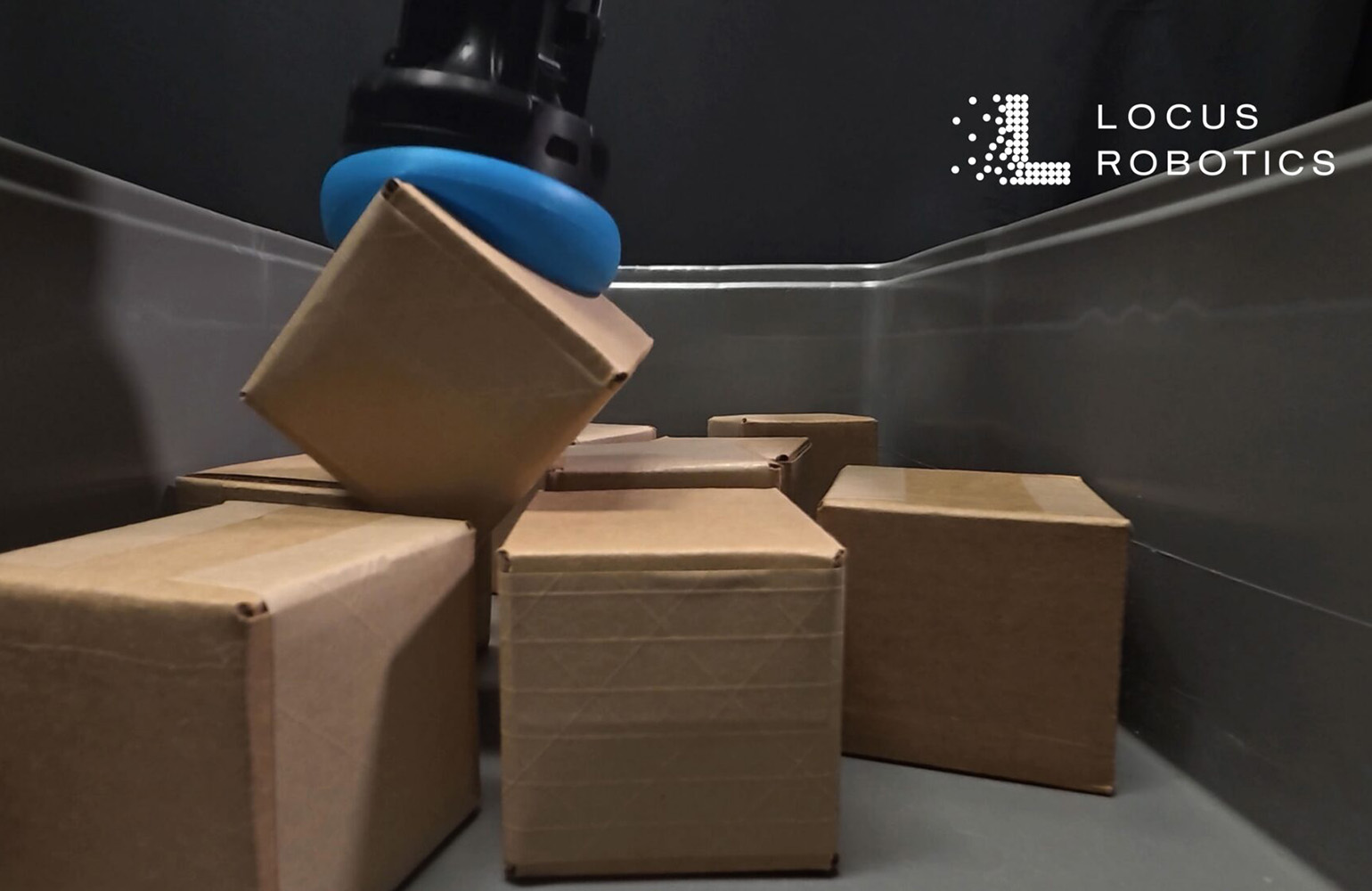
NeuraGrasp handles diverse items, including small containers, porous polybags, and textiles. | Source: Locus Robotics
Locus Robotics Corp. has solved numerous robotic hurdles in live operational settings. Its autonomous mobile robots (AMRs) have traversed vast distances across various facilities, supporting over 6 billion picks. Now, the company is expanding into robotic manipulation.
Locus entered the robotic picking sector in March 2025 by launching Array, a mobile manipulator featuring a custom vision-guided picking arm. Over a year later, Locus acquired Nexera Robotics, recognized for its NeuraGrasp gripping technology.
Roy Belak, senior vice president of robotic grasping at Locus and former CEO of Nexera, noted that Nexera had spent years refining its unique soft end effectors before joining Locus. He mentioned that the technology had already progressed through at least six product generations.
“We were reaching a point where the technology demonstrated compelling capabilities when we met Locus at MODEX. The rest of the history is clear,” Belak told The Robot Report.
The timing proved ideal for both organizations. Locus sought to manage more SKUs within its facilities, while Nexera, based in Vancouver, Canada, was ready to scale operations.
“We aim to deploy this technology at scale,” Belak stated. “As an innovator, I am excited to see it widely adopted, and this partnership presented a perfect opportunity.”
What does NeuraGrasp bring to Locus Array?
Nexera connected with Locus in 2025, during Array’s early market release planning. At that stage, Array used a standard suction-cup gripper. Belak explained that the teams worked extensively to integrate Nexera’s technology into Array’s development late in the process.
Fortunately, despite being far along in its development, Array was already equipped with the air and power supplies required by Nexera’s technology.
“Significant work was done prior to the acquisition to ensure the technology could be integrated into the development stream,” Belak recalled. “Had we missed that window by another year, making those changes would have been extremely difficult.”
While Belak did not specify an exact timeline for customer access to Nexera’s technology, he expressed optimism. He expects that Array’s next public display will likely feature the new technology.
Currently, Locus is in the early deployment phase of Array with its original gripper, so Nexera has not yet accessed the data that will soon become available.
“There is a long line of excited customers waiting for Array,” Belak said. “It is somewhat intimidating because once integrated, the system will operate in many different environments. We will then begin receiving data and optimizing the process as much as possible.”
Suction versus pinch picking
Stepping back to view the broader robotics industry, Belak noted that robotic manipulation exists on a spectrum between suction-based and pinch grasping.
“Suction is highly effective, particularly in warehouse operations,” he said. “It suffices 60% to 70% of the time. The challenge arises with the remaining 30% to 40%, where high coverage ratios are required.”
NeuraGrasp’s soft gripping technology bridges this gap by combining suction and pinching, according to Belak.
“The industry recognizes that pinch grasping will be influential in the future of robotic handling,” he said. “However, we firmly believe that suction provides a substantial portion of the solution using air. If it works, do not discard it.”
Locus is focusing on reliability and quality picks, not speed
“In industrial settings, reliability is paramount,” Belak stated. “While suction technologies have performance limits, their strength lies in incredible reliability. Pinch grasping technologies, depending on their complexity, can range from marginally to very unreliable, or at best, questionable.”
Belak emphasized the importance of robots performing tasks successfully. However, reliability remains the top priority, as a robot’s picking capability is irrelevant if it frequently breaks down or misses items. Additionally, pick quality is essential, he noted.
“There is a significant difference between performing a task and performing it with high quality. Locus Origin bots are already known for their high-quality operations,” Belak said. “We aim to bring that same ethos to picking.”
“Historically, picking claims have focused on return on investment without addressing underlying quality,” he continued. “We can achieve many picks per hour, but the focus should be on the quality of those picks.”
Locus’s team prioritizes avoiding product damage, double picks, and misspicks, Belak noted. These issues are rarely highlighted in robot advertisements but can quickly increase customer costs. “Once quality is established, speed can be increased,” Belak said.
What’s holding back robotic picking?
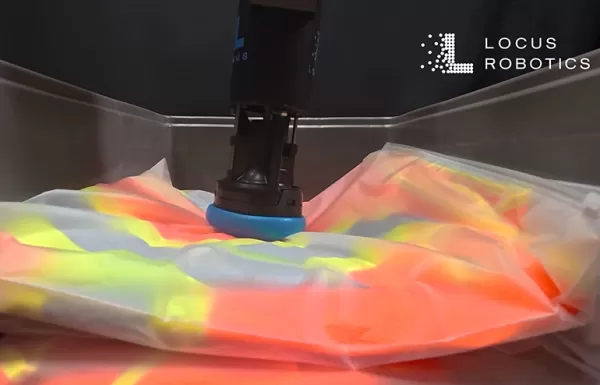
Nexera’s NeuraGrip handles previously difficult items, such as porous polybags. | Source: Locus Robotics
Belak identified two main roadblocks hindering the industry: AI development and providing robots with a sense of touch. The industry excels at creating sophisticated hands or electromechanical structures, but intelligence in pinch grasping lags behind.
“The challenge lies entirely in proprioception, data metrics, and feedback mechanisms required to make these hands function effectively,” Belak said.
This should not be surprising. The robotics industry has secured millions in funding recently to build robust physical AI systems for robots. Human brains evolved over billions of years, and while some companies attempt to close this gap by generating vast amounts of data, the lack of tactile sensing becomes apparent.
“One piece of the physical system is missing: a robust, reliable sense of touch on robots that does not degrade after limited usage. Simulating this or generating data for it is extremely difficult,” Belak said. “I do not believe simulated data will significantly solve this problem.”
Nexera currently utilizes a sense of touch and is interested in advancing it further. While Locus is still in the early stages with Array, Belak stated that the company’s manipulation roadmap extends beyond Array.
“Robotic manipulation—whether through Array, other technology versions, or picking benches—is a pillar of innovation we aim to excel at,” he said.
Editor’s note: Rick Faulk, CEO of Locus Robotics, will speak at RoboBusiness 2026 in Santa Clara, Calif., on Oct. 20 and 21. Faulk will participate in the panel discussion “The RaaS Playbook: Pricing, Service & Scale.”
Related article
 AI² Robotics raises $735M at $3B valuation for wheeled humanoid robots
AI2 manufactures wheeled humanoid robots rather than bipedal systems, trading mobility range for mechanical simplicity and durability. | Credit: Ai2 RoboticsAI² Robotics has secured approximately $735 million in a new financing round, elevating its v
Epson Unveils AX6 Cobot Featuring Compact Design and No-Code Programming
The AX6 force- and power-limited robot arm is designed to be lightweight and easy to use. Source: EpsonEpson Robots this week expanded its six-axis robot line with the AX6 collaborative robot. It said the new cobot is is designed with power- and forc
Siemens and Humanoid Test HMND 01 Alpha Humanoid Robot in Logistics
A mobile manipulator from Humanoid retrieves a tote from a conveyor belt. Source: SiemensSiemens AG and Humanoid announced the successful testing of the HMND 01 Alpha wheeled humanoid robot at Siemens' electronics factory in Erlangen, Germany. Levera
Related Special Topic Recommendations
Design & Art
AI² Robotics raises $735M at $3B valuation for wheeled humanoid robots
AI2 manufactures wheeled humanoid robots rather than bipedal systems, trading mobility range for mechanical simplicity and durability. | Credit: Ai2 RoboticsAI² Robotics has secured approximately $735 million in a new financing round, elevating its v
Epson Unveils AX6 Cobot Featuring Compact Design and No-Code Programming
The AX6 force- and power-limited robot arm is designed to be lightweight and easy to use. Source: EpsonEpson Robots this week expanded its six-axis robot line with the AX6 collaborative robot. It said the new cobot is is designed with power- and forc
Siemens and Humanoid Test HMND 01 Alpha Humanoid Robot in Logistics
A mobile manipulator from Humanoid retrieves a tote from a conveyor belt. Source: SiemensSiemens AG and Humanoid announced the successful testing of the HMND 01 Alpha wheeled humanoid robot at Siemens' electronics factory in Erlangen, Germany. Levera
Related Special Topic Recommendations
Design & Art
 Top AI Illustration Tools: Create Editorial Scenes and Cover Art Faster
2026 Latest Top-rated AI Illustration Tools: Our curated list features the best powerfully designed tools for creating stunning editorial scenes and eye-catching cover art quickly. Each option has gone through rigorous real-world tests, offering a free vs paid comparison to help you find the perfect match for your workflow. Try these must-try solutions today to unlock your AI edge and boost your creative productivity. Explore now at XIX.AI.
 10 tools
 xix.ai
Education and Learning
Top AI Tutors for Exam Prep: Practice Math, Science, and English
xix.ai
Education and Learning
Top AI Tutors for Exam Prep: Practice Math, Science, and English
2026 Latest Top-Rated Best AI Tutors for Exam Prep are here on XIX.AI! Our curated list features powerful game-changing tools that offer free vs paid comparison, real-world tests, and weekly updated rankings. They help boost your writing efficiency, simplify complex topic learning, and unlock your academic potential. Explore now to Discover your perfect exam prep tool and Start creating today to Unlock your AI edge!
10 tools
xix.ai
Finance
AI Budget Planning Tools for Personal Money Management
2026 Latest Best Top-Rated AI Budget Planning Tools for Personal Money Management are here on XIX.AI! This curated collection features powerful, game-changing solutions that help you conduct real-world tests, understand spending habits, and create personalized plans to boost productivity. Enjoy a free vs paid comparison along with detailed rankings. Must-try tools designed to simplify money management and unlock your AI edge. Explore now!
11 tools
xix.ai
Health & Wellness
AI Sleep Tracking Assistants: Improve Recovery with Better Bedtime Habits
2026 Latest Best Top-Rated AI Sleep Tracking Assistants curated for ultimate recovery. This fully updated weekly guide features powerful tools that deliver real-world tests, free vs paid comparison, and detailed rankings to help you find the must-try solution that boosts sleep quality and supports better bedtime habits. Explore now at XIX.AI to Unlock your AI edge.
10 tools
xix.ai
Data Analysis
AI SQL Copilots for Product and Revenue Analytics
2026 Latest Best Top-Rated AI SQL Copilots for Product and Revenue Analytics! XIX.AI has curated a powerful, game-changing collection of must-try tools that undergo real-world tests through weekly updated rankings. These tools help users boost productivity significantly by accelerating data analysis, streamlining complex queries, and generating accurate insights to drive smarter business decisions. Explore now to Discover your perfect tool for unlocking your AI edge!
14 tools
xix.ai
Education and Learning
Best AI Homework Helpers That Teach: Learn Concepts, Not Just Answers
2026 Latest Best Top-Rated AI Homework Helpers That Teach Core Concepts Not Just Answers Powerful Tools for Students Must-Try Curated List Weekly Updated Free vs Paid Comparison Real-World Tests Accurate Rankings to Help You Unlock Your Full Learning Potential Explore now to Discover your perfect tool for smarter studying.
10 tools
xix.ai

 Comments (0)
0/500
Comments (0)
0/500
NeuraGrasp handles diverse items, including small containers, porous polybags, and textiles. | Source: Locus Robotics
Locus Robotics Corp. has solved numerous robotic hurdles in live operational settings. Its autonomous mobile robots (AMRs) have traversed vast distances across various facilities, supporting over 6 billion picks. Now, the company is expanding into robotic manipulation.
Locus entered the robotic picking sector in March 2025 by launching Array, a mobile manipulator featuring a custom vision-guided picking arm. Over a year later, Locus acquired Nexera Robotics, recognized for its NeuraGrasp gripping technology.
Roy Belak, senior vice president of robotic grasping at Locus and former CEO of Nexera, noted that Nexera had spent years refining its unique soft end effectors before joining Locus. He mentioned that the technology had already progressed through at least six product generations.
“We were reaching a point where the technology demonstrated compelling capabilities when we met Locus at MODEX. The rest of the history is clear,” Belak told The Robot Report.
The timing proved ideal for both organizations. Locus sought to manage more SKUs within its facilities, while Nexera, based in Vancouver, Canada, was ready to scale operations.
“We aim to deploy this technology at scale,” Belak stated. “As an innovator, I am excited to see it widely adopted, and this partnership presented a perfect opportunity.”
What does NeuraGrasp bring to Locus Array?
Nexera connected with Locus in 2025, during Array’s early market release planning. At that stage, Array used a standard suction-cup gripper. Belak explained that the teams worked extensively to integrate Nexera’s technology into Array’s development late in the process.
Fortunately, despite being far along in its development, Array was already equipped with the air and power supplies required by Nexera’s technology.
“Significant work was done prior to the acquisition to ensure the technology could be integrated into the development stream,” Belak recalled. “Had we missed that window by another year, making those changes would have been extremely difficult.”
While Belak did not specify an exact timeline for customer access to Nexera’s technology, he expressed optimism. He expects that Array’s next public display will likely feature the new technology.
Currently, Locus is in the early deployment phase of Array with its original gripper, so Nexera has not yet accessed the data that will soon become available.
“There is a long line of excited customers waiting for Array,” Belak said. “It is somewhat intimidating because once integrated, the system will operate in many different environments. We will then begin receiving data and optimizing the process as much as possible.”
Suction versus pinch picking
Stepping back to view the broader robotics industry, Belak noted that robotic manipulation exists on a spectrum between suction-based and pinch grasping.
“Suction is highly effective, particularly in warehouse operations,” he said. “It suffices 60% to 70% of the time. The challenge arises with the remaining 30% to 40%, where high coverage ratios are required.”
NeuraGrasp’s soft gripping technology bridges this gap by combining suction and pinching, according to Belak.
“The industry recognizes that pinch grasping will be influential in the future of robotic handling,” he said. “However, we firmly believe that suction provides a substantial portion of the solution using air. If it works, do not discard it.”
Locus is focusing on reliability and quality picks, not speed
“In industrial settings, reliability is paramount,” Belak stated. “While suction technologies have performance limits, their strength lies in incredible reliability. Pinch grasping technologies, depending on their complexity, can range from marginally to very unreliable, or at best, questionable.”
Belak emphasized the importance of robots performing tasks successfully. However, reliability remains the top priority, as a robot’s picking capability is irrelevant if it frequently breaks down or misses items. Additionally, pick quality is essential, he noted.
“There is a significant difference between performing a task and performing it with high quality. Locus Origin bots are already known for their high-quality operations,” Belak said. “We aim to bring that same ethos to picking.”
“Historically, picking claims have focused on return on investment without addressing underlying quality,” he continued. “We can achieve many picks per hour, but the focus should be on the quality of those picks.”
Locus’s team prioritizes avoiding product damage, double picks, and misspicks, Belak noted. These issues are rarely highlighted in robot advertisements but can quickly increase customer costs. “Once quality is established, speed can be increased,” Belak said.
What’s holding back robotic picking?
Nexera’s NeuraGrip handles previously difficult items, such as porous polybags. | Source: Locus Robotics
Belak identified two main roadblocks hindering the industry: AI development and providing robots with a sense of touch. The industry excels at creating sophisticated hands or electromechanical structures, but intelligence in pinch grasping lags behind.
“The challenge lies entirely in proprioception, data metrics, and feedback mechanisms required to make these hands function effectively,” Belak said.
This should not be surprising. The robotics industry has secured millions in funding recently to build robust physical AI systems for robots. Human brains evolved over billions of years, and while some companies attempt to close this gap by generating vast amounts of data, the lack of tactile sensing becomes apparent.
“One piece of the physical system is missing: a robust, reliable sense of touch on robots that does not degrade after limited usage. Simulating this or generating data for it is extremely difficult,” Belak said. “I do not believe simulated data will significantly solve this problem.”
Nexera currently utilizes a sense of touch and is interested in advancing it further. While Locus is still in the early stages with Array, Belak stated that the company’s manipulation roadmap extends beyond Array.
“Robotic manipulation—whether through Array, other technology versions, or picking benches—is a pillar of innovation we aim to excel at,” he said.
Editor’s note: Rick Faulk, CEO of Locus Robotics, will speak at RoboBusiness 2026 in Santa Clara, Calif., on Oct. 20 and 21. Faulk will participate in the panel discussion “The RaaS Playbook: Pricing, Service & Scale.”








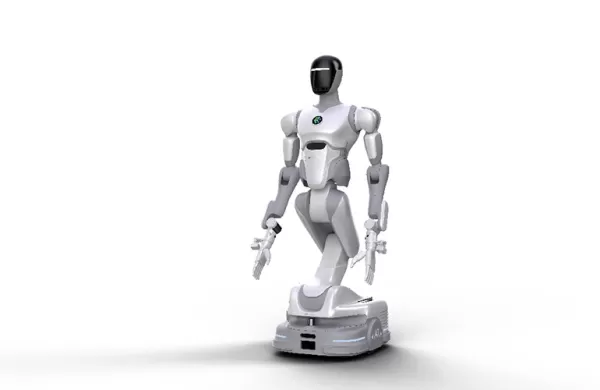 AI² Robotics raises $735M at $3B valuation for wheeled humanoid robots
AI2 manufactures wheeled humanoid robots rather than bipedal systems, trading mobility range for mechanical simplicity and durability. | Credit: Ai2 RoboticsAI² Robotics has secured approximately $735 million in a new financing round, elevating its v
AI² Robotics raises $735M at $3B valuation for wheeled humanoid robots
AI2 manufactures wheeled humanoid robots rather than bipedal systems, trading mobility range for mechanical simplicity and durability. | Credit: Ai2 RoboticsAI² Robotics has secured approximately $735 million in a new financing round, elevating its v
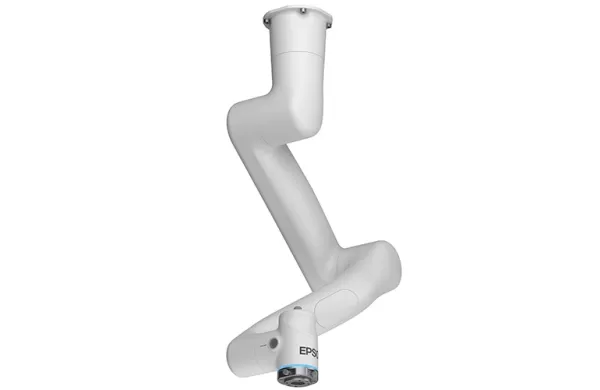 Epson Unveils AX6 Cobot Featuring Compact Design and No-Code Programming
The AX6 force- and power-limited robot arm is designed to be lightweight and easy to use. Source: EpsonEpson Robots this week expanded its six-axis robot line with the AX6 collaborative robot. It said the new cobot is is designed with power- and forc
Epson Unveils AX6 Cobot Featuring Compact Design and No-Code Programming
The AX6 force- and power-limited robot arm is designed to be lightweight and easy to use. Source: EpsonEpson Robots this week expanded its six-axis robot line with the AX6 collaborative robot. It said the new cobot is is designed with power- and forc
 Siemens and Humanoid Test HMND 01 Alpha Humanoid Robot in Logistics
A mobile manipulator from Humanoid retrieves a tote from a conveyor belt. Source: SiemensSiemens AG and Humanoid announced the successful testing of the HMND 01 Alpha wheeled humanoid robot at Siemens' electronics factory in Erlangen, Germany. Levera
Siemens and Humanoid Test HMND 01 Alpha Humanoid Robot in Logistics
A mobile manipulator from Humanoid retrieves a tote from a conveyor belt. Source: SiemensSiemens AG and Humanoid announced the successful testing of the HMND 01 Alpha wheeled humanoid robot at Siemens' electronics factory in Erlangen, Germany. Levera

2026 Latest Top-rated AI Illustration Tools: Our curated list features the best powerfully designed tools for creating stunning editorial scenes and eye-catching cover art quickly. Each option has gone through rigorous real-world tests, offering a free vs paid comparison to help you find the perfect match for your workflow. Try these must-try solutions today to unlock your AI edge and boost your creative productivity. Explore now at XIX.AI.
10 tools
xix.ai

2026 Latest Top-Rated Best AI Tutors for Exam Prep are here on XIX.AI! Our curated list features powerful game-changing tools that offer free vs paid comparison, real-world tests, and weekly updated rankings. They help boost your writing efficiency, simplify complex topic learning, and unlock your academic potential. Explore now to Discover your perfect exam prep tool and Start creating today to Unlock your AI edge!
10 tools
xix.ai

2026 Latest Best Top-Rated AI Budget Planning Tools for Personal Money Management are here on XIX.AI! This curated collection features powerful, game-changing solutions that help you conduct real-world tests, understand spending habits, and create personalized plans to boost productivity. Enjoy a free vs paid comparison along with detailed rankings. Must-try tools designed to simplify money management and unlock your AI edge. Explore now!
11 tools
xix.ai

2026 Latest Best Top-Rated AI Sleep Tracking Assistants curated for ultimate recovery. This fully updated weekly guide features powerful tools that deliver real-world tests, free vs paid comparison, and detailed rankings to help you find the must-try solution that boosts sleep quality and supports better bedtime habits. Explore now at XIX.AI to Unlock your AI edge.
10 tools
xix.ai

2026 Latest Best Top-Rated AI SQL Copilots for Product and Revenue Analytics! XIX.AI has curated a powerful, game-changing collection of must-try tools that undergo real-world tests through weekly updated rankings. These tools help users boost productivity significantly by accelerating data analysis, streamlining complex queries, and generating accurate insights to drive smarter business decisions. Explore now to Discover your perfect tool for unlocking your AI edge!
14 tools
xix.ai

2026 Latest Best Top-Rated AI Homework Helpers That Teach Core Concepts Not Just Answers Powerful Tools for Students Must-Try Curated List Weekly Updated Free vs Paid Comparison Real-World Tests Accurate Rankings to Help You Unlock Your Full Learning Potential Explore now to Discover your perfect tool for smarter studying.
10 tools
xix.ai












