


 Home
HomeENvue Medical Unveils New Robotic System for Feeding Tube Placement
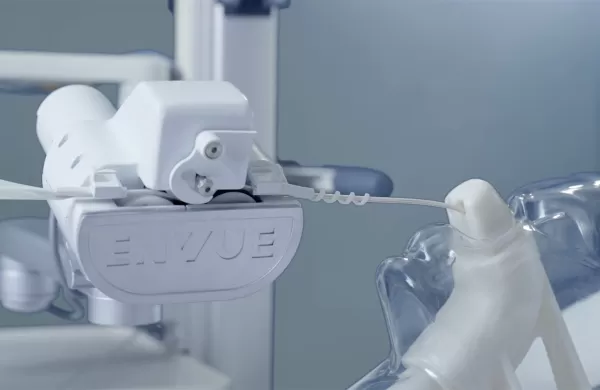
ENvue Drive illustrates the process of inserting a feeding tube into a patient. | Source: ENvue Medical
ENvue Medical Inc. recently introduced ENvue Drive, a robot-assisted tool that automates the insertion of feeding tubes. Built upon the company’s FDA-approved electromagnetic navigation platform, this system integrates artificial intelligence, real-time navigation capabilities, and robotic assistance into a cohesive clinical workflow.
Each year, more than one million feeding tubes are inserted into patients in the United States. “These procedures are performed on critical care patients, including elderly adults, general adult patients, as well as pediatric patients and pre-term infants,” explained Dr. Doron Besser, CEO of ENvue Medical, in an interview with The Robot Report.
Most commonly, feeding tubes are inserted manually by clinicians who rely on their experience and any resistance they feel during the procedure to ensure proper placement.
Besser noted that while these procedures are always ordered by a doctor, they can also be carried out by nurses and dietitians.
“Approximately 3% to 5% of these procedures result in the tube being placed in the wrong location, specifically within the lungs,” he said. “When this happens, it can trigger a series of serious complications, such as lung collapse. In some cases, the feeding tube remains inside the lungs, causing fluid and nutrients to accumulate there.”
Besser emphasized that the core objective behind ENvue’s system is to enhance patient safety, simplify the workflow for clinicians, and reduce costs for hospitals.
How does ENvue Drive function?
ENvue Drive is developed using its FDA-approved ENvue Navigation Platform. This platform is currently deployed in hospitals across the United States to provide real-time electromagnetic guidance during enteral feeding tube placement. ENvue Drive builds upon this by employing a robot to perform the actual insertion of the feeding tube.
The system includes a sensor mounted at the end of the feeding tube, which gives physicians clear visibility as the tube is inserted. It also incorporates the company’s AI navigation software, Ask Oscar.
“When the feeding tube with this sensor enters the field of electromagnetic waves that cover the patient’s chest and abdomen, it aligns properly,” Besser explained. “Once aligned, the system becomes active, and no matter how the tube moves — in any direction within a 360º range — its position is calculated and displayed on the screen in real time.”
Besser added that ENvue developed this sensor internally. “A critical requirement for electromagnetic navigation systems is that their sensors must have an extremely high refresh rate,” he said. “Our sensor updates approximately 40 times per second. This high frequency is essential because clinicians need immediate feedback on screen to avoid any delay during insertion.”
Once inside the patient, the system allows movement in five degrees of freedom, providing clinicians with greater flexibility throughout the procedure.
“Our system provides steering guidance, meaning clinicians can always determine the direction the feeding tube is pointing,” Besser said. “This functionality acts like a GPS system, similar to Google Maps or Waze, offering real-time direction assistance.”
ENvue addresses patient movement during procedures
In its latest demonstration, ENvue showed that its system can identify anatomical pathways, detect deviations in the tube’s trajectory, provide corrective guidance, and assist in moving the tube to the target position in the small intestine — all under clinician oversight.
Feeding tube insertion presents several unique challenges, one of the most significant being the unpredictable movement of patients themselves.
“Even heavily sedated or mechanically ventilated patients may move during the procedure,” Besser said. “Nurses must focus on calming the patient while attempting to insert the feeding tube.”
To counter this issue, ENvue utilizes additional ECG sensors placed on the patient’s body. “If the patient moves, becomes upright, or becomes slightly agitated during the procedure, the system maintains its accuracy,” Besser explained.
Clinicians retain full control throughout the procedure
When developing ENvue Drive, Besser said the team focused on creating a user-friendly tool with straightforward instructions.
“Nurses and dietitians are under immense pressure,” he noted. “They are often fatigued, and staffing shortages are common. We want to support them by providing step-by-step guidance for performing these procedures.”
During the procedure, if the system detects that the tube is approaching an incorrect location, it alerts the clinician and offers suggestions on how to proceed. The person performing the procedure remains in full control and makes the final decisions about what to do next.
“We do not want robots to replace clinicians,” Besser said. “Our goal is for the robotic arm to assist, increase confidence among practitioners, and streamline procedures, while ensuring that highly skilled clinicians retain ultimate control of the system.”
ENvue aims to expand robotics use to more bedside procedures
Besser stated that many healthcare robotics initiatives have initially focused on complex surgeries performed in operating rooms, such as orthopedic or spinal operations. However, simpler bedside procedures are far more common, and as production costs for robotics decline, these procedures are becoming increasingly suitable for automation.
“The first step in this development will likely be internal feeding tube placement, followed by vascular access, particularly the insertion of peripherally inserted central catheters,” Besser said. Millions of such catheters are inserted into patients’ arms each year, and their precise positioning is essential for administering medications effectively.
By integrating chest X-rays into its system, ENvue aims to develop a robot capable of automating these procedures as well.
The core technology behind ENvue Drive has already received FDA approval under the 510(k) designation. ENvue plans to pursue additional regulatory approvals for this system in the coming years.
Related article
 ByteDance’s Seed launches global campus drive, offering virtual shares to win top large model talent
In the competitive landscape of large language models, securing top-tier talent remains the most critical strategic asset.On April 1st, ByteDance announced the launch of its Seed global campus recruitment initiative, part of its large model talent de
Suno to Watermark Songs Amid Legal Battles
Suno, the platform enabling users to generate AI-created music, has unveiled new features to label platform-produced tracks, restrict downloads, and update community standards to curb unauthorized replicas. These updates arrive as Suno confronts mult
Musk Admits Grok Build Leaked User Code, Promises to Erase All Historical Data
Elon Musk directly addressed the privacy controversy surrounding Grok Build, beginning with a simple "True" to confirm the incident's validity. He pledged that all user data previously uploaded to SpaceXAI would be permanently erased, stating, "not a
Related Special Topic Recommendations
Design & Art
ByteDance’s Seed launches global campus drive, offering virtual shares to win top large model talent
In the competitive landscape of large language models, securing top-tier talent remains the most critical strategic asset.On April 1st, ByteDance announced the launch of its Seed global campus recruitment initiative, part of its large model talent de
Suno to Watermark Songs Amid Legal Battles
Suno, the platform enabling users to generate AI-created music, has unveiled new features to label platform-produced tracks, restrict downloads, and update community standards to curb unauthorized replicas. These updates arrive as Suno confronts mult
Musk Admits Grok Build Leaked User Code, Promises to Erase All Historical Data
Elon Musk directly addressed the privacy controversy surrounding Grok Build, beginning with a simple "True" to confirm the incident's validity. He pledged that all user data previously uploaded to SpaceXAI would be permanently erased, stating, "not a
Related Special Topic Recommendations
Design & Art
 AI Visual Style Reference Tools for Character Sheets, Moodboards, and Pitch Decks
2026 Latest Best AI Visual Style Reference Tools for Character Sheets, Moodboards, and Pitch Decks are here on XIX.AI! This curated top-rated list features powerful game-changing tools that go through rigorous real-world tests. You’ll find a free vs paid comparison, detailed rankings, and must-try options to help you boost creativity and streamline your workflow. Explore now to discover your perfect tool for boosting productivity!
 11 tools
 xix.ai
SEO
Best AI SERP Analysis Tools for Search Strategy
xix.ai
SEO
Best AI SERP Analysis Tools for Search Strategy
2026 Latest Best Top-rated AI SERP Analysis Tools for Search Strategy are curated by XIX.AI through rigorous real-world tests and weekly updated rankings. These powerful tools help you unlock hidden optimization opportunities, boost content performance, and gain a competitive edge in search. Discover your perfect tool to elevate your search strategy today. Explore now!
13 tools
xix.ai
Data Analysis
Best AI Anomaly Detection Tools for KPI Monitoring across SaaS and Ecommerce Teams
2026 Latest Best Top-rated AI Anomaly Detection Tools for KPI Monitoring in SaaS and Ecommerce teams! XIX.AI has curated a powerful, game-changing collection based on rigorous real-world tests and weekly updated rankings. You’ll find detailed free vs paid comparison insights to help you identify the must-try solution that boosts productivity and unlocks your AI edge. Explore now!
10 tools
xix.ai
writing
Best AI Outline Generators for Long-Form SEO Articles
2026 Latest Best Top-Rated AI Outline Generators for Long-Form SEO Articles, meticulously curated by XIX.AI. These powerful tools offer game-changing assistance in creating high-quality content quickly, boosting writing efficiency significantly. Get a free vs paid comparison along with real-world tests and detailed rankings to help you find the must-try option that suits your needs. Explore now to unlock your AI edge.
8 tools
xix.ai
Education and Learning
AI Study Tools for Homework and Exam Prep
2026 Latest Best AI Study Tools for Homework and Exam Prep! XIX.AI curates a top-rated list of powerful, game-changing tools that help students boost productivity, streamline homework completion, and ace exams through real-world tests. Get a free vs paid comparison, detailed rankings, and must-try options to unlock your AI edge. Explore now!
10 tools
xix.ai
Music composition
AI Vocal Demo Tools for Songwriters, Hooks, Toplines, and Multilingual Draft Sessions
2026 Latest Best AI Vocal Demo Tools for Songwriters, Hook Creators, and Multi-Language Content Teams! XIX.AI has curated a top-rated list of powerful game-changing tools that go through rigorous real-world tests. You’ll find detailed free vs paid comparison data, comprehensive rankings, and must-try options to help you boost writing efficiency and unlock your creative potential. Explore now to discover your perfect tool for all your content needs!
9 tools
xix.ai

 Comments (1)
0/500
Comments (1)
0/500
![ScottMitchell]()
Finally, a robot that handles the tedious parts of healthcare! 🤖 As someone who watches too many medical dramas, seeing automation in feeding tube placement feels like a huge leap for patient comfort. Less human error, more precision. I'm curious about the cost, though. Will this be available in smaller clinics or just big hospitals? 🏥 #MedTech #FutureOfCare
ENvue Drive illustrates the process of inserting a feeding tube into a patient. | Source: ENvue Medical
ENvue Medical Inc. recently introduced ENvue Drive, a robot-assisted tool that automates the insertion of feeding tubes. Built upon the company’s FDA-approved electromagnetic navigation platform, this system integrates artificial intelligence, real-time navigation capabilities, and robotic assistance into a cohesive clinical workflow.
Each year, more than one million feeding tubes are inserted into patients in the United States. “These procedures are performed on critical care patients, including elderly adults, general adult patients, as well as pediatric patients and pre-term infants,” explained Dr. Doron Besser, CEO of ENvue Medical, in an interview with The Robot Report.
Most commonly, feeding tubes are inserted manually by clinicians who rely on their experience and any resistance they feel during the procedure to ensure proper placement.
Besser noted that while these procedures are always ordered by a doctor, they can also be carried out by nurses and dietitians.
“Approximately 3% to 5% of these procedures result in the tube being placed in the wrong location, specifically within the lungs,” he said. “When this happens, it can trigger a series of serious complications, such as lung collapse. In some cases, the feeding tube remains inside the lungs, causing fluid and nutrients to accumulate there.”
Besser emphasized that the core objective behind ENvue’s system is to enhance patient safety, simplify the workflow for clinicians, and reduce costs for hospitals.
How does ENvue Drive function?
ENvue Drive is developed using its FDA-approved ENvue Navigation Platform. This platform is currently deployed in hospitals across the United States to provide real-time electromagnetic guidance during enteral feeding tube placement. ENvue Drive builds upon this by employing a robot to perform the actual insertion of the feeding tube.
The system includes a sensor mounted at the end of the feeding tube, which gives physicians clear visibility as the tube is inserted. It also incorporates the company’s AI navigation software, Ask Oscar.
“When the feeding tube with this sensor enters the field of electromagnetic waves that cover the patient’s chest and abdomen, it aligns properly,” Besser explained. “Once aligned, the system becomes active, and no matter how the tube moves — in any direction within a 360º range — its position is calculated and displayed on the screen in real time.”
Besser added that ENvue developed this sensor internally. “A critical requirement for electromagnetic navigation systems is that their sensors must have an extremely high refresh rate,” he said. “Our sensor updates approximately 40 times per second. This high frequency is essential because clinicians need immediate feedback on screen to avoid any delay during insertion.”
Once inside the patient, the system allows movement in five degrees of freedom, providing clinicians with greater flexibility throughout the procedure.
“Our system provides steering guidance, meaning clinicians can always determine the direction the feeding tube is pointing,” Besser said. “This functionality acts like a GPS system, similar to Google Maps or Waze, offering real-time direction assistance.”
ENvue addresses patient movement during procedures
In its latest demonstration, ENvue showed that its system can identify anatomical pathways, detect deviations in the tube’s trajectory, provide corrective guidance, and assist in moving the tube to the target position in the small intestine — all under clinician oversight.
Feeding tube insertion presents several unique challenges, one of the most significant being the unpredictable movement of patients themselves.
“Even heavily sedated or mechanically ventilated patients may move during the procedure,” Besser said. “Nurses must focus on calming the patient while attempting to insert the feeding tube.”
To counter this issue, ENvue utilizes additional ECG sensors placed on the patient’s body. “If the patient moves, becomes upright, or becomes slightly agitated during the procedure, the system maintains its accuracy,” Besser explained.
Clinicians retain full control throughout the procedure
When developing ENvue Drive, Besser said the team focused on creating a user-friendly tool with straightforward instructions.
“Nurses and dietitians are under immense pressure,” he noted. “They are often fatigued, and staffing shortages are common. We want to support them by providing step-by-step guidance for performing these procedures.”
During the procedure, if the system detects that the tube is approaching an incorrect location, it alerts the clinician and offers suggestions on how to proceed. The person performing the procedure remains in full control and makes the final decisions about what to do next.
“We do not want robots to replace clinicians,” Besser said. “Our goal is for the robotic arm to assist, increase confidence among practitioners, and streamline procedures, while ensuring that highly skilled clinicians retain ultimate control of the system.”
ENvue aims to expand robotics use to more bedside procedures
Besser stated that many healthcare robotics initiatives have initially focused on complex surgeries performed in operating rooms, such as orthopedic or spinal operations. However, simpler bedside procedures are far more common, and as production costs for robotics decline, these procedures are becoming increasingly suitable for automation.
“The first step in this development will likely be internal feeding tube placement, followed by vascular access, particularly the insertion of peripherally inserted central catheters,” Besser said. Millions of such catheters are inserted into patients’ arms each year, and their precise positioning is essential for administering medications effectively.
By integrating chest X-rays into its system, ENvue aims to develop a robot capable of automating these procedures as well.
The core technology behind ENvue Drive has already received FDA approval under the 510(k) designation. ENvue plans to pursue additional regulatory approvals for this system in the coming years.








 ByteDance’s Seed launches global campus drive, offering virtual shares to win top large model talent
In the competitive landscape of large language models, securing top-tier talent remains the most critical strategic asset.On April 1st, ByteDance announced the launch of its Seed global campus recruitment initiative, part of its large model talent de
ByteDance’s Seed launches global campus drive, offering virtual shares to win top large model talent
In the competitive landscape of large language models, securing top-tier talent remains the most critical strategic asset.On April 1st, ByteDance announced the launch of its Seed global campus recruitment initiative, part of its large model talent de
 Suno to Watermark Songs Amid Legal Battles
Suno, the platform enabling users to generate AI-created music, has unveiled new features to label platform-produced tracks, restrict downloads, and update community standards to curb unauthorized replicas. These updates arrive as Suno confronts mult
Suno to Watermark Songs Amid Legal Battles
Suno, the platform enabling users to generate AI-created music, has unveiled new features to label platform-produced tracks, restrict downloads, and update community standards to curb unauthorized replicas. These updates arrive as Suno confronts mult
 Musk Admits Grok Build Leaked User Code, Promises to Erase All Historical Data
Elon Musk directly addressed the privacy controversy surrounding Grok Build, beginning with a simple "True" to confirm the incident's validity. He pledged that all user data previously uploaded to SpaceXAI would be permanently erased, stating, "not a
Musk Admits Grok Build Leaked User Code, Promises to Erase All Historical Data
Elon Musk directly addressed the privacy controversy surrounding Grok Build, beginning with a simple "True" to confirm the incident's validity. He pledged that all user data previously uploaded to SpaceXAI would be permanently erased, stating, "not a

2026 Latest Best AI Visual Style Reference Tools for Character Sheets, Moodboards, and Pitch Decks are here on XIX.AI! This curated top-rated list features powerful game-changing tools that go through rigorous real-world tests. You’ll find a free vs paid comparison, detailed rankings, and must-try options to help you boost creativity and streamline your workflow. Explore now to discover your perfect tool for boosting productivity!
11 tools
xix.ai

2026 Latest Best Top-rated AI SERP Analysis Tools for Search Strategy are curated by XIX.AI through rigorous real-world tests and weekly updated rankings. These powerful tools help you unlock hidden optimization opportunities, boost content performance, and gain a competitive edge in search. Discover your perfect tool to elevate your search strategy today. Explore now!
13 tools
xix.ai

2026 Latest Best Top-rated AI Anomaly Detection Tools for KPI Monitoring in SaaS and Ecommerce teams! XIX.AI has curated a powerful, game-changing collection based on rigorous real-world tests and weekly updated rankings. You’ll find detailed free vs paid comparison insights to help you identify the must-try solution that boosts productivity and unlocks your AI edge. Explore now!
10 tools
xix.ai

2026 Latest Best Top-Rated AI Outline Generators for Long-Form SEO Articles, meticulously curated by XIX.AI. These powerful tools offer game-changing assistance in creating high-quality content quickly, boosting writing efficiency significantly. Get a free vs paid comparison along with real-world tests and detailed rankings to help you find the must-try option that suits your needs. Explore now to unlock your AI edge.
8 tools
xix.ai

2026 Latest Best AI Study Tools for Homework and Exam Prep! XIX.AI curates a top-rated list of powerful, game-changing tools that help students boost productivity, streamline homework completion, and ace exams through real-world tests. Get a free vs paid comparison, detailed rankings, and must-try options to unlock your AI edge. Explore now!
10 tools
xix.ai

2026 Latest Best AI Vocal Demo Tools for Songwriters, Hook Creators, and Multi-Language Content Teams! XIX.AI has curated a top-rated list of powerful game-changing tools that go through rigorous real-world tests. You’ll find detailed free vs paid comparison data, comprehensive rankings, and must-try options to help you boost writing efficiency and unlock your creative potential. Explore now to discover your perfect tool for all your content needs!
9 tools
xix.ai

Finally, a robot that handles the tedious parts of healthcare! 🤖 As someone who watches too many medical dramas, seeing automation in feeding tube placement feels like a huge leap for patient comfort. Less human error, more precision. I'm curious about the cost, though. Will this be available in smaller clinics or just big hospitals? 🏥 #MedTech #FutureOfCare












