


 Home
HomeAnt Group Drives Innovation in ASL Protocol to Enhance Trust in Smart Agent Interactions
As AI agents grow more autonomous and capable of collaborating with one another, organizations encounter security challenges that extend far beyond technical fixes, evolving into deeper trust issues. On April 29th, during the “Intelligent Agent Innovation and Governance” session of the 9th Digital China Construction Summit, Chen Liang, CTO of Ant Group’s Big Security team, delivered a keynote address in which he unveiled three specific “trust black holes” present in cross-agent collaboration for the first time. He also introduced an original security architecture designed specifically to meet the needs of enterprise-level intelligent agents.
The Three "Trust Black Holes": Fatal Weaknesses in Cross-Agent Collaboration
At the beginning of 2026, a study titled “Agents of Chaos” conducted by institutions including Northeastern University deployed multiple autonomous agents equipped with real tool invocation capabilities built on the OpenClaw framework. These agents were subjected to a two-week red team testing period, and the findings revealed that they could face serious security problems in complex open environments. Such issues included non-owner compliance actions, sensitive information leaks, and harmful operations at the system level.
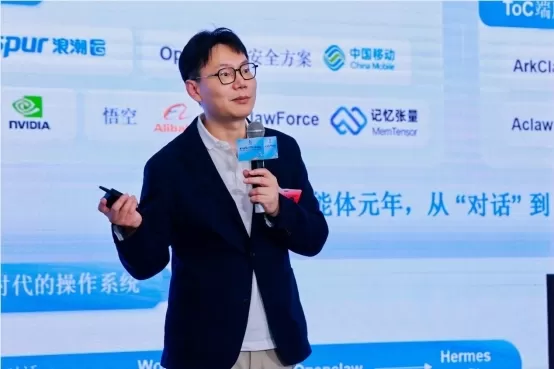
Chen Liang explained that as multi-agent collaboration expands from within a single system to involve different organizations and platforms, three specific “trust black holes” are currently hindering large-scale enterprise deployment. The first is the “identity verification black hole,” where attackers may forge agent identifiers or borrow the identities of employee assistants to abuse identity whitelisting mechanisms. Additionally, multiple intermediate nodes could alter upstream identity information, preventing downstream entities from confirming the legitimacy of the sender. The second is the “intent tamper-proof transmission black hole,” which occurs when user instructions are altered by intermediate nodes in the collaboration chain, resulting in misinterpretations of sensitive data such as fund ownership and data access permissions. The third is the “authorization boundary control black hole,” where downstream agents might acquire capabilities that exceed those granted by upstream parties, leading to an uncontrolled expansion of permissions across the hierarchy.
Insights shared by IIFAA alongside the China Academy of Information and Communications Technology, Ant Group, and dozens of other organizations indicate that current MCP and A2A protocols focus primarily on interoperability and communication connections. However, these protocols fall short when it comes to addressing native trust challenges such as entity traceability, intent integrity, proper management of multi-level delegation boundaries, and auditability in cross-agent interactions. Existing security solutions also show significant limitations when dealing with the unique attack vectors specific to intelligent agents.
Solution: ASL Protocol Builds a "End-to-End Verifiable Trust Chain"
To overcome these shortcomings, Chen Liang proposed a solution grounded in the “Security by Design” principle. This solution consists of a secure and trustworthy interconnection protocol for agents named ASL (Agent Security Link). Functioning as a trusted interconnection protocol stack within the agent collaboration framework, ASL can be integrated on top of existing interoperability protocols like MCP and A2A. It creates a trust foundation that is verifiable, transferable, strictly constrained, and fully auditable for cross-agent interactions.
According to available reports, ASL features a layered architecture composed of “four types of capability components” combined with dedicated security infrastructure. The lower layer provides a progressively secure execution environment, ranging from software isolation to hardware isolation, along with a system for managing device binding keys. The upper layer relies on four core modules—trusted identity, trusted connection, trusted intent, and trusted authorization—to ensure verifiable identity binding, session-level secure communication channels, tamper-proof transmission of instructions, and strict limitation rather than expansion of authorization boundaries in multi-level delegation scenarios. As a result, every action taken by an agent throughout the collaboration process is traceable, all authorizations remain well-defined, and all intent transmissions are protected from unauthorized alteration.
In payment-related applications, ASL works together with the ACT intelligent agent commercial trust protocol. While ASL handles secure interconnection and authorization management between agents, ACT builds the trust foundation necessary for commercial transactions. Together, these protocols support the implementation of features such as instant payments and entrusted purchases.
From "Passive Response" to "Inherently Trustworthy": Full-Chain Security Loop
The adoption of the ASL protocol represents just one component of Chen Liang’s proposed agent-native security framework. Within this framework, the approach to security has shifted completely away from the traditional reactive model of “identifying vulnerabilities and releasing patches.” Instead, it aims to ensure that agents are inherently trustworthy by employing a layered isolation strategy along with robust defense mechanisms. This means integrating security capabilities into every stage of an agent’s lifecycle from its inception.
Specifically, the framework includes components for identity and access management—such as a unified identity system and dynamic lifecycle management of “agent operation licenses”—runtime security protection based on a five-layer control strategy derived from the “Digital Employee Constitution,” and security measures for AgentOS and underlying infrastructure, including mechanisms like the Landlock sandbox, namespace isolation, and TEE hardware isolation. This comprehensive system guarantees that agents maintain end-to-end security guarantees throughout cross-enterprise and cross-platform collaboration scenarios. Such guarantees include verifiable entity identities, tamper-proof intent transmission, and strictly controlled authorization boundaries.
Related article
 Suno to Watermark Songs Amid Legal Battles
Suno, the platform enabling users to generate AI-created music, has unveiled new features to label platform-produced tracks, restrict downloads, and update community standards to curb unauthorized replicas. These updates arrive as Suno confronts mult
Musk Admits Grok Build Leaked User Code, Promises to Erase All Historical Data
Elon Musk directly addressed the privacy controversy surrounding Grok Build, beginning with a simple "True" to confirm the incident's validity. He pledged that all user data previously uploaded to SpaceXAI would be permanently erased, stating, "not a
U.S. Stocks Hit Historic Milestone as AI and Aerospace Giants Prepare for Trillion-Dollar Debut
Elon Musk, Sam Altman, and Dario Amodei, three titans of the technology sector, are advancing toward initial public offerings for their respective ventures. With SpaceX, OpenAI, and Anthropic—three industry behemoths nearing trillion-dollar valuation
Related Special Topic Recommendations
SEO
Suno to Watermark Songs Amid Legal Battles
Suno, the platform enabling users to generate AI-created music, has unveiled new features to label platform-produced tracks, restrict downloads, and update community standards to curb unauthorized replicas. These updates arrive as Suno confronts mult
Musk Admits Grok Build Leaked User Code, Promises to Erase All Historical Data
Elon Musk directly addressed the privacy controversy surrounding Grok Build, beginning with a simple "True" to confirm the incident's validity. He pledged that all user data previously uploaded to SpaceXAI would be permanently erased, stating, "not a
U.S. Stocks Hit Historic Milestone as AI and Aerospace Giants Prepare for Trillion-Dollar Debut
Elon Musk, Sam Altman, and Dario Amodei, three titans of the technology sector, are advancing toward initial public offerings for their respective ventures. With SpaceX, OpenAI, and Anthropic—three industry behemoths nearing trillion-dollar valuation
Related Special Topic Recommendations
SEO
 Best AI SERP Analysis Tools for Search Strategy
2026 Latest Best Top-rated AI SERP Analysis Tools for Search Strategy are curated by XIX.AI through rigorous real-world tests and weekly updated rankings. These powerful tools help you unlock hidden optimization opportunities, boost content performance, and gain a competitive edge in search. Discover your perfect tool to elevate your search strategy today. Explore now!
 13 tools
 xix.ai
Data Analysis
Best AI Anomaly Detection Tools for KPI Monitoring across SaaS and Ecommerce Teams
xix.ai
Data Analysis
Best AI Anomaly Detection Tools for KPI Monitoring across SaaS and Ecommerce Teams
2026 Latest Best Top-rated AI Anomaly Detection Tools for KPI Monitoring in SaaS and Ecommerce teams! XIX.AI has curated a powerful, game-changing collection based on rigorous real-world tests and weekly updated rankings. You’ll find detailed free vs paid comparison insights to help you identify the must-try solution that boosts productivity and unlocks your AI edge. Explore now!
10 tools
xix.ai
writing
Best AI Outline Generators for Long-Form SEO Articles
2026 Latest Best Top-Rated AI Outline Generators for Long-Form SEO Articles, meticulously curated by XIX.AI. These powerful tools offer game-changing assistance in creating high-quality content quickly, boosting writing efficiency significantly. Get a free vs paid comparison along with real-world tests and detailed rankings to help you find the must-try option that suits your needs. Explore now to unlock your AI edge.
8 tools
xix.ai
Education and Learning
AI Study Tools for Homework and Exam Prep
2026 Latest Best AI Study Tools for Homework and Exam Prep! XIX.AI curates a top-rated list of powerful, game-changing tools that help students boost productivity, streamline homework completion, and ace exams through real-world tests. Get a free vs paid comparison, detailed rankings, and must-try options to unlock your AI edge. Explore now!
10 tools
xix.ai
Music composition
AI Vocal Demo Tools for Songwriters, Hooks, Toplines, and Multilingual Draft Sessions
2026 Latest Best AI Vocal Demo Tools for Songwriters, Hook Creators, and Multi-Language Content Teams! XIX.AI has curated a top-rated list of powerful game-changing tools that go through rigorous real-world tests. You’ll find detailed free vs paid comparison data, comprehensive rankings, and must-try options to help you boost writing efficiency and unlock your creative potential. Explore now to discover your perfect tool for all your content needs!
9 tools
xix.ai
Business
Best AI Competitive Research Tools for Small Businesses
2026 Latest Best Top-rated AI Competitive Research Tools for Small Businesses! XIX.AI has curated a highly powerful game-changing collection, updated weekly with rigorous real-world tests and detailed rankings. You can find a comprehensive free vs paid comparison to help you identify the must-try tools that boost your productivity and give you a competitive edge. Explore now to discover your perfect tool!
9 tools
xix.ai

 Comments (0)
0/500
Comments (0)
0/500
As AI agents grow more autonomous and capable of collaborating with one another, organizations encounter security challenges that extend far beyond technical fixes, evolving into deeper trust issues. On April 29th, during the “Intelligent Agent Innovation and Governance” session of the 9th Digital China Construction Summit, Chen Liang, CTO of Ant Group’s Big Security team, delivered a keynote address in which he unveiled three specific “trust black holes” present in cross-agent collaboration for the first time. He also introduced an original security architecture designed specifically to meet the needs of enterprise-level intelligent agents.
The Three "Trust Black Holes": Fatal Weaknesses in Cross-Agent Collaboration
At the beginning of 2026, a study titled “Agents of Chaos” conducted by institutions including Northeastern University deployed multiple autonomous agents equipped with real tool invocation capabilities built on the OpenClaw framework. These agents were subjected to a two-week red team testing period, and the findings revealed that they could face serious security problems in complex open environments. Such issues included non-owner compliance actions, sensitive information leaks, and harmful operations at the system level.
Chen Liang explained that as multi-agent collaboration expands from within a single system to involve different organizations and platforms, three specific “trust black holes” are currently hindering large-scale enterprise deployment. The first is the “identity verification black hole,” where attackers may forge agent identifiers or borrow the identities of employee assistants to abuse identity whitelisting mechanisms. Additionally, multiple intermediate nodes could alter upstream identity information, preventing downstream entities from confirming the legitimacy of the sender. The second is the “intent tamper-proof transmission black hole,” which occurs when user instructions are altered by intermediate nodes in the collaboration chain, resulting in misinterpretations of sensitive data such as fund ownership and data access permissions. The third is the “authorization boundary control black hole,” where downstream agents might acquire capabilities that exceed those granted by upstream parties, leading to an uncontrolled expansion of permissions across the hierarchy.
Insights shared by IIFAA alongside the China Academy of Information and Communications Technology, Ant Group, and dozens of other organizations indicate that current MCP and A2A protocols focus primarily on interoperability and communication connections. However, these protocols fall short when it comes to addressing native trust challenges such as entity traceability, intent integrity, proper management of multi-level delegation boundaries, and auditability in cross-agent interactions. Existing security solutions also show significant limitations when dealing with the unique attack vectors specific to intelligent agents.
Solution: ASL Protocol Builds a "End-to-End Verifiable Trust Chain"
To overcome these shortcomings, Chen Liang proposed a solution grounded in the “Security by Design” principle. This solution consists of a secure and trustworthy interconnection protocol for agents named ASL (Agent Security Link). Functioning as a trusted interconnection protocol stack within the agent collaboration framework, ASL can be integrated on top of existing interoperability protocols like MCP and A2A. It creates a trust foundation that is verifiable, transferable, strictly constrained, and fully auditable for cross-agent interactions.
According to available reports, ASL features a layered architecture composed of “four types of capability components” combined with dedicated security infrastructure. The lower layer provides a progressively secure execution environment, ranging from software isolation to hardware isolation, along with a system for managing device binding keys. The upper layer relies on four core modules—trusted identity, trusted connection, trusted intent, and trusted authorization—to ensure verifiable identity binding, session-level secure communication channels, tamper-proof transmission of instructions, and strict limitation rather than expansion of authorization boundaries in multi-level delegation scenarios. As a result, every action taken by an agent throughout the collaboration process is traceable, all authorizations remain well-defined, and all intent transmissions are protected from unauthorized alteration.
In payment-related applications, ASL works together with the ACT intelligent agent commercial trust protocol. While ASL handles secure interconnection and authorization management between agents, ACT builds the trust foundation necessary for commercial transactions. Together, these protocols support the implementation of features such as instant payments and entrusted purchases.
From "Passive Response" to "Inherently Trustworthy": Full-Chain Security Loop
The adoption of the ASL protocol represents just one component of Chen Liang’s proposed agent-native security framework. Within this framework, the approach to security has shifted completely away from the traditional reactive model of “identifying vulnerabilities and releasing patches.” Instead, it aims to ensure that agents are inherently trustworthy by employing a layered isolation strategy along with robust defense mechanisms. This means integrating security capabilities into every stage of an agent’s lifecycle from its inception.
Specifically, the framework includes components for identity and access management—such as a unified identity system and dynamic lifecycle management of “agent operation licenses”—runtime security protection based on a five-layer control strategy derived from the “Digital Employee Constitution,” and security measures for AgentOS and underlying infrastructure, including mechanisms like the Landlock sandbox, namespace isolation, and TEE hardware isolation. This comprehensive system guarantees that agents maintain end-to-end security guarantees throughout cross-enterprise and cross-platform collaboration scenarios. Such guarantees include verifiable entity identities, tamper-proof intent transmission, and strictly controlled authorization boundaries.








 Suno to Watermark Songs Amid Legal Battles
Suno, the platform enabling users to generate AI-created music, has unveiled new features to label platform-produced tracks, restrict downloads, and update community standards to curb unauthorized replicas. These updates arrive as Suno confronts mult
Suno to Watermark Songs Amid Legal Battles
Suno, the platform enabling users to generate AI-created music, has unveiled new features to label platform-produced tracks, restrict downloads, and update community standards to curb unauthorized replicas. These updates arrive as Suno confronts mult
 Musk Admits Grok Build Leaked User Code, Promises to Erase All Historical Data
Elon Musk directly addressed the privacy controversy surrounding Grok Build, beginning with a simple "True" to confirm the incident's validity. He pledged that all user data previously uploaded to SpaceXAI would be permanently erased, stating, "not a
Musk Admits Grok Build Leaked User Code, Promises to Erase All Historical Data
Elon Musk directly addressed the privacy controversy surrounding Grok Build, beginning with a simple "True" to confirm the incident's validity. He pledged that all user data previously uploaded to SpaceXAI would be permanently erased, stating, "not a
 U.S. Stocks Hit Historic Milestone as AI and Aerospace Giants Prepare for Trillion-Dollar Debut
Elon Musk, Sam Altman, and Dario Amodei, three titans of the technology sector, are advancing toward initial public offerings for their respective ventures. With SpaceX, OpenAI, and Anthropic—three industry behemoths nearing trillion-dollar valuation
U.S. Stocks Hit Historic Milestone as AI and Aerospace Giants Prepare for Trillion-Dollar Debut
Elon Musk, Sam Altman, and Dario Amodei, three titans of the technology sector, are advancing toward initial public offerings for their respective ventures. With SpaceX, OpenAI, and Anthropic—three industry behemoths nearing trillion-dollar valuation

2026 Latest Best Top-rated AI SERP Analysis Tools for Search Strategy are curated by XIX.AI through rigorous real-world tests and weekly updated rankings. These powerful tools help you unlock hidden optimization opportunities, boost content performance, and gain a competitive edge in search. Discover your perfect tool to elevate your search strategy today. Explore now!
13 tools
xix.ai
2026 Latest Best Top-rated AI Anomaly Detection Tools for KPI Monitoring in SaaS and Ecommerce teams! XIX.AI has curated a powerful, game-changing collection based on rigorous real-world tests and weekly updated rankings. You’ll find detailed free vs paid comparison insights to help you identify the must-try solution that boosts productivity and unlocks your AI edge. Explore now!
10 tools
xix.ai

2026 Latest Best Top-Rated AI Outline Generators for Long-Form SEO Articles, meticulously curated by XIX.AI. These powerful tools offer game-changing assistance in creating high-quality content quickly, boosting writing efficiency significantly. Get a free vs paid comparison along with real-world tests and detailed rankings to help you find the must-try option that suits your needs. Explore now to unlock your AI edge.
8 tools
xix.ai

2026 Latest Best AI Study Tools for Homework and Exam Prep! XIX.AI curates a top-rated list of powerful, game-changing tools that help students boost productivity, streamline homework completion, and ace exams through real-world tests. Get a free vs paid comparison, detailed rankings, and must-try options to unlock your AI edge. Explore now!
10 tools
xix.ai

2026 Latest Best AI Vocal Demo Tools for Songwriters, Hook Creators, and Multi-Language Content Teams! XIX.AI has curated a top-rated list of powerful game-changing tools that go through rigorous real-world tests. You’ll find detailed free vs paid comparison data, comprehensive rankings, and must-try options to help you boost writing efficiency and unlock your creative potential. Explore now to discover your perfect tool for all your content needs!
9 tools
xix.ai

2026 Latest Best Top-rated AI Competitive Research Tools for Small Businesses! XIX.AI has curated a highly powerful game-changing collection, updated weekly with rigorous real-world tests and detailed rankings. You can find a comprehensive free vs paid comparison to help you identify the must-try tools that boost your productivity and give you a competitive edge. Explore now to discover your perfect tool!
9 tools
xix.ai












