


 Home
HomeAI Layoff Wave Turns Into a Powder Keg
A peculiar contradiction is unfolding in the tech sector: corporations are reporting record-breaking profits and revenue while simultaneously shedding tens of thousands of jobs, with artificial intelligence cited as the primary justification. According to TrueUp, a tech recruiting platform and layoff tracker, there have been an estimated 363 layoffs at tech companies this year, impacting nearly 150,000 workers. This represents a daily average of roughly 974 people, a pace that is 44% faster than last year.
The acceleration of this trend is evident. Last month saw the highest single-month layoff count in two years, with nearly 40,000 positions cut. For the third consecutive month, AI has been the most frequently cited reason for these reductions across all industries, according to the outplacement firm Challenger, Grey & Christmas.
However, skepticism is mounting regarding whether AI is truly the root cause, with many suggesting it serves as a convenient cover story rather than the actual driver. A prominent example occurred earlier this year at Block, the payments company founded by Jack Dorsey. After facing intense criticism for laying off nearly half of its workforce, Dorsey initially denied that the cuts signaled underlying trouble, arguing instead that AI tools were enabling a fundamentally new way of building and running a company. However, after being challenged by users on X regarding the excessive hiring during the pandemic, Dorsey eventually conceded that Block had indeed over-hired.
Other industry leaders have echoed this sentiment. Prominent venture capitalist Marc Andreessen recently described AI as a “silver bullet excuse” for layoffs that are fundamentally driven by pandemic-era overstaffing. Speaking with podcaster-investor Harry Stebbings, Andreessen noted, “Essentially, every large company is overstaffed. It’s at least overstaffed by 25%. I think most large companies are overstaffed by 50%. I think a lot of them are overstaffed by 75%. Now they all have the silver bullet excuse: Ah, it’s AI.”
The ambiguity surrounding these decisions was further highlighted earlier this month at Uber. The company reduced its People Division—the unit responsible for HR and recruiting—by approximately 23%, affecting less than 1% of its 34,000 employees. A company spokesperson clarified that these cuts were unrelated to AI. Nevertheless, the announcement followed closely on the heels of Uber’s CTO revealing that the company had exhausted its entire 2026 AI coding budget in just four months, forcing a cap on individual engineers’ spending on tools like Cursor and Claude Code. Regardless of official statements, observers are keen to draw connections between these events.
What makes this situation particularly volatile is that, just as tens of thousands of workers are being let go, a select group of AI insiders is accumulating wealth on an incomprehensible scale.
Early last month, AI chipmaker Cerebras Systems saw its stock surge 68% from its $185 IPO price on its first day of trading on the Nasdaq, valuing the company at roughly $67 billion. This marked the largest US tech IPO since Snowflake’s debut in 2020. By market close, co-founders Andrew Feldman and Sean Lie had become billionaires, although the company’s shares have since dropped by 30%.
Meanwhile, SpaceX went public on Friday, boasting a market capitalization of $2.1 trillion at the time of this writing. This valuation has turned Elon Musk into a paper trillionaire and potentially created an estimated 4,400 millionaires and around 400 centimillionaires, assuming share prices remain stable.
Anthropic and OpenAI are also rapidly approaching public market valuations of approximately $1 trillion or more.
Against this backdrop, Mark Zuckerberg’s recent real estate acquisition takes on a new significance. In early March, he purchased a $170 million mansion in Miami’s “Billionaire Bunker,” setting a record for the most expensive home sale in Miami-Dade County history. Just two months later, Meta announced it would lay off 8,000 employees, representing roughly 10% of its workforce.
Zuckerberg is not alone among tech titans who routinely spend staggering sums on their real estate portfolios. However, these displays of extreme wealth occur at a time when many Americans are facing financial pressures greater than they have in years.
Consider the following data: workers with employer-sponsored health insurance are facing premium increases of about 6% to 7% this year, more than double the inflation rate. The cost of private health insurance has roughly doubled since 2008, median home prices have climbed 28% since early 2020, and mortgage rates have nearly doubled.
A January 2026 New York Times/Siena poll revealed that 65% of voters believe a middle-class lifestyle is now out of reach. A more recent poll found that 76% of Americans cite the cost of living as their top economic concern, a sharp increase from 58% a year earlier.
This narrative extends beyond isolated job losses. It involves tens of thousands of laid-off tech workers entering an unusually harsh economic environment at the same time that tens of thousands of AI insiders are realizing once-in-a-generation paper wealth—all while being told that AI is the reason for their unemployment. Whether or not this is the true explanation (many economists point to tariffs, geopolitical conflicts in the Middle East, and broader economic uncertainty as the actual drivers of corporate caution), the optics remain stark. One group is accumulating unfathomable wealth from advancements that are supposedly replacing the other.
Precedents for the consequences of such a widening divide are easy to find. In 2008, a financial crisis triggered by loose lending and excessive risk-taking on Wall Street resulted in bailouts for the banks responsible, while millions of Americans lost their jobs and homes during the ensuing Great Recession. Three years later, this public anger crystallized into the Occupy Wall Street movement.
If current trends continue, today’s situation could make Occupy Wall Street seem quaint in comparison. That earlier movement emerged from a crisis, with public anger focused on who would bear the cost of the cleanup. This time, there is no market crash to blame. Companies are profitable, AI itself is generating new fortunes overnight, and layoffs are proceeding anyway, with AI cited as the primary driver. If the optics of 2008 were, “We’re bailing out the people who broke the economy while you lose your job,” the optics here could ultimately be, “We’re getting richer than ever off the very technology we’re using to replace you.”
Many companies, including Block, Atlassian, and Cloudflare, have seen their stock prices surge when they attribute cuts to AI, making the strategy appear logical on the surface. However, these companies might want to consider whether this is truly the message they wish to convey to those they are laying off, and to the broader public watching these developments.
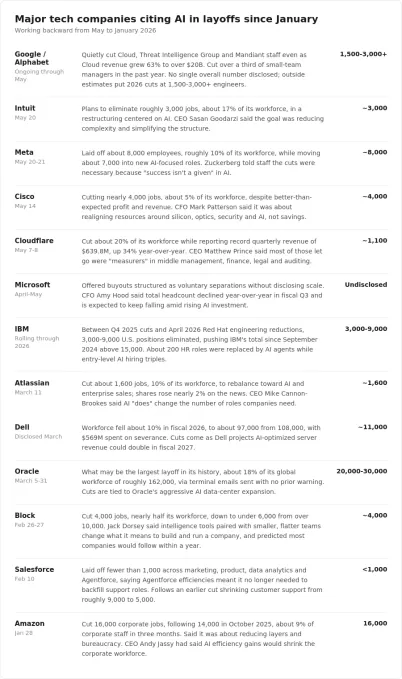
Image Credits:TechCrunch /
Related article
 Google Tests Remy AI Agent for Gemini as Focus Shifts to User Control
According to Business Insider, Google is testing Remy, a new AI personal agent for Gemini. This tool aims to execute tasks on behalf of users, streamlining both professional workflows and daily routines.Currently, Remy is undergoing testing in an int
Ollie bets privacy focus to win AI assistant race
To be genuinely helpful, an AI assistant must understand its user deeply. Ollie, a personal assistant designed for daily life, operates on the premise that this doesn’t require surrendering your data or compromising your privacy.While certain enterpr
How AI LIVE: London Will Explore AI & Industrial Automation
The summit will convene C-suite executives from around the globe to address pressing challenges in global industries, ranging from AI-driven disruption to economic volatility.AI LIVE: The London Summit will gather over 2,000 international leaders und
Related Special Topic Recommendations
Data Analysis
Google Tests Remy AI Agent for Gemini as Focus Shifts to User Control
According to Business Insider, Google is testing Remy, a new AI personal agent for Gemini. This tool aims to execute tasks on behalf of users, streamlining both professional workflows and daily routines.Currently, Remy is undergoing testing in an int
Ollie bets privacy focus to win AI assistant race
To be genuinely helpful, an AI assistant must understand its user deeply. Ollie, a personal assistant designed for daily life, operates on the premise that this doesn’t require surrendering your data or compromising your privacy.While certain enterpr
How AI LIVE: London Will Explore AI & Industrial Automation
The summit will convene C-suite executives from around the globe to address pressing challenges in global industries, ranging from AI-driven disruption to economic volatility.AI LIVE: The London Summit will gather over 2,000 international leaders und
Related Special Topic Recommendations
Data Analysis
 Best AI Anomaly Detection Tools for KPI Monitoring across SaaS and Ecommerce Teams
2026 Latest Best Top-rated AI Anomaly Detection Tools for KPI Monitoring in SaaS and Ecommerce teams! XIX.AI has curated a powerful, game-changing collection based on rigorous real-world tests and weekly updated rankings. You’ll find detailed free vs paid comparison insights to help you identify the must-try solution that boosts productivity and unlocks your AI edge. Explore now!
 10 tools
 xix.ai
writing
Best AI Outline Generators for Long-Form SEO Articles
xix.ai
writing
Best AI Outline Generators for Long-Form SEO Articles
2026 Latest Best Top-Rated AI Outline Generators for Long-Form SEO Articles, meticulously curated by XIX.AI. These powerful tools offer game-changing assistance in creating high-quality content quickly, boosting writing efficiency significantly. Get a free vs paid comparison along with real-world tests and detailed rankings to help you find the must-try option that suits your needs. Explore now to unlock your AI edge.
8 tools
xix.ai
Education and Learning
AI Study Tools for Homework and Exam Prep
2026 Latest Best AI Study Tools for Homework and Exam Prep! XIX.AI curates a top-rated list of powerful, game-changing tools that help students boost productivity, streamline homework completion, and ace exams through real-world tests. Get a free vs paid comparison, detailed rankings, and must-try options to unlock your AI edge. Explore now!
10 tools
xix.ai
Music composition
AI Vocal Demo Tools for Songwriters, Hooks, Toplines, and Multilingual Draft Sessions
2026 Latest Best AI Vocal Demo Tools for Songwriters, Hook Creators, and Multi-Language Content Teams! XIX.AI has curated a top-rated list of powerful game-changing tools that go through rigorous real-world tests. You’ll find detailed free vs paid comparison data, comprehensive rankings, and must-try options to help you boost writing efficiency and unlock your creative potential. Explore now to discover your perfect tool for all your content needs!
9 tools
xix.ai
Business
Best AI Competitive Research Tools for Small Businesses
2026 Latest Best Top-rated AI Competitive Research Tools for Small Businesses! XIX.AI has curated a highly powerful game-changing collection, updated weekly with rigorous real-world tests and detailed rankings. You can find a comprehensive free vs paid comparison to help you identify the must-try tools that boost your productivity and give you a competitive edge. Explore now to discover your perfect tool!
9 tools
xix.ai
Image editing
Photoshop AI Retouch Tools for Ecommerce Apparel, Skin Cleanup, and Color Consistency
2026 Latest Best Photoshop AI retouch tools for ecommerce apparel, skin cleanup, and color consistency! This top-rated curated list features powerful game-changing solutions that help you boost writing efficiency, streamline content creation, and achieve perfect visual results effortlessly. Each tool has undergone real-world tests through weekly updated rankings, complete with free vs paid comparison details. Backed by XIX.AI, it’s the must-try guide for anyone aiming to unlock your AI edge. Explore now!
10 tools
xix.ai

 Comments (10)
0/500
Comments (10)
0/500
![JasonMartin]()
Lucros recordes e demissões em massa usando IA como desculpa. É contraditório. A tecnologia deveria ajudar as pessoas, não substituí-las arbitrariamente.
![DouglasPerez]()
Ganancias récord y despidos masivos con la excusa de la IA. Es una contradicción enorme. La tecnología debería crear oportunidades, no eliminar trabajos sin razón.
![TerryHernández]()
Gewinne explodieren, aber Stellen werden unter dem Vorwand von KI gestrichen. Das ist ein Widerspruch. Technologie sollte unterstützen, nicht einfach Menschen ersetzen.
![EricRoberts]()
이익은 최고치인데 AI를 핑계로 해고라니? 모순이 심하네요. 기술 발전이 일자리를 없애는 도구로 쓰이면 안 되는데, 기업들의 태도가 참 아이러니합니다.
![DennisAllen]()
Прибыль на рекордном уровне, а людей увольняют под предлогом ИИ. Это абсурд. Технологии должны помогать, а не создавать безработицу для увеличения дивидендов.
![EricAllen]()
Des profits records et des licenciements massifs sous prétexte d'IA ? C'est contradictoire. La technologie devrait aider, pas remplacer brutalement les humains sans solution.
A peculiar contradiction is unfolding in the tech sector: corporations are reporting record-breaking profits and revenue while simultaneously shedding tens of thousands of jobs, with artificial intelligence cited as the primary justification. According to TrueUp, a tech recruiting platform and layoff tracker, there have been an estimated 363 layoffs at tech companies this year, impacting nearly 150,000 workers. This represents a daily average of roughly 974 people, a pace that is 44% faster than last year.
The acceleration of this trend is evident. Last month saw the highest single-month layoff count in two years, with nearly 40,000 positions cut. For the third consecutive month, AI has been the most frequently cited reason for these reductions across all industries, according to the outplacement firm Challenger, Grey & Christmas.
However, skepticism is mounting regarding whether AI is truly the root cause, with many suggesting it serves as a convenient cover story rather than the actual driver. A prominent example occurred earlier this year at Block, the payments company founded by Jack Dorsey. After facing intense criticism for laying off nearly half of its workforce, Dorsey initially denied that the cuts signaled underlying trouble, arguing instead that AI tools were enabling a fundamentally new way of building and running a company. However, after being challenged by users on X regarding the excessive hiring during the pandemic, Dorsey eventually conceded that Block had indeed over-hired.
Other industry leaders have echoed this sentiment. Prominent venture capitalist Marc Andreessen recently described AI as a “silver bullet excuse” for layoffs that are fundamentally driven by pandemic-era overstaffing. Speaking with podcaster-investor Harry Stebbings, Andreessen noted, “Essentially, every large company is overstaffed. It’s at least overstaffed by 25%. I think most large companies are overstaffed by 50%. I think a lot of them are overstaffed by 75%. Now they all have the silver bullet excuse: Ah, it’s AI.”
The ambiguity surrounding these decisions was further highlighted earlier this month at Uber. The company reduced its People Division—the unit responsible for HR and recruiting—by approximately 23%, affecting less than 1% of its 34,000 employees. A company spokesperson clarified that these cuts were unrelated to AI. Nevertheless, the announcement followed closely on the heels of Uber’s CTO revealing that the company had exhausted its entire 2026 AI coding budget in just four months, forcing a cap on individual engineers’ spending on tools like Cursor and Claude Code. Regardless of official statements, observers are keen to draw connections between these events.
What makes this situation particularly volatile is that, just as tens of thousands of workers are being let go, a select group of AI insiders is accumulating wealth on an incomprehensible scale.
Early last month, AI chipmaker Cerebras Systems saw its stock surge 68% from its $185 IPO price on its first day of trading on the Nasdaq, valuing the company at roughly $67 billion. This marked the largest US tech IPO since Snowflake’s debut in 2020. By market close, co-founders Andrew Feldman and Sean Lie had become billionaires, although the company’s shares have since dropped by 30%.
Meanwhile, SpaceX went public on Friday, boasting a market capitalization of $2.1 trillion at the time of this writing. This valuation has turned Elon Musk into a paper trillionaire and potentially created an estimated 4,400 millionaires and around 400 centimillionaires, assuming share prices remain stable.
Anthropic and OpenAI are also rapidly approaching public market valuations of approximately $1 trillion or more.
Against this backdrop, Mark Zuckerberg’s recent real estate acquisition takes on a new significance. In early March, he purchased a $170 million mansion in Miami’s “Billionaire Bunker,” setting a record for the most expensive home sale in Miami-Dade County history. Just two months later, Meta announced it would lay off 8,000 employees, representing roughly 10% of its workforce.
Zuckerberg is not alone among tech titans who routinely spend staggering sums on their real estate portfolios. However, these displays of extreme wealth occur at a time when many Americans are facing financial pressures greater than they have in years.
Consider the following data: workers with employer-sponsored health insurance are facing premium increases of about 6% to 7% this year, more than double the inflation rate. The cost of private health insurance has roughly doubled since 2008, median home prices have climbed 28% since early 2020, and mortgage rates have nearly doubled.
A January 2026 New York Times/Siena poll revealed that 65% of voters believe a middle-class lifestyle is now out of reach. A more recent poll found that 76% of Americans cite the cost of living as their top economic concern, a sharp increase from 58% a year earlier.
This narrative extends beyond isolated job losses. It involves tens of thousands of laid-off tech workers entering an unusually harsh economic environment at the same time that tens of thousands of AI insiders are realizing once-in-a-generation paper wealth—all while being told that AI is the reason for their unemployment. Whether or not this is the true explanation (many economists point to tariffs, geopolitical conflicts in the Middle East, and broader economic uncertainty as the actual drivers of corporate caution), the optics remain stark. One group is accumulating unfathomable wealth from advancements that are supposedly replacing the other.
Precedents for the consequences of such a widening divide are easy to find. In 2008, a financial crisis triggered by loose lending and excessive risk-taking on Wall Street resulted in bailouts for the banks responsible, while millions of Americans lost their jobs and homes during the ensuing Great Recession. Three years later, this public anger crystallized into the Occupy Wall Street movement.
If current trends continue, today’s situation could make Occupy Wall Street seem quaint in comparison. That earlier movement emerged from a crisis, with public anger focused on who would bear the cost of the cleanup. This time, there is no market crash to blame. Companies are profitable, AI itself is generating new fortunes overnight, and layoffs are proceeding anyway, with AI cited as the primary driver. If the optics of 2008 were, “We’re bailing out the people who broke the economy while you lose your job,” the optics here could ultimately be, “We’re getting richer than ever off the very technology we’re using to replace you.”
Many companies, including Block, Atlassian, and Cloudflare, have seen their stock prices surge when they attribute cuts to AI, making the strategy appear logical on the surface. However, these companies might want to consider whether this is truly the message they wish to convey to those they are laying off, and to the broader public watching these developments.
Image Credits:TechCrunch /







 Google Tests Remy AI Agent for Gemini as Focus Shifts to User Control
According to Business Insider, Google is testing Remy, a new AI personal agent for Gemini. This tool aims to execute tasks on behalf of users, streamlining both professional workflows and daily routines.Currently, Remy is undergoing testing in an int
Google Tests Remy AI Agent for Gemini as Focus Shifts to User Control
According to Business Insider, Google is testing Remy, a new AI personal agent for Gemini. This tool aims to execute tasks on behalf of users, streamlining both professional workflows and daily routines.Currently, Remy is undergoing testing in an int
 Ollie bets privacy focus to win AI assistant race
To be genuinely helpful, an AI assistant must understand its user deeply. Ollie, a personal assistant designed for daily life, operates on the premise that this doesn’t require surrendering your data or compromising your privacy.While certain enterpr
Ollie bets privacy focus to win AI assistant race
To be genuinely helpful, an AI assistant must understand its user deeply. Ollie, a personal assistant designed for daily life, operates on the premise that this doesn’t require surrendering your data or compromising your privacy.While certain enterpr
 How AI LIVE: London Will Explore AI & Industrial Automation
The summit will convene C-suite executives from around the globe to address pressing challenges in global industries, ranging from AI-driven disruption to economic volatility.AI LIVE: The London Summit will gather over 2,000 international leaders und
How AI LIVE: London Will Explore AI & Industrial Automation
The summit will convene C-suite executives from around the globe to address pressing challenges in global industries, ranging from AI-driven disruption to economic volatility.AI LIVE: The London Summit will gather over 2,000 international leaders und

2026 Latest Best Top-rated AI Anomaly Detection Tools for KPI Monitoring in SaaS and Ecommerce teams! XIX.AI has curated a powerful, game-changing collection based on rigorous real-world tests and weekly updated rankings. You’ll find detailed free vs paid comparison insights to help you identify the must-try solution that boosts productivity and unlocks your AI edge. Explore now!
10 tools
xix.ai

2026 Latest Best Top-Rated AI Outline Generators for Long-Form SEO Articles, meticulously curated by XIX.AI. These powerful tools offer game-changing assistance in creating high-quality content quickly, boosting writing efficiency significantly. Get a free vs paid comparison along with real-world tests and detailed rankings to help you find the must-try option that suits your needs. Explore now to unlock your AI edge.
8 tools
xix.ai

2026 Latest Best AI Study Tools for Homework and Exam Prep! XIX.AI curates a top-rated list of powerful, game-changing tools that help students boost productivity, streamline homework completion, and ace exams through real-world tests. Get a free vs paid comparison, detailed rankings, and must-try options to unlock your AI edge. Explore now!
10 tools
xix.ai

2026 Latest Best AI Vocal Demo Tools for Songwriters, Hook Creators, and Multi-Language Content Teams! XIX.AI has curated a top-rated list of powerful game-changing tools that go through rigorous real-world tests. You’ll find detailed free vs paid comparison data, comprehensive rankings, and must-try options to help you boost writing efficiency and unlock your creative potential. Explore now to discover your perfect tool for all your content needs!
9 tools
xix.ai

2026 Latest Best Top-rated AI Competitive Research Tools for Small Businesses! XIX.AI has curated a highly powerful game-changing collection, updated weekly with rigorous real-world tests and detailed rankings. You can find a comprehensive free vs paid comparison to help you identify the must-try tools that boost your productivity and give you a competitive edge. Explore now to discover your perfect tool!
9 tools
xix.ai

2026 Latest Best Photoshop AI retouch tools for ecommerce apparel, skin cleanup, and color consistency! This top-rated curated list features powerful game-changing solutions that help you boost writing efficiency, streamline content creation, and achieve perfect visual results effortlessly. Each tool has undergone real-world tests through weekly updated rankings, complete with free vs paid comparison details. Backed by XIX.AI, it’s the must-try guide for anyone aiming to unlock your AI edge. Explore now!
10 tools
xix.ai

Lucros recordes e demissões em massa usando IA como desculpa. É contraditório. A tecnologia deveria ajudar as pessoas, não substituí-las arbitrariamente.
Ganancias récord y despidos masivos con la excusa de la IA. Es una contradicción enorme. La tecnología debería crear oportunidades, no eliminar trabajos sin razón.
Gewinne explodieren, aber Stellen werden unter dem Vorwand von KI gestrichen. Das ist ein Widerspruch. Technologie sollte unterstützen, nicht einfach Menschen ersetzen.
이익은 최고치인데 AI를 핑계로 해고라니? 모순이 심하네요. 기술 발전이 일자리를 없애는 도구로 쓰이면 안 되는데, 기업들의 태도가 참 아이러니합니다.
Прибыль на рекордном уровне, а людей увольняют под предлогом ИИ. Это абсурд. Технологии должны помогать, а не создавать безработицу для увеличения дивидендов.
Des profits records et des licenciements massifs sous prétexte d'IA ? C'est contradictoire. La technologie devrait aider, pas remplacer brutalement les humains sans solution.












