


 Home
HomeThe $3 Trillion Question: Can AI Answer It?
Three years ago, Sequoia partner David Cahn became one of the first to quantify the impact of Silicon Valley’s massive spending on AI infrastructure.
In 2023, he responded to Nvidia’s reported $50 billion annual GPU revenue. Using that figure, plus the implied costs of running data centers and operator margins, he calculated that $200 billion in revenue would be needed to recoup the initial investment.
He framed it as a challenge, urging entrepreneurs to develop AI products and services that could leverage that infrastructure and generate revenue. Fast forward three years of hyperscaling, and Cahn now has a new estimate for AI infrastructure spending in 2026: $1.5 trillion.
All told, he estimates the AI industry must generate $3 trillion in revenue to justify all those chips and data center expenses. And that’s likely an underestimate—rising memory costs and greater use of specialized or inference-specific chips will push the figure higher. “Recently,” he writes, “the required revenue per GW of CapEx has sharply increased due to these bottleneck dynamics and rising costs of construction.”
On the other side of the ledger, Anthropic is believed to have reached $60 billion in annual recurring revenue (ARR), while OpenAI reportedly earned $13 billion in 2025 (though in November 2025 it claimed $20 billion ARR) and is likely earning more this year. Still, a significant gap remains.
One person tracking that gap is Torsten Slok, chief economist at Apollo, the giant asset manager. In a recent note, he observes that the hyperscalers—Google, Meta, Microsoft, and Amazon—are all forecasting substantial acceleration in free cash flow by 2028. In other words, they anticipate a payoff from all the chips they purchased.
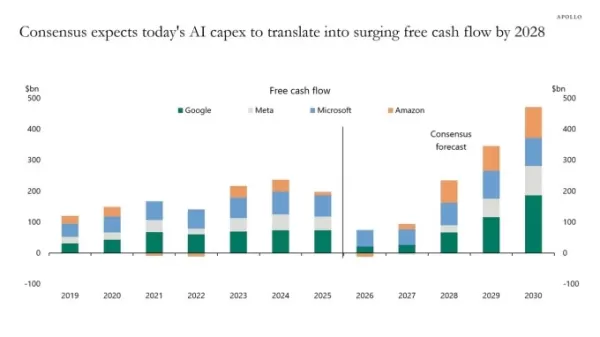
Image Credits:Torsten Slok/Apollo / Torsten Slok/Apollo
What if they don’t? Slok highlights a risk currently visible in AI usage: more organizations are shifting to cheaper open-weight models, often from China, rather than those created by frontier labs, and overall token prices are declining. According to CEO Sam Altman, OpenAI’s latest model is 54% more token-efficient for coding tasks. That benefits users worried about the cost of their AI agents, but it could hurt companies building token factories if users don’t dramatically increase their overall token consumption.
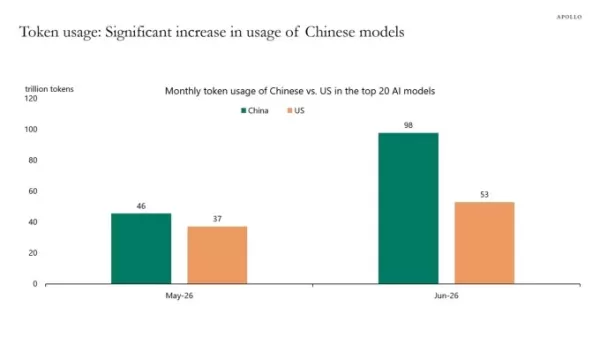
Image Credits:Torsten Slok/Apollo / Torsten Slok/Apollo
Slok worries that if hyperscalers fail to meet their cash flow targets, the market reaction could be severe—
“with so much riding on so few names,” he writes, “a slower payoff wouldn’t just be a sector problem, it would risk tipping the economy into recession and the S&P 500 into a correction.”
Just something to keep in mind as you steer your AI agents toward cheaper tokens.
Related article
 Apple, Google Partner With Anthropic to Address 27-Year-Old Vulnerability via Glass Wing Protection
As artificial intelligence advances rapidly in code generation and logical reasoning, the cybersecurity landscape faces unprecedented challenges. Recently, the prominent AI startup Anthropic officially launched a cross-industry collaboration called *
OpenAI Chief Scientist Addresses AI Reasoning Transparency Debate: Complexity Steady, No Sudden Jump
On September 2, Jakub Pachocki, OpenAI’s Chief Scientist, addressed public concerns on X regarding the AI model Astra, clarifying claims that it operates without oversight and lacks transparent reasoning.Why the Controversy Erupted: Deep Recurrence O
U.S. Navy Selects Blue Water Autonomy for Deep-Sea Survey Missions
Blue Water Autonomy’s Liberty Class is a 190-foot steel autonomous ship. | Source: Blue Water AutonomyBoston-based technology and shipbuilding firm Blue Water Autonomy has secured a multiple-award contract with the Naval Oceanographic Office (NAVOCEA
Related Special Topic Recommendations
Text-to-speech
Apple, Google Partner With Anthropic to Address 27-Year-Old Vulnerability via Glass Wing Protection
As artificial intelligence advances rapidly in code generation and logical reasoning, the cybersecurity landscape faces unprecedented challenges. Recently, the prominent AI startup Anthropic officially launched a cross-industry collaboration called *
OpenAI Chief Scientist Addresses AI Reasoning Transparency Debate: Complexity Steady, No Sudden Jump
On September 2, Jakub Pachocki, OpenAI’s Chief Scientist, addressed public concerns on X regarding the AI model Astra, clarifying claims that it operates without oversight and lacks transparent reasoning.Why the Controversy Erupted: Deep Recurrence O
U.S. Navy Selects Blue Water Autonomy for Deep-Sea Survey Missions
Blue Water Autonomy’s Liberty Class is a 190-foot steel autonomous ship. | Source: Blue Water AutonomyBoston-based technology and shipbuilding firm Blue Water Autonomy has secured a multiple-award contract with the Naval Oceanographic Office (NAVOCEA
Related Special Topic Recommendations
Text-to-speech
 Best AI Text to Speech Tools for Online Courses
2026 Latest Best Top-rated AI Text to Speech Tools for Online Courses are curated by XIX.AI based on rigorous real-world tests and weekly updated rankings. These powerful tools help creators deliver crystal-clear audio content effortlessly, boosting writing efficiency and streamlining course production. Check out the free vs paid comparison to find your perfect fit. Explore now to unlock your AI edge in online education.
 10 tools
 xix.ai
writing
AI Blog Title Tools for Higher Click Through Rates
xix.ai
writing
AI Blog Title Tools for Higher Click Through Rates
2026 Latest Best Top-Rated AI Blog Title Tools for Higher Click Through Rates! XIX.AI has carefully curated a powerful, game-changing collection of top tools that go through rigorous real-world tests. You’ll find a free vs paid comparison, weekly updated rankings, and detailed insights to help you boost your blog’s traffic efficiently. Must-try options are highlighted to help you unlock your AI edge. Explore now!
10 tools
xix.ai
automation
Best AI Task Routing Tools for Support Workflows
2026 Latest Best Top-rated AI Task Routing Tools for Support Workflows! XIX.AI has curated a highly powerful game-changing collection of must-try solutions, all undergoing rigorous real-world tests and updated weekly. These tools streamline workflows, boost productivity, and help teams deliver faster, more efficient support. Explore now to discover your perfect tool and unlock your AI edge!
17 tools
xix.ai
Academic Research
AI Citation and Paper Summary Tools
2026 Latest Best Top-Rated AI Citation and Paper Summary Tools Curated by XIX.AI. Get powerful game-changing solutions for quick content creation, improved writing efficiency, and boosting productivity. We offer a free vs paid comparison along with real-world tests and weekly updated rankings to help you find the must-try tool that fits your needs perfectly. Explore now to Unlock your AI edge.
10 tools
xix.ai
Productivity
Best AI Productivity Tools for Daily Work
2026 Latest Best Top-Rated AI Productivity Tools for Daily Work! XIX.AI has curated a powerful, game-changing selection based on rigorous weekly updated rankings and real-world tests. You’ll find must-try options that boost writing efficiency, streamline content creation, and help you overcome daily work challenges. Get a free vs paid comparison to find the perfect fit for your needs. Explore now to unlock your AI edge!
9 tools
xix.ai
Academic Research
AI Systematic Review Tools for Research Screening
2026 Latest Best Top-Rated AI Systematic Review Tools for Research Screening are here on XIX.AI! This curated collection includes powerful, game-changing solutions that go through rigorous real-world tests to deliver accurate results. We also offer a free vs paid comparison along with weekly updated rankings to help you find the must-try option that boosts your research efficiency significantly. Explore now to unlock your AI edge in academic work!
11 tools
xix.ai

 Comments (0)
0/500
Comments (0)
0/500
Three years ago, Sequoia partner David Cahn became one of the first to quantify the impact of Silicon Valley’s massive spending on AI infrastructure.
In 2023, he responded to Nvidia’s reported $50 billion annual GPU revenue. Using that figure, plus the implied costs of running data centers and operator margins, he calculated that $200 billion in revenue would be needed to recoup the initial investment.
He framed it as a challenge, urging entrepreneurs to develop AI products and services that could leverage that infrastructure and generate revenue. Fast forward three years of hyperscaling, and Cahn now has a new estimate for AI infrastructure spending in 2026: $1.5 trillion.
All told, he estimates the AI industry must generate $3 trillion in revenue to justify all those chips and data center expenses. And that’s likely an underestimate—rising memory costs and greater use of specialized or inference-specific chips will push the figure higher. “Recently,” he writes, “the required revenue per GW of CapEx has sharply increased due to these bottleneck dynamics and rising costs of construction.”
On the other side of the ledger, Anthropic is believed to have reached $60 billion in annual recurring revenue (ARR), while OpenAI reportedly earned $13 billion in 2025 (though in November 2025 it claimed $20 billion ARR) and is likely earning more this year. Still, a significant gap remains.
One person tracking that gap is Torsten Slok, chief economist at Apollo, the giant asset manager. In a recent note, he observes that the hyperscalers—Google, Meta, Microsoft, and Amazon—are all forecasting substantial acceleration in free cash flow by 2028. In other words, they anticipate a payoff from all the chips they purchased.
Image Credits:Torsten Slok/Apollo / Torsten Slok/Apollo
What if they don’t? Slok highlights a risk currently visible in AI usage: more organizations are shifting to cheaper open-weight models, often from China, rather than those created by frontier labs, and overall token prices are declining. According to CEO Sam Altman, OpenAI’s latest model is 54% more token-efficient for coding tasks. That benefits users worried about the cost of their AI agents, but it could hurt companies building token factories if users don’t dramatically increase their overall token consumption.
Image Credits:Torsten Slok/Apollo / Torsten Slok/Apollo
Slok worries that if hyperscalers fail to meet their cash flow targets, the market reaction could be severe—
“with so much riding on so few names,” he writes, “a slower payoff wouldn’t just be a sector problem, it would risk tipping the economy into recession and the S&P 500 into a correction.”
Just something to keep in mind as you steer your AI agents toward cheaper tokens.








 Apple, Google Partner With Anthropic to Address 27-Year-Old Vulnerability via Glass Wing Protection
As artificial intelligence advances rapidly in code generation and logical reasoning, the cybersecurity landscape faces unprecedented challenges. Recently, the prominent AI startup Anthropic officially launched a cross-industry collaboration called *
Apple, Google Partner With Anthropic to Address 27-Year-Old Vulnerability via Glass Wing Protection
As artificial intelligence advances rapidly in code generation and logical reasoning, the cybersecurity landscape faces unprecedented challenges. Recently, the prominent AI startup Anthropic officially launched a cross-industry collaboration called *
 OpenAI Chief Scientist Addresses AI Reasoning Transparency Debate: Complexity Steady, No Sudden Jump
On September 2, Jakub Pachocki, OpenAI’s Chief Scientist, addressed public concerns on X regarding the AI model Astra, clarifying claims that it operates without oversight and lacks transparent reasoning.Why the Controversy Erupted: Deep Recurrence O
OpenAI Chief Scientist Addresses AI Reasoning Transparency Debate: Complexity Steady, No Sudden Jump
On September 2, Jakub Pachocki, OpenAI’s Chief Scientist, addressed public concerns on X regarding the AI model Astra, clarifying claims that it operates without oversight and lacks transparent reasoning.Why the Controversy Erupted: Deep Recurrence O
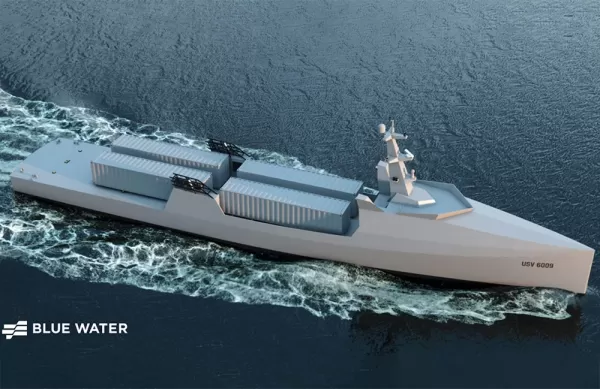 U.S. Navy Selects Blue Water Autonomy for Deep-Sea Survey Missions
Blue Water Autonomy’s Liberty Class is a 190-foot steel autonomous ship. | Source: Blue Water AutonomyBoston-based technology and shipbuilding firm Blue Water Autonomy has secured a multiple-award contract with the Naval Oceanographic Office (NAVOCEA
U.S. Navy Selects Blue Water Autonomy for Deep-Sea Survey Missions
Blue Water Autonomy’s Liberty Class is a 190-foot steel autonomous ship. | Source: Blue Water AutonomyBoston-based technology and shipbuilding firm Blue Water Autonomy has secured a multiple-award contract with the Naval Oceanographic Office (NAVOCEA

2026 Latest Best Top-rated AI Text to Speech Tools for Online Courses are curated by XIX.AI based on rigorous real-world tests and weekly updated rankings. These powerful tools help creators deliver crystal-clear audio content effortlessly, boosting writing efficiency and streamlining course production. Check out the free vs paid comparison to find your perfect fit. Explore now to unlock your AI edge in online education.
10 tools
xix.ai

2026 Latest Best Top-Rated AI Blog Title Tools for Higher Click Through Rates! XIX.AI has carefully curated a powerful, game-changing collection of top tools that go through rigorous real-world tests. You’ll find a free vs paid comparison, weekly updated rankings, and detailed insights to help you boost your blog’s traffic efficiently. Must-try options are highlighted to help you unlock your AI edge. Explore now!
10 tools
xix.ai

2026 Latest Best Top-rated AI Task Routing Tools for Support Workflows! XIX.AI has curated a highly powerful game-changing collection of must-try solutions, all undergoing rigorous real-world tests and updated weekly. These tools streamline workflows, boost productivity, and help teams deliver faster, more efficient support. Explore now to discover your perfect tool and unlock your AI edge!
17 tools
xix.ai
2026 Latest Best Top-Rated AI Citation and Paper Summary Tools Curated by XIX.AI. Get powerful game-changing solutions for quick content creation, improved writing efficiency, and boosting productivity. We offer a free vs paid comparison along with real-world tests and weekly updated rankings to help you find the must-try tool that fits your needs perfectly. Explore now to Unlock your AI edge.
10 tools
xix.ai

2026 Latest Best Top-Rated AI Productivity Tools for Daily Work! XIX.AI has curated a powerful, game-changing selection based on rigorous weekly updated rankings and real-world tests. You’ll find must-try options that boost writing efficiency, streamline content creation, and help you overcome daily work challenges. Get a free vs paid comparison to find the perfect fit for your needs. Explore now to unlock your AI edge!
9 tools
xix.ai

2026 Latest Best Top-Rated AI Systematic Review Tools for Research Screening are here on XIX.AI! This curated collection includes powerful, game-changing solutions that go through rigorous real-world tests to deliver accurate results. We also offer a free vs paid comparison along with weekly updated rankings to help you find the must-try option that boosts your research efficiency significantly. Explore now to unlock your AI edge in academic work!
11 tools
xix.ai












