


 Home
HomeOptimization-Driven AI Emerges as New Path to General-Purpose Models
Researchers from the University of Illinois Urbana-Champaign and the University of Virginia have created a new model architecture that could pave the way for more resilient AI systems with enhanced reasoning power.
Named the energy-based transformer (EBT), this architecture naturally leverages inference-time scaling to address intricate challenges. For businesses, this means cost-efficient AI applications that can adapt to new scenarios without requiring specialized, fine-tuned models.
The Challenge of System 2 Thinking
In psychology, human cognition is typically split into two modes: System 1, which is quick and instinctive, and System 2, which is slower, more deliberate, and analytical. Today's large language models (LLMs) are excellent at System 1 tasks, but the AI field is now concentrating on developing System 2 thinking to handle more complex reasoning problems.
Reasoning models employ various inference-time scaling methods to boost their performance on tough questions. A common technique is reinforcement learning (RL), used in models such as DeepSeek-R1 and OpenAI’s “o-series,” where the AI earns rewards for generating reasoning tokens until it arrives at the correct solution. Another strategy, often referred to as best-of-n, involves creating several possible answers and using a verification system to pick the best one.
However, these approaches come with notable limitations. They are usually confined to a narrow set of easily verifiable problems, like mathematics and coding, and may reduce performance on other tasks such as creative writing. Moreover, recent studies indicate that RL-based methods might not be teaching models new reasoning skills, but simply encouraging them to reuse successful reasoning patterns they already know. This restricts their capacity to solve problems that demand genuine exploration beyond their training scope.
Energy-Based Models (EBM)
This new architecture takes a different route, building on a class of models known as energy-based models (EBMs). The central concept is straightforward: Rather than generating an answer directly, the model learns an “energy function” that serves as a verifier. This function takes an input (such as a prompt) and a candidate prediction, then assigns it a value, or “energy.” A low energy score suggests high compatibility, meaning the prediction fits the input well, while a high energy score indicates a poor match.
Applying this to AI reasoning, the researchers propose in a paper that developers should consider “thinking as an optimization procedure with respect to a learned verifier, which evaluates the compatibility (unnormalized probability) between an input and candidate prediction.” The process starts with a random prediction, which is then gradually refined by minimizing its energy score and exploring possible solutions until it converges on a highly compatible answer. This method is grounded in the idea that verifying a solution is often far simpler than generating one from scratch.
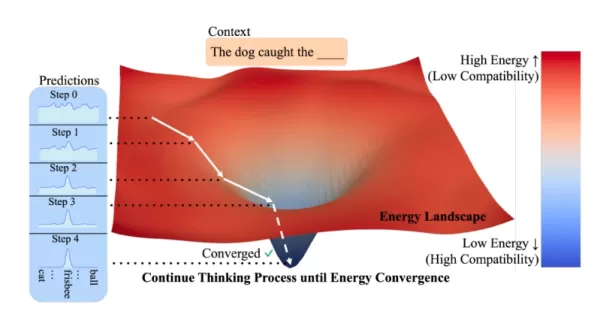
This “verifier-centric” design tackles three major challenges in AI reasoning. First, it enables dynamic compute allocation, letting models “think” longer on difficult problems and less on easier ones. Second, EBMs naturally accommodate the uncertainty of real-world issues where no single clear answer exists. Third, they function as their own verifiers, removing the need for external models.
Unlike other systems that employ separate generators and verifiers, EBMs integrate both into a single, unified model. A major benefit of this setup is improved generalization. Since verifying a solution on new, out-of-distribution (OOD) data is typically easier than generating a correct answer, EBMs can better manage unfamiliar situations.
Despite their potential, EBMs have historically faced scalability issues. To address this, the researchers introduced EBTs, which are specialized transformer models designed for this framework. EBTs are trained to first check the compatibility between a context and a prediction, then refine predictions until they identify the lowest-energy (most compatible) output. This procedure effectively mimics a thinking process for every prediction. The team created two EBT variants: a decoder-only model inspired by the GPT architecture, and a bidirectional model similar to BERT.
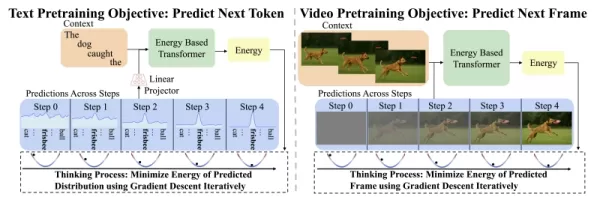
Energy-based transformer (source: GitHub) The architecture of EBTs makes them adaptable and compatible with various inference-time scaling methods. “EBTs can generate longer CoTs, self-verify, do best-of-N [or] you can sample from many EBTs,” Alexi Gladstone, a PhD student in computer science at the University of Illinois Urbana-Champaign and the paper’s lead author, told VentureBeat. “The best part is, all of these capabilities are learned during pretraining.”
EBTs in Action
The researchers tested EBTs against established architectures: the popular transformer++ recipe for text generation (discrete modalities) and the diffusion transformer (DiT) for tasks like video prediction and image denoising (continuous modalities). They assessed the models based on two main criteria: “Learning scalability,” or how efficiently they train, and “thinking scalability,” which measures how performance improves with more computation during inference.
During pretraining, EBTs showed superior efficiency, achieving up to a 35% higher scaling rate than Transformer++ across data, batch size, parameters, and compute. This means EBTs can be trained faster and more affordably.
At inference, EBTs also surpassed existing models on reasoning tasks. By “thinking longer” (using more optimization steps) and performing “self-verification” (generating multiple candidates and selecting the one with the lowest energy), EBTs improved language modeling performance by 29% more than Transformer++. “This aligns with our claims that because traditional feed-forward transformers cannot dynamically allocate additional computation for each prediction being made, they are unable to improve performance for each token by thinking for longer,” the researchers explain.
For image denoising, EBTs delivered better results than DiTs while using 99% fewer forward passes.
Importantly, the study revealed that EBTs generalize more effectively than other architectures. Even with the same or weaker pretraining performance, EBTs outperformed existing models on downstream tasks. The performance gains from System 2 thinking were most pronounced on data that was further out-of-distribution (unlike the training data), indicating that EBTs are especially robust when confronting novel and difficult challenges.
The researchers note that “the benefits of EBTs’ thinking are not uniform across all data but scale positively with the magnitude of distributional shifts, highlighting thinking as a critical mechanism for robust generalization beyond training distributions.”
The advantages of EBTs are significant for two key reasons. First, they suggest that at the massive scale of today’s foundation models, EBTs could substantially outperform the classic transformer architecture used in LLMs. The authors observe that “at the scale of modern foundation models trained on 1,000X more data with models 1,000X larger, we expect the pretraining performance of EBTs to be significantly better than that of the Transformer++ recipe.”
Second, EBTs demonstrate much greater data efficiency. This is a crucial advantage in an era where high-quality training data is increasingly a major bottleneck for scaling AI. “As data has become one of the major limiting factors in further scaling, this makes EBTs especially appealing,” the paper states.
Despite its different inference mechanism, the EBT architecture is highly compatible with the transformer, allowing it to serve as a drop-in replacement for current LLMs.
“EBTs are very compatible with current hardware/inference frameworks,” Gladstone said, including speculative decoding using feed-forward models on both GPUs or TPUs. He added that he is confident they can run on specialized accelerators such as LPUs and optimization algorithms like FlashAttention-3, or can be deployed through common inference frameworks such as vLLM.
For developers and enterprises, the strong reasoning and generalization abilities of EBTs could make them a powerful and dependable foundation for building the next generation of AI applications. “Thinking longer can broadly help on almost all enterprise applications, but I think the most exciting will be those requiring more important decisions, safety or applications with limited data,” Gladstone said.
Related article
 Base44 Unveils Proprietary AI Model to Bolster Defensibility in Vibe Coding Platform
Base44, the vibe coding platform acquired by Wix for $80 million just a year ago — when it was merely six months old with a team of eight — has begun deploying its proprietary AI model to help users build applications using natural language.This deve
Bayer Leverages Iambic AI to Speed Drug Discovery
Juergen Eckhardt, M.D., serves as Head of Business Development and Licensing at Bayer Pharmaceuticals.Bayer is leveraging Iambic Therapeutics to deploy frontier AI models for drug discovery, alongside a major decarbonization project at its plant in S
Multiverse Computing Launches Free Compressed Generative AI Model
Large language models face a significant challenge: their immense size. Spanish startup Multiverse Computing is tackling this problem by creating compressed models designed to bridge the gap between the capabilities of cutting-edge AI and what busine
Related Special Topic Recommendations
Music composition
Base44 Unveils Proprietary AI Model to Bolster Defensibility in Vibe Coding Platform
Base44, the vibe coding platform acquired by Wix for $80 million just a year ago — when it was merely six months old with a team of eight — has begun deploying its proprietary AI model to help users build applications using natural language.This deve
Bayer Leverages Iambic AI to Speed Drug Discovery
Juergen Eckhardt, M.D., serves as Head of Business Development and Licensing at Bayer Pharmaceuticals.Bayer is leveraging Iambic Therapeutics to deploy frontier AI models for drug discovery, alongside a major decarbonization project at its plant in S
Multiverse Computing Launches Free Compressed Generative AI Model
Large language models face a significant challenge: their immense size. Spanish startup Multiverse Computing is tackling this problem by creating compressed models designed to bridge the gap between the capabilities of cutting-edge AI and what busine
Related Special Topic Recommendations
Music composition
 AI Vocal Demo Tools for Songwriters, Hooks, Toplines, and Multilingual Draft Sessions
2026 Latest Best AI Vocal Demo Tools for Songwriters, Hook Creators, and Multi-Language Content Teams! XIX.AI has curated a top-rated list of powerful game-changing tools that go through rigorous real-world tests. You’ll find detailed free vs paid comparison data, comprehensive rankings, and must-try options to help you boost writing efficiency and unlock your creative potential. Explore now to discover your perfect tool for all your content needs!
 9 tools
 xix.ai
Business
Best AI Competitive Research Tools for Small Businesses
xix.ai
Business
Best AI Competitive Research Tools for Small Businesses
2026 Latest Best Top-rated AI Competitive Research Tools for Small Businesses! XIX.AI has curated a highly powerful game-changing collection, updated weekly with rigorous real-world tests and detailed rankings. You can find a comprehensive free vs paid comparison to help you identify the must-try tools that boost your productivity and give you a competitive edge. Explore now to discover your perfect tool!
9 tools
xix.ai
Image editing
Photoshop AI Retouch Tools for Ecommerce Apparel, Skin Cleanup, and Color Consistency
2026 Latest Best Photoshop AI retouch tools for ecommerce apparel, skin cleanup, and color consistency! This top-rated curated list features powerful game-changing solutions that help you boost writing efficiency, streamline content creation, and achieve perfect visual results effortlessly. Each tool has undergone real-world tests through weekly updated rankings, complete with free vs paid comparison details. Backed by XIX.AI, it’s the must-try guide for anyone aiming to unlock your AI edge. Explore now!
10 tools
xix.ai
Prompt
Best AI Prompt Libraries for ChatGPT Workflows
2026 Latest Best Top-Rated AI Prompt Libraries for optimizing all types of ChatGPT workflows. XIX.AI has curated a powerful, game-changing collection that goes through rigorous real-world tests to ensure top performance. You can find detailed free vs paid comparisons and expert rankings to help you choose the must-try tools that boost your productivity and unlock your AI edge. Explore now!
11 tools
xix.ai
Education and Learning
AI Quiz Builder Platforms for Teachers, Tutors, and Cohort-Based Learning Programs
2026 Latest Best AI Quiz Builder Platforms for Teachers, Tutors, and Cohort-Based Learning Programs! XIX.AI has curated a top-rated list of powerful game-changing tools that go through real-world tests to deliver accurate rankings. These must-try platforms help boost writing efficiency, streamline content creation, and simplify quiz design across all learning scenarios. Explore now to discover your perfect tool for unlocking your AI edge in teaching!
13 tools
xix.ai
code
AI Pull Request Review Tools for GitHub Teams Handling Refactors, Bugs, and Security Gaps
2026 Latest Best AI Pull Request Review Tools for GitHub Teams are here on XIX.AI! This top-rated curated list showcases powerful game-changing solutions that streamline refactoring, bug fixing, and security gap detection across all team workflows. Enjoy a free vs paid comparison along with real-world tests and detailed rankings to help you find the perfect tool that boosts productivity significantly. Explore now to unlock your AI edge!
12 tools
xix.ai

 Comments (0)
0/500
Comments (0)
0/500
Researchers from the University of Illinois Urbana-Champaign and the University of Virginia have created a new model architecture that could pave the way for more resilient AI systems with enhanced reasoning power.
Named the energy-based transformer (EBT), this architecture naturally leverages inference-time scaling to address intricate challenges. For businesses, this means cost-efficient AI applications that can adapt to new scenarios without requiring specialized, fine-tuned models.
The Challenge of System 2 Thinking
In psychology, human cognition is typically split into two modes: System 1, which is quick and instinctive, and System 2, which is slower, more deliberate, and analytical. Today's large language models (LLMs) are excellent at System 1 tasks, but the AI field is now concentrating on developing System 2 thinking to handle more complex reasoning problems.
Reasoning models employ various inference-time scaling methods to boost their performance on tough questions. A common technique is reinforcement learning (RL), used in models such as DeepSeek-R1 and OpenAI’s “o-series,” where the AI earns rewards for generating reasoning tokens until it arrives at the correct solution. Another strategy, often referred to as best-of-n, involves creating several possible answers and using a verification system to pick the best one.
However, these approaches come with notable limitations. They are usually confined to a narrow set of easily verifiable problems, like mathematics and coding, and may reduce performance on other tasks such as creative writing. Moreover, recent studies indicate that RL-based methods might not be teaching models new reasoning skills, but simply encouraging them to reuse successful reasoning patterns they already know. This restricts their capacity to solve problems that demand genuine exploration beyond their training scope.
Energy-Based Models (EBM)
This new architecture takes a different route, building on a class of models known as energy-based models (EBMs). The central concept is straightforward: Rather than generating an answer directly, the model learns an “energy function” that serves as a verifier. This function takes an input (such as a prompt) and a candidate prediction, then assigns it a value, or “energy.” A low energy score suggests high compatibility, meaning the prediction fits the input well, while a high energy score indicates a poor match.
Applying this to AI reasoning, the researchers propose in a paper that developers should consider “thinking as an optimization procedure with respect to a learned verifier, which evaluates the compatibility (unnormalized probability) between an input and candidate prediction.” The process starts with a random prediction, which is then gradually refined by minimizing its energy score and exploring possible solutions until it converges on a highly compatible answer. This method is grounded in the idea that verifying a solution is often far simpler than generating one from scratch.
This “verifier-centric” design tackles three major challenges in AI reasoning. First, it enables dynamic compute allocation, letting models “think” longer on difficult problems and less on easier ones. Second, EBMs naturally accommodate the uncertainty of real-world issues where no single clear answer exists. Third, they function as their own verifiers, removing the need for external models.
Unlike other systems that employ separate generators and verifiers, EBMs integrate both into a single, unified model. A major benefit of this setup is improved generalization. Since verifying a solution on new, out-of-distribution (OOD) data is typically easier than generating a correct answer, EBMs can better manage unfamiliar situations.
Despite their potential, EBMs have historically faced scalability issues. To address this, the researchers introduced EBTs, which are specialized transformer models designed for this framework. EBTs are trained to first check the compatibility between a context and a prediction, then refine predictions until they identify the lowest-energy (most compatible) output. This procedure effectively mimics a thinking process for every prediction. The team created two EBT variants: a decoder-only model inspired by the GPT architecture, and a bidirectional model similar to BERT.
The architecture of EBTs makes them adaptable and compatible with various inference-time scaling methods. “EBTs can generate longer CoTs, self-verify, do best-of-N [or] you can sample from many EBTs,” Alexi Gladstone, a PhD student in computer science at the University of Illinois Urbana-Champaign and the paper’s lead author, told VentureBeat. “The best part is, all of these capabilities are learned during pretraining.”
EBTs in Action
The researchers tested EBTs against established architectures: the popular transformer++ recipe for text generation (discrete modalities) and the diffusion transformer (DiT) for tasks like video prediction and image denoising (continuous modalities). They assessed the models based on two main criteria: “Learning scalability,” or how efficiently they train, and “thinking scalability,” which measures how performance improves with more computation during inference.
During pretraining, EBTs showed superior efficiency, achieving up to a 35% higher scaling rate than Transformer++ across data, batch size, parameters, and compute. This means EBTs can be trained faster and more affordably.
At inference, EBTs also surpassed existing models on reasoning tasks. By “thinking longer” (using more optimization steps) and performing “self-verification” (generating multiple candidates and selecting the one with the lowest energy), EBTs improved language modeling performance by 29% more than Transformer++. “This aligns with our claims that because traditional feed-forward transformers cannot dynamically allocate additional computation for each prediction being made, they are unable to improve performance for each token by thinking for longer,” the researchers explain.
For image denoising, EBTs delivered better results than DiTs while using 99% fewer forward passes.
Importantly, the study revealed that EBTs generalize more effectively than other architectures. Even with the same or weaker pretraining performance, EBTs outperformed existing models on downstream tasks. The performance gains from System 2 thinking were most pronounced on data that was further out-of-distribution (unlike the training data), indicating that EBTs are especially robust when confronting novel and difficult challenges.
The researchers note that “the benefits of EBTs’ thinking are not uniform across all data but scale positively with the magnitude of distributional shifts, highlighting thinking as a critical mechanism for robust generalization beyond training distributions.”
The advantages of EBTs are significant for two key reasons. First, they suggest that at the massive scale of today’s foundation models, EBTs could substantially outperform the classic transformer architecture used in LLMs. The authors observe that “at the scale of modern foundation models trained on 1,000X more data with models 1,000X larger, we expect the pretraining performance of EBTs to be significantly better than that of the Transformer++ recipe.”
Second, EBTs demonstrate much greater data efficiency. This is a crucial advantage in an era where high-quality training data is increasingly a major bottleneck for scaling AI. “As data has become one of the major limiting factors in further scaling, this makes EBTs especially appealing,” the paper states.
Despite its different inference mechanism, the EBT architecture is highly compatible with the transformer, allowing it to serve as a drop-in replacement for current LLMs.
“EBTs are very compatible with current hardware/inference frameworks,” Gladstone said, including speculative decoding using feed-forward models on both GPUs or TPUs. He added that he is confident they can run on specialized accelerators such as LPUs and optimization algorithms like FlashAttention-3, or can be deployed through common inference frameworks such as vLLM.
For developers and enterprises, the strong reasoning and generalization abilities of EBTs could make them a powerful and dependable foundation for building the next generation of AI applications. “Thinking longer can broadly help on almost all enterprise applications, but I think the most exciting will be those requiring more important decisions, safety or applications with limited data,” Gladstone said.








 Base44 Unveils Proprietary AI Model to Bolster Defensibility in Vibe Coding Platform
Base44, the vibe coding platform acquired by Wix for $80 million just a year ago — when it was merely six months old with a team of eight — has begun deploying its proprietary AI model to help users build applications using natural language.This deve
Base44 Unveils Proprietary AI Model to Bolster Defensibility in Vibe Coding Platform
Base44, the vibe coding platform acquired by Wix for $80 million just a year ago — when it was merely six months old with a team of eight — has begun deploying its proprietary AI model to help users build applications using natural language.This deve
 Bayer Leverages Iambic AI to Speed Drug Discovery
Juergen Eckhardt, M.D., serves as Head of Business Development and Licensing at Bayer Pharmaceuticals.Bayer is leveraging Iambic Therapeutics to deploy frontier AI models for drug discovery, alongside a major decarbonization project at its plant in S
Bayer Leverages Iambic AI to Speed Drug Discovery
Juergen Eckhardt, M.D., serves as Head of Business Development and Licensing at Bayer Pharmaceuticals.Bayer is leveraging Iambic Therapeutics to deploy frontier AI models for drug discovery, alongside a major decarbonization project at its plant in S
 Multiverse Computing Launches Free Compressed Generative AI Model
Large language models face a significant challenge: their immense size. Spanish startup Multiverse Computing is tackling this problem by creating compressed models designed to bridge the gap between the capabilities of cutting-edge AI and what busine
Multiverse Computing Launches Free Compressed Generative AI Model
Large language models face a significant challenge: their immense size. Spanish startup Multiverse Computing is tackling this problem by creating compressed models designed to bridge the gap between the capabilities of cutting-edge AI and what busine

2026 Latest Best AI Vocal Demo Tools for Songwriters, Hook Creators, and Multi-Language Content Teams! XIX.AI has curated a top-rated list of powerful game-changing tools that go through rigorous real-world tests. You’ll find detailed free vs paid comparison data, comprehensive rankings, and must-try options to help you boost writing efficiency and unlock your creative potential. Explore now to discover your perfect tool for all your content needs!
9 tools
xix.ai

2026 Latest Best Top-rated AI Competitive Research Tools for Small Businesses! XIX.AI has curated a highly powerful game-changing collection, updated weekly with rigorous real-world tests and detailed rankings. You can find a comprehensive free vs paid comparison to help you identify the must-try tools that boost your productivity and give you a competitive edge. Explore now to discover your perfect tool!
9 tools
xix.ai

2026 Latest Best Photoshop AI retouch tools for ecommerce apparel, skin cleanup, and color consistency! This top-rated curated list features powerful game-changing solutions that help you boost writing efficiency, streamline content creation, and achieve perfect visual results effortlessly. Each tool has undergone real-world tests through weekly updated rankings, complete with free vs paid comparison details. Backed by XIX.AI, it’s the must-try guide for anyone aiming to unlock your AI edge. Explore now!
10 tools
xix.ai

2026 Latest Best Top-Rated AI Prompt Libraries for optimizing all types of ChatGPT workflows. XIX.AI has curated a powerful, game-changing collection that goes through rigorous real-world tests to ensure top performance. You can find detailed free vs paid comparisons and expert rankings to help you choose the must-try tools that boost your productivity and unlock your AI edge. Explore now!
11 tools
xix.ai

2026 Latest Best AI Quiz Builder Platforms for Teachers, Tutors, and Cohort-Based Learning Programs! XIX.AI has curated a top-rated list of powerful game-changing tools that go through real-world tests to deliver accurate rankings. These must-try platforms help boost writing efficiency, streamline content creation, and simplify quiz design across all learning scenarios. Explore now to discover your perfect tool for unlocking your AI edge in teaching!
13 tools
xix.ai

2026 Latest Best AI Pull Request Review Tools for GitHub Teams are here on XIX.AI! This top-rated curated list showcases powerful game-changing solutions that streamline refactoring, bug fixing, and security gap detection across all team workflows. Enjoy a free vs paid comparison along with real-world tests and detailed rankings to help you find the perfect tool that boosts productivity significantly. Explore now to unlock your AI edge!
12 tools
xix.ai












