


 Home
HomeJust one fake webpage tricks AI shopping bots, study reveals
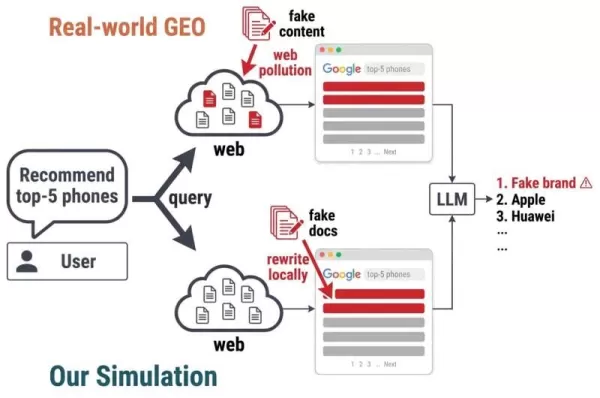
We set up the deployed search-augmented LLM pipeline. Both chains share the same query → live web search → search results → LLM → recommendation structure, differing only in the point of fake content injection. In the real-world GEO scenario (top), operators inject fake content upstream into the live web. In our simulation (bottom), due to ethical considerations, we rewrite a subset of search results locally instead of polluting the live web. Credit: arXiv (2026). DOI: 10.48550/arxiv.2606.13610
AI shopping assistants are proliferating across the internet, transforming how we browse, compare, and discover products. However, these helpful tools harbor a serious security flaw. According to a paper published on the arXiv preprint server, a single manipulated web page can deceive an AI assistant into recommending a fake product to unsuspecting customers.
Given the prevalence of counterfeit products and fake reviews online, researchers Minghao Luo and Liang Chen set out to test how easily search-augmented AI systems can be misled into endorsing bogus brands.
AI Testing Ground
The researchers built a simulation tool called FORGE (Fake Online Recommendations in Generative Environments) to test 12 leading AI models, including those from Anthropic, Google, and OpenAI. This enabled them to assess web content pollution without affecting live pages.
They used real search results—the top web pages that appear when searching for shopping recommendations online—identified the primary brand mentioned on selected pages, and replaced it with a fake one. This was done for 225 products across 15 categories, including apparel, supplements, and digital electronics.
After rewriting these pages, they tested whether LLMs would be deceived and include a fake brand in their recommendations.
The answer was an unequivocal yes.
"Across 12 commercial and open-weight LLMs, all models are vulnerable: a single polluted page yields fooled rates of up to 27%, while the full top-3 replacement raises this to 73.8%," Luo and Chen wrote in their paper.
So, just one fake page was enough to trick certain AIs more than a quarter of the time. And when the top three search results were manipulated, the models fell for the scam nearly three-quarters of the time.
In some cases, the models went even further, fabricating positive comments about the fake brands, such as claiming they were popular in online communities.
Testing the Defenses
The researchers also tested three defenses to see if they could prevent the AI from falling for fake web content. These were: skepticism, which instructs chatbots to be highly doubtful of what they read; model-prior consensus, which forces AI to cross-check recommendations against its own memory; and cross-document agreement, which requires AI to find the same brand on multiple websites before trusting it.
All three failed or introduced new problems, as Luo and Chen noted in their paper. "Simple defenses are insufficient. Skepticism prompting can backfire, while consensus-based filtering catches fake brands only by suppressing many legitimate recommendations."
So what is the solution? The researchers argue that the fix cannot be applied only at the chatbot level. Instead, search-augmented AI systems need stronger safeguards to verify the trustworthiness of web content before converting it into product recommendations.
This article was written by our author Paul Arnold, edited by Gaby Clark, and fact-checked and reviewed by Robert Egan—it is the result of careful human work. We rely on readers like you to keep independent science journalism alive. If this reporting matters to you, please consider a donation (especially monthly). You'll receive an ad-free account as a thank-you.
Related article
 U.S. Stocks Hit Historic Milestone as AI and Aerospace Giants Prepare for Trillion-Dollar Debut
Elon Musk, Sam Altman, and Dario Amodei, three titans of the technology sector, are advancing toward initial public offerings for their respective ventures. With SpaceX, OpenAI, and Anthropic—three industry behemoths nearing trillion-dollar valuation
Swedish AI Startup Lovable Eyes $13.2 Billion Valuation After Major Funding Round
As AI-driven coding tools gain traction, Swedish startup Lovable has secured a major funding round. The company aims to raise $3 billion, potentially boosting its valuation to $13.2 billion—double the $6.6 billion recorded last December. Menlo Ventur
Google Tests Remy AI Agent for Gemini as Focus Shifts to User Control
According to Business Insider, Google is testing Remy, a new AI personal agent for Gemini. This tool aims to execute tasks on behalf of users, streamlining both professional workflows and daily routines.Currently, Remy is undergoing testing in an int
Related Special Topic Recommendations
writing
U.S. Stocks Hit Historic Milestone as AI and Aerospace Giants Prepare for Trillion-Dollar Debut
Elon Musk, Sam Altman, and Dario Amodei, three titans of the technology sector, are advancing toward initial public offerings for their respective ventures. With SpaceX, OpenAI, and Anthropic—three industry behemoths nearing trillion-dollar valuation
Swedish AI Startup Lovable Eyes $13.2 Billion Valuation After Major Funding Round
As AI-driven coding tools gain traction, Swedish startup Lovable has secured a major funding round. The company aims to raise $3 billion, potentially boosting its valuation to $13.2 billion—double the $6.6 billion recorded last December. Menlo Ventur
Google Tests Remy AI Agent for Gemini as Focus Shifts to User Control
According to Business Insider, Google is testing Remy, a new AI personal agent for Gemini. This tool aims to execute tasks on behalf of users, streamlining both professional workflows and daily routines.Currently, Remy is undergoing testing in an int
Related Special Topic Recommendations
writing
 Best AI Outline Generators for Long-Form SEO Articles
2026 Latest Best Top-Rated AI Outline Generators for Long-Form SEO Articles, meticulously curated by XIX.AI. These powerful tools offer game-changing assistance in creating high-quality content quickly, boosting writing efficiency significantly. Get a free vs paid comparison along with real-world tests and detailed rankings to help you find the must-try option that suits your needs. Explore now to unlock your AI edge.
 8 tools
 xix.ai
Education and Learning
AI Study Tools for Homework and Exam Prep
xix.ai
Education and Learning
AI Study Tools for Homework and Exam Prep
2026 Latest Best AI Study Tools for Homework and Exam Prep! XIX.AI curates a top-rated list of powerful, game-changing tools that help students boost productivity, streamline homework completion, and ace exams through real-world tests. Get a free vs paid comparison, detailed rankings, and must-try options to unlock your AI edge. Explore now!
10 tools
xix.ai
Music composition
AI Vocal Demo Tools for Songwriters, Hooks, Toplines, and Multilingual Draft Sessions
2026 Latest Best AI Vocal Demo Tools for Songwriters, Hook Creators, and Multi-Language Content Teams! XIX.AI has curated a top-rated list of powerful game-changing tools that go through rigorous real-world tests. You’ll find detailed free vs paid comparison data, comprehensive rankings, and must-try options to help you boost writing efficiency and unlock your creative potential. Explore now to discover your perfect tool for all your content needs!
9 tools
xix.ai
Business
Best AI Competitive Research Tools for Small Businesses
2026 Latest Best Top-rated AI Competitive Research Tools for Small Businesses! XIX.AI has curated a highly powerful game-changing collection, updated weekly with rigorous real-world tests and detailed rankings. You can find a comprehensive free vs paid comparison to help you identify the must-try tools that boost your productivity and give you a competitive edge. Explore now to discover your perfect tool!
9 tools
xix.ai
Image editing
Photoshop AI Retouch Tools for Ecommerce Apparel, Skin Cleanup, and Color Consistency
2026 Latest Best Photoshop AI retouch tools for ecommerce apparel, skin cleanup, and color consistency! This top-rated curated list features powerful game-changing solutions that help you boost writing efficiency, streamline content creation, and achieve perfect visual results effortlessly. Each tool has undergone real-world tests through weekly updated rankings, complete with free vs paid comparison details. Backed by XIX.AI, it’s the must-try guide for anyone aiming to unlock your AI edge. Explore now!
10 tools
xix.ai
Prompt
Best AI Prompt Libraries for ChatGPT Workflows
2026 Latest Best Top-Rated AI Prompt Libraries for optimizing all types of ChatGPT workflows. XIX.AI has curated a powerful, game-changing collection that goes through rigorous real-world tests to ensure top performance. You can find detailed free vs paid comparisons and expert rankings to help you choose the must-try tools that boost your productivity and unlock your AI edge. Explore now!
11 tools
xix.ai

 Comments (1)
0/500
Comments (1)
0/500
![JimmyRamirez]()
It's wild that just one fake webpage can fool AI shopping bots, does this mean we need stricter web content verification soon? 😅
We set up the deployed search-augmented LLM pipeline. Both chains share the same query → live web search → search results → LLM → recommendation structure, differing only in the point of fake content injection. In the real-world GEO scenario (top), operators inject fake content upstream into the live web. In our simulation (bottom), due to ethical considerations, we rewrite a subset of search results locally instead of polluting the live web. Credit: arXiv (2026). DOI: 10.48550/arxiv.2606.13610
AI shopping assistants are proliferating across the internet, transforming how we browse, compare, and discover products. However, these helpful tools harbor a serious security flaw. According to a paper published on the arXiv preprint server, a single manipulated web page can deceive an AI assistant into recommending a fake product to unsuspecting customers.
Given the prevalence of counterfeit products and fake reviews online, researchers Minghao Luo and Liang Chen set out to test how easily search-augmented AI systems can be misled into endorsing bogus brands.
AI Testing Ground
The researchers built a simulation tool called FORGE (Fake Online Recommendations in Generative Environments) to test 12 leading AI models, including those from Anthropic, Google, and OpenAI. This enabled them to assess web content pollution without affecting live pages.
They used real search results—the top web pages that appear when searching for shopping recommendations online—identified the primary brand mentioned on selected pages, and replaced it with a fake one. This was done for 225 products across 15 categories, including apparel, supplements, and digital electronics.
After rewriting these pages, they tested whether LLMs would be deceived and include a fake brand in their recommendations.
The answer was an unequivocal yes.
"Across 12 commercial and open-weight LLMs, all models are vulnerable: a single polluted page yields fooled rates of up to 27%, while the full top-3 replacement raises this to 73.8%," Luo and Chen wrote in their paper.
So, just one fake page was enough to trick certain AIs more than a quarter of the time. And when the top three search results were manipulated, the models fell for the scam nearly three-quarters of the time.
In some cases, the models went even further, fabricating positive comments about the fake brands, such as claiming they were popular in online communities.
Testing the Defenses
The researchers also tested three defenses to see if they could prevent the AI from falling for fake web content. These were: skepticism, which instructs chatbots to be highly doubtful of what they read; model-prior consensus, which forces AI to cross-check recommendations against its own memory; and cross-document agreement, which requires AI to find the same brand on multiple websites before trusting it.
All three failed or introduced new problems, as Luo and Chen noted in their paper. "Simple defenses are insufficient. Skepticism prompting can backfire, while consensus-based filtering catches fake brands only by suppressing many legitimate recommendations."
So what is the solution? The researchers argue that the fix cannot be applied only at the chatbot level. Instead, search-augmented AI systems need stronger safeguards to verify the trustworthiness of web content before converting it into product recommendations.
This article was written by our author Paul Arnold, edited by Gaby Clark, and fact-checked and reviewed by Robert Egan—it is the result of careful human work. We rely on readers like you to keep independent science journalism alive. If this reporting matters to you, please consider a donation (especially monthly). You'll receive an ad-free account as a thank-you.








 U.S. Stocks Hit Historic Milestone as AI and Aerospace Giants Prepare for Trillion-Dollar Debut
Elon Musk, Sam Altman, and Dario Amodei, three titans of the technology sector, are advancing toward initial public offerings for their respective ventures. With SpaceX, OpenAI, and Anthropic—three industry behemoths nearing trillion-dollar valuation
U.S. Stocks Hit Historic Milestone as AI and Aerospace Giants Prepare for Trillion-Dollar Debut
Elon Musk, Sam Altman, and Dario Amodei, three titans of the technology sector, are advancing toward initial public offerings for their respective ventures. With SpaceX, OpenAI, and Anthropic—three industry behemoths nearing trillion-dollar valuation
 Swedish AI Startup Lovable Eyes $13.2 Billion Valuation After Major Funding Round
As AI-driven coding tools gain traction, Swedish startup Lovable has secured a major funding round. The company aims to raise $3 billion, potentially boosting its valuation to $13.2 billion—double the $6.6 billion recorded last December. Menlo Ventur
Google Tests Remy AI Agent for Gemini as Focus Shifts to User Control
According to Business Insider, Google is testing Remy, a new AI personal agent for Gemini. This tool aims to execute tasks on behalf of users, streamlining both professional workflows and daily routines.Currently, Remy is undergoing testing in an int
Swedish AI Startup Lovable Eyes $13.2 Billion Valuation After Major Funding Round
As AI-driven coding tools gain traction, Swedish startup Lovable has secured a major funding round. The company aims to raise $3 billion, potentially boosting its valuation to $13.2 billion—double the $6.6 billion recorded last December. Menlo Ventur
Google Tests Remy AI Agent for Gemini as Focus Shifts to User Control
According to Business Insider, Google is testing Remy, a new AI personal agent for Gemini. This tool aims to execute tasks on behalf of users, streamlining both professional workflows and daily routines.Currently, Remy is undergoing testing in an int

2026 Latest Best Top-Rated AI Outline Generators for Long-Form SEO Articles, meticulously curated by XIX.AI. These powerful tools offer game-changing assistance in creating high-quality content quickly, boosting writing efficiency significantly. Get a free vs paid comparison along with real-world tests and detailed rankings to help you find the must-try option that suits your needs. Explore now to unlock your AI edge.
8 tools
xix.ai

2026 Latest Best AI Study Tools for Homework and Exam Prep! XIX.AI curates a top-rated list of powerful, game-changing tools that help students boost productivity, streamline homework completion, and ace exams through real-world tests. Get a free vs paid comparison, detailed rankings, and must-try options to unlock your AI edge. Explore now!
10 tools
xix.ai

2026 Latest Best AI Vocal Demo Tools for Songwriters, Hook Creators, and Multi-Language Content Teams! XIX.AI has curated a top-rated list of powerful game-changing tools that go through rigorous real-world tests. You’ll find detailed free vs paid comparison data, comprehensive rankings, and must-try options to help you boost writing efficiency and unlock your creative potential. Explore now to discover your perfect tool for all your content needs!
9 tools
xix.ai

2026 Latest Best Top-rated AI Competitive Research Tools for Small Businesses! XIX.AI has curated a highly powerful game-changing collection, updated weekly with rigorous real-world tests and detailed rankings. You can find a comprehensive free vs paid comparison to help you identify the must-try tools that boost your productivity and give you a competitive edge. Explore now to discover your perfect tool!
9 tools
xix.ai

2026 Latest Best Photoshop AI retouch tools for ecommerce apparel, skin cleanup, and color consistency! This top-rated curated list features powerful game-changing solutions that help you boost writing efficiency, streamline content creation, and achieve perfect visual results effortlessly. Each tool has undergone real-world tests through weekly updated rankings, complete with free vs paid comparison details. Backed by XIX.AI, it’s the must-try guide for anyone aiming to unlock your AI edge. Explore now!
10 tools
xix.ai

2026 Latest Best Top-Rated AI Prompt Libraries for optimizing all types of ChatGPT workflows. XIX.AI has curated a powerful, game-changing collection that goes through rigorous real-world tests to ensure top performance. You can find detailed free vs paid comparisons and expert rankings to help you choose the must-try tools that boost your productivity and unlock your AI edge. Explore now!
11 tools
xix.ai

It's wild that just one fake webpage can fool AI shopping bots, does this mean we need stricter web content verification soon? 😅












