


 Home
HomeFirst US autonomous ground vehicles engage in Ukraine combat
Forterra, an American builder of autonomous vehicles, announced today that over 100 of its self-driving ATVs have been operating in Ukraine's conflict zones for the past nine months—what the company believes is the largest deployment of autonomous ground vehicles in combat by any U.S. defense technology firm.
“I believe that applies to every defense technology ever created—you just don't know until you face the realities of combat,” Scott Sanders, Forterra's chief growth officer and a former U.S. Marine officer, told TechCrunch.
Funded by U.S. defense dollars, this mission is part of a broader effort to transform the U.S. military by supporting Ukraine's resistance against Russian invaders. While aerial drones have drawn most of the attention in the conflict, the dynamics they've created—large no-go zones where surveillance can bring death from above—have also driven Ukrainian strategists to pursue ground-based autonomy.
“There's nowhere to hide,” Sergeant Major Corey Wilkens, who leads a U.S. Army program developing autonomous vehicles and tactics, explained. “You become extremely vulnerable to attacks from [first-person view drones], other drones dropping munitions, artillery, mortars—the full range of weaponry they have.”
According to a Ukrainian army soldier who has worked with these vehicles and whom TechCrunch is not identifying for security reasons, Ukraine is already building its own uncrewed ground vehicles (UGVs) to help transport supplies and munitions or evacuate wounded soldiers. However, these are typically battery-powered and can only carry up to 250 kilograms.
Forterra's Lancer vehicles, built on Polaris ATVs and outfitted with a custom sensor and computing system, are gas-powered and can carry 750 kilograms of cargo, making them more versatile and practical. “The bottom line is that this UGV for logistics and sustaining our defense is the most important UGV in Ukraine,” the soldier said. “It's fucking fantastic, and we're desperate to get more.”
They didn't feel that way at first. The Ukrainian Armed Forces have had mixed experiences with Western contractors introducing new technology to the battlefield, and initially Forterra's offerings seemed a bit too tailored to the high-end requirements of the U.S. Army. Adapting the vehicle to the situation—specifically by adding a Starlink satellite internet antenna—turned it into a huge value add.
Since arriving in Ukraine last October, the vehicles have driven more than 2,500 miles across more than 1,100 missions, carrying 777,440 pounds of total weight and completing 52 casualty evacuations. Some have been lost in combat, particularly when they get stuck in deep mud or other terrain where Russian forces can target them at leisure.
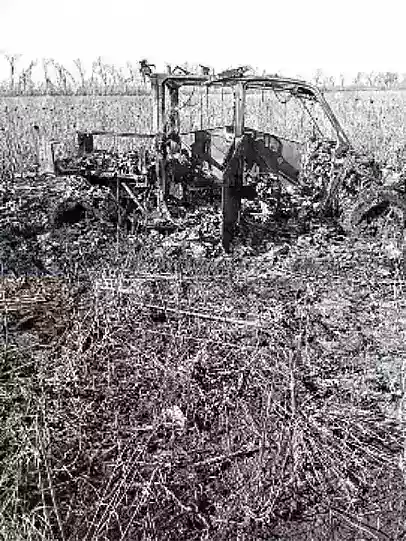
A Forterra Lancer destroyed on the battlefield in Ukraine. Image credit:Forterra
Forterra has learned some valuable lessons—about electronic warfare, remotely updating their software, maneuvering in challenging conditions, and ensuring their vehicles don't break down. The company, which has raised over $500 million in venture funding from investors such as XYZ Venture Capital and Moore Strategic Partners, is now better positioned to compete for lucrative national security contracts.
They've also seen the limits of autonomy: For now, Ukrainian soldiers have mainly been teleoperating the vehicles in combat zones, partly because they're too valuable to risk losing and partly because autonomous vehicles aren't yet ready for the realities of war.
For example, while the vehicles can navigate autonomously across various terrains, they aren't yet capable of identifying unexpected enemy forces and responding appropriately. “We actually need to be able to respond to enemy threats in real time, right in front of the enemy, which the autonomy doesn't know how to do yet,” the Ukrainian soldier explained.
Forterra, which started developing autonomous vehicles 20 years ago, is working on combining the algorithms that powered self-driving cars with newer generative AI software that allows machines to respond to their surroundings in a generalized way. As with other autonomous systems, a key challenge is collecting the right data.
“There are a lot of things you have to do that aren't available in an open-source model because they're not things humans do—whether it's figuring out how to navigate a minefield or [operating] a weapon system,” Sanders told TechCrunch. “You need to be able to adjust the dials, leaning more on a classical robotics approach for some things, and then leverage AI where needed.”
Competitors in this space are tackling similar challenges, such as Scout AI, which raised $100 million earlier this year to train foundation models and develop a range of autonomous platforms for the military, including UGVs. Other startups like Field AI and Overland AI are testing UGVs with the U.S. military.
Even with the limitations of UGVs, American military experts are convinced that it's time to invest in these tools. “Ground autonomy is achievable now, and we've seen it,” Wilkens said.
Scott Philips, Forterra's chief innovation officer, visited a Ukrainian unit's operations center to see the vehicles in action firsthand, earning the unit's respect by visiting an area within range of Russian attacks.
“What struck me most was seeing exactly where the seams are: which steps are still manual, where data has to be re-entered or re-verified by hand, and where the team has already found ways to automate or speed things up,” Philips told TechCrunch. “That's the kind of ground truth you can't get from a slide deck because it shows you precisely where better tooling could take pressure off the people doing this work in real time.”
One challenge issued by the Ukrainians: Make it cheaper. Forterra's Lancers aren't expensive for their category, thanks to relying on Polaris' commercial supply chain for the vehicle itself, but they are still too valuable to be deployed as freely as UAVs can be.
“Attrition is just a fact of this battlefield. We've lost a few so far, and it hurts. We need more, and therefore we need them cheaper,” the Ukrainian soldier told TechCrunch.
Related article
 Former Infosys Chief’s AI Startup Secures Another $53M
Hang Ten Systems, an AI startup established by former Infosys CEO Vishal Sikka just four months ago, has secured an additional $53 million in seed funding. This latest investment round was finalized merely five weeks after the initial $32 million see
Crypto exchange OKX aims to empower AI agents to hire and pay each other
As AI agents start serving individuals and collaborating with each other, they require mechanisms to locate tasks, compensate for services, and establish credibility. Crypto exchange OKX anticipates this future is arriving sooner than anticipated, in
Thiel-backed startup claims AI can judge journalism, despite risks to whistleblowers
Following his role in the lawsuit that led to Gawker’s bankruptcy, Aron D’Souza identified a critical flaw in the American media landscape: individuals harmed by coverage lacked effective means to respond.His answer is technology. D’Souza’s new ventu
Related Special Topic Recommendations
writing
Former Infosys Chief’s AI Startup Secures Another $53M
Hang Ten Systems, an AI startup established by former Infosys CEO Vishal Sikka just four months ago, has secured an additional $53 million in seed funding. This latest investment round was finalized merely five weeks after the initial $32 million see
Crypto exchange OKX aims to empower AI agents to hire and pay each other
As AI agents start serving individuals and collaborating with each other, they require mechanisms to locate tasks, compensate for services, and establish credibility. Crypto exchange OKX anticipates this future is arriving sooner than anticipated, in
Thiel-backed startup claims AI can judge journalism, despite risks to whistleblowers
Following his role in the lawsuit that led to Gawker’s bankruptcy, Aron D’Souza identified a critical flaw in the American media landscape: individuals harmed by coverage lacked effective means to respond.His answer is technology. D’Souza’s new ventu
Related Special Topic Recommendations
writing
 Best AI Outline Generators for Long-Form SEO Articles
2026 Latest Best Top-Rated AI Outline Generators for Long-Form SEO Articles, meticulously curated by XIX.AI. These powerful tools offer game-changing assistance in creating high-quality content quickly, boosting writing efficiency significantly. Get a free vs paid comparison along with real-world tests and detailed rankings to help you find the must-try option that suits your needs. Explore now to unlock your AI edge.
 8 tools
 xix.ai
Education and Learning
AI Study Tools for Homework and Exam Prep
xix.ai
Education and Learning
AI Study Tools for Homework and Exam Prep
2026 Latest Best AI Study Tools for Homework and Exam Prep! XIX.AI curates a top-rated list of powerful, game-changing tools that help students boost productivity, streamline homework completion, and ace exams through real-world tests. Get a free vs paid comparison, detailed rankings, and must-try options to unlock your AI edge. Explore now!
10 tools
xix.ai
Music composition
AI Vocal Demo Tools for Songwriters, Hooks, Toplines, and Multilingual Draft Sessions
2026 Latest Best AI Vocal Demo Tools for Songwriters, Hook Creators, and Multi-Language Content Teams! XIX.AI has curated a top-rated list of powerful game-changing tools that go through rigorous real-world tests. You’ll find detailed free vs paid comparison data, comprehensive rankings, and must-try options to help you boost writing efficiency and unlock your creative potential. Explore now to discover your perfect tool for all your content needs!
9 tools
xix.ai
Business
Best AI Competitive Research Tools for Small Businesses
2026 Latest Best Top-rated AI Competitive Research Tools for Small Businesses! XIX.AI has curated a highly powerful game-changing collection, updated weekly with rigorous real-world tests and detailed rankings. You can find a comprehensive free vs paid comparison to help you identify the must-try tools that boost your productivity and give you a competitive edge. Explore now to discover your perfect tool!
9 tools
xix.ai
Image editing
Photoshop AI Retouch Tools for Ecommerce Apparel, Skin Cleanup, and Color Consistency
2026 Latest Best Photoshop AI retouch tools for ecommerce apparel, skin cleanup, and color consistency! This top-rated curated list features powerful game-changing solutions that help you boost writing efficiency, streamline content creation, and achieve perfect visual results effortlessly. Each tool has undergone real-world tests through weekly updated rankings, complete with free vs paid comparison details. Backed by XIX.AI, it’s the must-try guide for anyone aiming to unlock your AI edge. Explore now!
10 tools
xix.ai
Prompt
Best AI Prompt Libraries for ChatGPT Workflows
2026 Latest Best Top-Rated AI Prompt Libraries for optimizing all types of ChatGPT workflows. XIX.AI has curated a powerful, game-changing collection that goes through rigorous real-world tests to ensure top performance. You can find detailed free vs paid comparisons and expert rankings to help you choose the must-try tools that boost your productivity and unlock your AI edge. Explore now!
11 tools
xix.ai

 Comments (0)
0/500
Comments (0)
0/500
Forterra, an American builder of autonomous vehicles, announced today that over 100 of its self-driving ATVs have been operating in Ukraine's conflict zones for the past nine months—what the company believes is the largest deployment of autonomous ground vehicles in combat by any U.S. defense technology firm.
“I believe that applies to every defense technology ever created—you just don't know until you face the realities of combat,” Scott Sanders, Forterra's chief growth officer and a former U.S. Marine officer, told TechCrunch.
Funded by U.S. defense dollars, this mission is part of a broader effort to transform the U.S. military by supporting Ukraine's resistance against Russian invaders. While aerial drones have drawn most of the attention in the conflict, the dynamics they've created—large no-go zones where surveillance can bring death from above—have also driven Ukrainian strategists to pursue ground-based autonomy.
“There's nowhere to hide,” Sergeant Major Corey Wilkens, who leads a U.S. Army program developing autonomous vehicles and tactics, explained. “You become extremely vulnerable to attacks from [first-person view drones], other drones dropping munitions, artillery, mortars—the full range of weaponry they have.”
According to a Ukrainian army soldier who has worked with these vehicles and whom TechCrunch is not identifying for security reasons, Ukraine is already building its own uncrewed ground vehicles (UGVs) to help transport supplies and munitions or evacuate wounded soldiers. However, these are typically battery-powered and can only carry up to 250 kilograms.
Forterra's Lancer vehicles, built on Polaris ATVs and outfitted with a custom sensor and computing system, are gas-powered and can carry 750 kilograms of cargo, making them more versatile and practical. “The bottom line is that this UGV for logistics and sustaining our defense is the most important UGV in Ukraine,” the soldier said. “It's fucking fantastic, and we're desperate to get more.”
They didn't feel that way at first. The Ukrainian Armed Forces have had mixed experiences with Western contractors introducing new technology to the battlefield, and initially Forterra's offerings seemed a bit too tailored to the high-end requirements of the U.S. Army. Adapting the vehicle to the situation—specifically by adding a Starlink satellite internet antenna—turned it into a huge value add.
Since arriving in Ukraine last October, the vehicles have driven more than 2,500 miles across more than 1,100 missions, carrying 777,440 pounds of total weight and completing 52 casualty evacuations. Some have been lost in combat, particularly when they get stuck in deep mud or other terrain where Russian forces can target them at leisure.
A Forterra Lancer destroyed on the battlefield in Ukraine. Image credit:Forterra
Forterra has learned some valuable lessons—about electronic warfare, remotely updating their software, maneuvering in challenging conditions, and ensuring their vehicles don't break down. The company, which has raised over $500 million in venture funding from investors such as XYZ Venture Capital and Moore Strategic Partners, is now better positioned to compete for lucrative national security contracts.
They've also seen the limits of autonomy: For now, Ukrainian soldiers have mainly been teleoperating the vehicles in combat zones, partly because they're too valuable to risk losing and partly because autonomous vehicles aren't yet ready for the realities of war.
For example, while the vehicles can navigate autonomously across various terrains, they aren't yet capable of identifying unexpected enemy forces and responding appropriately. “We actually need to be able to respond to enemy threats in real time, right in front of the enemy, which the autonomy doesn't know how to do yet,” the Ukrainian soldier explained.
Forterra, which started developing autonomous vehicles 20 years ago, is working on combining the algorithms that powered self-driving cars with newer generative AI software that allows machines to respond to their surroundings in a generalized way. As with other autonomous systems, a key challenge is collecting the right data.
“There are a lot of things you have to do that aren't available in an open-source model because they're not things humans do—whether it's figuring out how to navigate a minefield or [operating] a weapon system,” Sanders told TechCrunch. “You need to be able to adjust the dials, leaning more on a classical robotics approach for some things, and then leverage AI where needed.”
Competitors in this space are tackling similar challenges, such as Scout AI, which raised $100 million earlier this year to train foundation models and develop a range of autonomous platforms for the military, including UGVs. Other startups like Field AI and Overland AI are testing UGVs with the U.S. military.
Even with the limitations of UGVs, American military experts are convinced that it's time to invest in these tools. “Ground autonomy is achievable now, and we've seen it,” Wilkens said.
Scott Philips, Forterra's chief innovation officer, visited a Ukrainian unit's operations center to see the vehicles in action firsthand, earning the unit's respect by visiting an area within range of Russian attacks.
“What struck me most was seeing exactly where the seams are: which steps are still manual, where data has to be re-entered or re-verified by hand, and where the team has already found ways to automate or speed things up,” Philips told TechCrunch. “That's the kind of ground truth you can't get from a slide deck because it shows you precisely where better tooling could take pressure off the people doing this work in real time.”
One challenge issued by the Ukrainians: Make it cheaper. Forterra's Lancers aren't expensive for their category, thanks to relying on Polaris' commercial supply chain for the vehicle itself, but they are still too valuable to be deployed as freely as UAVs can be.
“Attrition is just a fact of this battlefield. We've lost a few so far, and it hurts. We need more, and therefore we need them cheaper,” the Ukrainian soldier told TechCrunch.








 Former Infosys Chief’s AI Startup Secures Another $53M
Hang Ten Systems, an AI startup established by former Infosys CEO Vishal Sikka just four months ago, has secured an additional $53 million in seed funding. This latest investment round was finalized merely five weeks after the initial $32 million see
Former Infosys Chief’s AI Startup Secures Another $53M
Hang Ten Systems, an AI startup established by former Infosys CEO Vishal Sikka just four months ago, has secured an additional $53 million in seed funding. This latest investment round was finalized merely five weeks after the initial $32 million see
 Crypto exchange OKX aims to empower AI agents to hire and pay each other
As AI agents start serving individuals and collaborating with each other, they require mechanisms to locate tasks, compensate for services, and establish credibility. Crypto exchange OKX anticipates this future is arriving sooner than anticipated, in
Crypto exchange OKX aims to empower AI agents to hire and pay each other
As AI agents start serving individuals and collaborating with each other, they require mechanisms to locate tasks, compensate for services, and establish credibility. Crypto exchange OKX anticipates this future is arriving sooner than anticipated, in
 Thiel-backed startup claims AI can judge journalism, despite risks to whistleblowers
Following his role in the lawsuit that led to Gawker’s bankruptcy, Aron D’Souza identified a critical flaw in the American media landscape: individuals harmed by coverage lacked effective means to respond.His answer is technology. D’Souza’s new ventu
Thiel-backed startup claims AI can judge journalism, despite risks to whistleblowers
Following his role in the lawsuit that led to Gawker’s bankruptcy, Aron D’Souza identified a critical flaw in the American media landscape: individuals harmed by coverage lacked effective means to respond.His answer is technology. D’Souza’s new ventu

2026 Latest Best Top-Rated AI Outline Generators for Long-Form SEO Articles, meticulously curated by XIX.AI. These powerful tools offer game-changing assistance in creating high-quality content quickly, boosting writing efficiency significantly. Get a free vs paid comparison along with real-world tests and detailed rankings to help you find the must-try option that suits your needs. Explore now to unlock your AI edge.
8 tools
xix.ai

2026 Latest Best AI Study Tools for Homework and Exam Prep! XIX.AI curates a top-rated list of powerful, game-changing tools that help students boost productivity, streamline homework completion, and ace exams through real-world tests. Get a free vs paid comparison, detailed rankings, and must-try options to unlock your AI edge. Explore now!
10 tools
xix.ai

2026 Latest Best AI Vocal Demo Tools for Songwriters, Hook Creators, and Multi-Language Content Teams! XIX.AI has curated a top-rated list of powerful game-changing tools that go through rigorous real-world tests. You’ll find detailed free vs paid comparison data, comprehensive rankings, and must-try options to help you boost writing efficiency and unlock your creative potential. Explore now to discover your perfect tool for all your content needs!
9 tools
xix.ai

2026 Latest Best Top-rated AI Competitive Research Tools for Small Businesses! XIX.AI has curated a highly powerful game-changing collection, updated weekly with rigorous real-world tests and detailed rankings. You can find a comprehensive free vs paid comparison to help you identify the must-try tools that boost your productivity and give you a competitive edge. Explore now to discover your perfect tool!
9 tools
xix.ai

2026 Latest Best Photoshop AI retouch tools for ecommerce apparel, skin cleanup, and color consistency! This top-rated curated list features powerful game-changing solutions that help you boost writing efficiency, streamline content creation, and achieve perfect visual results effortlessly. Each tool has undergone real-world tests through weekly updated rankings, complete with free vs paid comparison details. Backed by XIX.AI, it’s the must-try guide for anyone aiming to unlock your AI edge. Explore now!
10 tools
xix.ai

2026 Latest Best Top-Rated AI Prompt Libraries for optimizing all types of ChatGPT workflows. XIX.AI has curated a powerful, game-changing collection that goes through rigorous real-world tests to ensure top performance. You can find detailed free vs paid comparisons and expert rankings to help you choose the must-try tools that boost your productivity and unlock your AI edge. Explore now!
11 tools
xix.ai












