


 Home
HomeWall Street sees US memory maker Micron as the next Nvidia
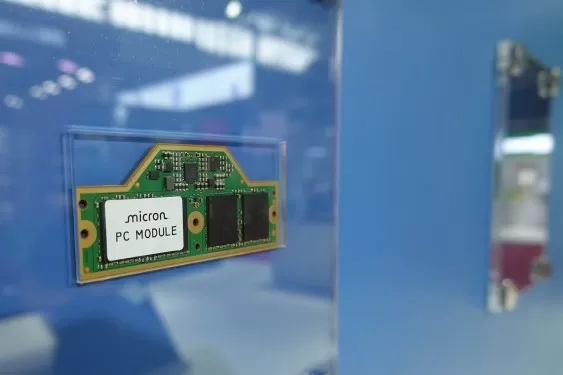
Micron, the memory chip maker based in Boise, Idaho, has captured Wall Street's attention. Whether this enthusiasm lasts will largely depend on how long the AI-driven memory chip supply crunch continues.
Micron says it has strengthened its long-term position to handle a sudden drop in demand or a supply glut. Wall Street has bought into that story, briefly pushing Micron's market cap above Meta and Tesla for the first time on Thursday, before it slipped back by Friday to nearly match them.
Specifically, Micron ended Friday's session with a market cap near $1.27 trillion, compared to Meta's $1.39 trillion and Tesla's $1.42 trillion. Its stock has surged more than 236% in the past month alone, closing Friday at $1,132 per share. For years before mid-2025, it had traded below $100 per share.
This is a dizzying ascent for a company most consumers associate with the small memory cards once commonly used to expand PC, smartphone, or other device storage.
Wall Street isn't worried about that product line. Micron is riding the AI data center buildout boom, which has caused a shortage of system memory chips (DRAM and NAND) that Micron produces, especially High-Bandwidth Memory (HBM). A single AI server requires far more memory than a laptop.
AI system makers like Nvidia, along with hyperscalers building their own systems — such as Microsoft, Amazon AWS, Google, Meta, and Oracle — are buying up vast quantities of memory. This is pushing all other companies that need memory to stockpile it too, from PC makers like Dell and HP to other device manufacturers.
This supply shortage, dubbed "RAMageddon," is expected to persist into 2027. It's already driving up prices of consumer electronics like Apple products and Xbox consoles.
With the entire tech industry clamoring for more memory, Micron reported blockbuster third-quarter earnings last week. Revenue quadrupled year-over-year to $41.45 billion, while profits soared from $1.88 billion to $28.2 billion. Micron also gave a positive outlook, forecasting fourth-quarter revenue between $49 billion and $51 billion.
Wall Street, eager to find more publicly traded AI-related companies that could perform as well as Nvidia, became even more enamored with Micron.
The historic challenge for memory chip makers like Micron and Samsung is that expanding manufacturing facilities to boost capacity is a time-consuming, costly endeavor. Demand often falls just as companies are able to ramp up capacity, leading to a glut and subsequent price drops.
Micron preempted any talk of an AI bust by highlighting a series of long-term supply agreements, including with Nvidia and AI lab Anthropic, which should protect it. In its earnings presentation, the company said it has signed 16 strategic customer agreements across data center, consumer, and automotive market segments, agreements that it expects to fundamentally reshape its business model.
That appeared to convince several analysts that Micron could be another long-term, profitable investment. In a research note, William Blair tech analyst Sebastien Naji observed that demand growth continues to outpace the rate at which new cleanroom capacity can come online.
"Given the strong likelihood of continued ASP growth in the coming quarters and improving revenue visibility thanks to a rapidly expanding set of long-term agreements (SCAs) with key customers, we see potential for more durable earnings growth and reiterate our Outperform rating," Naji wrote.
Whether Micron can truly sustain itself long-term without a bust cycle remains to be seen. But for a brief moment on Thursday, this U.S. company was worth more than some of the industry's giants.
Related article
 Ollie bets privacy focus to win AI assistant race
To be genuinely helpful, an AI assistant must understand its user deeply. Ollie, a personal assistant designed for daily life, operates on the premise that this doesn’t require surrendering your data or compromising your privacy.While certain enterpr
How AI LIVE: London Will Explore AI & Industrial Automation
The summit will convene C-suite executives from around the globe to address pressing challenges in global industries, ranging from AI-driven disruption to economic volatility.AI LIVE: The London Summit will gather over 2,000 international leaders und
Anthropic Enters AI Legal Tech Market as Competition Intensifies
Anthropic unveiled a suite of new chatbot capabilities on Tuesday, aimed at delivering automated support to legal practices. These enhancements expand upon Claude for Legal, the firm-specific platform introduced earlier this year, by adding specializ
Related Special Topic Recommendations
Education and Learning
Ollie bets privacy focus to win AI assistant race
To be genuinely helpful, an AI assistant must understand its user deeply. Ollie, a personal assistant designed for daily life, operates on the premise that this doesn’t require surrendering your data or compromising your privacy.While certain enterpr
How AI LIVE: London Will Explore AI & Industrial Automation
The summit will convene C-suite executives from around the globe to address pressing challenges in global industries, ranging from AI-driven disruption to economic volatility.AI LIVE: The London Summit will gather over 2,000 international leaders und
Anthropic Enters AI Legal Tech Market as Competition Intensifies
Anthropic unveiled a suite of new chatbot capabilities on Tuesday, aimed at delivering automated support to legal practices. These enhancements expand upon Claude for Legal, the firm-specific platform introduced earlier this year, by adding specializ
Related Special Topic Recommendations
Education and Learning
 AI Study Tools for Homework and Exam Prep
2026 Latest Best AI Study Tools for Homework and Exam Prep! XIX.AI curates a top-rated list of powerful, game-changing tools that help students boost productivity, streamline homework completion, and ace exams through real-world tests. Get a free vs paid comparison, detailed rankings, and must-try options to unlock your AI edge. Explore now!
 10 tools
 xix.ai
Music composition
AI Vocal Demo Tools for Songwriters, Hooks, Toplines, and Multilingual Draft Sessions
xix.ai
Music composition
AI Vocal Demo Tools for Songwriters, Hooks, Toplines, and Multilingual Draft Sessions
2026 Latest Best AI Vocal Demo Tools for Songwriters, Hook Creators, and Multi-Language Content Teams! XIX.AI has curated a top-rated list of powerful game-changing tools that go through rigorous real-world tests. You’ll find detailed free vs paid comparison data, comprehensive rankings, and must-try options to help you boost writing efficiency and unlock your creative potential. Explore now to discover your perfect tool for all your content needs!
9 tools
xix.ai
Business
Best AI Competitive Research Tools for Small Businesses
2026 Latest Best Top-rated AI Competitive Research Tools for Small Businesses! XIX.AI has curated a highly powerful game-changing collection, updated weekly with rigorous real-world tests and detailed rankings. You can find a comprehensive free vs paid comparison to help you identify the must-try tools that boost your productivity and give you a competitive edge. Explore now to discover your perfect tool!
9 tools
xix.ai
Image editing
Photoshop AI Retouch Tools for Ecommerce Apparel, Skin Cleanup, and Color Consistency
2026 Latest Best Photoshop AI retouch tools for ecommerce apparel, skin cleanup, and color consistency! This top-rated curated list features powerful game-changing solutions that help you boost writing efficiency, streamline content creation, and achieve perfect visual results effortlessly. Each tool has undergone real-world tests through weekly updated rankings, complete with free vs paid comparison details. Backed by XIX.AI, it’s the must-try guide for anyone aiming to unlock your AI edge. Explore now!
10 tools
xix.ai
Prompt
Best AI Prompt Libraries for ChatGPT Workflows
2026 Latest Best Top-Rated AI Prompt Libraries for optimizing all types of ChatGPT workflows. XIX.AI has curated a powerful, game-changing collection that goes through rigorous real-world tests to ensure top performance. You can find detailed free vs paid comparisons and expert rankings to help you choose the must-try tools that boost your productivity and unlock your AI edge. Explore now!
11 tools
xix.ai
Education and Learning
AI Quiz Builder Platforms for Teachers, Tutors, and Cohort-Based Learning Programs
2026 Latest Best AI Quiz Builder Platforms for Teachers, Tutors, and Cohort-Based Learning Programs! XIX.AI has curated a top-rated list of powerful game-changing tools that go through real-world tests to deliver accurate rankings. These must-try platforms help boost writing efficiency, streamline content creation, and simplify quiz design across all learning scenarios. Explore now to discover your perfect tool for unlocking your AI edge in teaching!
13 tools
xix.ai

 Comments (0)
0/500
Comments (0)
0/500
Micron, the memory chip maker based in Boise, Idaho, has captured Wall Street's attention. Whether this enthusiasm lasts will largely depend on how long the AI-driven memory chip supply crunch continues.
Micron says it has strengthened its long-term position to handle a sudden drop in demand or a supply glut. Wall Street has bought into that story, briefly pushing Micron's market cap above Meta and Tesla for the first time on Thursday, before it slipped back by Friday to nearly match them.
Specifically, Micron ended Friday's session with a market cap near $1.27 trillion, compared to Meta's $1.39 trillion and Tesla's $1.42 trillion. Its stock has surged more than 236% in the past month alone, closing Friday at $1,132 per share. For years before mid-2025, it had traded below $100 per share.
This is a dizzying ascent for a company most consumers associate with the small memory cards once commonly used to expand PC, smartphone, or other device storage.
Wall Street isn't worried about that product line. Micron is riding the AI data center buildout boom, which has caused a shortage of system memory chips (DRAM and NAND) that Micron produces, especially High-Bandwidth Memory (HBM). A single AI server requires far more memory than a laptop.
AI system makers like Nvidia, along with hyperscalers building their own systems — such as Microsoft, Amazon AWS, Google, Meta, and Oracle — are buying up vast quantities of memory. This is pushing all other companies that need memory to stockpile it too, from PC makers like Dell and HP to other device manufacturers.
This supply shortage, dubbed "RAMageddon," is expected to persist into 2027. It's already driving up prices of consumer electronics like Apple products and Xbox consoles.
With the entire tech industry clamoring for more memory, Micron reported blockbuster third-quarter earnings last week. Revenue quadrupled year-over-year to $41.45 billion, while profits soared from $1.88 billion to $28.2 billion. Micron also gave a positive outlook, forecasting fourth-quarter revenue between $49 billion and $51 billion.
Wall Street, eager to find more publicly traded AI-related companies that could perform as well as Nvidia, became even more enamored with Micron.
The historic challenge for memory chip makers like Micron and Samsung is that expanding manufacturing facilities to boost capacity is a time-consuming, costly endeavor. Demand often falls just as companies are able to ramp up capacity, leading to a glut and subsequent price drops.
Micron preempted any talk of an AI bust by highlighting a series of long-term supply agreements, including with Nvidia and AI lab Anthropic, which should protect it. In its earnings presentation, the company said it has signed 16 strategic customer agreements across data center, consumer, and automotive market segments, agreements that it expects to fundamentally reshape its business model.
That appeared to convince several analysts that Micron could be another long-term, profitable investment. In a research note, William Blair tech analyst Sebastien Naji observed that demand growth continues to outpace the rate at which new cleanroom capacity can come online.
"Given the strong likelihood of continued ASP growth in the coming quarters and improving revenue visibility thanks to a rapidly expanding set of long-term agreements (SCAs) with key customers, we see potential for more durable earnings growth and reiterate our Outperform rating," Naji wrote.
Whether Micron can truly sustain itself long-term without a bust cycle remains to be seen. But for a brief moment on Thursday, this U.S. company was worth more than some of the industry's giants.








 Ollie bets privacy focus to win AI assistant race
To be genuinely helpful, an AI assistant must understand its user deeply. Ollie, a personal assistant designed for daily life, operates on the premise that this doesn’t require surrendering your data or compromising your privacy.While certain enterpr
Ollie bets privacy focus to win AI assistant race
To be genuinely helpful, an AI assistant must understand its user deeply. Ollie, a personal assistant designed for daily life, operates on the premise that this doesn’t require surrendering your data or compromising your privacy.While certain enterpr
 How AI LIVE: London Will Explore AI & Industrial Automation
The summit will convene C-suite executives from around the globe to address pressing challenges in global industries, ranging from AI-driven disruption to economic volatility.AI LIVE: The London Summit will gather over 2,000 international leaders und
How AI LIVE: London Will Explore AI & Industrial Automation
The summit will convene C-suite executives from around the globe to address pressing challenges in global industries, ranging from AI-driven disruption to economic volatility.AI LIVE: The London Summit will gather over 2,000 international leaders und
 Anthropic Enters AI Legal Tech Market as Competition Intensifies
Anthropic unveiled a suite of new chatbot capabilities on Tuesday, aimed at delivering automated support to legal practices. These enhancements expand upon Claude for Legal, the firm-specific platform introduced earlier this year, by adding specializ
Anthropic Enters AI Legal Tech Market as Competition Intensifies
Anthropic unveiled a suite of new chatbot capabilities on Tuesday, aimed at delivering automated support to legal practices. These enhancements expand upon Claude for Legal, the firm-specific platform introduced earlier this year, by adding specializ

2026 Latest Best AI Study Tools for Homework and Exam Prep! XIX.AI curates a top-rated list of powerful, game-changing tools that help students boost productivity, streamline homework completion, and ace exams through real-world tests. Get a free vs paid comparison, detailed rankings, and must-try options to unlock your AI edge. Explore now!
10 tools
xix.ai

2026 Latest Best AI Vocal Demo Tools for Songwriters, Hook Creators, and Multi-Language Content Teams! XIX.AI has curated a top-rated list of powerful game-changing tools that go through rigorous real-world tests. You’ll find detailed free vs paid comparison data, comprehensive rankings, and must-try options to help you boost writing efficiency and unlock your creative potential. Explore now to discover your perfect tool for all your content needs!
9 tools
xix.ai

2026 Latest Best Top-rated AI Competitive Research Tools for Small Businesses! XIX.AI has curated a highly powerful game-changing collection, updated weekly with rigorous real-world tests and detailed rankings. You can find a comprehensive free vs paid comparison to help you identify the must-try tools that boost your productivity and give you a competitive edge. Explore now to discover your perfect tool!
9 tools
xix.ai

2026 Latest Best Photoshop AI retouch tools for ecommerce apparel, skin cleanup, and color consistency! This top-rated curated list features powerful game-changing solutions that help you boost writing efficiency, streamline content creation, and achieve perfect visual results effortlessly. Each tool has undergone real-world tests through weekly updated rankings, complete with free vs paid comparison details. Backed by XIX.AI, it’s the must-try guide for anyone aiming to unlock your AI edge. Explore now!
10 tools
xix.ai

2026 Latest Best Top-Rated AI Prompt Libraries for optimizing all types of ChatGPT workflows. XIX.AI has curated a powerful, game-changing collection that goes through rigorous real-world tests to ensure top performance. You can find detailed free vs paid comparisons and expert rankings to help you choose the must-try tools that boost your productivity and unlock your AI edge. Explore now!
11 tools
xix.ai

2026 Latest Best AI Quiz Builder Platforms for Teachers, Tutors, and Cohort-Based Learning Programs! XIX.AI has curated a top-rated list of powerful game-changing tools that go through real-world tests to deliver accurate rankings. These must-try platforms help boost writing efficiency, streamline content creation, and simplify quiz design across all learning scenarios. Explore now to discover your perfect tool for unlocking your AI edge in teaching!
13 tools
xix.ai












