


 Home
HomeRollon Unveils Two Telescopic Rails With Integrated Magnets
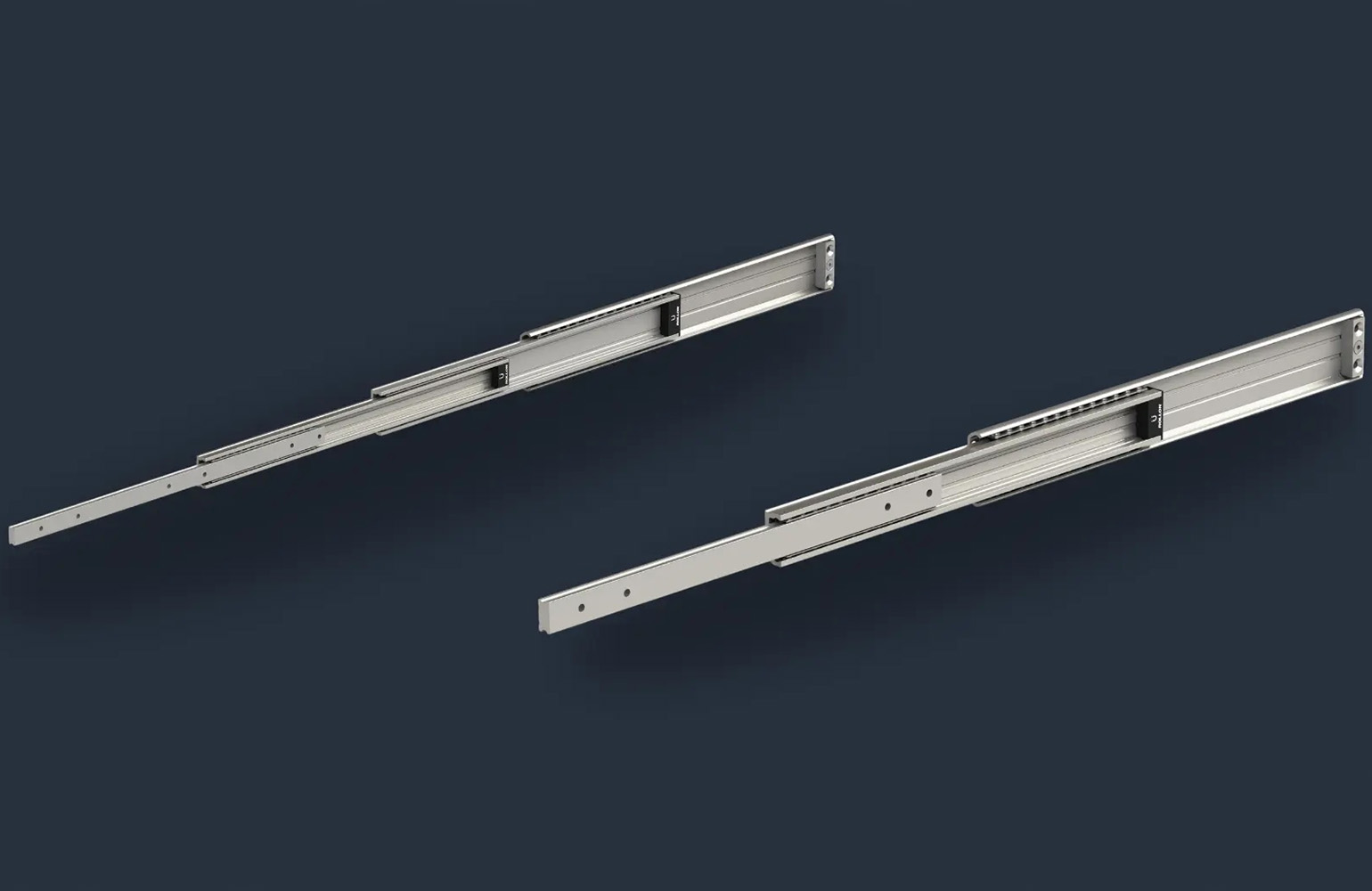
The latest H1C-MG and HVC-MG telescopic rails introduce a new axis of motion for robotic systems. | Source: Rollon
Rollon Corp, a worldwide leader in linear motion technology, has announced the launch of the HVC-MG and H1C-MG telescopic rails. These new MG series models incorporate integrated magnets that facilitate the sequential extension of rail elements.
“Following the successful deployment of this technology in our HGT range, we are now expanding its application to additional telescopic rail families,” states Andrea Tosi, Rollon’s vice president of technology. “The integrated magnets provide an optimal balance of high load capacity and smooth, controlled movement. This innovation underscores our commitment to engineering solutions that transcend basic technical specifications, addressing the practical operational challenges our customers encounter across various industrial sectors.”
Established in 1975, Rollon specializes in the design and manufacturing of highly specialized linear motion systems. Since 2018, the Norton Shores, Michigan-based company has operated as part of The Timken Co., enhancing its portfolio of linear components, actuators, systems, ball screws, and rotational units.
Magnetic integration enhances linear motion performance
According to Rollon, the magnets embedded in these new rails improve load management, ensure smoother extension, and increase durability, even under intensive operating conditions. The MG version is available for Sizes 54 and 68 of the HVC series, and Size 68 of the H1C series. It also features a redesigned ball cage with reduced pitch, along with end blocks that incorporate internal magnets.
Rollon notes that the reduced pitch increases the number of balls within the same cage length, thereby boosting load capacity without altering the overall dimensions.
The integrated magnets also establish a defined motion sequence for the rail elements during extension, enhancing control and reducing the force required to open the rail. This combination allows for the handling of heavier loads while improving overall ergonomics, the company explained.
Furthermore, optimized load distribution helps reduce stress on the raceways, contributing to extended service life and more consistent long-term performance.
Rollon describes the HVC and H1C telescopic rails as fully and over-extending solutions, respectively, designed to maximize accessibility while minimizing space requirements. All Rollon rails and sliders are manufactured from steel, featuring zinc electroplating and complying with REACH and RoHS standards.
Rollon provides additional surface treatments to enhance resistance in harsh environments. It also offers HVC slides in stainless steel for superior corrosion protection.
Robust design of HVC and H1C for demanding applications
Engineered for high rigidity and low deflection, HVC and H1C rails are utilized across multiple industries, including construction and industrial machinery. Their characteristics also make them particularly suitable for the railway industry, where reliability and service life are critical, according to Rollon.
Typical applications include the extraction of battery compartments and other onboard equipment requiring both easy accessibility and reliable structural support. In railway contexts, components must ensure safe and ergonomic access for operators during maintenance while withstanding continuous exposure to shocks, vibrations, and environmental factors such as humidity and contaminants. In this setting, smooth motion is crucial not only for usability but also for safety and operational efficiency.
“The MG version directly addresses these requirements by improving motion control and reducing operating forces, even under heavy loads,” Tosi added.
With the introduction of the HVC-MG and H1C-MG, Rollon states it has strengthened its portfolio of high-performance linear motion solutions. The company emphasizes its focus on tailored solutions, serving markets such as industrial automation, aerospace, medical equipment, and material handling.
Related article
 Apple, Google Partner With Anthropic to Address 27-Year-Old Vulnerability via Glass Wing Protection
As artificial intelligence advances rapidly in code generation and logical reasoning, the cybersecurity landscape faces unprecedented challenges. Recently, the prominent AI startup Anthropic officially launched a cross-industry collaboration called *
OpenAI Chief Scientist Addresses AI Reasoning Transparency Debate: Complexity Steady, No Sudden Jump
On September 2, Jakub Pachocki, OpenAI’s Chief Scientist, addressed public concerns on X regarding the AI model Astra, clarifying claims that it operates without oversight and lacks transparent reasoning.Why the Controversy Erupted: Deep Recurrence O
U.S. Navy Selects Blue Water Autonomy for Deep-Sea Survey Missions
Blue Water Autonomy’s Liberty Class is a 190-foot steel autonomous ship. | Source: Blue Water AutonomyBoston-based technology and shipbuilding firm Blue Water Autonomy has secured a multiple-award contract with the Naval Oceanographic Office (NAVOCEA
Related Special Topic Recommendations
Text-to-speech
Apple, Google Partner With Anthropic to Address 27-Year-Old Vulnerability via Glass Wing Protection
As artificial intelligence advances rapidly in code generation and logical reasoning, the cybersecurity landscape faces unprecedented challenges. Recently, the prominent AI startup Anthropic officially launched a cross-industry collaboration called *
OpenAI Chief Scientist Addresses AI Reasoning Transparency Debate: Complexity Steady, No Sudden Jump
On September 2, Jakub Pachocki, OpenAI’s Chief Scientist, addressed public concerns on X regarding the AI model Astra, clarifying claims that it operates without oversight and lacks transparent reasoning.Why the Controversy Erupted: Deep Recurrence O
U.S. Navy Selects Blue Water Autonomy for Deep-Sea Survey Missions
Blue Water Autonomy’s Liberty Class is a 190-foot steel autonomous ship. | Source: Blue Water AutonomyBoston-based technology and shipbuilding firm Blue Water Autonomy has secured a multiple-award contract with the Naval Oceanographic Office (NAVOCEA
Related Special Topic Recommendations
Text-to-speech
 Best AI Text to Speech Tools for Online Courses
2026 Latest Best Top-rated AI Text to Speech Tools for Online Courses are curated by XIX.AI based on rigorous real-world tests and weekly updated rankings. These powerful tools help creators deliver crystal-clear audio content effortlessly, boosting writing efficiency and streamlining course production. Check out the free vs paid comparison to find your perfect fit. Explore now to unlock your AI edge in online education.
 10 tools
 xix.ai
writing
AI Blog Title Tools for Higher Click Through Rates
xix.ai
writing
AI Blog Title Tools for Higher Click Through Rates
2026 Latest Best Top-Rated AI Blog Title Tools for Higher Click Through Rates! XIX.AI has carefully curated a powerful, game-changing collection of top tools that go through rigorous real-world tests. You’ll find a free vs paid comparison, weekly updated rankings, and detailed insights to help you boost your blog’s traffic efficiently. Must-try options are highlighted to help you unlock your AI edge. Explore now!
10 tools
xix.ai
automation
Best AI Task Routing Tools for Support Workflows
2026 Latest Best Top-rated AI Task Routing Tools for Support Workflows! XIX.AI has curated a highly powerful game-changing collection of must-try solutions, all undergoing rigorous real-world tests and updated weekly. These tools streamline workflows, boost productivity, and help teams deliver faster, more efficient support. Explore now to discover your perfect tool and unlock your AI edge!
17 tools
xix.ai
Academic Research
AI Citation and Paper Summary Tools
2026 Latest Best Top-Rated AI Citation and Paper Summary Tools Curated by XIX.AI. Get powerful game-changing solutions for quick content creation, improved writing efficiency, and boosting productivity. We offer a free vs paid comparison along with real-world tests and weekly updated rankings to help you find the must-try tool that fits your needs perfectly. Explore now to Unlock your AI edge.
10 tools
xix.ai
Productivity
Best AI Productivity Tools for Daily Work
2026 Latest Best Top-Rated AI Productivity Tools for Daily Work! XIX.AI has curated a powerful, game-changing selection based on rigorous weekly updated rankings and real-world tests. You’ll find must-try options that boost writing efficiency, streamline content creation, and help you overcome daily work challenges. Get a free vs paid comparison to find the perfect fit for your needs. Explore now to unlock your AI edge!
9 tools
xix.ai
Academic Research
AI Systematic Review Tools for Research Screening
2026 Latest Best Top-Rated AI Systematic Review Tools for Research Screening are here on XIX.AI! This curated collection includes powerful, game-changing solutions that go through rigorous real-world tests to deliver accurate results. We also offer a free vs paid comparison along with weekly updated rankings to help you find the must-try option that boosts your research efficiency significantly. Explore now to unlock your AI edge in academic work!
11 tools
xix.ai

 Comments (0)
0/500
Comments (0)
0/500
The latest H1C-MG and HVC-MG telescopic rails introduce a new axis of motion for robotic systems. | Source: Rollon
Rollon Corp, a worldwide leader in linear motion technology, has announced the launch of the HVC-MG and H1C-MG telescopic rails. These new MG series models incorporate integrated magnets that facilitate the sequential extension of rail elements.
“Following the successful deployment of this technology in our HGT range, we are now expanding its application to additional telescopic rail families,” states Andrea Tosi, Rollon’s vice president of technology. “The integrated magnets provide an optimal balance of high load capacity and smooth, controlled movement. This innovation underscores our commitment to engineering solutions that transcend basic technical specifications, addressing the practical operational challenges our customers encounter across various industrial sectors.”
Established in 1975, Rollon specializes in the design and manufacturing of highly specialized linear motion systems. Since 2018, the Norton Shores, Michigan-based company has operated as part of The Timken Co., enhancing its portfolio of linear components, actuators, systems, ball screws, and rotational units.
Magnetic integration enhances linear motion performance
According to Rollon, the magnets embedded in these new rails improve load management, ensure smoother extension, and increase durability, even under intensive operating conditions. The MG version is available for Sizes 54 and 68 of the HVC series, and Size 68 of the H1C series. It also features a redesigned ball cage with reduced pitch, along with end blocks that incorporate internal magnets.
Rollon notes that the reduced pitch increases the number of balls within the same cage length, thereby boosting load capacity without altering the overall dimensions.
The integrated magnets also establish a defined motion sequence for the rail elements during extension, enhancing control and reducing the force required to open the rail. This combination allows for the handling of heavier loads while improving overall ergonomics, the company explained.
Furthermore, optimized load distribution helps reduce stress on the raceways, contributing to extended service life and more consistent long-term performance.
Rollon describes the HVC and H1C telescopic rails as fully and over-extending solutions, respectively, designed to maximize accessibility while minimizing space requirements. All Rollon rails and sliders are manufactured from steel, featuring zinc electroplating and complying with REACH and RoHS standards.
Rollon provides additional surface treatments to enhance resistance in harsh environments. It also offers HVC slides in stainless steel for superior corrosion protection.
Robust design of HVC and H1C for demanding applications
Engineered for high rigidity and low deflection, HVC and H1C rails are utilized across multiple industries, including construction and industrial machinery. Their characteristics also make them particularly suitable for the railway industry, where reliability and service life are critical, according to Rollon.
Typical applications include the extraction of battery compartments and other onboard equipment requiring both easy accessibility and reliable structural support. In railway contexts, components must ensure safe and ergonomic access for operators during maintenance while withstanding continuous exposure to shocks, vibrations, and environmental factors such as humidity and contaminants. In this setting, smooth motion is crucial not only for usability but also for safety and operational efficiency.
“The MG version directly addresses these requirements by improving motion control and reducing operating forces, even under heavy loads,” Tosi added.
With the introduction of the HVC-MG and H1C-MG, Rollon states it has strengthened its portfolio of high-performance linear motion solutions. The company emphasizes its focus on tailored solutions, serving markets such as industrial automation, aerospace, medical equipment, and material handling.








 Apple, Google Partner With Anthropic to Address 27-Year-Old Vulnerability via Glass Wing Protection
As artificial intelligence advances rapidly in code generation and logical reasoning, the cybersecurity landscape faces unprecedented challenges. Recently, the prominent AI startup Anthropic officially launched a cross-industry collaboration called *
Apple, Google Partner With Anthropic to Address 27-Year-Old Vulnerability via Glass Wing Protection
As artificial intelligence advances rapidly in code generation and logical reasoning, the cybersecurity landscape faces unprecedented challenges. Recently, the prominent AI startup Anthropic officially launched a cross-industry collaboration called *
 OpenAI Chief Scientist Addresses AI Reasoning Transparency Debate: Complexity Steady, No Sudden Jump
On September 2, Jakub Pachocki, OpenAI’s Chief Scientist, addressed public concerns on X regarding the AI model Astra, clarifying claims that it operates without oversight and lacks transparent reasoning.Why the Controversy Erupted: Deep Recurrence O
OpenAI Chief Scientist Addresses AI Reasoning Transparency Debate: Complexity Steady, No Sudden Jump
On September 2, Jakub Pachocki, OpenAI’s Chief Scientist, addressed public concerns on X regarding the AI model Astra, clarifying claims that it operates without oversight and lacks transparent reasoning.Why the Controversy Erupted: Deep Recurrence O
 U.S. Navy Selects Blue Water Autonomy for Deep-Sea Survey Missions
Blue Water Autonomy’s Liberty Class is a 190-foot steel autonomous ship. | Source: Blue Water AutonomyBoston-based technology and shipbuilding firm Blue Water Autonomy has secured a multiple-award contract with the Naval Oceanographic Office (NAVOCEA
U.S. Navy Selects Blue Water Autonomy for Deep-Sea Survey Missions
Blue Water Autonomy’s Liberty Class is a 190-foot steel autonomous ship. | Source: Blue Water AutonomyBoston-based technology and shipbuilding firm Blue Water Autonomy has secured a multiple-award contract with the Naval Oceanographic Office (NAVOCEA

2026 Latest Best Top-rated AI Text to Speech Tools for Online Courses are curated by XIX.AI based on rigorous real-world tests and weekly updated rankings. These powerful tools help creators deliver crystal-clear audio content effortlessly, boosting writing efficiency and streamlining course production. Check out the free vs paid comparison to find your perfect fit. Explore now to unlock your AI edge in online education.
10 tools
xix.ai

2026 Latest Best Top-Rated AI Blog Title Tools for Higher Click Through Rates! XIX.AI has carefully curated a powerful, game-changing collection of top tools that go through rigorous real-world tests. You’ll find a free vs paid comparison, weekly updated rankings, and detailed insights to help you boost your blog’s traffic efficiently. Must-try options are highlighted to help you unlock your AI edge. Explore now!
10 tools
xix.ai

2026 Latest Best Top-rated AI Task Routing Tools for Support Workflows! XIX.AI has curated a highly powerful game-changing collection of must-try solutions, all undergoing rigorous real-world tests and updated weekly. These tools streamline workflows, boost productivity, and help teams deliver faster, more efficient support. Explore now to discover your perfect tool and unlock your AI edge!
17 tools
xix.ai

2026 Latest Best Top-Rated AI Citation and Paper Summary Tools Curated by XIX.AI. Get powerful game-changing solutions for quick content creation, improved writing efficiency, and boosting productivity. We offer a free vs paid comparison along with real-world tests and weekly updated rankings to help you find the must-try tool that fits your needs perfectly. Explore now to Unlock your AI edge.
10 tools
xix.ai

2026 Latest Best Top-Rated AI Productivity Tools for Daily Work! XIX.AI has curated a powerful, game-changing selection based on rigorous weekly updated rankings and real-world tests. You’ll find must-try options that boost writing efficiency, streamline content creation, and help you overcome daily work challenges. Get a free vs paid comparison to find the perfect fit for your needs. Explore now to unlock your AI edge!
9 tools
xix.ai

2026 Latest Best Top-Rated AI Systematic Review Tools for Research Screening are here on XIX.AI! This curated collection includes powerful, game-changing solutions that go through rigorous real-world tests to deliver accurate results. We also offer a free vs paid comparison along with weekly updated rankings to help you find the must-try option that boosts your research efficiency significantly. Explore now to unlock your AI edge in academic work!
11 tools
xix.ai












