


 Home
HomeRocket AI Delivers McKinsey-Style Reports at a Fraction of the Cost
Indian startup Rocket is betting that the next big opportunity is the part before vibe coding: having AI help people decide what to build. It has launched a platform that produces consulting-style product strategies.
The startup, based in Surat, India, on Tuesday launched its platform, Rocket 1.0, which connects research, product building, and competitive intelligence in a single workflow. The platform generates detailed product strategy documents — including pricing, unit economics, and go-to-market recommendations.
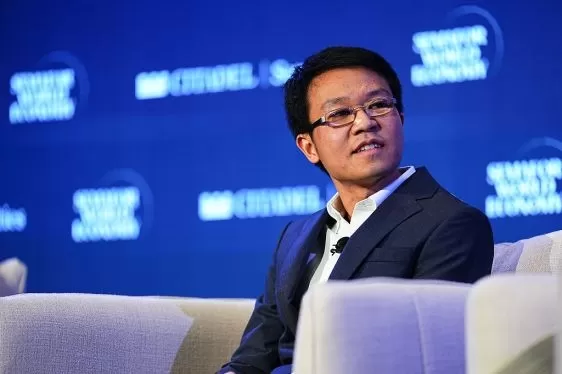
As AI-powered coding tools proliferate — from platforms like Cursor, Replit, and Lovable to features such as Claude Code and Codex — writing code has become significantly easier and faster. “Everyone can generate the code now… it has become a commodity. But what to build is something which everyone is missing,” said Rocket co-founder and CEO Vishal Virani (pictured above), adding that “running a business and just building a codebase are two different things.”
TechCrunch briefly tested Rocket’s platform ahead of its launch and found that it generated product requirement documents in PDF format from simple prompts. These documents resemble consulting-style reports rather than vibe coding tools or chatbots, which largely focus on features and execution.
However, some of the analysis appeared to be synthesized from existing data — combining known pricing models, user behavior patterns, and competitive insights — rather than based on independently verifiable information. This suggests users may still need to validate outputs before making business decisions. Virani said the platform can offer human support when users encounter issues.
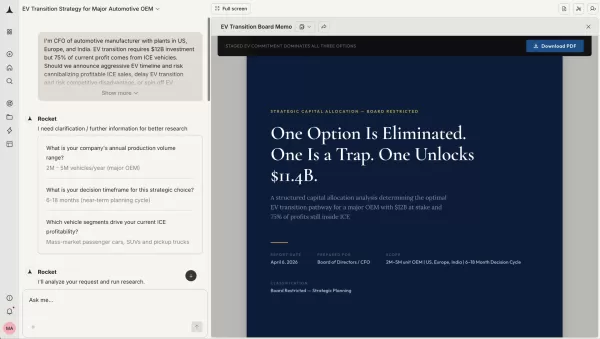
Rocket’s platform generates consulting-style reports Based on text prompts given by usersImage Credits:Rocket
The product can also track competitors, including changes to their websites and traffic trends. Rocket draws on more than 1,000 data sources for its analysis, including Meta’s ad libraries, Similarweb’s API, and its own crawlers, Virani said.
Rocket’s subscription plans range from $25 per month for building applications to $250 for strategy and research capabilities, and up to $350 for the full platform, including competitive intelligence.
The $250 plan can generate two to three “McKinsey-grade” research reports alongside product builds, Virani told TechCrunch, positioning its higher-tier offerings as a lower-cost alternative to traditional consulting, which often costs thousands of dollars for similar strategy work.
Rocket raised a $15 million seed round in September from Accel, Salesforce Ventures, and Together Fund. Since then, the startup says it has grown from 400,000 to over 1.5 million users across 180 countries. It also reported an annualized average revenue per user in the ~$4,000 range, though it did not disclose detailed paying customer numbers. The startup said it operates at gross margins of over 50%, with 20–30% of its customers being small- and medium-sized businesses.
Rocket has a team of 57 employees and is headquartered in Surat, with operations in Palo Alto.
Related article
 Cognition CEO dismisses reports of SpaceX acquisition bid
SpaceX, led by Elon Musk, explored purchasing AI coding firm Cognition to close the gap with rivals OpenAI, Anthropic, and Google, according to a Wednesday Bloomberg report citing informed sources.Cognition CEO Scott Wu quickly refuted the claim on X
Google integrates automated workflow creation into Opal
On Tuesday, Google announced a new method for building automated workflows within its vibe-coding application, Opal. The company introduced a new agent feature that enables users to develop mini-apps capable of planning and executing tasks based on s
Anthropic Launches AI Code Review Tool
Peer feedback is essential in coding for early bug detection, maintaining codebase consistency, and enhancing overall software quality.The emergence of "vibe coding"—using AI tools that generate code from plain-language instructions—has transformed d
Related Special Topic Recommendations
SEO
Cognition CEO dismisses reports of SpaceX acquisition bid
SpaceX, led by Elon Musk, explored purchasing AI coding firm Cognition to close the gap with rivals OpenAI, Anthropic, and Google, according to a Wednesday Bloomberg report citing informed sources.Cognition CEO Scott Wu quickly refuted the claim on X
Google integrates automated workflow creation into Opal
On Tuesday, Google announced a new method for building automated workflows within its vibe-coding application, Opal. The company introduced a new agent feature that enables users to develop mini-apps capable of planning and executing tasks based on s
Anthropic Launches AI Code Review Tool
Peer feedback is essential in coding for early bug detection, maintaining codebase consistency, and enhancing overall software quality.The emergence of "vibe coding"—using AI tools that generate code from plain-language instructions—has transformed d
Related Special Topic Recommendations
SEO
 Best AI SERP Analysis Tools for Search Strategy
2026 Latest Best Top-rated AI SERP Analysis Tools for Search Strategy are curated by XIX.AI through rigorous real-world tests and weekly updated rankings. These powerful tools help you unlock hidden optimization opportunities, boost content performance, and gain a competitive edge in search. Discover your perfect tool to elevate your search strategy today. Explore now!
 13 tools
 xix.ai
Data Analysis
Best AI Anomaly Detection Tools for KPI Monitoring across SaaS and Ecommerce Teams
xix.ai
Data Analysis
Best AI Anomaly Detection Tools for KPI Monitoring across SaaS and Ecommerce Teams
2026 Latest Best Top-rated AI Anomaly Detection Tools for KPI Monitoring in SaaS and Ecommerce teams! XIX.AI has curated a powerful, game-changing collection based on rigorous real-world tests and weekly updated rankings. You’ll find detailed free vs paid comparison insights to help you identify the must-try solution that boosts productivity and unlocks your AI edge. Explore now!
10 tools
xix.ai
writing
Best AI Outline Generators for Long-Form SEO Articles
2026 Latest Best Top-Rated AI Outline Generators for Long-Form SEO Articles, meticulously curated by XIX.AI. These powerful tools offer game-changing assistance in creating high-quality content quickly, boosting writing efficiency significantly. Get a free vs paid comparison along with real-world tests and detailed rankings to help you find the must-try option that suits your needs. Explore now to unlock your AI edge.
8 tools
xix.ai
Education and Learning
AI Study Tools for Homework and Exam Prep
2026 Latest Best AI Study Tools for Homework and Exam Prep! XIX.AI curates a top-rated list of powerful, game-changing tools that help students boost productivity, streamline homework completion, and ace exams through real-world tests. Get a free vs paid comparison, detailed rankings, and must-try options to unlock your AI edge. Explore now!
10 tools
xix.ai
Music composition
AI Vocal Demo Tools for Songwriters, Hooks, Toplines, and Multilingual Draft Sessions
2026 Latest Best AI Vocal Demo Tools for Songwriters, Hook Creators, and Multi-Language Content Teams! XIX.AI has curated a top-rated list of powerful game-changing tools that go through rigorous real-world tests. You’ll find detailed free vs paid comparison data, comprehensive rankings, and must-try options to help you boost writing efficiency and unlock your creative potential. Explore now to discover your perfect tool for all your content needs!
9 tools
xix.ai
Business
Best AI Competitive Research Tools for Small Businesses
2026 Latest Best Top-rated AI Competitive Research Tools for Small Businesses! XIX.AI has curated a highly powerful game-changing collection, updated weekly with rigorous real-world tests and detailed rankings. You can find a comprehensive free vs paid comparison to help you identify the must-try tools that boost your productivity and give you a competitive edge. Explore now to discover your perfect tool!
9 tools
xix.ai

 Comments (0)
0/500
Comments (0)
0/500
Indian startup Rocket is betting that the next big opportunity is the part before vibe coding: having AI help people decide what to build. It has launched a platform that produces consulting-style product strategies.
The startup, based in Surat, India, on Tuesday launched its platform, Rocket 1.0, which connects research, product building, and competitive intelligence in a single workflow. The platform generates detailed product strategy documents — including pricing, unit economics, and go-to-market recommendations.
As AI-powered coding tools proliferate — from platforms like Cursor, Replit, and Lovable to features such as Claude Code and Codex — writing code has become significantly easier and faster. “Everyone can generate the code now… it has become a commodity. But what to build is something which everyone is missing,” said Rocket co-founder and CEO Vishal Virani (pictured above), adding that “running a business and just building a codebase are two different things.”
TechCrunch briefly tested Rocket’s platform ahead of its launch and found that it generated product requirement documents in PDF format from simple prompts. These documents resemble consulting-style reports rather than vibe coding tools or chatbots, which largely focus on features and execution.
However, some of the analysis appeared to be synthesized from existing data — combining known pricing models, user behavior patterns, and competitive insights — rather than based on independently verifiable information. This suggests users may still need to validate outputs before making business decisions. Virani said the platform can offer human support when users encounter issues.
Rocket’s platform generates consulting-style reports Based on text prompts given by usersImage Credits:Rocket
The product can also track competitors, including changes to their websites and traffic trends. Rocket draws on more than 1,000 data sources for its analysis, including Meta’s ad libraries, Similarweb’s API, and its own crawlers, Virani said.
Rocket’s subscription plans range from $25 per month for building applications to $250 for strategy and research capabilities, and up to $350 for the full platform, including competitive intelligence.
The $250 plan can generate two to three “McKinsey-grade” research reports alongside product builds, Virani told TechCrunch, positioning its higher-tier offerings as a lower-cost alternative to traditional consulting, which often costs thousands of dollars for similar strategy work.
Rocket raised a $15 million seed round in September from Accel, Salesforce Ventures, and Together Fund. Since then, the startup says it has grown from 400,000 to over 1.5 million users across 180 countries. It also reported an annualized average revenue per user in the ~$4,000 range, though it did not disclose detailed paying customer numbers. The startup said it operates at gross margins of over 50%, with 20–30% of its customers being small- and medium-sized businesses.
Rocket has a team of 57 employees and is headquartered in Surat, with operations in Palo Alto.








 Cognition CEO dismisses reports of SpaceX acquisition bid
SpaceX, led by Elon Musk, explored purchasing AI coding firm Cognition to close the gap with rivals OpenAI, Anthropic, and Google, according to a Wednesday Bloomberg report citing informed sources.Cognition CEO Scott Wu quickly refuted the claim on X
Cognition CEO dismisses reports of SpaceX acquisition bid
SpaceX, led by Elon Musk, explored purchasing AI coding firm Cognition to close the gap with rivals OpenAI, Anthropic, and Google, according to a Wednesday Bloomberg report citing informed sources.Cognition CEO Scott Wu quickly refuted the claim on X
 Google integrates automated workflow creation into Opal
On Tuesday, Google announced a new method for building automated workflows within its vibe-coding application, Opal. The company introduced a new agent feature that enables users to develop mini-apps capable of planning and executing tasks based on s
Google integrates automated workflow creation into Opal
On Tuesday, Google announced a new method for building automated workflows within its vibe-coding application, Opal. The company introduced a new agent feature that enables users to develop mini-apps capable of planning and executing tasks based on s
 Anthropic Launches AI Code Review Tool
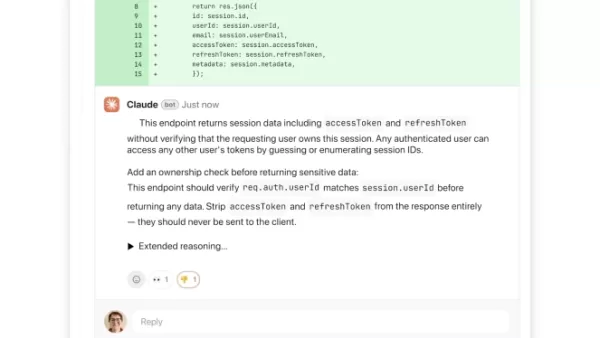
Peer feedback is essential in coding for early bug detection, maintaining codebase consistency, and enhancing overall software quality.The emergence of "vibe coding"—using AI tools that generate code from plain-language instructions—has transformed d
Anthropic Launches AI Code Review Tool
Peer feedback is essential in coding for early bug detection, maintaining codebase consistency, and enhancing overall software quality.The emergence of "vibe coding"—using AI tools that generate code from plain-language instructions—has transformed d

2026 Latest Best Top-rated AI SERP Analysis Tools for Search Strategy are curated by XIX.AI through rigorous real-world tests and weekly updated rankings. These powerful tools help you unlock hidden optimization opportunities, boost content performance, and gain a competitive edge in search. Discover your perfect tool to elevate your search strategy today. Explore now!
13 tools
xix.ai
2026 Latest Best Top-rated AI Anomaly Detection Tools for KPI Monitoring in SaaS and Ecommerce teams! XIX.AI has curated a powerful, game-changing collection based on rigorous real-world tests and weekly updated rankings. You’ll find detailed free vs paid comparison insights to help you identify the must-try solution that boosts productivity and unlocks your AI edge. Explore now!
10 tools
xix.ai

2026 Latest Best Top-Rated AI Outline Generators for Long-Form SEO Articles, meticulously curated by XIX.AI. These powerful tools offer game-changing assistance in creating high-quality content quickly, boosting writing efficiency significantly. Get a free vs paid comparison along with real-world tests and detailed rankings to help you find the must-try option that suits your needs. Explore now to unlock your AI edge.
8 tools
xix.ai

2026 Latest Best AI Study Tools for Homework and Exam Prep! XIX.AI curates a top-rated list of powerful, game-changing tools that help students boost productivity, streamline homework completion, and ace exams through real-world tests. Get a free vs paid comparison, detailed rankings, and must-try options to unlock your AI edge. Explore now!
10 tools
xix.ai

2026 Latest Best AI Vocal Demo Tools for Songwriters, Hook Creators, and Multi-Language Content Teams! XIX.AI has curated a top-rated list of powerful game-changing tools that go through rigorous real-world tests. You’ll find detailed free vs paid comparison data, comprehensive rankings, and must-try options to help you boost writing efficiency and unlock your creative potential. Explore now to discover your perfect tool for all your content needs!
9 tools
xix.ai

2026 Latest Best Top-rated AI Competitive Research Tools for Small Businesses! XIX.AI has curated a highly powerful game-changing collection, updated weekly with rigorous real-world tests and detailed rankings. You can find a comprehensive free vs paid comparison to help you identify the must-try tools that boost your productivity and give you a competitive edge. Explore now to discover your perfect tool!
9 tools
xix.ai












