


 Home
HomePixi Launches New iOS App to Transform Text Messages into Interactive AR Experiences
Set aside stickers, GIFs, and emoji reactions — Pixi is betting that the next advancement in messaging lies in interactive augmented reality.
On Wednesday, the startup released its messaging-focused app on the App Store, enabling users to send AI-driven AR characters via iMessage. Rather than appearing as static media, these characters come to life through the recipient’s iPhone camera, allowing them to respond to their surroundings, interact with people, and reply in real time.
Although augmented reality is no longer a cutting-edge technology — companies such as Snap have been developing AR filters and lenses for years — Pixi believes its approach offers a distinct advantage. By integrating AR with on-device AI, its characters can understand what’s happening around them and adjust their behavior accordingly. For example, a virtual cat will react when a real dog passes by. (According to the company, all visual and audio processing takes place on the device to protect user privacy.)
Mark Drummond, founder of Pixi and formerly employed at DreamWorks Animation and Apple, says the app is designed to add a greater sense of presence and spontaneity to digital conversations. Instead of sending a text message wishing someone a Happy Birthday, users can send characters that create a shared experience, transforming a simple message into something more akin to a digital gift or playful interaction.
“The issue we’re addressing for consumers is the desire to think of a friend when they’re not around,” he told TechCrunch. “This phenomenon is sometimes referred to as pebbling or creative gifting — essentially sharing tokens of affection, such as cards, e-cards, or gifts. While traditional methods exist, we can do better by creating something that’s truly digital and leverages everything we’ve learned about AR on the iPhone.”
Earlier this week, Drummond demonstrated the app to us by selecting a cat character, which performed a series of stand-up jokes on his desk. Notably, the cat appeared to respond to Drummond’s facial expressions, with the experience ending when he smiled, highlighting the character’s ability to detect emotional cues.
At launch, users will have access to a robot, a cat, and an animated envelope character that can react to their voice and “attack” their friends in a fun way. If the user moves, the envelope will chase them. The app also includes games such as tic-tac-toe and whack-a-mole.
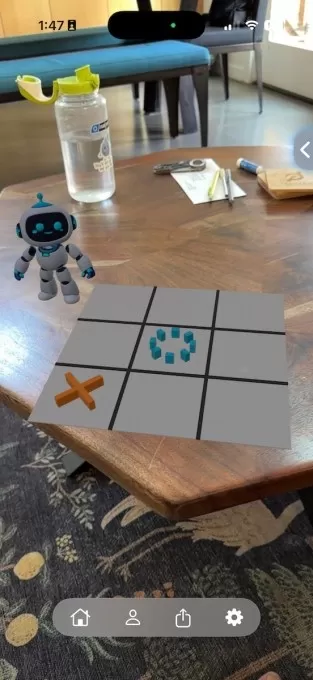
Image Credits:Pixi Platforms
Pixi plans to expand beyond just a few initial characters. Its long-term goal is to establish a marketplace where studios, brands, and independent creators can share their unique characters for users to choose from. The company envisions this platform being used for events such as movie premieres or product launches, helping to generate excitement, similar to how M&M’s introduces new flavors.
Drummond also mentioned the possibility of adding Alice from Wonderland as a character option, since she is part of publicly available intellectual property. He explained that “our Alice character needs to react to objects on the user’s desktop in a way that aligns with her character personality,” so partners can see how their creations will interact with the technology.
In the future, Pixi hopes to enable users to create their own characters and define their personalities.
“Part of our strategy is to make these generative AI tools available to our users, allowing them to specify exactly what they want, such as ‘I want a blue blob that threatens my friend, growls at them, and keeps chasing them on the phone,’” Drummond explained.
To send a character to a friend, users need to download the app on an iPhone and use iMessage by tapping the plus sign button in the lower left corner. Recipients don’t need to install anything to receive Pixi messages.
Initially, the app will be available only on iPhone models 11 and newer, but the company plans to bring it to Android devices as well as messaging platforms like WhatsApp and Instagram in the future.
While the app is free for users, brands will have the option to charge for their own characters if they choose.
“We aim to encourage people to use the app for free, because this way they become your own brand ambassadors. You’re giving them the freedom to use your characters to share their own stories,” Drummond said.
Related article
 Gemini offers free personalized AI image generation to U.S. users
On Monday, Google revealed that the Gemini app is extending its personalized image generation capabilities, powered by Nano Banana, to a wider audience. As of today, all eligible users in the United States can use this feature at no cost, removing th
New Guide: Preventing Meta’s AI Image Tool from Accessing Your Instagram Content
On Tuesday, Meta introduced “Muse Image,” a cutting-edge AI image generation tool that enables users to produce original artwork, modify existing photos, and craft customized ads right within its apps.However, one specific feature of this tool has sw
China's AI companion rules: Beijing's real target
The concept of an AI companion may seem dystopian, yet it has become a recurring topic in broader discussions about the risks of generative AI. Essentially, it refers to a conversational agent designed to maintain a continuous, personal relationship
Related Special Topic Recommendations
writing
Gemini offers free personalized AI image generation to U.S. users
On Monday, Google revealed that the Gemini app is extending its personalized image generation capabilities, powered by Nano Banana, to a wider audience. As of today, all eligible users in the United States can use this feature at no cost, removing th
New Guide: Preventing Meta’s AI Image Tool from Accessing Your Instagram Content
On Tuesday, Meta introduced “Muse Image,” a cutting-edge AI image generation tool that enables users to produce original artwork, modify existing photos, and craft customized ads right within its apps.However, one specific feature of this tool has sw
China's AI companion rules: Beijing's real target
The concept of an AI companion may seem dystopian, yet it has become a recurring topic in broader discussions about the risks of generative AI. Essentially, it refers to a conversational agent designed to maintain a continuous, personal relationship
Related Special Topic Recommendations
writing
 Best AI Outline Generators for Long-Form SEO Articles
2026 Latest Best Top-Rated AI Outline Generators for Long-Form SEO Articles, meticulously curated by XIX.AI. These powerful tools offer game-changing assistance in creating high-quality content quickly, boosting writing efficiency significantly. Get a free vs paid comparison along with real-world tests and detailed rankings to help you find the must-try option that suits your needs. Explore now to unlock your AI edge.
 8 tools
 xix.ai
Education and Learning
AI Study Tools for Homework and Exam Prep
xix.ai
Education and Learning
AI Study Tools for Homework and Exam Prep
2026 Latest Best AI Study Tools for Homework and Exam Prep! XIX.AI curates a top-rated list of powerful, game-changing tools that help students boost productivity, streamline homework completion, and ace exams through real-world tests. Get a free vs paid comparison, detailed rankings, and must-try options to unlock your AI edge. Explore now!
10 tools
xix.ai
Music composition
AI Vocal Demo Tools for Songwriters, Hooks, Toplines, and Multilingual Draft Sessions
2026 Latest Best AI Vocal Demo Tools for Songwriters, Hook Creators, and Multi-Language Content Teams! XIX.AI has curated a top-rated list of powerful game-changing tools that go through rigorous real-world tests. You’ll find detailed free vs paid comparison data, comprehensive rankings, and must-try options to help you boost writing efficiency and unlock your creative potential. Explore now to discover your perfect tool for all your content needs!
9 tools
xix.ai
Business
Best AI Competitive Research Tools for Small Businesses
2026 Latest Best Top-rated AI Competitive Research Tools for Small Businesses! XIX.AI has curated a highly powerful game-changing collection, updated weekly with rigorous real-world tests and detailed rankings. You can find a comprehensive free vs paid comparison to help you identify the must-try tools that boost your productivity and give you a competitive edge. Explore now to discover your perfect tool!
9 tools
xix.ai
Image editing
Photoshop AI Retouch Tools for Ecommerce Apparel, Skin Cleanup, and Color Consistency
2026 Latest Best Photoshop AI retouch tools for ecommerce apparel, skin cleanup, and color consistency! This top-rated curated list features powerful game-changing solutions that help you boost writing efficiency, streamline content creation, and achieve perfect visual results effortlessly. Each tool has undergone real-world tests through weekly updated rankings, complete with free vs paid comparison details. Backed by XIX.AI, it’s the must-try guide for anyone aiming to unlock your AI edge. Explore now!
10 tools
xix.ai
Prompt
Best AI Prompt Libraries for ChatGPT Workflows
2026 Latest Best Top-Rated AI Prompt Libraries for optimizing all types of ChatGPT workflows. XIX.AI has curated a powerful, game-changing collection that goes through rigorous real-world tests to ensure top performance. You can find detailed free vs paid comparisons and expert rankings to help you choose the must-try tools that boost your productivity and unlock your AI edge. Explore now!
11 tools
xix.ai

 Comments (0)
0/500
Comments (0)
0/500
Set aside stickers, GIFs, and emoji reactions — Pixi is betting that the next advancement in messaging lies in interactive augmented reality.
On Wednesday, the startup released its messaging-focused app on the App Store, enabling users to send AI-driven AR characters via iMessage. Rather than appearing as static media, these characters come to life through the recipient’s iPhone camera, allowing them to respond to their surroundings, interact with people, and reply in real time.
Although augmented reality is no longer a cutting-edge technology — companies such as Snap have been developing AR filters and lenses for years — Pixi believes its approach offers a distinct advantage. By integrating AR with on-device AI, its characters can understand what’s happening around them and adjust their behavior accordingly. For example, a virtual cat will react when a real dog passes by. (According to the company, all visual and audio processing takes place on the device to protect user privacy.)
Mark Drummond, founder of Pixi and formerly employed at DreamWorks Animation and Apple, says the app is designed to add a greater sense of presence and spontaneity to digital conversations. Instead of sending a text message wishing someone a Happy Birthday, users can send characters that create a shared experience, transforming a simple message into something more akin to a digital gift or playful interaction.
“The issue we’re addressing for consumers is the desire to think of a friend when they’re not around,” he told TechCrunch. “This phenomenon is sometimes referred to as pebbling or creative gifting — essentially sharing tokens of affection, such as cards, e-cards, or gifts. While traditional methods exist, we can do better by creating something that’s truly digital and leverages everything we’ve learned about AR on the iPhone.”
Earlier this week, Drummond demonstrated the app to us by selecting a cat character, which performed a series of stand-up jokes on his desk. Notably, the cat appeared to respond to Drummond’s facial expressions, with the experience ending when he smiled, highlighting the character’s ability to detect emotional cues.
At launch, users will have access to a robot, a cat, and an animated envelope character that can react to their voice and “attack” their friends in a fun way. If the user moves, the envelope will chase them. The app also includes games such as tic-tac-toe and whack-a-mole.
Image Credits:Pixi Platforms
Pixi plans to expand beyond just a few initial characters. Its long-term goal is to establish a marketplace where studios, brands, and independent creators can share their unique characters for users to choose from. The company envisions this platform being used for events such as movie premieres or product launches, helping to generate excitement, similar to how M&M’s introduces new flavors.
Drummond also mentioned the possibility of adding Alice from Wonderland as a character option, since she is part of publicly available intellectual property. He explained that “our Alice character needs to react to objects on the user’s desktop in a way that aligns with her character personality,” so partners can see how their creations will interact with the technology.
In the future, Pixi hopes to enable users to create their own characters and define their personalities.
“Part of our strategy is to make these generative AI tools available to our users, allowing them to specify exactly what they want, such as ‘I want a blue blob that threatens my friend, growls at them, and keeps chasing them on the phone,’” Drummond explained.
To send a character to a friend, users need to download the app on an iPhone and use iMessage by tapping the plus sign button in the lower left corner. Recipients don’t need to install anything to receive Pixi messages.
Initially, the app will be available only on iPhone models 11 and newer, but the company plans to bring it to Android devices as well as messaging platforms like WhatsApp and Instagram in the future.
While the app is free for users, brands will have the option to charge for their own characters if they choose.
“We aim to encourage people to use the app for free, because this way they become your own brand ambassadors. You’re giving them the freedom to use your characters to share their own stories,” Drummond said.








 Gemini offers free personalized AI image generation to U.S. users
On Monday, Google revealed that the Gemini app is extending its personalized image generation capabilities, powered by Nano Banana, to a wider audience. As of today, all eligible users in the United States can use this feature at no cost, removing th
Gemini offers free personalized AI image generation to U.S. users
On Monday, Google revealed that the Gemini app is extending its personalized image generation capabilities, powered by Nano Banana, to a wider audience. As of today, all eligible users in the United States can use this feature at no cost, removing th
 New Guide: Preventing Meta’s AI Image Tool from Accessing Your Instagram Content
On Tuesday, Meta introduced “Muse Image,” a cutting-edge AI image generation tool that enables users to produce original artwork, modify existing photos, and craft customized ads right within its apps.However, one specific feature of this tool has sw
New Guide: Preventing Meta’s AI Image Tool from Accessing Your Instagram Content
On Tuesday, Meta introduced “Muse Image,” a cutting-edge AI image generation tool that enables users to produce original artwork, modify existing photos, and craft customized ads right within its apps.However, one specific feature of this tool has sw
 China's AI companion rules: Beijing's real target
The concept of an AI companion may seem dystopian, yet it has become a recurring topic in broader discussions about the risks of generative AI. Essentially, it refers to a conversational agent designed to maintain a continuous, personal relationship
China's AI companion rules: Beijing's real target
The concept of an AI companion may seem dystopian, yet it has become a recurring topic in broader discussions about the risks of generative AI. Essentially, it refers to a conversational agent designed to maintain a continuous, personal relationship

2026 Latest Best Top-Rated AI Outline Generators for Long-Form SEO Articles, meticulously curated by XIX.AI. These powerful tools offer game-changing assistance in creating high-quality content quickly, boosting writing efficiency significantly. Get a free vs paid comparison along with real-world tests and detailed rankings to help you find the must-try option that suits your needs. Explore now to unlock your AI edge.
8 tools
xix.ai

2026 Latest Best AI Study Tools for Homework and Exam Prep! XIX.AI curates a top-rated list of powerful, game-changing tools that help students boost productivity, streamline homework completion, and ace exams through real-world tests. Get a free vs paid comparison, detailed rankings, and must-try options to unlock your AI edge. Explore now!
10 tools
xix.ai

2026 Latest Best AI Vocal Demo Tools for Songwriters, Hook Creators, and Multi-Language Content Teams! XIX.AI has curated a top-rated list of powerful game-changing tools that go through rigorous real-world tests. You’ll find detailed free vs paid comparison data, comprehensive rankings, and must-try options to help you boost writing efficiency and unlock your creative potential. Explore now to discover your perfect tool for all your content needs!
9 tools
xix.ai

2026 Latest Best Top-rated AI Competitive Research Tools for Small Businesses! XIX.AI has curated a highly powerful game-changing collection, updated weekly with rigorous real-world tests and detailed rankings. You can find a comprehensive free vs paid comparison to help you identify the must-try tools that boost your productivity and give you a competitive edge. Explore now to discover your perfect tool!
9 tools
xix.ai

2026 Latest Best Photoshop AI retouch tools for ecommerce apparel, skin cleanup, and color consistency! This top-rated curated list features powerful game-changing solutions that help you boost writing efficiency, streamline content creation, and achieve perfect visual results effortlessly. Each tool has undergone real-world tests through weekly updated rankings, complete with free vs paid comparison details. Backed by XIX.AI, it’s the must-try guide for anyone aiming to unlock your AI edge. Explore now!
10 tools
xix.ai
2026 Latest Best Top-Rated AI Prompt Libraries for optimizing all types of ChatGPT workflows. XIX.AI has curated a powerful, game-changing collection that goes through rigorous real-world tests to ensure top performance. You can find detailed free vs paid comparisons and expert rankings to help you choose the must-try tools that boost your productivity and unlock your AI edge. Explore now!
11 tools
xix.ai












