


 Home
HomeOpenAI, NVIDIA Forge MRC Protocol to Transform AI Training Networks
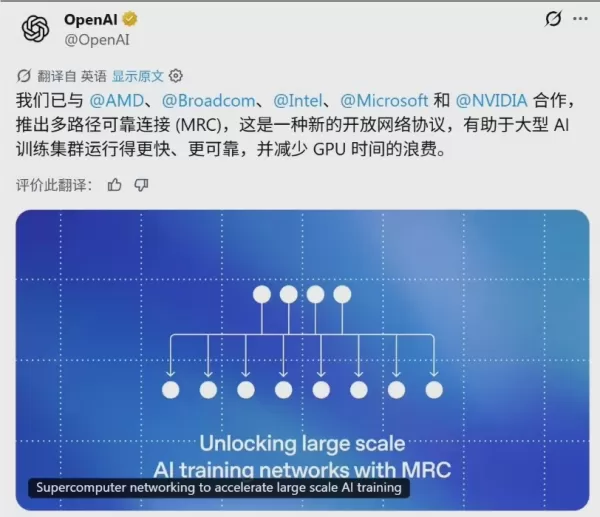
OpenAI has officially announced a collaboration with five industry leaders—AMD, Broadcom, Intel, Microsoft, and NVIDIA—to launch the Multipath Reliable Connection (MRC) protocol. This open-source protocol, released through the Open Compute Project (OCP), is designed to tackle the network latency and failures commonly encountered in large-scale AI training.
Eliminating the "Single Point of Failure": From Three-Tier to Two-Tier Architecture
In traditional AI model training, network congestion or a minor failure on a single link can cascade like dominoes, forcing tens of thousands of GPUs into idle states and leading to significant computational waste.
To fundamentally improve system resilience, the MRC protocol introduces a multi-plane network design. It intelligently divides a single 800Gb/s interface into multiple smaller links. This structural optimization enables the system to support massive clusters of up to approximately 131,000 GPUs using just two switch layers. Compared to traditional two- or four-tier architectures, this shift not only drastically reduces the number of physical components and energy consumption but also significantly cuts construction costs.
Advanced Traffic Management: Packet "Spraying" and Microsecond-Level Recovery
Beyond architectural simplification, MRC introduces a novel approach to traffic distribution. It employs adaptive packet spraying technology, moving away from traditional single-path transmission. This method breaks down task packets and distributes them across hundreds of parallel paths. Even if packets arrive out of order, the receiver can accurately reassemble them, effectively preventing localized congestion in the core network.
For network control, MRC replaces complex dynamic routing protocols (like BGP) with SRv6 source routing technology. This allows the sender to directly specify the path, while switches perform only simple static forwarding. This design slashes network fault recovery time from seconds to microseconds, enabling the system to achieve near "seamless self-healing" in the face of link instability.
Real-World Validation: The Supercomputer "Stabilizer"
The MRC protocol is already deployed in NVIDIA's GB200 supercomputer and Oracle's cloud infrastructure. Test data confirms that even during active training scenarios, MRC can automatically reroute around disruptions—such as sudden link jitter or switch reboots—ensuring complex training tasks continue without interruption.
Related article
 U.S. Stocks Hit Historic Milestone as AI and Aerospace Giants Prepare for Trillion-Dollar Debut
Elon Musk, Sam Altman, and Dario Amodei, three titans of the technology sector, are advancing toward initial public offerings for their respective ventures. With SpaceX, OpenAI, and Anthropic—three industry behemoths nearing trillion-dollar valuation
Swedish AI Startup Lovable Eyes $13.2 Billion Valuation After Major Funding Round
As AI-driven coding tools gain traction, Swedish startup Lovable has secured a major funding round. The company aims to raise $3 billion, potentially boosting its valuation to $13.2 billion—double the $6.6 billion recorded last December. Menlo Ventur
Google Tests Remy AI Agent for Gemini as Focus Shifts to User Control
According to Business Insider, Google is testing Remy, a new AI personal agent for Gemini. This tool aims to execute tasks on behalf of users, streamlining both professional workflows and daily routines.Currently, Remy is undergoing testing in an int
Related Special Topic Recommendations
writing
U.S. Stocks Hit Historic Milestone as AI and Aerospace Giants Prepare for Trillion-Dollar Debut
Elon Musk, Sam Altman, and Dario Amodei, three titans of the technology sector, are advancing toward initial public offerings for their respective ventures. With SpaceX, OpenAI, and Anthropic—three industry behemoths nearing trillion-dollar valuation
Swedish AI Startup Lovable Eyes $13.2 Billion Valuation After Major Funding Round
As AI-driven coding tools gain traction, Swedish startup Lovable has secured a major funding round. The company aims to raise $3 billion, potentially boosting its valuation to $13.2 billion—double the $6.6 billion recorded last December. Menlo Ventur
Google Tests Remy AI Agent for Gemini as Focus Shifts to User Control
According to Business Insider, Google is testing Remy, a new AI personal agent for Gemini. This tool aims to execute tasks on behalf of users, streamlining both professional workflows and daily routines.Currently, Remy is undergoing testing in an int
Related Special Topic Recommendations
writing
 Best AI Outline Generators for Long-Form SEO Articles
2026 Latest Best Top-Rated AI Outline Generators for Long-Form SEO Articles, meticulously curated by XIX.AI. These powerful tools offer game-changing assistance in creating high-quality content quickly, boosting writing efficiency significantly. Get a free vs paid comparison along with real-world tests and detailed rankings to help you find the must-try option that suits your needs. Explore now to unlock your AI edge.
 8 tools
 xix.ai
Education and Learning
AI Study Tools for Homework and Exam Prep
xix.ai
Education and Learning
AI Study Tools for Homework and Exam Prep
2026 Latest Best AI Study Tools for Homework and Exam Prep! XIX.AI curates a top-rated list of powerful, game-changing tools that help students boost productivity, streamline homework completion, and ace exams through real-world tests. Get a free vs paid comparison, detailed rankings, and must-try options to unlock your AI edge. Explore now!
10 tools
xix.ai
Music composition
AI Vocal Demo Tools for Songwriters, Hooks, Toplines, and Multilingual Draft Sessions
2026 Latest Best AI Vocal Demo Tools for Songwriters, Hook Creators, and Multi-Language Content Teams! XIX.AI has curated a top-rated list of powerful game-changing tools that go through rigorous real-world tests. You’ll find detailed free vs paid comparison data, comprehensive rankings, and must-try options to help you boost writing efficiency and unlock your creative potential. Explore now to discover your perfect tool for all your content needs!
9 tools
xix.ai
Business
Best AI Competitive Research Tools for Small Businesses
2026 Latest Best Top-rated AI Competitive Research Tools for Small Businesses! XIX.AI has curated a highly powerful game-changing collection, updated weekly with rigorous real-world tests and detailed rankings. You can find a comprehensive free vs paid comparison to help you identify the must-try tools that boost your productivity and give you a competitive edge. Explore now to discover your perfect tool!
9 tools
xix.ai
Image editing
Photoshop AI Retouch Tools for Ecommerce Apparel, Skin Cleanup, and Color Consistency
2026 Latest Best Photoshop AI retouch tools for ecommerce apparel, skin cleanup, and color consistency! This top-rated curated list features powerful game-changing solutions that help you boost writing efficiency, streamline content creation, and achieve perfect visual results effortlessly. Each tool has undergone real-world tests through weekly updated rankings, complete with free vs paid comparison details. Backed by XIX.AI, it’s the must-try guide for anyone aiming to unlock your AI edge. Explore now!
10 tools
xix.ai
Prompt
Best AI Prompt Libraries for ChatGPT Workflows
2026 Latest Best Top-Rated AI Prompt Libraries for optimizing all types of ChatGPT workflows. XIX.AI has curated a powerful, game-changing collection that goes through rigorous real-world tests to ensure top performance. You can find detailed free vs paid comparisons and expert rankings to help you choose the must-try tools that boost your productivity and unlock your AI edge. Explore now!
11 tools
xix.ai

 Comments (0)
0/500
Comments (0)
0/500
OpenAI has officially announced a collaboration with five industry leaders—AMD, Broadcom, Intel, Microsoft, and NVIDIA—to launch the Multipath Reliable Connection (MRC) protocol. This open-source protocol, released through the Open Compute Project (OCP), is designed to tackle the network latency and failures commonly encountered in large-scale AI training.
Eliminating the "Single Point of Failure": From Three-Tier to Two-Tier Architecture
In traditional AI model training, network congestion or a minor failure on a single link can cascade like dominoes, forcing tens of thousands of GPUs into idle states and leading to significant computational waste.
To fundamentally improve system resilience, the MRC protocol introduces a multi-plane network design. It intelligently divides a single 800Gb/s interface into multiple smaller links. This structural optimization enables the system to support massive clusters of up to approximately 131,000 GPUs using just two switch layers. Compared to traditional two- or four-tier architectures, this shift not only drastically reduces the number of physical components and energy consumption but also significantly cuts construction costs.
Advanced Traffic Management: Packet "Spraying" and Microsecond-Level Recovery
Beyond architectural simplification, MRC introduces a novel approach to traffic distribution. It employs adaptive packet spraying technology, moving away from traditional single-path transmission. This method breaks down task packets and distributes them across hundreds of parallel paths. Even if packets arrive out of order, the receiver can accurately reassemble them, effectively preventing localized congestion in the core network.
For network control, MRC replaces complex dynamic routing protocols (like BGP) with SRv6 source routing technology. This allows the sender to directly specify the path, while switches perform only simple static forwarding. This design slashes network fault recovery time from seconds to microseconds, enabling the system to achieve near "seamless self-healing" in the face of link instability.
Real-World Validation: The Supercomputer "Stabilizer"
The MRC protocol is already deployed in NVIDIA's GB200 supercomputer and Oracle's cloud infrastructure. Test data confirms that even during active training scenarios, MRC can automatically reroute around disruptions—such as sudden link jitter or switch reboots—ensuring complex training tasks continue without interruption.








 U.S. Stocks Hit Historic Milestone as AI and Aerospace Giants Prepare for Trillion-Dollar Debut
Elon Musk, Sam Altman, and Dario Amodei, three titans of the technology sector, are advancing toward initial public offerings for their respective ventures. With SpaceX, OpenAI, and Anthropic—three industry behemoths nearing trillion-dollar valuation
U.S. Stocks Hit Historic Milestone as AI and Aerospace Giants Prepare for Trillion-Dollar Debut
Elon Musk, Sam Altman, and Dario Amodei, three titans of the technology sector, are advancing toward initial public offerings for their respective ventures. With SpaceX, OpenAI, and Anthropic—three industry behemoths nearing trillion-dollar valuation
 Swedish AI Startup Lovable Eyes $13.2 Billion Valuation After Major Funding Round
As AI-driven coding tools gain traction, Swedish startup Lovable has secured a major funding round. The company aims to raise $3 billion, potentially boosting its valuation to $13.2 billion—double the $6.6 billion recorded last December. Menlo Ventur
Google Tests Remy AI Agent for Gemini as Focus Shifts to User Control
According to Business Insider, Google is testing Remy, a new AI personal agent for Gemini. This tool aims to execute tasks on behalf of users, streamlining both professional workflows and daily routines.Currently, Remy is undergoing testing in an int
Swedish AI Startup Lovable Eyes $13.2 Billion Valuation After Major Funding Round
As AI-driven coding tools gain traction, Swedish startup Lovable has secured a major funding round. The company aims to raise $3 billion, potentially boosting its valuation to $13.2 billion—double the $6.6 billion recorded last December. Menlo Ventur
Google Tests Remy AI Agent for Gemini as Focus Shifts to User Control
According to Business Insider, Google is testing Remy, a new AI personal agent for Gemini. This tool aims to execute tasks on behalf of users, streamlining both professional workflows and daily routines.Currently, Remy is undergoing testing in an int

2026 Latest Best Top-Rated AI Outline Generators for Long-Form SEO Articles, meticulously curated by XIX.AI. These powerful tools offer game-changing assistance in creating high-quality content quickly, boosting writing efficiency significantly. Get a free vs paid comparison along with real-world tests and detailed rankings to help you find the must-try option that suits your needs. Explore now to unlock your AI edge.
8 tools
xix.ai

2026 Latest Best AI Study Tools for Homework and Exam Prep! XIX.AI curates a top-rated list of powerful, game-changing tools that help students boost productivity, streamline homework completion, and ace exams through real-world tests. Get a free vs paid comparison, detailed rankings, and must-try options to unlock your AI edge. Explore now!
10 tools
xix.ai

2026 Latest Best AI Vocal Demo Tools for Songwriters, Hook Creators, and Multi-Language Content Teams! XIX.AI has curated a top-rated list of powerful game-changing tools that go through rigorous real-world tests. You’ll find detailed free vs paid comparison data, comprehensive rankings, and must-try options to help you boost writing efficiency and unlock your creative potential. Explore now to discover your perfect tool for all your content needs!
9 tools
xix.ai

2026 Latest Best Top-rated AI Competitive Research Tools for Small Businesses! XIX.AI has curated a highly powerful game-changing collection, updated weekly with rigorous real-world tests and detailed rankings. You can find a comprehensive free vs paid comparison to help you identify the must-try tools that boost your productivity and give you a competitive edge. Explore now to discover your perfect tool!
9 tools
xix.ai

2026 Latest Best Photoshop AI retouch tools for ecommerce apparel, skin cleanup, and color consistency! This top-rated curated list features powerful game-changing solutions that help you boost writing efficiency, streamline content creation, and achieve perfect visual results effortlessly. Each tool has undergone real-world tests through weekly updated rankings, complete with free vs paid comparison details. Backed by XIX.AI, it’s the must-try guide for anyone aiming to unlock your AI edge. Explore now!
10 tools
xix.ai
2026 Latest Best Top-Rated AI Prompt Libraries for optimizing all types of ChatGPT workflows. XIX.AI has curated a powerful, game-changing collection that goes through rigorous real-world tests to ensure top performance. You can find detailed free vs paid comparisons and expert rankings to help you choose the must-try tools that boost your productivity and unlock your AI edge. Explore now!
11 tools
xix.ai












