


 Home
Khosla-backed Genesis AI Unveils Full-Stack Robotics Solution
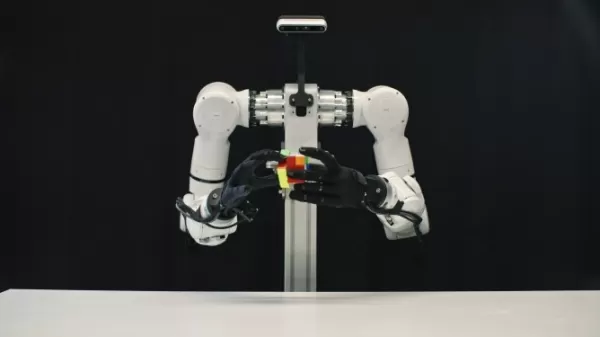
Genesis AI, a startup that secured a $105 million seed round to develop foundational AI for robotics, has launched its inaugural model, GENE-26.5, featuring unexpectedly dexterous hands. In a demonstration video, the company highlighted various advanced tasks executed by its in-house-designed robotic hands.
“The model has always been the primary objective, as superior intelligence stems from better models,” Genesis co-founder and CEO Zhou Xian told TechCrunch. However, the company soon recognized the necessity of hardware control. “Consequently, we chose to pursue a full-stack approach,” he explained.
Other well-funded firms operate at the intersection of AI and robotics, including Physical Intelligence and Skild AI. Xian acknowledged that “there are likely 50 to 100 robotic hand companies in existence.” Nevertheless, he and co-founder Théophile Gervet believe that building their own hardware will provide a competitive advantage.
The critical distinction is that Genesis’ hand matches the size and shape of a human hand, unlike the two-finger grippers commonly used by other robotics companies, thereby narrowing the gap with real-world scenarios.
“This enables us to gather significantly more data than previously possible, allowing us to train models capable of executing a wider array of tasks,” said Gervet, a former research scientist at Mistral AI who now serves as Genesis’ president.
Among the physical manipulation tasks demonstrated in the video below, Gervet’s personal favorite is cooking, as it demonstrates the robot’s ability to complete a complex sequence of difficult actions, such as cracking an egg and slicing a tomato. Genesis has also tasked its robots with preparing smoothies, playing the piano, and solving a Rubik’s cube—a common robotics benchmark.
Other tasks, such as laboratory work, represent more immediate commercial applications for Genesis’ technology. However, the underlying process is equally crucial: the startup has also developed a sensor-equipped glove that serves as a real-life counterpart to its robotic hand, collecting data that is easier to utilize.
“Our concept was that by designing a robotic hand that closely mimics a human hand, we could instantly unlock vast amounts of human data without worrying about the so-called ‘embodiment gap’ in robotics research,” Xian stated.
Others have attempted to address this challenge; the key innovation lies in how Genesis integrates this with its model. The current version, named GENE-26.5 for May 2026, is expected to undergo numerous iterations thanks to the simulation system they have developed. “The primary bottleneck for model iteration speed is evaluation. This significantly accelerates our model training process,” he noted.
Beyond simulation, data remains essential for training models that enable robots to perform more tasks. This is where Genesis’ glove proves valuable. Gervet explained that, unlike cumbersome data collection devices, it is lightweight, easy to wear, and relatively inexpensive to produce, similar to security gloves already used in various industries.
“We are currently in discussions with numerous customers, and a key value proposition of the glove is that it allows users to wear the data collection device while performing their daily jobs, whether as a pharmaceutical lab technician or in manufacturing,” Gervet said. This approach is further supported by ‘egocentric video data,’ where individuals film themselves performing tasks.
Nevertheless, it remains uncertain whether workers would be willing to wear the gloves and cameras that could train robots to replace them, or if they would receive additional compensation for this training. Gervet suggested that this is a matter between Genesis’ customers and their employees. “We have not yet finalized these details,” he remarked.
Regardless, workers may choose not to share this data with the startup, a possibility the founders acknowledge. However, Genesis has other avenues to build its ‘human skill library,’ including paying third-party partners to collect data. According to a press release that did not mention compensation, its model is already trained on “massive amounts of human-based internet videos.”
Combined with its simulation system, this could help Genesis reduce the costs of its technology for real-world applications, such as those demonstrated. “This represents a significant milestone for their team and the broader robotics industry,” said Eric Schmidt, Google’s former CEO and an investor in the startup.
In July 2025, just months after its founding, the startup emerged from stealth with a $105 million seed round co-led by Eclipse and Khosla Ventures. Additional backers included Bpifrance, HSG, and individuals such as Schmidt, Xavier Niel, Daniela Rus, and Vladlen Koltun.
This funding enabled Genesis to expand its workforce. With offices in Paris and California, the company has also opened a location in London. “A major reason for establishing a presence in Europe is the high talent density across the continent,” Gervet stated. The team of 60 people is distributed with “40-45% in Europe and 50-55% in the U.S.,” and the startup is currently hiring in all three locations.
In addition to hiring, the company plans to unveil its first general-purpose robot soon, which Xian told TechCrunch will be a full-body robot, not just hands. However, he emphasized that the roadmap remains unchanged.
“Our objective is to create the most capable robotic system,” he concluded.
Related article
 Google Unveils Agentic AI for Gemini, Launching with Enterprise Clients
During a Google Cloud event on Thursday, the company unveiled plans to integrate Gemini AI into the agentic era. This launch introduces a unified agent capable of not only answering queries but also executing tasks on behalf of users, all within a si
Google Unveils Dreambeans, Its Most Eccentric AI Tool Yet, to Transform Your Life Into a Cartoon
Google Labs, the division responsible for experimental product design, has released a new AI-powered application for iOS and Android that brings your daily life to life.Introducing Dreambeans. The reasoning behind the name will be explained shortly.W
Stripe to Acquire OpenRouter as AI Model Routing Gains Momentum
Stripe has agreed to acquire OpenRouter, an AI model-routing platform that gives developers access to hundreds of models through a single interface. The deal adds model selection and routing to Stripe’s existing work around AI usage and token-based b
Related Special Topic Recommendations
Design & Art
 Top AI Illustration Tools: Create Editorial Scenes and Cover Art Faster
2026 Latest Top-rated AI Illustration Tools: Our curated list features the best powerfully designed tools for creating stunning editorial scenes and eye-catching cover art quickly. Each option has gone through rigorous real-world tests, offering a free vs paid comparison to help you find the perfect match for your workflow. Try these must-try solutions today to unlock your AI edge and boost your creative productivity. Explore now at XIX.AI.
 10 tools
 xix.ai
Education and Learning
Top AI Tutors for Exam Prep: Practice Math, Science, and English
2026 Latest Top-Rated Best AI Tutors for Exam Prep are here on XIX.AI! Our curated list features powerful game-changing tools that offer free vs paid comparison, real-world tests, and weekly updated rankings. They help boost your writing efficiency, simplify complex topic learning, and unlock your academic potential. Explore now to Discover your perfect exam prep tool and Start creating today to Unlock your AI edge!
10 tools
xix.ai
Finance
AI Budget Planning Tools for Personal Money Management
2026 Latest Best Top-Rated AI Budget Planning Tools for Personal Money Management are here on XIX.AI! This curated collection features powerful, game-changing solutions that help you conduct real-world tests, understand spending habits, and create personalized plans to boost productivity. Enjoy a free vs paid comparison along with detailed rankings. Must-try tools designed to simplify money management and unlock your AI edge. Explore now!
11 tools
xix.ai
Health & Wellness
AI Sleep Tracking Assistants: Improve Recovery with Better Bedtime Habits
2026 Latest Best Top-Rated AI Sleep Tracking Assistants curated for ultimate recovery. This fully updated weekly guide features powerful tools that deliver real-world tests, free vs paid comparison, and detailed rankings to help you find the must-try solution that boosts sleep quality and supports better bedtime habits. Explore now at XIX.AI to Unlock your AI edge.
10 tools
xix.ai
Data Analysis
AI SQL Copilots for Product and Revenue Analytics
2026 Latest Best Top-Rated AI SQL Copilots for Product and Revenue Analytics! XIX.AI has curated a powerful, game-changing collection of must-try tools that undergo real-world tests through weekly updated rankings. These tools help users boost productivity significantly by accelerating data analysis, streamlining complex queries, and generating accurate insights to drive smarter business decisions. Explore now to Discover your perfect tool for unlocking your AI edge!
14 tools
xix.ai
Education and Learning
Best AI Homework Helpers That Teach: Learn Concepts, Not Just Answers
2026 Latest Best Top-Rated AI Homework Helpers That Teach Core Concepts Not Just Answers Powerful Tools for Students Must-Try Curated List Weekly Updated Free vs Paid Comparison Real-World Tests Accurate Rankings to Help You Unlock Your Full Learning Potential Explore now to Discover your perfect tool for smarter studying.
10 tools
xix.ai

 Comments (0)
0/500
Genesis AI, a startup that secured a $105 million seed round to develop foundational AI for robotics, has launched its inaugural model, GENE-26.5, featuring unexpectedly dexterous hands. In a demonstration video, the company highlighted various advanced tasks executed by its in-house-designed robotic hands.
“The model has always been the primary objective, as superior intelligence stems from better models,” Genesis co-founder and CEO Zhou Xian told TechCrunch. However, the company soon recognized the necessity of hardware control. “Consequently, we chose to pursue a full-stack approach,” he explained.
Other well-funded firms operate at the intersection of AI and robotics, including Physical Intelligence and Skild AI. Xian acknowledged that “there are likely 50 to 100 robotic hand companies in existence.” Nevertheless, he and co-founder Théophile Gervet believe that building their own hardware will provide a competitive advantage.
The critical distinction is that Genesis’ hand matches the size and shape of a human hand, unlike the two-finger grippers commonly used by other robotics companies, thereby narrowing the gap with real-world scenarios.
“This enables us to gather significantly more data than previously possible, allowing us to train models capable of executing a wider array of tasks,” said Gervet, a former research scientist at Mistral AI who now serves as Genesis’ president.
Among the physical manipulation tasks demonstrated in the video below, Gervet’s personal favorite is cooking, as it demonstrates the robot’s ability to complete a complex sequence of difficult actions, such as cracking an egg and slicing a tomato. Genesis has also tasked its robots with preparing smoothies, playing the piano, and solving a Rubik’s cube—a common robotics benchmark.
Other tasks, such as laboratory work, represent more immediate commercial applications for Genesis’ technology. However, the underlying process is equally crucial: the startup has also developed a sensor-equipped glove that serves as a real-life counterpart to its robotic hand, collecting data that is easier to utilize.
“Our concept was that by designing a robotic hand that closely mimics a human hand, we could instantly unlock vast amounts of human data without worrying about the so-called ‘embodiment gap’ in robotics research,” Xian stated.
Others have attempted to address this challenge; the key innovation lies in how Genesis integrates this with its model. The current version, named GENE-26.5 for May 2026, is expected to undergo numerous iterations thanks to the simulation system they have developed. “The primary bottleneck for model iteration speed is evaluation. This significantly accelerates our model training process,” he noted.
Beyond simulation, data remains essential for training models that enable robots to perform more tasks. This is where Genesis’ glove proves valuable. Gervet explained that, unlike cumbersome data collection devices, it is lightweight, easy to wear, and relatively inexpensive to produce, similar to security gloves already used in various industries.
“We are currently in discussions with numerous customers, and a key value proposition of the glove is that it allows users to wear the data collection device while performing their daily jobs, whether as a pharmaceutical lab technician or in manufacturing,” Gervet said. This approach is further supported by ‘egocentric video data,’ where individuals film themselves performing tasks.
Nevertheless, it remains uncertain whether workers would be willing to wear the gloves and cameras that could train robots to replace them, or if they would receive additional compensation for this training. Gervet suggested that this is a matter between Genesis’ customers and their employees. “We have not yet finalized these details,” he remarked.
Regardless, workers may choose not to share this data with the startup, a possibility the founders acknowledge. However, Genesis has other avenues to build its ‘human skill library,’ including paying third-party partners to collect data. According to a press release that did not mention compensation, its model is already trained on “massive amounts of human-based internet videos.”
Combined with its simulation system, this could help Genesis reduce the costs of its technology for real-world applications, such as those demonstrated. “This represents a significant milestone for their team and the broader robotics industry,” said Eric Schmidt, Google’s former CEO and an investor in the startup.
In July 2025, just months after its founding, the startup emerged from stealth with a $105 million seed round co-led by Eclipse and Khosla Ventures. Additional backers included Bpifrance, HSG, and individuals such as Schmidt, Xavier Niel, Daniela Rus, and Vladlen Koltun.
This funding enabled Genesis to expand its workforce. With offices in Paris and California, the company has also opened a location in London. “A major reason for establishing a presence in Europe is the high talent density across the continent,” Gervet stated. The team of 60 people is distributed with “40-45% in Europe and 50-55% in the U.S.,” and the startup is currently hiring in all three locations.
In addition to hiring, the company plans to unveil its first general-purpose robot soon, which Xian told TechCrunch will be a full-body robot, not just hands. However, he emphasized that the roadmap remains unchanged.
“Our objective is to create the most capable robotic system,” he concluded.








 Google Unveils Agentic AI for Gemini, Launching with Enterprise Clients
During a Google Cloud event on Thursday, the company unveiled plans to integrate Gemini AI into the agentic era. This launch introduces a unified agent capable of not only answering queries but also executing tasks on behalf of users, all within a si
 Google Unveils Dreambeans, Its Most Eccentric AI Tool Yet, to Transform Your Life Into a Cartoon
Google Labs, the division responsible for experimental product design, has released a new AI-powered application for iOS and Android that brings your daily life to life.Introducing Dreambeans. The reasoning behind the name will be explained shortly.W
 Stripe to Acquire OpenRouter as AI Model Routing Gains Momentum
Stripe has agreed to acquire OpenRouter, an AI model-routing platform that gives developers access to hundreds of models through a single interface. The deal adds model selection and routing to Stripe’s existing work around AI usage and token-based b

2026 Latest Top-rated AI Illustration Tools: Our curated list features the best powerfully designed tools for creating stunning editorial scenes and eye-catching cover art quickly. Each option has gone through rigorous real-world tests, offering a free vs paid comparison to help you find the perfect match for your workflow. Try these must-try solutions today to unlock your AI edge and boost your creative productivity. Explore now at XIX.AI.
10 tools
xix.ai

2026 Latest Top-Rated Best AI Tutors for Exam Prep are here on XIX.AI! Our curated list features powerful game-changing tools that offer free vs paid comparison, real-world tests, and weekly updated rankings. They help boost your writing efficiency, simplify complex topic learning, and unlock your academic potential. Explore now to Discover your perfect exam prep tool and Start creating today to Unlock your AI edge!
10 tools
xix.ai

2026 Latest Best Top-Rated AI Budget Planning Tools for Personal Money Management are here on XIX.AI! This curated collection features powerful, game-changing solutions that help you conduct real-world tests, understand spending habits, and create personalized plans to boost productivity. Enjoy a free vs paid comparison along with detailed rankings. Must-try tools designed to simplify money management and unlock your AI edge. Explore now!
11 tools
xix.ai

2026 Latest Best Top-Rated AI Sleep Tracking Assistants curated for ultimate recovery. This fully updated weekly guide features powerful tools that deliver real-world tests, free vs paid comparison, and detailed rankings to help you find the must-try solution that boosts sleep quality and supports better bedtime habits. Explore now at XIX.AI to Unlock your AI edge.
10 tools
xix.ai

2026 Latest Best Top-Rated AI SQL Copilots for Product and Revenue Analytics! XIX.AI has curated a powerful, game-changing collection of must-try tools that undergo real-world tests through weekly updated rankings. These tools help users boost productivity significantly by accelerating data analysis, streamlining complex queries, and generating accurate insights to drive smarter business decisions. Explore now to Discover your perfect tool for unlocking your AI edge!
14 tools
xix.ai

2026 Latest Best Top-Rated AI Homework Helpers That Teach Core Concepts Not Just Answers Powerful Tools for Students Must-Try Curated List Weekly Updated Free vs Paid Comparison Real-World Tests Accurate Rankings to Help You Unlock Your Full Learning Potential Explore now to Discover your perfect tool for smarter studying.
10 tools
xix.ai












