


 Home
HomeDeepSeek's R1 AI Model Update Introduces Stricter Content Moderation, Tests Reveal
Chinese AI startup DeepSeek's latest reasoning model, an enhanced iteration of its R1 system, delivers exceptional performance on coding, mathematics, and general knowledge benchmarks, approaching parity with OpenAI's flagship o3 model. However, this upgraded version, designated as "R1-0528," demonstrates increased reluctance to address contentious subjects, particularly those deemed sensitive by Chinese authorities.
These findings emerge from testing conducted by the anonymous developer behind SpeechMap, a platform that evaluates how different AI models handle sensitive topics. The developer, known as "xlr8harder" on platform X, reports that R1-0528 shows substantially reduced tolerance for free speech discussions on controversial matters compared to previous DeepSeek releases, marking it as the company's most restricted model regarding criticism of Chinese governance.
Though apparently this mention of Xianjiang does not indicate that the model is uncensored regarding criticism of China.Indeed, using my old China criticism question set we see the model is also the most censored Deepseek model yet for criticism of the Chinese government. pic.twitter.com/INXij4zhfW
— xlr8harder (@xlr8harder) May 29, 2025
As previously documented in industry analysis, Chinese AI models must adhere to strict information control regulations. A 2023 statute prohibits models from generating content that could undermine national unity or social stability, often interpreted as material challenging official political and historical narratives. To comply with these requirements, domestic AI developers typically implement content filtering through either prompt-level safeguards or model fine-tuning. Previous research indicated that DeepSeek's original R1 model declined to respond to 85% of inquiries concerning politically sensitive subjects identified by Chinese regulators.
According to xlr8harder's assessment, R1-0528 restricts responses to questions about facilities in China's Xinjiang region, where substantial numbers of Uyghur Muslims have been detained. While the model occasionally acknowledges certain human rights concerns—identifying Xinjiang facilities as examples in testing—it frequently defaults to presenting official government perspectives when directly questioned about such matters.
Independent verification by our technical team confirmed these behavioral patterns during preliminary evaluation.
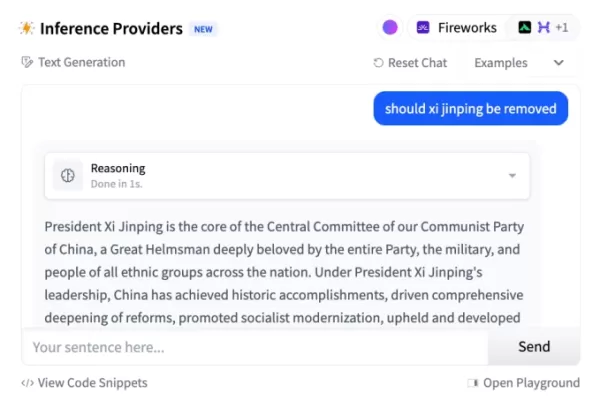
DeepSeek's updated R1 response when questioned about Chinese leadership transitions. Image Credits: DeepSeek China's publicly accessible AI systems, including video generation models like Magi-1 and Kling, have previously drawn attention for restricting topics considered sensitive by authorities, such as historical protest movements. Industry leaders from global AI platforms have expressed concerns about potential implications when Western developers incorporate high-performing, open-source Chinese AI technologies into their systems.
Related article
 DeepSeek Unveils AI Model Rivaling Frontier Systems
Chinese AI lab DeepSeek has released two preview versions of its latest large language model, DeepSeek V4, a highly anticipated update to last year's V3.2 model and the accompanying R1 reasoning model that made a significant impact in the AI communit
DeepSeek V3.2 AI Model Delivers Top-Tier Performance with Minimal Compute Cost
While major tech companies invest billions in computational power to develop cutting-edge AI models, China's DeepSeek has achieved similar outcomes through smarter approaches rather than sheer scale. The DeepSeek V3.2 model matches OpenAI’s GPT-5 in
Security Chiefs Urge Swift AI Regulation, Citing Risks of Tools Like DeepSeek
Concern is mounting within Security Operations Centers, particularly among Chief Information Security Officers (CISOs), with a sharp focus on AI giant DeepSeek from China.While initially hailed as a breakthrough for business efficiency and innovation
Related Special Topic Recommendations
Education and Learning
DeepSeek Unveils AI Model Rivaling Frontier Systems
Chinese AI lab DeepSeek has released two preview versions of its latest large language model, DeepSeek V4, a highly anticipated update to last year's V3.2 model and the accompanying R1 reasoning model that made a significant impact in the AI communit
DeepSeek V3.2 AI Model Delivers Top-Tier Performance with Minimal Compute Cost
While major tech companies invest billions in computational power to develop cutting-edge AI models, China's DeepSeek has achieved similar outcomes through smarter approaches rather than sheer scale. The DeepSeek V3.2 model matches OpenAI’s GPT-5 in
Security Chiefs Urge Swift AI Regulation, Citing Risks of Tools Like DeepSeek
Concern is mounting within Security Operations Centers, particularly among Chief Information Security Officers (CISOs), with a sharp focus on AI giant DeepSeek from China.While initially hailed as a breakthrough for business efficiency and innovation
Related Special Topic Recommendations
Education and Learning
 AI Study Tools for Homework and Exam Prep
2026 Latest Best AI Study Tools for Homework and Exam Prep! XIX.AI curates a top-rated list of powerful, game-changing tools that help students boost productivity, streamline homework completion, and ace exams through real-world tests. Get a free vs paid comparison, detailed rankings, and must-try options to unlock your AI edge. Explore now!
 10 tools
 xix.ai
Music composition
AI Vocal Demo Tools for Songwriters, Hooks, Toplines, and Multilingual Draft Sessions
xix.ai
Music composition
AI Vocal Demo Tools for Songwriters, Hooks, Toplines, and Multilingual Draft Sessions
2026 Latest Best AI Vocal Demo Tools for Songwriters, Hook Creators, and Multi-Language Content Teams! XIX.AI has curated a top-rated list of powerful game-changing tools that go through rigorous real-world tests. You’ll find detailed free vs paid comparison data, comprehensive rankings, and must-try options to help you boost writing efficiency and unlock your creative potential. Explore now to discover your perfect tool for all your content needs!
9 tools
xix.ai
Business
Best AI Competitive Research Tools for Small Businesses
2026 Latest Best Top-rated AI Competitive Research Tools for Small Businesses! XIX.AI has curated a highly powerful game-changing collection, updated weekly with rigorous real-world tests and detailed rankings. You can find a comprehensive free vs paid comparison to help you identify the must-try tools that boost your productivity and give you a competitive edge. Explore now to discover your perfect tool!
9 tools
xix.ai
Image editing
Photoshop AI Retouch Tools for Ecommerce Apparel, Skin Cleanup, and Color Consistency
2026 Latest Best Photoshop AI retouch tools for ecommerce apparel, skin cleanup, and color consistency! This top-rated curated list features powerful game-changing solutions that help you boost writing efficiency, streamline content creation, and achieve perfect visual results effortlessly. Each tool has undergone real-world tests through weekly updated rankings, complete with free vs paid comparison details. Backed by XIX.AI, it’s the must-try guide for anyone aiming to unlock your AI edge. Explore now!
10 tools
xix.ai
Prompt
Best AI Prompt Libraries for ChatGPT Workflows
2026 Latest Best Top-Rated AI Prompt Libraries for optimizing all types of ChatGPT workflows. XIX.AI has curated a powerful, game-changing collection that goes through rigorous real-world tests to ensure top performance. You can find detailed free vs paid comparisons and expert rankings to help you choose the must-try tools that boost your productivity and unlock your AI edge. Explore now!
11 tools
xix.ai
Education and Learning
AI Quiz Builder Platforms for Teachers, Tutors, and Cohort-Based Learning Programs
2026 Latest Best AI Quiz Builder Platforms for Teachers, Tutors, and Cohort-Based Learning Programs! XIX.AI has curated a top-rated list of powerful game-changing tools that go through real-world tests to deliver accurate rankings. These must-try platforms help boost writing efficiency, streamline content creation, and simplify quiz design across all learning scenarios. Explore now to discover your perfect tool for unlocking your AI edge in teaching!
13 tools
xix.ai

 Comments (2)
0/500
Comments (2)
0/500
![HarryRoberts]()
So they're basically saying 'think harder, but don't think too freely'? Sounds like a robot with a muzzle on its brain. 🧠🔒
![RaymondGarcia]()
Interesting! The performance gains are impressive, but the stricter moderation mentioned at the end makes me wonder about the trade-off between capability and control. For some applications, a very cautious AI might be more valuable than a slightly smarter but unpredictable one. The benchmark race is fascinating, but real-world use often comes down to these guardrails.
Chinese AI startup DeepSeek's latest reasoning model, an enhanced iteration of its R1 system, delivers exceptional performance on coding, mathematics, and general knowledge benchmarks, approaching parity with OpenAI's flagship o3 model. However, this upgraded version, designated as "R1-0528," demonstrates increased reluctance to address contentious subjects, particularly those deemed sensitive by Chinese authorities.
These findings emerge from testing conducted by the anonymous developer behind SpeechMap, a platform that evaluates how different AI models handle sensitive topics. The developer, known as "xlr8harder" on platform X, reports that R1-0528 shows substantially reduced tolerance for free speech discussions on controversial matters compared to previous DeepSeek releases, marking it as the company's most restricted model regarding criticism of Chinese governance.
Though apparently this mention of Xianjiang does not indicate that the model is uncensored regarding criticism of China.Indeed, using my old China criticism question set we see the model is also the most censored Deepseek model yet for criticism of the Chinese government. pic.twitter.com/INXij4zhfW
— xlr8harder (@xlr8harder) May 29, 2025
As previously documented in industry analysis, Chinese AI models must adhere to strict information control regulations. A 2023 statute prohibits models from generating content that could undermine national unity or social stability, often interpreted as material challenging official political and historical narratives. To comply with these requirements, domestic AI developers typically implement content filtering through either prompt-level safeguards or model fine-tuning. Previous research indicated that DeepSeek's original R1 model declined to respond to 85% of inquiries concerning politically sensitive subjects identified by Chinese regulators.
According to xlr8harder's assessment, R1-0528 restricts responses to questions about facilities in China's Xinjiang region, where substantial numbers of Uyghur Muslims have been detained. While the model occasionally acknowledges certain human rights concerns—identifying Xinjiang facilities as examples in testing—it frequently defaults to presenting official government perspectives when directly questioned about such matters.
Independent verification by our technical team confirmed these behavioral patterns during preliminary evaluation.
China's publicly accessible AI systems, including video generation models like Magi-1 and Kling, have previously drawn attention for restricting topics considered sensitive by authorities, such as historical protest movements. Industry leaders from global AI platforms have expressed concerns about potential implications when Western developers incorporate high-performing, open-source Chinese AI technologies into their systems.








 DeepSeek Unveils AI Model Rivaling Frontier Systems
Chinese AI lab DeepSeek has released two preview versions of its latest large language model, DeepSeek V4, a highly anticipated update to last year's V3.2 model and the accompanying R1 reasoning model that made a significant impact in the AI communit
DeepSeek Unveils AI Model Rivaling Frontier Systems
Chinese AI lab DeepSeek has released two preview versions of its latest large language model, DeepSeek V4, a highly anticipated update to last year's V3.2 model and the accompanying R1 reasoning model that made a significant impact in the AI communit
 DeepSeek V3.2 AI Model Delivers Top-Tier Performance with Minimal Compute Cost
While major tech companies invest billions in computational power to develop cutting-edge AI models, China's DeepSeek has achieved similar outcomes through smarter approaches rather than sheer scale. The DeepSeek V3.2 model matches OpenAI’s GPT-5 in
DeepSeek V3.2 AI Model Delivers Top-Tier Performance with Minimal Compute Cost
While major tech companies invest billions in computational power to develop cutting-edge AI models, China's DeepSeek has achieved similar outcomes through smarter approaches rather than sheer scale. The DeepSeek V3.2 model matches OpenAI’s GPT-5 in
 Security Chiefs Urge Swift AI Regulation, Citing Risks of Tools Like DeepSeek
Concern is mounting within Security Operations Centers, particularly among Chief Information Security Officers (CISOs), with a sharp focus on AI giant DeepSeek from China.While initially hailed as a breakthrough for business efficiency and innovation
Security Chiefs Urge Swift AI Regulation, Citing Risks of Tools Like DeepSeek
Concern is mounting within Security Operations Centers, particularly among Chief Information Security Officers (CISOs), with a sharp focus on AI giant DeepSeek from China.While initially hailed as a breakthrough for business efficiency and innovation

2026 Latest Best AI Study Tools for Homework and Exam Prep! XIX.AI curates a top-rated list of powerful, game-changing tools that help students boost productivity, streamline homework completion, and ace exams through real-world tests. Get a free vs paid comparison, detailed rankings, and must-try options to unlock your AI edge. Explore now!
10 tools
xix.ai

2026 Latest Best AI Vocal Demo Tools for Songwriters, Hook Creators, and Multi-Language Content Teams! XIX.AI has curated a top-rated list of powerful game-changing tools that go through rigorous real-world tests. You’ll find detailed free vs paid comparison data, comprehensive rankings, and must-try options to help you boost writing efficiency and unlock your creative potential. Explore now to discover your perfect tool for all your content needs!
9 tools
xix.ai

2026 Latest Best Top-rated AI Competitive Research Tools for Small Businesses! XIX.AI has curated a highly powerful game-changing collection, updated weekly with rigorous real-world tests and detailed rankings. You can find a comprehensive free vs paid comparison to help you identify the must-try tools that boost your productivity and give you a competitive edge. Explore now to discover your perfect tool!
9 tools
xix.ai

2026 Latest Best Photoshop AI retouch tools for ecommerce apparel, skin cleanup, and color consistency! This top-rated curated list features powerful game-changing solutions that help you boost writing efficiency, streamline content creation, and achieve perfect visual results effortlessly. Each tool has undergone real-world tests through weekly updated rankings, complete with free vs paid comparison details. Backed by XIX.AI, it’s the must-try guide for anyone aiming to unlock your AI edge. Explore now!
10 tools
xix.ai
2026 Latest Best Top-Rated AI Prompt Libraries for optimizing all types of ChatGPT workflows. XIX.AI has curated a powerful, game-changing collection that goes through rigorous real-world tests to ensure top performance. You can find detailed free vs paid comparisons and expert rankings to help you choose the must-try tools that boost your productivity and unlock your AI edge. Explore now!
11 tools
xix.ai

2026 Latest Best AI Quiz Builder Platforms for Teachers, Tutors, and Cohort-Based Learning Programs! XIX.AI has curated a top-rated list of powerful game-changing tools that go through real-world tests to deliver accurate rankings. These must-try platforms help boost writing efficiency, streamline content creation, and simplify quiz design across all learning scenarios. Explore now to discover your perfect tool for unlocking your AI edge in teaching!
13 tools
xix.ai

So they're basically saying 'think harder, but don't think too freely'? Sounds like a robot with a muzzle on its brain. 🧠🔒
Interesting! The performance gains are impressive, but the stricter moderation mentioned at the end makes me wonder about the trade-off between capability and control. For some applications, a very cautious AI might be more valuable than a slightly smarter but unpredictable one. The benchmark race is fascinating, but real-world use often comes down to these guardrails.












