


 Home
HomeWhat is the deepest leaves sum in binary trees? 2026 guide and solutions.
Mastering binary trees is essential for any data scientist or software developer. A particularly engaging challenge is computing the sum of a tree's deepest leaves. This guide offers a complete walkthrough for solving this problem with level order traversal, a core tree manipulation technique.
Key Points
Level order traversal is a breadth-first search method for navigating trees.
The deepest leaves are the nodes located at the binary tree's maximum depth.
A queue data structure is typically employed to execute level order traversal.
Grasping the role of null markers in level order traversal is vital.
This problem focuses on summing node values exclusively from the deepest level.
Understanding the Deepest Leaves Sum Problem
What is the Deepest Leaves Sum?
The deepest leaves sum problem involves calculating the total value of all nodes at the greatest depth or level in a given binary tree.
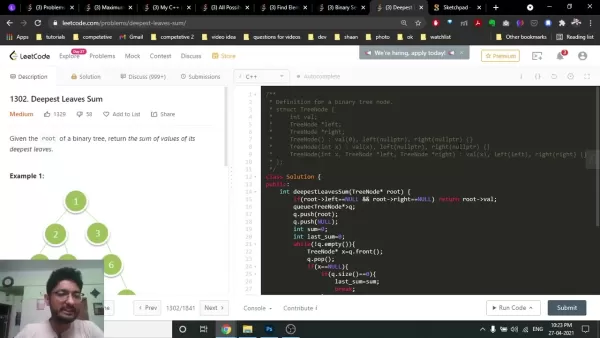
Your objective, given the root of a binary tree, is to navigate the tree, locate its deepest level, and return the sum of all node values found there.
Consider a binary tree with several levels. The deepest level holds the nodes most distant from the root. Summing the values of these nodes yields the final answer. This problem is common in technical interviews and demonstrates proficiency with tree traversal algorithms and queue data structures. A solid grasp of binary trees and their traversals is critical for data science and software development. This specific challenge underscores the value of level-order traversal and efficient tree manipulation for optimal outcomes.Binary Tree Basics
Before tackling the solution, it's important to understand some fundamental binary tree concepts. A binary tree is a hierarchical data structure where each node can have up to two children, known as the left and right child. Familiarity with these ideas leads to a more effective problem-solving approach.
- Node: Each element in a binary tree is called a node. Nodes store data and references to their children.
- Root: The top node in the tree. A tree has a single root.
- Leaf: A node without any children.
- Depth/Level: A node's distance from the root. The root is at level 0.
- Height: The maximum depth of any node in the tree. This is another essential concept.
Understanding these fundamentals is crucial for anyone working with binary trees, particularly for activities like data manipulation, algorithm development, and efficient problem-solving. A firm grasp of these concepts simplifies tackling complex problems such as finding the sum of the deepest leaves.
Level Order Traversal and Its Importance
Level order traversal, also called breadth-first search (BFS), entails navigating a tree level by level, beginning at the root. This method is fundamental for solving the deepest leaves sum problem.
- Breadth-First Approach: The core concept is to visit all nodes on the same level before proceeding to the next.
- Queue Data Structure: A queue is commonly used to implement level order traversal, guaranteeing nodes are processed in the proper sequence.
- Null Markers: Null markers can signal the end of a level, aiding in transitions between levels.
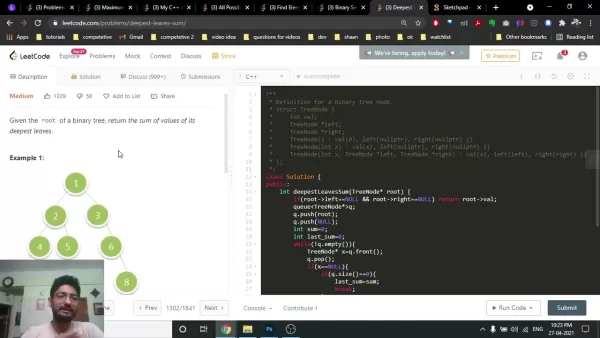
Level order traversal offers several advantages:
- Efficiency: It methodically explores the tree level by level.
- Finding Deepest Level: It readily identifies the tree's deepest level.
- Queue Management: Using a queue simplifies handling nodes at each level.
Learning this traversal algorithm is highly beneficial for students of data structures and algorithms, easing the process of solving tree-related problems.
Step-by-Step Solution Using Level Order Traversal
Implementing Level Order Traversal with a Queue
To apply level order traversal for the deepest leaves sum problem, adhere to these steps:
- Initialize: Create a queue and add the root node.
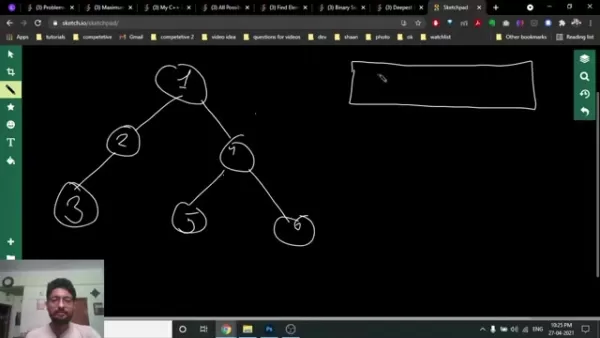
Also, add a null marker to signify the end of the initial level.
- Iterate: Continue looping until the queue is empty.
- Process Each Node: Remove a node from the queue. If the node is not null, add its value to the current level's sum. Add its left and right children to the queue.
- Handle Null Markers: If the removed node is null, it marks the end of a level. At this stage:
- If the queue still has nodes, add another null marker for the next level.
- Update the final level sum with the current level's total.
- Reset the current level sum to zero.
- Final Result: Once the loop completes, the final level sum will represent the sum of the deepest leaves.
This method enables efficient traversal and summation, which is particularly useful for those studying algorithm efficiency and optimized coding practices.
Detailed Example
Let's implement this technique on a sample binary tree.
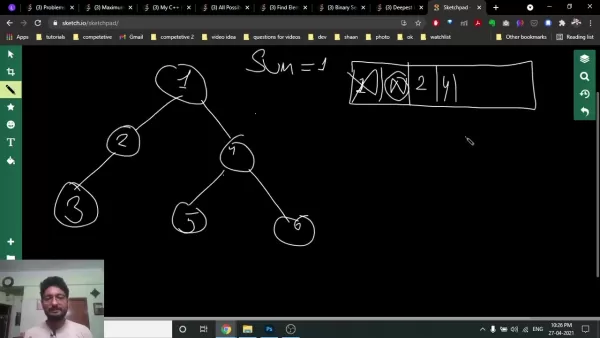
Consider this tree:
1 / 2 4 / / 3 5 6
Following the procedure:
- Start with Root: Add the root (1) and a null marker to the queue.
- First Level: Process node 1. Add nodes 2 and 4. Include a null marker.
- Second Level: Process nodes 2 and 4. Add nodes 3, 5, and 6. Include a null marker.
- Third Level: When the null marker is processed, update the final level sum. Process nodes 3, 5, and 6.
- Final Calculation: After processing the last level, the deepest leaves sum is 3 + 5 + 6 = 14.
This example allows students of binary trees to easily follow along and strengthen their comprehension of both the data structure and the traversal algorithm. It offers practical insight for learners of data structures.
C++ Code Implementation
Below is the C++ code for the algorithm.
#include #include struct TreeNode {int val;TreeNode *left;TreeNode *right;TreeNode(int x) : val(x), left(nullptr), right(nullptr) {}};int deepestLeavesSum(TreeNode* root) {if (!root) return 0;std::queue q;q.push(root);q.push(nullptr);int lastSum = 0, levelSum = 0;while (!q.empty()) {TreeNode* node = q.front();q.pop();if (node == nullptr) {if (!q.empty()) {q.push(nullptr);}lastSum = levelSum;levelSum = 0;} else {levelSum += node->val;if (node->left) q.push(node->left);if (node->right) q.push(node->right);}}return lastSum;}int main() {TreeNode* root = new TreeNode(1);root->left = new TreeNode(2);root->right = new TreeNode(4);root->left->left = new TreeNode(3);root->right->left = new TreeNode(5);root->right->right = new TreeNode(6);std::cout This code illustrates the practical application of level order traversal and queue data structures. It serves as excellent reference material for those studying C++ programming and algorithm design, demonstrating how these techniques address a typical tree-related challenge.
Using the Deepest Leaves Sum Algorithm
Implementing in Different Environments
The deepest leaves sum algorithm can be adapted for various environments, such as:
- Web Applications: Utilize JavaScript for client-side tree processing.
- Backend Services: Implement in Java or Python for server-side data handling.
- Embedded Systems: Code in C or C++ for real-time data analysis.
This flexibility enables developers to deploy it across multiple platforms, enhancing performance and memory management. This capability is advantageous for professionals in cross-platform development and efficient algorithm implementation. The algorithm is applicable in diverse software architectures.
Understanding the Cost of Implementation
Resource Requirements and Optimization
Applying the deepest leaves sum algorithm requires considering both time and space complexity. Key points include:
- Time Complexity: The algorithm operates in O(N) time, where N is the number of nodes, since it visits each node once.
- Space Complexity: The space complexity is O(W), where W is the tree's maximum width, as the queue must accommodate all nodes at the broadest level.
Optimizing the algorithm depends on your application's specific constraints and needs. Methods like iterative deepening can lower memory consumption in exceptionally deep trees. This knowledge is essential for those studying algorithm analysis and performance optimization, allowing them to customize solutions for peak efficiency.
Evaluating Level Order Traversal for Deepest Leaves Sum
Pros
Methodical level-by-level exploration guarantees the algorithm efficiently locates the deepest level.
The queue data structure streamlines node management at each level, resulting in code that is easier to write and comprehend.
Null markers offer a clear and efficient method for handling level transitions and tracking when a level is complete.
Cons
The O(W) space complexity, where W is the tree's maximum width, can be restrictive for very broad trees.
The algorithm may not be the most memory-efficient for extremely deep trees, as it must store nodes from all levels in the queue.
It demands careful queue management to ensure nodes are processed in the correct order, particularly with skewed or unbalanced trees.
Core Features of Level Order Traversal
Essential Components and Benefits
Level order traversal offers several core features that enhance its utility for tree processing:
- Systematic Exploration: Guarantees all nodes at each level are visited before advancing.
- Queue Utilization: Efficient deployment of a queue to manage node processing.
- Level Delimitation: Employing null markers to clearly separate levels.
- Simplicity: Straightforward and easy-to-implement traversal logic.
These features are vital across numerous applications. Experts in systematic data processing and queue data structures will find these elements particularly advantageous.
Diverse Use Cases for Deepest Leaves Sum Algorithm
Real-World Applications in Various Industries
The deepest leaves sum algorithm is applicable in many real-world situations:
- Network Routing: Identifying the most distant nodes in a network layout.
- Database Indexing: Examining tree-based indexes to enhance query performance.
- File System Traversal: Locating the deepest files in a directory hierarchy.
- Artificial Intelligence: Applied in decision tree algorithms to evaluate final decision results.
The algorithm's adaptability and broad utility emphasize its practical worth, aiding professionals in network optimization, database management, and AI-driven solutions. The binary tree is central to many critical operations.
Frequently Asked Questions
What is the time complexity of the deepest leaves sum algorithm?
The time complexity is O(N), where N is the number of nodes in the binary tree, since the algorithm visits each node exactly once.
What is the space complexity of the deepest leaves sum algorithm?
The space complexity is O(W), where W is the tree's maximum width, because the queue must hold, at most, all nodes from the broadest level.
How does level order traversal help solve this problem?
Level order traversal ensures all nodes at the same level are processed before moving deeper, simplifying the identification of the deepest level and the summation of its nodes.
Are null markers necessary for this algorithm?
Yes, null markers help distinguish levels, facilitating level transitions and indicating when a level is fully processed. This method enhances the algorithm's clarity.
Can this algorithm be optimized for very deep trees?
Yes, iterative deepening can reduce memory usage in very deep trees. Iterative deepening merges the space efficiency of depth-first search with the completeness of breadth-first search.
Related Questions
How can I modify this algorithm to find the sum of nodes at a specific level?
To calculate the sum of nodes at a particular level, adjust the level order traversal algorithm. Introduce a counter to monitor the current level. When the counter reaches the target level, sum the node values. Here's a step-by-step approach:Initialize: Create a queue and add the root node with the level counter initialized to 0. Also, add a level delimiter (e.g., a null marker) to indicate the end of each level. Iterate: Loop until the queue is empty.Process Each Node: Remove a node and its level from the queue. If the current level matches the target, add the node's value to the sum. Add its left and right children with an increased level counter.Handle Level Delimiters: If the removed node is a level delimiter (null marker):Increase the level counter.If the queue isn't empty, add another level delimiter for the next level.Verify if the level counter equals the target level. If it does, begin summing values at this level.Optimization: To skip unnecessary nodes, you can add a condition to exit the loop after fully processing the target level. This method efficiently computes the sum for any specified level. Proper execution of this approach facilitates effective data management, enabling rapid responses to specific queries. All these measures ensure that data manipulation and search operations are efficient.
Related article
 South Korea Breaks Ground on National AI Computing Center, Investing 2.5 Trillion Won with 2028 Target
South Korean outlet EtNews reports that groundbreaking for the Korea AI Computing Center (KOACC) took place on August 3 at the Solar City data center park in Sunan, Jeollanam-do. Backed by a total investment of 2.5 trillion KRW (roughly 11.838 billio
Six Tech Giants Back Linux Foundation With $12.5M to Tackle AI Vulnerability Noise
To tackle the flood of low-quality security reports produced by AI automation tools, six major tech companies—Anthropic, Amazon (AWS), GitHub, Google, Microsoft, and OpenAI—have collectively contributed $12.5 million in funding to Linux Foundation in
Musk Considered Leaving OpenAI to His Kids as Altman Testifies
This morning, OpenAI CEO Sam Altman took the stand to address former co-founder Elon Musk’s lawsuit challenging the company’s corporate structure.When asked about Musk’s claim that other founders “stole a charity” by launching a for-profit subsidiary
Related Special Topic Recommendations
Music composition
South Korea Breaks Ground on National AI Computing Center, Investing 2.5 Trillion Won with 2028 Target
South Korean outlet EtNews reports that groundbreaking for the Korea AI Computing Center (KOACC) took place on August 3 at the Solar City data center park in Sunan, Jeollanam-do. Backed by a total investment of 2.5 trillion KRW (roughly 11.838 billio
Six Tech Giants Back Linux Foundation With $12.5M to Tackle AI Vulnerability Noise
To tackle the flood of low-quality security reports produced by AI automation tools, six major tech companies—Anthropic, Amazon (AWS), GitHub, Google, Microsoft, and OpenAI—have collectively contributed $12.5 million in funding to Linux Foundation in
Musk Considered Leaving OpenAI to His Kids as Altman Testifies
This morning, OpenAI CEO Sam Altman took the stand to address former co-founder Elon Musk’s lawsuit challenging the company’s corporate structure.When asked about Musk’s claim that other founders “stole a charity” by launching a for-profit subsidiary
Related Special Topic Recommendations
Music composition
 AI Vocal Demo Tools for Songwriters, Hooks, Toplines, and Multilingual Draft Sessions
2026 Latest Best AI Vocal Demo Tools for Songwriters, Hook Creators, and Multi-Language Content Teams! XIX.AI has curated a top-rated list of powerful game-changing tools that go through rigorous real-world tests. You’ll find detailed free vs paid comparison data, comprehensive rankings, and must-try options to help you boost writing efficiency and unlock your creative potential. Explore now to discover your perfect tool for all your content needs!
 9 tools
 xix.ai
Business
Best AI Competitive Research Tools for Small Businesses
xix.ai
Business
Best AI Competitive Research Tools for Small Businesses
2026 Latest Best Top-rated AI Competitive Research Tools for Small Businesses! XIX.AI has curated a highly powerful game-changing collection, updated weekly with rigorous real-world tests and detailed rankings. You can find a comprehensive free vs paid comparison to help you identify the must-try tools that boost your productivity and give you a competitive edge. Explore now to discover your perfect tool!
9 tools
xix.ai
Image editing
Photoshop AI Retouch Tools for Ecommerce Apparel, Skin Cleanup, and Color Consistency
2026 Latest Best Photoshop AI retouch tools for ecommerce apparel, skin cleanup, and color consistency! This top-rated curated list features powerful game-changing solutions that help you boost writing efficiency, streamline content creation, and achieve perfect visual results effortlessly. Each tool has undergone real-world tests through weekly updated rankings, complete with free vs paid comparison details. Backed by XIX.AI, it’s the must-try guide for anyone aiming to unlock your AI edge. Explore now!
10 tools
xix.ai
Prompt
Best AI Prompt Libraries for ChatGPT Workflows
2026 Latest Best Top-Rated AI Prompt Libraries for optimizing all types of ChatGPT workflows. XIX.AI has curated a powerful, game-changing collection that goes through rigorous real-world tests to ensure top performance. You can find detailed free vs paid comparisons and expert rankings to help you choose the must-try tools that boost your productivity and unlock your AI edge. Explore now!
11 tools
xix.ai
Education and Learning
AI Quiz Builder Platforms for Teachers, Tutors, and Cohort-Based Learning Programs
2026 Latest Best AI Quiz Builder Platforms for Teachers, Tutors, and Cohort-Based Learning Programs! XIX.AI has curated a top-rated list of powerful game-changing tools that go through real-world tests to deliver accurate rankings. These must-try platforms help boost writing efficiency, streamline content creation, and simplify quiz design across all learning scenarios. Explore now to discover your perfect tool for unlocking your AI edge in teaching!
13 tools
xix.ai
code
AI Pull Request Review Tools for GitHub Teams Handling Refactors, Bugs, and Security Gaps
2026 Latest Best AI Pull Request Review Tools for GitHub Teams are here on XIX.AI! This top-rated curated list showcases powerful game-changing solutions that streamline refactoring, bug fixing, and security gap detection across all team workflows. Enjoy a free vs paid comparison along with real-world tests and detailed rankings to help you find the perfect tool that boosts productivity significantly. Explore now to unlock your AI edge!
12 tools
xix.ai

 Comments (1)
0/500
Comments (1)
0/500
![HarryRoberts]()
Interesting approach! I've always struggled with level order traversal in interviews. The guide's step-by-step breakdown is super helpful, especially the part about handling edge cases. Might try implementing this in Python tonight. Anyone else find tree problems oddly satisfying? 🌳
Mastering binary trees is essential for any data scientist or software developer. A particularly engaging challenge is computing the sum of a tree's deepest leaves. This guide offers a complete walkthrough for solving this problem with level order traversal, a core tree manipulation technique.
Key Points
Level order traversal is a breadth-first search method for navigating trees.
The deepest leaves are the nodes located at the binary tree's maximum depth.
A queue data structure is typically employed to execute level order traversal.
Grasping the role of null markers in level order traversal is vital.
This problem focuses on summing node values exclusively from the deepest level.
Understanding the Deepest Leaves Sum Problem
What is the Deepest Leaves Sum?
The deepest leaves sum problem involves calculating the total value of all nodes at the greatest depth or level in a given binary tree.
Your objective, given the root of a binary tree, is to navigate the tree, locate its deepest level, and return the sum of all node values found there.
Consider a binary tree with several levels. The deepest level holds the nodes most distant from the root. Summing the values of these nodes yields the final answer. This problem is common in technical interviews and demonstrates proficiency with tree traversal algorithms and queue data structures. A solid grasp of binary trees and their traversals is critical for data science and software development. This specific challenge underscores the value of level-order traversal and efficient tree manipulation for optimal outcomes.Binary Tree Basics
Before tackling the solution, it's important to understand some fundamental binary tree concepts. A binary tree is a hierarchical data structure where each node can have up to two children, known as the left and right child. Familiarity with these ideas leads to a more effective problem-solving approach.
- Node: Each element in a binary tree is called a node. Nodes store data and references to their children.
- Root: The top node in the tree. A tree has a single root.
- Leaf: A node without any children.
- Depth/Level: A node's distance from the root. The root is at level 0.
- Height: The maximum depth of any node in the tree. This is another essential concept.
Understanding these fundamentals is crucial for anyone working with binary trees, particularly for activities like data manipulation, algorithm development, and efficient problem-solving. A firm grasp of these concepts simplifies tackling complex problems such as finding the sum of the deepest leaves.
Level Order Traversal and Its Importance
Level order traversal, also called breadth-first search (BFS), entails navigating a tree level by level, beginning at the root. This method is fundamental for solving the deepest leaves sum problem.
- Breadth-First Approach: The core concept is to visit all nodes on the same level before proceeding to the next.
- Queue Data Structure: A queue is commonly used to implement level order traversal, guaranteeing nodes are processed in the proper sequence.
- Null Markers: Null markers can signal the end of a level, aiding in transitions between levels.
Level order traversal offers several advantages:
- Efficiency: It methodically explores the tree level by level.
- Finding Deepest Level: It readily identifies the tree's deepest level.
- Queue Management: Using a queue simplifies handling nodes at each level.
Learning this traversal algorithm is highly beneficial for students of data structures and algorithms, easing the process of solving tree-related problems.
Step-by-Step Solution Using Level Order Traversal
Implementing Level Order Traversal with a Queue
To apply level order traversal for the deepest leaves sum problem, adhere to these steps:
- Initialize: Create a queue and add the root node.
Also, add a null marker to signify the end of the initial level.
- Iterate: Continue looping until the queue is empty.
- Process Each Node: Remove a node from the queue. If the node is not null, add its value to the current level's sum. Add its left and right children to the queue.
- Handle Null Markers: If the removed node is null, it marks the end of a level. At this stage:
- If the queue still has nodes, add another null marker for the next level.
- Update the final level sum with the current level's total.
- Reset the current level sum to zero.
- Final Result: Once the loop completes, the final level sum will represent the sum of the deepest leaves.
This method enables efficient traversal and summation, which is particularly useful for those studying algorithm efficiency and optimized coding practices.
Detailed Example
Let's implement this technique on a sample binary tree.
Consider this tree:
1 / 2 4 / / 3 5 6
Following the procedure:
- Start with Root: Add the root (1) and a null marker to the queue.
- First Level: Process node 1. Add nodes 2 and 4. Include a null marker.
- Second Level: Process nodes 2 and 4. Add nodes 3, 5, and 6. Include a null marker.
- Third Level: When the null marker is processed, update the final level sum. Process nodes 3, 5, and 6.
- Final Calculation: After processing the last level, the deepest leaves sum is 3 + 5 + 6 = 14.
This example allows students of binary trees to easily follow along and strengthen their comprehension of both the data structure and the traversal algorithm. It offers practical insight for learners of data structures.
C++ Code Implementation
Below is the C++ code for the algorithm.
This code illustrates the practical application of level order traversal and queue data structures. It serves as excellent reference material for those studying C++ programming and algorithm design, demonstrating how these techniques address a typical tree-related challenge. The deepest leaves sum algorithm can be adapted for various environments, such as: This flexibility enables developers to deploy it across multiple platforms, enhancing performance and memory management. This capability is advantageous for professionals in cross-platform development and efficient algorithm implementation. The algorithm is applicable in diverse software architectures. Applying the deepest leaves sum algorithm requires considering both time and space complexity. Key points include: Optimizing the algorithm depends on your application's specific constraints and needs. Methods like iterative deepening can lower memory consumption in exceptionally deep trees. This knowledge is essential for those studying algorithm analysis and performance optimization, allowing them to customize solutions for peak efficiency. Methodical level-by-level exploration guarantees the algorithm efficiently locates the deepest level. The queue data structure streamlines node management at each level, resulting in code that is easier to write and comprehend. Null markers offer a clear and efficient method for handling level transitions and tracking when a level is complete. The O(W) space complexity, where W is the tree's maximum width, can be restrictive for very broad trees. The algorithm may not be the most memory-efficient for extremely deep trees, as it must store nodes from all levels in the queue. It demands careful queue management to ensure nodes are processed in the correct order, particularly with skewed or unbalanced trees. Level order traversal offers several core features that enhance its utility for tree processing: These features are vital across numerous applications. Experts in systematic data processing and queue data structures will find these elements particularly advantageous. The deepest leaves sum algorithm is applicable in many real-world situations: The algorithm's adaptability and broad utility emphasize its practical worth, aiding professionals in network optimization, database management, and AI-driven solutions. The binary tree is central to many critical operations. The time complexity is O(N), where N is the number of nodes in the binary tree, since the algorithm visits each node exactly once. The space complexity is O(W), where W is the tree's maximum width, because the queue must hold, at most, all nodes from the broadest level. Level order traversal ensures all nodes at the same level are processed before moving deeper, simplifying the identification of the deepest level and the summation of its nodes. Yes, null markers help distinguish levels, facilitating level transitions and indicating when a level is fully processed. This method enhances the algorithm's clarity. Yes, iterative deepening can reduce memory usage in very deep trees. Iterative deepening merges the space efficiency of depth-first search with the completeness of breadth-first search. To calculate the sum of nodes at a particular level, adjust the level order traversal algorithm. Introduce a counter to monitor the current level. When the counter reaches the target level, sum the node values. Here's a step-by-step approach:Initialize: Create a queue and add the root node with the level counter initialized to 0. Also, add a level delimiter (e.g., a null marker) to indicate the end of each level. Iterate: Loop until the queue is empty.Process Each Node: Remove a node and its level from the queue. If the current level matches the target, add the node's value to the sum. Add its left and right children with an increased level counter.Handle Level Delimiters: If the removed node is a level delimiter (null marker):Increase the level counter.If the queue isn't empty, add another level delimiter for the next level.Verify if the level counter equals the target level. If it does, begin summing values at this level.Optimization: To skip unnecessary nodes, you can add a condition to exit the loop after fully processing the target level. This method efficiently computes the sum for any specified level. Proper execution of this approach facilitates effective data management, enabling rapid responses to specific queries. All these measures ensure that data manipulation and search operations are efficient.#include Using the Deepest Leaves Sum Algorithm
Implementing in Different Environments
Understanding the Cost of Implementation
Resource Requirements and Optimization
Evaluating Level Order Traversal for Deepest Leaves Sum
Pros
Cons
Core Features of Level Order Traversal
Essential Components and Benefits
Diverse Use Cases for Deepest Leaves Sum Algorithm
Real-World Applications in Various Industries
Frequently Asked Questions
What is the time complexity of the deepest leaves sum algorithm?
What is the space complexity of the deepest leaves sum algorithm?
How does level order traversal help solve this problem?
Are null markers necessary for this algorithm?
Can this algorithm be optimized for very deep trees?
Related Questions
How can I modify this algorithm to find the sum of nodes at a specific level?








 South Korea Breaks Ground on National AI Computing Center, Investing 2.5 Trillion Won with 2028 Target
South Korean outlet EtNews reports that groundbreaking for the Korea AI Computing Center (KOACC) took place on August 3 at the Solar City data center park in Sunan, Jeollanam-do. Backed by a total investment of 2.5 trillion KRW (roughly 11.838 billio
South Korea Breaks Ground on National AI Computing Center, Investing 2.5 Trillion Won with 2028 Target
South Korean outlet EtNews reports that groundbreaking for the Korea AI Computing Center (KOACC) took place on August 3 at the Solar City data center park in Sunan, Jeollanam-do. Backed by a total investment of 2.5 trillion KRW (roughly 11.838 billio
 Six Tech Giants Back Linux Foundation With $12.5M to Tackle AI Vulnerability Noise
To tackle the flood of low-quality security reports produced by AI automation tools, six major tech companies—Anthropic, Amazon (AWS), GitHub, Google, Microsoft, and OpenAI—have collectively contributed $12.5 million in funding to Linux Foundation in
Six Tech Giants Back Linux Foundation With $12.5M to Tackle AI Vulnerability Noise
To tackle the flood of low-quality security reports produced by AI automation tools, six major tech companies—Anthropic, Amazon (AWS), GitHub, Google, Microsoft, and OpenAI—have collectively contributed $12.5 million in funding to Linux Foundation in
 Musk Considered Leaving OpenAI to His Kids as Altman Testifies
This morning, OpenAI CEO Sam Altman took the stand to address former co-founder Elon Musk’s lawsuit challenging the company’s corporate structure.When asked about Musk’s claim that other founders “stole a charity” by launching a for-profit subsidiary
Musk Considered Leaving OpenAI to His Kids as Altman Testifies
This morning, OpenAI CEO Sam Altman took the stand to address former co-founder Elon Musk’s lawsuit challenging the company’s corporate structure.When asked about Musk’s claim that other founders “stole a charity” by launching a for-profit subsidiary

2026 Latest Best AI Vocal Demo Tools for Songwriters, Hook Creators, and Multi-Language Content Teams! XIX.AI has curated a top-rated list of powerful game-changing tools that go through rigorous real-world tests. You’ll find detailed free vs paid comparison data, comprehensive rankings, and must-try options to help you boost writing efficiency and unlock your creative potential. Explore now to discover your perfect tool for all your content needs!
9 tools
xix.ai

2026 Latest Best Top-rated AI Competitive Research Tools for Small Businesses! XIX.AI has curated a highly powerful game-changing collection, updated weekly with rigorous real-world tests and detailed rankings. You can find a comprehensive free vs paid comparison to help you identify the must-try tools that boost your productivity and give you a competitive edge. Explore now to discover your perfect tool!
9 tools
xix.ai

2026 Latest Best Photoshop AI retouch tools for ecommerce apparel, skin cleanup, and color consistency! This top-rated curated list features powerful game-changing solutions that help you boost writing efficiency, streamline content creation, and achieve perfect visual results effortlessly. Each tool has undergone real-world tests through weekly updated rankings, complete with free vs paid comparison details. Backed by XIX.AI, it’s the must-try guide for anyone aiming to unlock your AI edge. Explore now!
10 tools
xix.ai

2026 Latest Best Top-Rated AI Prompt Libraries for optimizing all types of ChatGPT workflows. XIX.AI has curated a powerful, game-changing collection that goes through rigorous real-world tests to ensure top performance. You can find detailed free vs paid comparisons and expert rankings to help you choose the must-try tools that boost your productivity and unlock your AI edge. Explore now!
11 tools
xix.ai

2026 Latest Best AI Quiz Builder Platforms for Teachers, Tutors, and Cohort-Based Learning Programs! XIX.AI has curated a top-rated list of powerful game-changing tools that go through real-world tests to deliver accurate rankings. These must-try platforms help boost writing efficiency, streamline content creation, and simplify quiz design across all learning scenarios. Explore now to discover your perfect tool for unlocking your AI edge in teaching!
13 tools
xix.ai

2026 Latest Best AI Pull Request Review Tools for GitHub Teams are here on XIX.AI! This top-rated curated list showcases powerful game-changing solutions that streamline refactoring, bug fixing, and security gap detection across all team workflows. Enjoy a free vs paid comparison along with real-world tests and detailed rankings to help you find the perfect tool that boosts productivity significantly. Explore now to unlock your AI edge!
12 tools
xix.ai

Interesting approach! I've always struggled with level order traversal in interviews. The guide's step-by-step breakdown is super helpful, especially the part about handling edge cases. Might try implementing this in Python tonight. Anyone else find tree problems oddly satisfying? 🌳












