


 Home
HomeChatGPT’s market share drops below 50% for first time
More than three and a half years after ChatGPT first launched, AI assistants are now used by millions globally, and the competitive landscape is shifting rapidly. Although OpenAI’s chatbot remains the most popular assistant worldwide, its market share has slipped below 50% for the first time, as users increasingly migrate between platforms such as Google’s Gemini, Anthropic’s Claude, and xAI’s Grok, according to analytics firm Sensor Tower’s State of AI Report for 2026.
ChatGPT’s growth has been remarkable. It became the fastest app ever to reach 1 billion monthly users, as Sensor Tower reported this month. Notably, OpenAI tracks weekly active users, and it last reported 900 million of them in February. The chatbot still leads globally with over 1.1 billion monthly users, followed by Gemini with 662 million and Claude with 245 million.
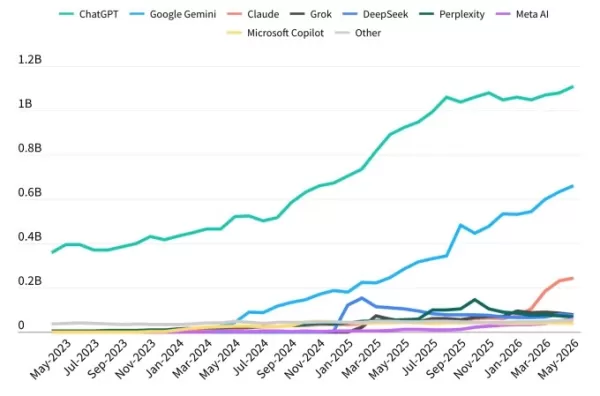
Image Credits:Sensor Tower
Until January, ChatGPT held more than 50% market share, but by the end of May, that figure had dropped to 46.4%, driven by the rise of Gemini (27.7%) and Claude (10.3%). Other assistants, including Grok, Perplexity, DeepSeek, and Meta AI, each account for less than 5% of the market.
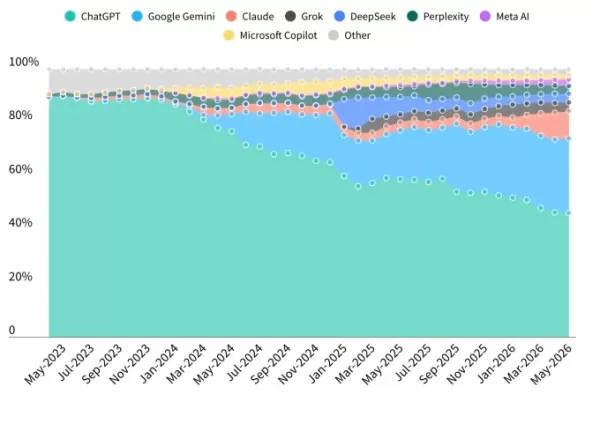
Image Credits:Sensor Tower
Sensor Tower’s State of AI Report also found that users are increasingly willing to switch between assistants. Specific events appear to accelerate this behavior: OpenAI’s deal with the U.S. Department of Defense (DoD) in February triggered a measurable spike in uninstalls, for example, suggesting that brand trust and values alignment matter to users, not just features. While Gemini’s momentum largely stems from its integration with Google’s broader ecosystem, Anthropic’s Claude has built a strong reputation for productivity use cases and is closing in on ChatGPT’s user-retention rate.
In the first half of 2026, people are on track to download nearly 2.3 billion AI apps and spend over $4.2 billion on them, according to Sensor Tower estimates. That compares to $1.83 billion in spending during H1 2025, a jump that suggests the industry is shifting focus from pure growth toward monetization. That said, both download and spend growth rates have slowed, indicating that the market may be maturing even as absolute numbers continue to climb.
Regionally, Asia recorded its first download decline of 3.3% in Q1 2026, driven by dips in China and India. Despite leading globally in total downloads, Asia trails North America and Europe in in-app spending, a split that matters for companies deciding where to invest in premium features and monetization.
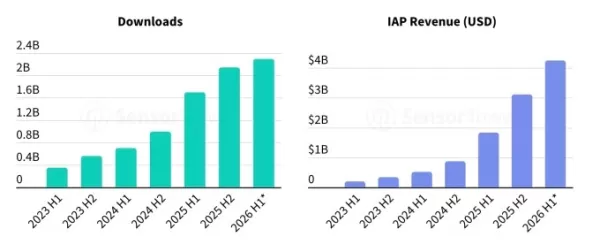
Image Credits:Sensor Tower
In the U.S., users are gravitating toward AI assistants for productivity tasks and spending more on premium features. Across platforms, average revenue per user has grown industry-wide, but Claude is standing out. Thirteen percent of Anthropic’s users are paying for a subscription plan, a conversion rate that leads the field and will be a key metric for investors evaluating which AI businesses are building lasting revenue.
Sensor Tower estimates that hours spent on AI apps will have increased from 17.2 billion hours in H1 2025 to roughly 36 billion hours in H1 2026. The top three assistants command 89% of time spent on AI assistant apps. Meanwhile, adjacent categories like AI companions or AI content-generation apps remain fragmented and wide open to competition, representing both a risk and an opportunity depending on which players move first.
Ads and shopping
OpenAI began experimenting with ads in ChatGPT in February. According to Sensor Tower, the company has gradually scaled the number of ads and the share of users who see them. By May, an average of 17% of daily users were being served ads, a figure to watch as ChatGPT’s monetization strategy evolves beyond subscriptions.
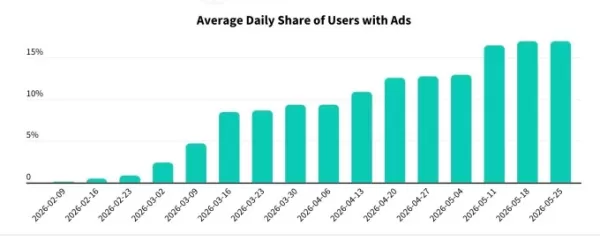
Image Credits:Sensor Tower
Software and shopping are the largest advertiser categories in ChatGPT so far, followed by media and entertainment, and food and dining.
As ChatGPT deepens its shopping integrations, it is increasingly sending referral traffic to retailers like Target, Walmart, and Costco. Amazon, which has blocked ChatGPT’s web crawlers, has seen stagnant referral traffic from the platform as a result.
That creates an opening for others. Sites like Walmart have embedded their own AI assistants to help shoppers find products. While Amazon’s Rufus has seen flat user growth, Walmart’s Spark has been gaining ground. Sensor Tower also noted that Amazon shoppers who used Rufus spent more time in the app and converted at higher rates than those who didn’t, hinting that on-platform AI can meaningfully influence purchasing behavior when users actually engage with it.
Related article
 Sam Altman Sparks Debate Over AI's Deceleration
Listen onApple PodcastsListen onSpotifyOpenAI CEO Sam Altman recently suggested that it may be time to “pace the rate of AI development” to allow society to “harden around some of these new capability levels.”On the latest episode of TechCrunch’s Equ
OpenAI fights Apple trade secret lawsuit
OpenAI rebutted Apple’s trade secret allegations on Tuesday, arguing the lawsuit is unfounded.“We take these claims seriously but see no evidence supporting them,” OpenAI stated, as reported by Bloomberg’s Ed Ludlow on X. “We support fair competition
Gemini Spark now manages Google Photos library
Google is expanding its AI integration by enabling Gemini Spark to manage Google Photos libraries. Users can now instruct the agent to edit images, organize albums, generate shared collections from favorite shots, convert concert flyers into calendar
Related Special Topic Recommendations
Design & Art
Sam Altman Sparks Debate Over AI's Deceleration
Listen onApple PodcastsListen onSpotifyOpenAI CEO Sam Altman recently suggested that it may be time to “pace the rate of AI development” to allow society to “harden around some of these new capability levels.”On the latest episode of TechCrunch’s Equ
OpenAI fights Apple trade secret lawsuit
OpenAI rebutted Apple’s trade secret allegations on Tuesday, arguing the lawsuit is unfounded.“We take these claims seriously but see no evidence supporting them,” OpenAI stated, as reported by Bloomberg’s Ed Ludlow on X. “We support fair competition
Gemini Spark now manages Google Photos library
Google is expanding its AI integration by enabling Gemini Spark to manage Google Photos libraries. Users can now instruct the agent to edit images, organize albums, generate shared collections from favorite shots, convert concert flyers into calendar
Related Special Topic Recommendations
Design & Art
 AI Visual Style Reference Tools for Character Sheets, Moodboards, and Pitch Decks
2026 Latest Best AI Visual Style Reference Tools for Character Sheets, Moodboards, and Pitch Decks are here on XIX.AI! This curated top-rated list features powerful game-changing tools that go through rigorous real-world tests. You’ll find a free vs paid comparison, detailed rankings, and must-try options to help you boost creativity and streamline your workflow. Explore now to discover your perfect tool for boosting productivity!
 11 tools
 xix.ai
SEO
Best AI SERP Analysis Tools for Search Strategy
xix.ai
SEO
Best AI SERP Analysis Tools for Search Strategy
2026 Latest Best Top-rated AI SERP Analysis Tools for Search Strategy are curated by XIX.AI through rigorous real-world tests and weekly updated rankings. These powerful tools help you unlock hidden optimization opportunities, boost content performance, and gain a competitive edge in search. Discover your perfect tool to elevate your search strategy today. Explore now!
13 tools
xix.ai
Data Analysis
Best AI Anomaly Detection Tools for KPI Monitoring across SaaS and Ecommerce Teams
2026 Latest Best Top-rated AI Anomaly Detection Tools for KPI Monitoring in SaaS and Ecommerce teams! XIX.AI has curated a powerful, game-changing collection based on rigorous real-world tests and weekly updated rankings. You’ll find detailed free vs paid comparison insights to help you identify the must-try solution that boosts productivity and unlocks your AI edge. Explore now!
10 tools
xix.ai
writing
Best AI Outline Generators for Long-Form SEO Articles
2026 Latest Best Top-Rated AI Outline Generators for Long-Form SEO Articles, meticulously curated by XIX.AI. These powerful tools offer game-changing assistance in creating high-quality content quickly, boosting writing efficiency significantly. Get a free vs paid comparison along with real-world tests and detailed rankings to help you find the must-try option that suits your needs. Explore now to unlock your AI edge.
8 tools
xix.ai
Education and Learning
AI Study Tools for Homework and Exam Prep
2026 Latest Best AI Study Tools for Homework and Exam Prep! XIX.AI curates a top-rated list of powerful, game-changing tools that help students boost productivity, streamline homework completion, and ace exams through real-world tests. Get a free vs paid comparison, detailed rankings, and must-try options to unlock your AI edge. Explore now!
10 tools
xix.ai
Music composition
AI Vocal Demo Tools for Songwriters, Hooks, Toplines, and Multilingual Draft Sessions
2026 Latest Best AI Vocal Demo Tools for Songwriters, Hook Creators, and Multi-Language Content Teams! XIX.AI has curated a top-rated list of powerful game-changing tools that go through rigorous real-world tests. You’ll find detailed free vs paid comparison data, comprehensive rankings, and must-try options to help you boost writing efficiency and unlock your creative potential. Explore now to discover your perfect tool for all your content needs!
9 tools
xix.ai

 Comments (1)
0/500
Comments (1)
0/500
![ArthurThomas]()
It’s wild to think that OpenAI’s dominance is finally cracking. I remember when everyone was obsessed with ChatGPT, but now there are so many alternatives popping up. Honestly, healthy competition is good for us users because it drives innovation and lowers prices. I’ve been testing a few other models lately, and some are surprisingly good at coding tasks. It’s no longer a one-horse race. 🏎️💨
More than three and a half years after ChatGPT first launched, AI assistants are now used by millions globally, and the competitive landscape is shifting rapidly. Although OpenAI’s chatbot remains the most popular assistant worldwide, its market share has slipped below 50% for the first time, as users increasingly migrate between platforms such as Google’s Gemini, Anthropic’s Claude, and xAI’s Grok, according to analytics firm Sensor Tower’s State of AI Report for 2026.
ChatGPT’s growth has been remarkable. It became the fastest app ever to reach 1 billion monthly users, as Sensor Tower reported this month. Notably, OpenAI tracks weekly active users, and it last reported 900 million of them in February. The chatbot still leads globally with over 1.1 billion monthly users, followed by Gemini with 662 million and Claude with 245 million.
Image Credits:Sensor Tower
Until January, ChatGPT held more than 50% market share, but by the end of May, that figure had dropped to 46.4%, driven by the rise of Gemini (27.7%) and Claude (10.3%). Other assistants, including Grok, Perplexity, DeepSeek, and Meta AI, each account for less than 5% of the market.
Image Credits:Sensor Tower
Sensor Tower’s State of AI Report also found that users are increasingly willing to switch between assistants. Specific events appear to accelerate this behavior: OpenAI’s deal with the U.S. Department of Defense (DoD) in February triggered a measurable spike in uninstalls, for example, suggesting that brand trust and values alignment matter to users, not just features. While Gemini’s momentum largely stems from its integration with Google’s broader ecosystem, Anthropic’s Claude has built a strong reputation for productivity use cases and is closing in on ChatGPT’s user-retention rate.
In the first half of 2026, people are on track to download nearly 2.3 billion AI apps and spend over $4.2 billion on them, according to Sensor Tower estimates. That compares to $1.83 billion in spending during H1 2025, a jump that suggests the industry is shifting focus from pure growth toward monetization. That said, both download and spend growth rates have slowed, indicating that the market may be maturing even as absolute numbers continue to climb.
Regionally, Asia recorded its first download decline of 3.3% in Q1 2026, driven by dips in China and India. Despite leading globally in total downloads, Asia trails North America and Europe in in-app spending, a split that matters for companies deciding where to invest in premium features and monetization.
Image Credits:Sensor Tower
In the U.S., users are gravitating toward AI assistants for productivity tasks and spending more on premium features. Across platforms, average revenue per user has grown industry-wide, but Claude is standing out. Thirteen percent of Anthropic’s users are paying for a subscription plan, a conversion rate that leads the field and will be a key metric for investors evaluating which AI businesses are building lasting revenue.
Sensor Tower estimates that hours spent on AI apps will have increased from 17.2 billion hours in H1 2025 to roughly 36 billion hours in H1 2026. The top three assistants command 89% of time spent on AI assistant apps. Meanwhile, adjacent categories like AI companions or AI content-generation apps remain fragmented and wide open to competition, representing both a risk and an opportunity depending on which players move first.
Ads and shopping
OpenAI began experimenting with ads in ChatGPT in February. According to Sensor Tower, the company has gradually scaled the number of ads and the share of users who see them. By May, an average of 17% of daily users were being served ads, a figure to watch as ChatGPT’s monetization strategy evolves beyond subscriptions.
Image Credits:Sensor Tower
Software and shopping are the largest advertiser categories in ChatGPT so far, followed by media and entertainment, and food and dining.
As ChatGPT deepens its shopping integrations, it is increasingly sending referral traffic to retailers like Target, Walmart, and Costco. Amazon, which has blocked ChatGPT’s web crawlers, has seen stagnant referral traffic from the platform as a result.
That creates an opening for others. Sites like Walmart have embedded their own AI assistants to help shoppers find products. While Amazon’s Rufus has seen flat user growth, Walmart’s Spark has been gaining ground. Sensor Tower also noted that Amazon shoppers who used Rufus spent more time in the app and converted at higher rates than those who didn’t, hinting that on-platform AI can meaningfully influence purchasing behavior when users actually engage with it.








 Sam Altman Sparks Debate Over AI's Deceleration
Listen onApple PodcastsListen onSpotifyOpenAI CEO Sam Altman recently suggested that it may be time to “pace the rate of AI development” to allow society to “harden around some of these new capability levels.”On the latest episode of TechCrunch’s Equ
Sam Altman Sparks Debate Over AI's Deceleration
Listen onApple PodcastsListen onSpotifyOpenAI CEO Sam Altman recently suggested that it may be time to “pace the rate of AI development” to allow society to “harden around some of these new capability levels.”On the latest episode of TechCrunch’s Equ
 OpenAI fights Apple trade secret lawsuit
OpenAI rebutted Apple’s trade secret allegations on Tuesday, arguing the lawsuit is unfounded.“We take these claims seriously but see no evidence supporting them,” OpenAI stated, as reported by Bloomberg’s Ed Ludlow on X. “We support fair competition
OpenAI fights Apple trade secret lawsuit
OpenAI rebutted Apple’s trade secret allegations on Tuesday, arguing the lawsuit is unfounded.“We take these claims seriously but see no evidence supporting them,” OpenAI stated, as reported by Bloomberg’s Ed Ludlow on X. “We support fair competition
 Gemini Spark now manages Google Photos library
Google is expanding its AI integration by enabling Gemini Spark to manage Google Photos libraries. Users can now instruct the agent to edit images, organize albums, generate shared collections from favorite shots, convert concert flyers into calendar
Gemini Spark now manages Google Photos library
Google is expanding its AI integration by enabling Gemini Spark to manage Google Photos libraries. Users can now instruct the agent to edit images, organize albums, generate shared collections from favorite shots, convert concert flyers into calendar

2026 Latest Best AI Visual Style Reference Tools for Character Sheets, Moodboards, and Pitch Decks are here on XIX.AI! This curated top-rated list features powerful game-changing tools that go through rigorous real-world tests. You’ll find a free vs paid comparison, detailed rankings, and must-try options to help you boost creativity and streamline your workflow. Explore now to discover your perfect tool for boosting productivity!
11 tools
xix.ai

2026 Latest Best Top-rated AI SERP Analysis Tools for Search Strategy are curated by XIX.AI through rigorous real-world tests and weekly updated rankings. These powerful tools help you unlock hidden optimization opportunities, boost content performance, and gain a competitive edge in search. Discover your perfect tool to elevate your search strategy today. Explore now!
13 tools
xix.ai
2026 Latest Best Top-rated AI Anomaly Detection Tools for KPI Monitoring in SaaS and Ecommerce teams! XIX.AI has curated a powerful, game-changing collection based on rigorous real-world tests and weekly updated rankings. You’ll find detailed free vs paid comparison insights to help you identify the must-try solution that boosts productivity and unlocks your AI edge. Explore now!
10 tools
xix.ai

2026 Latest Best Top-Rated AI Outline Generators for Long-Form SEO Articles, meticulously curated by XIX.AI. These powerful tools offer game-changing assistance in creating high-quality content quickly, boosting writing efficiency significantly. Get a free vs paid comparison along with real-world tests and detailed rankings to help you find the must-try option that suits your needs. Explore now to unlock your AI edge.
8 tools
xix.ai

2026 Latest Best AI Study Tools for Homework and Exam Prep! XIX.AI curates a top-rated list of powerful, game-changing tools that help students boost productivity, streamline homework completion, and ace exams through real-world tests. Get a free vs paid comparison, detailed rankings, and must-try options to unlock your AI edge. Explore now!
10 tools
xix.ai

2026 Latest Best AI Vocal Demo Tools for Songwriters, Hook Creators, and Multi-Language Content Teams! XIX.AI has curated a top-rated list of powerful game-changing tools that go through rigorous real-world tests. You’ll find detailed free vs paid comparison data, comprehensive rankings, and must-try options to help you boost writing efficiency and unlock your creative potential. Explore now to discover your perfect tool for all your content needs!
9 tools
xix.ai

It’s wild to think that OpenAI’s dominance is finally cracking. I remember when everyone was obsessed with ChatGPT, but now there are so many alternatives popping up. Honestly, healthy competition is good for us users because it drives innovation and lowers prices. I’ve been testing a few other models lately, and some are surprisingly good at coding tasks. It’s no longer a one-horse race. 🏎️💨












