


 Home
HomeXiaomi open-sources MiMo Code terminal AI assistant with free multimodal model
Today, the Xiaomi technology team officially released and open-sourced an exploratory AI programming assistant that runs on the terminal — MiMo Code V0.1.0. This project is a derivative of the open-source project OpenCode and is released under the permissive MIT license, allowing individuals and companies to freely modify, distribute, and integrate it for commercial use.
As a self-evolving tool centered on "model-Agent collaborative optimization," MiMo Code aims to overcome the limitations of traditional AI coding tools. Its core highlights include:
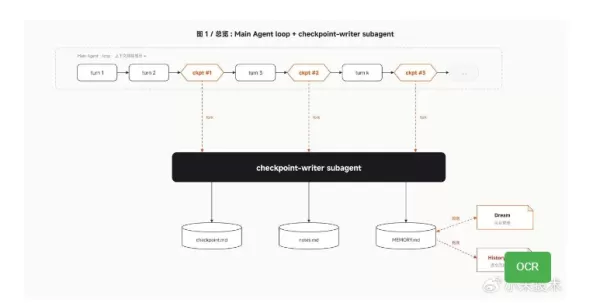
Innovative persistent memory system that solves the "AI forgetfulness" problem: Traditional tools depend on the model's own recording capabilities, which often lose critical information in lengthy conversations. MiMo Code introduces three mechanisms—project memory, session checkpoints, and task progress—fully delegating the recording work to an independent Subagent. When the context window is full, the Subagent automatically rebuilds a clean summary, enabling the main Agent to continue seamlessly. Additionally, the built-in /dream command triggers automatically every 7 days to deduplicate, verify, and compress historical sessions, achieving memory consolidation and making the tool "understand you better over time."
Dedicated Harness system and Compose mode: To address compatibility issues between models and frameworks, Xiaomi has developed a dedicated Harness system for its built-in model. Users only need to press the Tab key to switch to Compose mode, enter a simple idea, and the AI automatically handles the entire workflow: "design, planning, coding, testing, and review." In real-world testing against Claude Code, MiMo Code adopts a strategy of "heavy upfront planning and stable later verification," which is slightly slower initially but produces more feature-rich, thoroughly tested industrial-grade products, resulting in less total time spent.
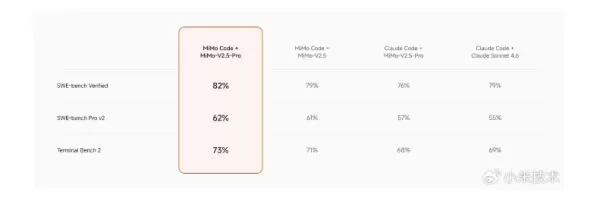
Excellent performance on authoritative test sets: Using the same MiMo model and relying solely on the Agent system's collaborative advantages, MiMo Code achieved a score of 62% on SWE-Bench Pro (beating Claude Code's 57%) and 73% on Terminal Bench2 (exceeding Claude Code's 68%).
Support for top-tier models and full Chinese localization: The tool includes a limited-time free multimodal model MiMo-V2.5 (with performance comparable to Claude Sonnet4.6), which is ready to use without registration. It also supports mainstream APIs and third-party token plans from providers like DeepSeek, Kimi, and GLM. A status dashboard is always displayed on the right side of the interface, and all settings have been fully localized in Chinese.
Voice interaction without manual operation: Leveraging MiMo-V2.5-ASR voice recognition technology, users can not only modify instructions verbally but also say commands like "send" and "execute" directly, achieving full hands-free control.
Blog: https://mimo.xiaomi.com/mimocode
Related article
 ByteDance Boosts Core AI Incentives as Doubao Surges 14.6%
ByteDance recently convened a DouBao equity briefing to unveil fresh incentive policies for staff involved in the DouBao division. The strike price for DouBao shares has been lifted from $14.85 in June 2026 to $17.02, marking an approximate 14.6% inc
MiniMax Unveils 10x Team Program to Incentivize Global AI Experts
MiniMax (Xiyu Technology), the General Artificial Intelligence Lab, has officially launched "10x Team," a global talent collaboration initiative. This program aims to recruit top experts across industries to explore the deep application of large mode
South Korea Breaks Ground on National AI Computing Center, Investing 2.5 Trillion Won with 2028 Target
South Korean outlet EtNews reports that groundbreaking for the Korea AI Computing Center (KOACC) took place on August 3 at the Solar City data center park in Sunan, Jeollanam-do. Backed by a total investment of 2.5 trillion KRW (roughly 11.838 billio
Related Special Topic Recommendations
Education and Learning
ByteDance Boosts Core AI Incentives as Doubao Surges 14.6%
ByteDance recently convened a DouBao equity briefing to unveil fresh incentive policies for staff involved in the DouBao division. The strike price for DouBao shares has been lifted from $14.85 in June 2026 to $17.02, marking an approximate 14.6% inc
MiniMax Unveils 10x Team Program to Incentivize Global AI Experts
MiniMax (Xiyu Technology), the General Artificial Intelligence Lab, has officially launched "10x Team," a global talent collaboration initiative. This program aims to recruit top experts across industries to explore the deep application of large mode
South Korea Breaks Ground on National AI Computing Center, Investing 2.5 Trillion Won with 2028 Target
South Korean outlet EtNews reports that groundbreaking for the Korea AI Computing Center (KOACC) took place on August 3 at the Solar City data center park in Sunan, Jeollanam-do. Backed by a total investment of 2.5 trillion KRW (roughly 11.838 billio
Related Special Topic Recommendations
Education and Learning
 AI Study Tools for Homework and Exam Prep
2026 Latest Best AI Study Tools for Homework and Exam Prep! XIX.AI curates a top-rated list of powerful, game-changing tools that help students boost productivity, streamline homework completion, and ace exams through real-world tests. Get a free vs paid comparison, detailed rankings, and must-try options to unlock your AI edge. Explore now!
 10 tools
 xix.ai
Music composition
AI Vocal Demo Tools for Songwriters, Hooks, Toplines, and Multilingual Draft Sessions
xix.ai
Music composition
AI Vocal Demo Tools for Songwriters, Hooks, Toplines, and Multilingual Draft Sessions
2026 Latest Best AI Vocal Demo Tools for Songwriters, Hook Creators, and Multi-Language Content Teams! XIX.AI has curated a top-rated list of powerful game-changing tools that go through rigorous real-world tests. You’ll find detailed free vs paid comparison data, comprehensive rankings, and must-try options to help you boost writing efficiency and unlock your creative potential. Explore now to discover your perfect tool for all your content needs!
9 tools
xix.ai
Business
Best AI Competitive Research Tools for Small Businesses
2026 Latest Best Top-rated AI Competitive Research Tools for Small Businesses! XIX.AI has curated a highly powerful game-changing collection, updated weekly with rigorous real-world tests and detailed rankings. You can find a comprehensive free vs paid comparison to help you identify the must-try tools that boost your productivity and give you a competitive edge. Explore now to discover your perfect tool!
9 tools
xix.ai
Image editing
Photoshop AI Retouch Tools for Ecommerce Apparel, Skin Cleanup, and Color Consistency
2026 Latest Best Photoshop AI retouch tools for ecommerce apparel, skin cleanup, and color consistency! This top-rated curated list features powerful game-changing solutions that help you boost writing efficiency, streamline content creation, and achieve perfect visual results effortlessly. Each tool has undergone real-world tests through weekly updated rankings, complete with free vs paid comparison details. Backed by XIX.AI, it’s the must-try guide for anyone aiming to unlock your AI edge. Explore now!
10 tools
xix.ai
Prompt
Best AI Prompt Libraries for ChatGPT Workflows
2026 Latest Best Top-Rated AI Prompt Libraries for optimizing all types of ChatGPT workflows. XIX.AI has curated a powerful, game-changing collection that goes through rigorous real-world tests to ensure top performance. You can find detailed free vs paid comparisons and expert rankings to help you choose the must-try tools that boost your productivity and unlock your AI edge. Explore now!
11 tools
xix.ai
Education and Learning
AI Quiz Builder Platforms for Teachers, Tutors, and Cohort-Based Learning Programs
2026 Latest Best AI Quiz Builder Platforms for Teachers, Tutors, and Cohort-Based Learning Programs! XIX.AI has curated a top-rated list of powerful game-changing tools that go through real-world tests to deliver accurate rankings. These must-try platforms help boost writing efficiency, streamline content creation, and simplify quiz design across all learning scenarios. Explore now to discover your perfect tool for unlocking your AI edge in teaching!
13 tools
xix.ai

 Comments (0)
0/500
Comments (0)
0/500
Today, the Xiaomi technology team officially released and open-sourced an exploratory AI programming assistant that runs on the terminal — MiMo Code V0.1.0. This project is a derivative of the open-source project OpenCode and is released under the permissive MIT license, allowing individuals and companies to freely modify, distribute, and integrate it for commercial use.
As a self-evolving tool centered on "model-Agent collaborative optimization," MiMo Code aims to overcome the limitations of traditional AI coding tools. Its core highlights include:
Innovative persistent memory system that solves the "AI forgetfulness" problem: Traditional tools depend on the model's own recording capabilities, which often lose critical information in lengthy conversations. MiMo Code introduces three mechanisms—project memory, session checkpoints, and task progress—fully delegating the recording work to an independent Subagent. When the context window is full, the Subagent automatically rebuilds a clean summary, enabling the main Agent to continue seamlessly. Additionally, the built-in /dream command triggers automatically every 7 days to deduplicate, verify, and compress historical sessions, achieving memory consolidation and making the tool "understand you better over time."
Dedicated Harness system and Compose mode: To address compatibility issues between models and frameworks, Xiaomi has developed a dedicated Harness system for its built-in model. Users only need to press the Tab key to switch to Compose mode, enter a simple idea, and the AI automatically handles the entire workflow: "design, planning, coding, testing, and review." In real-world testing against Claude Code, MiMo Code adopts a strategy of "heavy upfront planning and stable later verification," which is slightly slower initially but produces more feature-rich, thoroughly tested industrial-grade products, resulting in less total time spent.
Excellent performance on authoritative test sets: Using the same MiMo model and relying solely on the Agent system's collaborative advantages, MiMo Code achieved a score of 62% on SWE-Bench Pro (beating Claude Code's 57%) and 73% on Terminal Bench2 (exceeding Claude Code's 68%).
Support for top-tier models and full Chinese localization: The tool includes a limited-time free multimodal model MiMo-V2.5 (with performance comparable to Claude Sonnet4.6), which is ready to use without registration. It also supports mainstream APIs and third-party token plans from providers like DeepSeek, Kimi, and GLM. A status dashboard is always displayed on the right side of the interface, and all settings have been fully localized in Chinese.
Voice interaction without manual operation: Leveraging MiMo-V2.5-ASR voice recognition technology, users can not only modify instructions verbally but also say commands like "send" and "execute" directly, achieving full hands-free control.
Blog: https://mimo.xiaomi.com/mimocode








 ByteDance Boosts Core AI Incentives as Doubao Surges 14.6%
ByteDance recently convened a DouBao equity briefing to unveil fresh incentive policies for staff involved in the DouBao division. The strike price for DouBao shares has been lifted from $14.85 in June 2026 to $17.02, marking an approximate 14.6% inc
ByteDance Boosts Core AI Incentives as Doubao Surges 14.6%
ByteDance recently convened a DouBao equity briefing to unveil fresh incentive policies for staff involved in the DouBao division. The strike price for DouBao shares has been lifted from $14.85 in June 2026 to $17.02, marking an approximate 14.6% inc
 MiniMax Unveils 10x Team Program to Incentivize Global AI Experts
MiniMax (Xiyu Technology), the General Artificial Intelligence Lab, has officially launched "10x Team," a global talent collaboration initiative. This program aims to recruit top experts across industries to explore the deep application of large mode
MiniMax Unveils 10x Team Program to Incentivize Global AI Experts
MiniMax (Xiyu Technology), the General Artificial Intelligence Lab, has officially launched "10x Team," a global talent collaboration initiative. This program aims to recruit top experts across industries to explore the deep application of large mode
 South Korea Breaks Ground on National AI Computing Center, Investing 2.5 Trillion Won with 2028 Target
South Korean outlet EtNews reports that groundbreaking for the Korea AI Computing Center (KOACC) took place on August 3 at the Solar City data center park in Sunan, Jeollanam-do. Backed by a total investment of 2.5 trillion KRW (roughly 11.838 billio
South Korea Breaks Ground on National AI Computing Center, Investing 2.5 Trillion Won with 2028 Target
South Korean outlet EtNews reports that groundbreaking for the Korea AI Computing Center (KOACC) took place on August 3 at the Solar City data center park in Sunan, Jeollanam-do. Backed by a total investment of 2.5 trillion KRW (roughly 11.838 billio

2026 Latest Best AI Study Tools for Homework and Exam Prep! XIX.AI curates a top-rated list of powerful, game-changing tools that help students boost productivity, streamline homework completion, and ace exams through real-world tests. Get a free vs paid comparison, detailed rankings, and must-try options to unlock your AI edge. Explore now!
10 tools
xix.ai

2026 Latest Best AI Vocal Demo Tools for Songwriters, Hook Creators, and Multi-Language Content Teams! XIX.AI has curated a top-rated list of powerful game-changing tools that go through rigorous real-world tests. You’ll find detailed free vs paid comparison data, comprehensive rankings, and must-try options to help you boost writing efficiency and unlock your creative potential. Explore now to discover your perfect tool for all your content needs!
9 tools
xix.ai

2026 Latest Best Top-rated AI Competitive Research Tools for Small Businesses! XIX.AI has curated a highly powerful game-changing collection, updated weekly with rigorous real-world tests and detailed rankings. You can find a comprehensive free vs paid comparison to help you identify the must-try tools that boost your productivity and give you a competitive edge. Explore now to discover your perfect tool!
9 tools
xix.ai

2026 Latest Best Photoshop AI retouch tools for ecommerce apparel, skin cleanup, and color consistency! This top-rated curated list features powerful game-changing solutions that help you boost writing efficiency, streamline content creation, and achieve perfect visual results effortlessly. Each tool has undergone real-world tests through weekly updated rankings, complete with free vs paid comparison details. Backed by XIX.AI, it’s the must-try guide for anyone aiming to unlock your AI edge. Explore now!
10 tools
xix.ai
2026 Latest Best Top-Rated AI Prompt Libraries for optimizing all types of ChatGPT workflows. XIX.AI has curated a powerful, game-changing collection that goes through rigorous real-world tests to ensure top performance. You can find detailed free vs paid comparisons and expert rankings to help you choose the must-try tools that boost your productivity and unlock your AI edge. Explore now!
11 tools
xix.ai

2026 Latest Best AI Quiz Builder Platforms for Teachers, Tutors, and Cohort-Based Learning Programs! XIX.AI has curated a top-rated list of powerful game-changing tools that go through real-world tests to deliver accurate rankings. These must-try platforms help boost writing efficiency, streamline content creation, and simplify quiz design across all learning scenarios. Explore now to discover your perfect tool for unlocking your AI edge in teaching!
13 tools
xix.ai












