


 Home
HomeThe Real Difference: Not One Thing, but Another
Sometimes, things are not only one thing but also another. The phrase "It's not just this — it's that" has become so common in AI-generated writing that it now serves as more than a hint of synthetic content — it's nearly a certainty.
That's why, when I saw a Barron's report on how this sentence structure has surged in corporate communications, I was not merely intrigued — I was genuinely amused. The report didn't just comment on the frequency of this phrasing; it searched the market intelligence firm AlphaSense's database to quantify its use in corporate news releases, earnings reports, and government filings.
According to Barron's, this phrasing is no longer just a quirk of corporate communications — it's an epidemic, rising from about 50 mentions in 2023 to over 200 in 2025.
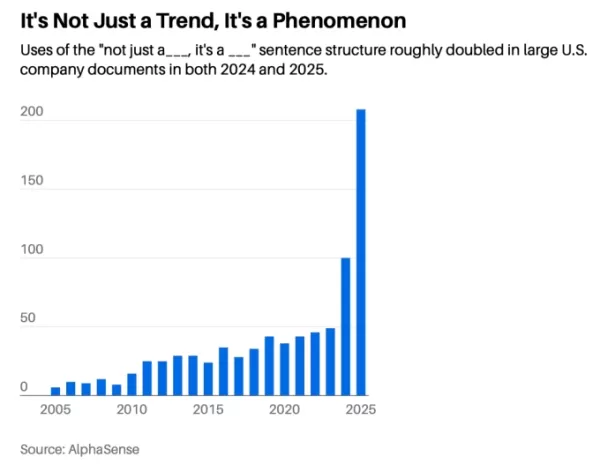
Image source: Barron's (opens in a new window)
The data isn't the only evidence — I also found some examples from the past year:
“In 2025, AI won’t just be a tool; it will be a collaborator.” (Cisco)“The future of autonomy isn’t just on the horizon; it’s already unfolding.” (Accenture) “DevOps teams are managing not just deployments, but also security compliance and cloud spending.” (Workday)“These systems aren’t just executing tasks; they’re starting to learn, adapt, and collaborate.” (McKinsey)“When Bill founded Microsoft, he envisioned not just a software company, but a software factory, unconstrained by any single product or category.” (Satya Nadella in a Microsoft blog post)“It’s not just about building tools for specific roles or tasks. It’s about building tools that empower everyone to create their own tools.” (The same Microsoft blog post.)“Just imagine if all 8 billion people could summon a researcher … not just to get information but use their expertise to get things done that benefit them.” (Still, that same Microsoft blog post.)It's no coincidence that generative AI tools frequently use this phrase — it's a mirror of our own writing, which these tools were trained on (without our permission, I should note — an act that is not just disrespectful to writers but a violation). And it's not only this sentence structure — em-dashes have also become a telltale sign of AI-generated text.
This isn't just a humorous trend — it's a symbol of how dependent these companies have become on AI (though we can't be certain whether the quotes above were AI-assisted). So next time you see a sentence like that, remember it's not merely a catchy phrase — it might be a symptom of something larger.
Related article
 Google Tests Remy AI Agent for Gemini as Focus Shifts to User Control
According to Business Insider, Google is testing Remy, a new AI personal agent for Gemini. This tool aims to execute tasks on behalf of users, streamlining both professional workflows and daily routines.Currently, Remy is undergoing testing in an int
Ollie bets privacy focus to win AI assistant race
To be genuinely helpful, an AI assistant must understand its user deeply. Ollie, a personal assistant designed for daily life, operates on the premise that this doesn’t require surrendering your data or compromising your privacy.While certain enterpr
How AI LIVE: London Will Explore AI & Industrial Automation
The summit will convene C-suite executives from around the globe to address pressing challenges in global industries, ranging from AI-driven disruption to economic volatility.AI LIVE: The London Summit will gather over 2,000 international leaders und
Related Special Topic Recommendations
Data Analysis
Google Tests Remy AI Agent for Gemini as Focus Shifts to User Control
According to Business Insider, Google is testing Remy, a new AI personal agent for Gemini. This tool aims to execute tasks on behalf of users, streamlining both professional workflows and daily routines.Currently, Remy is undergoing testing in an int
Ollie bets privacy focus to win AI assistant race
To be genuinely helpful, an AI assistant must understand its user deeply. Ollie, a personal assistant designed for daily life, operates on the premise that this doesn’t require surrendering your data or compromising your privacy.While certain enterpr
How AI LIVE: London Will Explore AI & Industrial Automation
The summit will convene C-suite executives from around the globe to address pressing challenges in global industries, ranging from AI-driven disruption to economic volatility.AI LIVE: The London Summit will gather over 2,000 international leaders und
Related Special Topic Recommendations
Data Analysis
 Best AI Anomaly Detection Tools for KPI Monitoring across SaaS and Ecommerce Teams
2026 Latest Best Top-rated AI Anomaly Detection Tools for KPI Monitoring in SaaS and Ecommerce teams! XIX.AI has curated a powerful, game-changing collection based on rigorous real-world tests and weekly updated rankings. You’ll find detailed free vs paid comparison insights to help you identify the must-try solution that boosts productivity and unlocks your AI edge. Explore now!
 10 tools
 xix.ai
writing
Best AI Outline Generators for Long-Form SEO Articles
xix.ai
writing
Best AI Outline Generators for Long-Form SEO Articles
2026 Latest Best Top-Rated AI Outline Generators for Long-Form SEO Articles, meticulously curated by XIX.AI. These powerful tools offer game-changing assistance in creating high-quality content quickly, boosting writing efficiency significantly. Get a free vs paid comparison along with real-world tests and detailed rankings to help you find the must-try option that suits your needs. Explore now to unlock your AI edge.
8 tools
xix.ai
Education and Learning
AI Study Tools for Homework and Exam Prep
2026 Latest Best AI Study Tools for Homework and Exam Prep! XIX.AI curates a top-rated list of powerful, game-changing tools that help students boost productivity, streamline homework completion, and ace exams through real-world tests. Get a free vs paid comparison, detailed rankings, and must-try options to unlock your AI edge. Explore now!
10 tools
xix.ai
Music composition
AI Vocal Demo Tools for Songwriters, Hooks, Toplines, and Multilingual Draft Sessions
2026 Latest Best AI Vocal Demo Tools for Songwriters, Hook Creators, and Multi-Language Content Teams! XIX.AI has curated a top-rated list of powerful game-changing tools that go through rigorous real-world tests. You’ll find detailed free vs paid comparison data, comprehensive rankings, and must-try options to help you boost writing efficiency and unlock your creative potential. Explore now to discover your perfect tool for all your content needs!
9 tools
xix.ai
Business
Best AI Competitive Research Tools for Small Businesses
2026 Latest Best Top-rated AI Competitive Research Tools for Small Businesses! XIX.AI has curated a highly powerful game-changing collection, updated weekly with rigorous real-world tests and detailed rankings. You can find a comprehensive free vs paid comparison to help you identify the must-try tools that boost your productivity and give you a competitive edge. Explore now to discover your perfect tool!
9 tools
xix.ai
Image editing
Photoshop AI Retouch Tools for Ecommerce Apparel, Skin Cleanup, and Color Consistency
2026 Latest Best Photoshop AI retouch tools for ecommerce apparel, skin cleanup, and color consistency! This top-rated curated list features powerful game-changing solutions that help you boost writing efficiency, streamline content creation, and achieve perfect visual results effortlessly. Each tool has undergone real-world tests through weekly updated rankings, complete with free vs paid comparison details. Backed by XIX.AI, it’s the must-try guide for anyone aiming to unlock your AI edge. Explore now!
10 tools
xix.ai

 Comments (0)
0/500
Comments (0)
0/500
Sometimes, things are not only one thing but also another. The phrase "It's not just this — it's that" has become so common in AI-generated writing that it now serves as more than a hint of synthetic content — it's nearly a certainty.
That's why, when I saw a Barron's report on how this sentence structure has surged in corporate communications, I was not merely intrigued — I was genuinely amused. The report didn't just comment on the frequency of this phrasing; it searched the market intelligence firm AlphaSense's database to quantify its use in corporate news releases, earnings reports, and government filings.
According to Barron's, this phrasing is no longer just a quirk of corporate communications — it's an epidemic, rising from about 50 mentions in 2023 to over 200 in 2025.
Image source: Barron's (opens in a new window)
The data isn't the only evidence — I also found some examples from the past year:
“In 2025, AI won’t just be a tool; it will be a collaborator.” (Cisco)“The future of autonomy isn’t just on the horizon; it’s already unfolding.” (Accenture) “DevOps teams are managing not just deployments, but also security compliance and cloud spending.” (Workday)“These systems aren’t just executing tasks; they’re starting to learn, adapt, and collaborate.” (McKinsey)“When Bill founded Microsoft, he envisioned not just a software company, but a software factory, unconstrained by any single product or category.” (Satya Nadella in a Microsoft blog post)“It’s not just about building tools for specific roles or tasks. It’s about building tools that empower everyone to create their own tools.” (The same Microsoft blog post.)“Just imagine if all 8 billion people could summon a researcher … not just to get information but use their expertise to get things done that benefit them.” (Still, that same Microsoft blog post.)It's no coincidence that generative AI tools frequently use this phrase — it's a mirror of our own writing, which these tools were trained on (without our permission, I should note — an act that is not just disrespectful to writers but a violation). And it's not only this sentence structure — em-dashes have also become a telltale sign of AI-generated text.
This isn't just a humorous trend — it's a symbol of how dependent these companies have become on AI (though we can't be certain whether the quotes above were AI-assisted). So next time you see a sentence like that, remember it's not merely a catchy phrase — it might be a symptom of something larger.







 Google Tests Remy AI Agent for Gemini as Focus Shifts to User Control
According to Business Insider, Google is testing Remy, a new AI personal agent for Gemini. This tool aims to execute tasks on behalf of users, streamlining both professional workflows and daily routines.Currently, Remy is undergoing testing in an int
Google Tests Remy AI Agent for Gemini as Focus Shifts to User Control
According to Business Insider, Google is testing Remy, a new AI personal agent for Gemini. This tool aims to execute tasks on behalf of users, streamlining both professional workflows and daily routines.Currently, Remy is undergoing testing in an int
 Ollie bets privacy focus to win AI assistant race
To be genuinely helpful, an AI assistant must understand its user deeply. Ollie, a personal assistant designed for daily life, operates on the premise that this doesn’t require surrendering your data or compromising your privacy.While certain enterpr
Ollie bets privacy focus to win AI assistant race
To be genuinely helpful, an AI assistant must understand its user deeply. Ollie, a personal assistant designed for daily life, operates on the premise that this doesn’t require surrendering your data or compromising your privacy.While certain enterpr
 How AI LIVE: London Will Explore AI & Industrial Automation
The summit will convene C-suite executives from around the globe to address pressing challenges in global industries, ranging from AI-driven disruption to economic volatility.AI LIVE: The London Summit will gather over 2,000 international leaders und
How AI LIVE: London Will Explore AI & Industrial Automation
The summit will convene C-suite executives from around the globe to address pressing challenges in global industries, ranging from AI-driven disruption to economic volatility.AI LIVE: The London Summit will gather over 2,000 international leaders und
2026 Latest Best Top-rated AI Anomaly Detection Tools for KPI Monitoring in SaaS and Ecommerce teams! XIX.AI has curated a powerful, game-changing collection based on rigorous real-world tests and weekly updated rankings. You’ll find detailed free vs paid comparison insights to help you identify the must-try solution that boosts productivity and unlocks your AI edge. Explore now!
10 tools
xix.ai

2026 Latest Best Top-Rated AI Outline Generators for Long-Form SEO Articles, meticulously curated by XIX.AI. These powerful tools offer game-changing assistance in creating high-quality content quickly, boosting writing efficiency significantly. Get a free vs paid comparison along with real-world tests and detailed rankings to help you find the must-try option that suits your needs. Explore now to unlock your AI edge.
8 tools
xix.ai

2026 Latest Best AI Study Tools for Homework and Exam Prep! XIX.AI curates a top-rated list of powerful, game-changing tools that help students boost productivity, streamline homework completion, and ace exams through real-world tests. Get a free vs paid comparison, detailed rankings, and must-try options to unlock your AI edge. Explore now!
10 tools
xix.ai

2026 Latest Best AI Vocal Demo Tools for Songwriters, Hook Creators, and Multi-Language Content Teams! XIX.AI has curated a top-rated list of powerful game-changing tools that go through rigorous real-world tests. You’ll find detailed free vs paid comparison data, comprehensive rankings, and must-try options to help you boost writing efficiency and unlock your creative potential. Explore now to discover your perfect tool for all your content needs!
9 tools
xix.ai

2026 Latest Best Top-rated AI Competitive Research Tools for Small Businesses! XIX.AI has curated a highly powerful game-changing collection, updated weekly with rigorous real-world tests and detailed rankings. You can find a comprehensive free vs paid comparison to help you identify the must-try tools that boost your productivity and give you a competitive edge. Explore now to discover your perfect tool!
9 tools
xix.ai
2026 Latest Best Photoshop AI retouch tools for ecommerce apparel, skin cleanup, and color consistency! This top-rated curated list features powerful game-changing solutions that help you boost writing efficiency, streamline content creation, and achieve perfect visual results effortlessly. Each tool has undergone real-world tests through weekly updated rankings, complete with free vs paid comparison details. Backed by XIX.AI, it’s the must-try guide for anyone aiming to unlock your AI edge. Explore now!
10 tools
xix.ai












