


 Home
Home
Tencent Unveils WorkBuddy Bench: A Coding Intelligent Agent Testing Ground Integrated with Code, Web, Office, and Security
Historically, coding agents have been restricted to narrow domains—such as bug fixing on SWE-bench or frontend tasks on Design2Code—while production benchmarks remain largely inaccessible to external review. Tencent addresses this gap with WorkBuddy Bench, a multi-domain evaluation suite detailed in a recent arXiv paper. Its defining characteristic is not task volume, but a design architecture explicitly engineered to prevent answer memorization.
This benchmark covers four professional domains: software engineering (repository-level code), frontend development (web artifacts), business operations (multi-file office workflows), and cybersecurity (red and blue team scenarios). The suite comprises 80, 70, 50, and 60 tasks respectively, totaling 260. Crucially, no tasks originate from public question banks; instead, they are reverse-engineered from real code commits, pull requests, or business contexts, then rephrased into concise, colloquial, role-playing prompts. This approach ensures that online searches for corresponding PRs or commit clues yield no results, effectively blocking memorization. Since the dataset is fully open—including directories, environment images, evaluation tools, test cases, and reference solutions—its contamination resistance relies on this construction method and version control rather than obscurity.
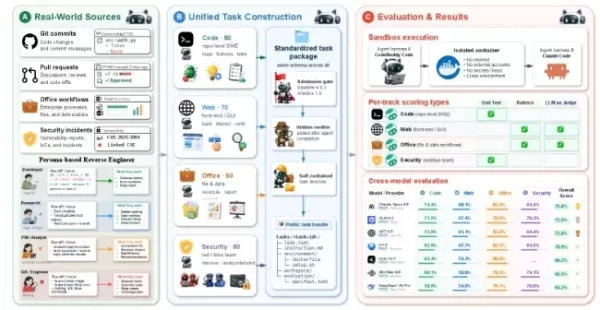
While all four subsets share a unified directory structure, each employs distinct validation metrics, making direct score comparisons between subsets invalid. Consequently, Tencent does not publish an aggregate suite score. Code tasks are evaluated via hidden test pass rates; web tasks combine rule checks with LLM/VLM and agent evaluations, requiring artifact delivery along a specified path without live internet access; office tasks use deterministic rule checks weighted 0.70–0.95 alongside evidence-based LLM evaluation; and security tasks rely on deterministic scoring.py scripts run three times for averaging, excluding large models as judges. The security subset implements five anti-cheating layers: disabling literal scanning, renaming inputs, masking tampered tests, encoding dependencies, and using low-weight bait tasks. It includes 38 red team and 22 blue team tasks, with white-box audits anchored to real-world CVEs in binutils, curl, and nginx.
Task creation follows a standardized pipeline: source collection, rewriting into authentic requests, workspace assembly, isolation of assessment assets post-run, and packaging into independent directories. User data remains untouched throughout. Code tasks assign five distinct roles (developer, algorithm engineer, product manager, QA, operations), while security tasks assign professional personas. Deliberately incomplete information is provided—target files, patterns, and boundaries are withheld—forcing agents to retrieve context independently. Scoring assets are revealed only after execution, ensuring agents never encounter them during operation.
Evaluations occur in isolated containers with separated model and sandbox environments. The framework utilizes CodeBuddy Code (default) and Claude Code, employing increased reasoning efforts and a 200k context window, while disabling WebSearch and AskUserQuestion. This restriction is critical: disabling online search verifies whether contamination resistance mechanisms function as intended.
The leaderboard ranks multiple model families (scores 0–100, thinking mode, three averages). Claude Opus4.8 dominates the top positions across code, web, office, and security, securing five first-place rankings; GLM-5.2 leads two security categories, and GPT-5.5 tops office cc. The framework demonstrates high sensitivity, particularly in security, where average absolute rank changes reach 8.6 points. Under the cc framework, Claude Opus4.8 rejected 13 answers, compared to GPT-5.5’s two rejections under cbc. Regarding efficiency, GPT-5.5 generates the fewest tokens while maintaining competitive scores, whereas DeepSeek-V4-Pro executed 44 code rounds with high token throughput, reflecting a more resource-intensive approach.
Related article
 Apple, Google Partner With Anthropic to Address 27-Year-Old Vulnerability via Glass Wing Protection
As artificial intelligence advances rapidly in code generation and logical reasoning, the cybersecurity landscape faces unprecedented challenges. Recently, the prominent AI startup Anthropic officially launched a cross-industry collaboration called *
OpenAI Chief Scientist Addresses AI Reasoning Transparency Debate: Complexity Steady, No Sudden Jump
On September 2, Jakub Pachocki, OpenAI’s Chief Scientist, addressed public concerns on X regarding the AI model Astra, clarifying claims that it operates without oversight and lacks transparent reasoning.Why the Controversy Erupted: Deep Recurrence O
U.S. Navy Selects Blue Water Autonomy for Deep-Sea Survey Missions
Blue Water Autonomy’s Liberty Class is a 190-foot steel autonomous ship. | Source: Blue Water AutonomyBoston-based technology and shipbuilding firm Blue Water Autonomy has secured a multiple-award contract with the Naval Oceanographic Office (NAVOCEA
Related Special Topic Recommendations
Text-to-speech
Apple, Google Partner With Anthropic to Address 27-Year-Old Vulnerability via Glass Wing Protection
As artificial intelligence advances rapidly in code generation and logical reasoning, the cybersecurity landscape faces unprecedented challenges. Recently, the prominent AI startup Anthropic officially launched a cross-industry collaboration called *
OpenAI Chief Scientist Addresses AI Reasoning Transparency Debate: Complexity Steady, No Sudden Jump
On September 2, Jakub Pachocki, OpenAI’s Chief Scientist, addressed public concerns on X regarding the AI model Astra, clarifying claims that it operates without oversight and lacks transparent reasoning.Why the Controversy Erupted: Deep Recurrence O
U.S. Navy Selects Blue Water Autonomy for Deep-Sea Survey Missions
Blue Water Autonomy’s Liberty Class is a 190-foot steel autonomous ship. | Source: Blue Water AutonomyBoston-based technology and shipbuilding firm Blue Water Autonomy has secured a multiple-award contract with the Naval Oceanographic Office (NAVOCEA
Related Special Topic Recommendations
Text-to-speech
 Best AI Text to Speech Tools for Online Courses
2026 Latest Best Top-rated AI Text to Speech Tools for Online Courses are curated by XIX.AI based on rigorous real-world tests and weekly updated rankings. These powerful tools help creators deliver crystal-clear audio content effortlessly, boosting writing efficiency and streamlining course production. Check out the free vs paid comparison to find your perfect fit. Explore now to unlock your AI edge in online education.
 10 tools
 xix.ai
writing
AI Blog Title Tools for Higher Click Through Rates
xix.ai
writing
AI Blog Title Tools for Higher Click Through Rates
2026 Latest Best Top-Rated AI Blog Title Tools for Higher Click Through Rates! XIX.AI has carefully curated a powerful, game-changing collection of top tools that go through rigorous real-world tests. You’ll find a free vs paid comparison, weekly updated rankings, and detailed insights to help you boost your blog’s traffic efficiently. Must-try options are highlighted to help you unlock your AI edge. Explore now!
10 tools
xix.ai
automation
Best AI Task Routing Tools for Support Workflows
2026 Latest Best Top-rated AI Task Routing Tools for Support Workflows! XIX.AI has curated a highly powerful game-changing collection of must-try solutions, all undergoing rigorous real-world tests and updated weekly. These tools streamline workflows, boost productivity, and help teams deliver faster, more efficient support. Explore now to discover your perfect tool and unlock your AI edge!
17 tools
xix.ai
Academic Research
AI Citation and Paper Summary Tools
2026 Latest Best Top-Rated AI Citation and Paper Summary Tools Curated by XIX.AI. Get powerful game-changing solutions for quick content creation, improved writing efficiency, and boosting productivity. We offer a free vs paid comparison along with real-world tests and weekly updated rankings to help you find the must-try tool that fits your needs perfectly. Explore now to Unlock your AI edge.
10 tools
xix.ai
Productivity
Best AI Productivity Tools for Daily Work
2026 Latest Best Top-Rated AI Productivity Tools for Daily Work! XIX.AI has curated a powerful, game-changing selection based on rigorous weekly updated rankings and real-world tests. You’ll find must-try options that boost writing efficiency, streamline content creation, and help you overcome daily work challenges. Get a free vs paid comparison to find the perfect fit for your needs. Explore now to unlock your AI edge!
9 tools
xix.ai
Academic Research
AI Systematic Review Tools for Research Screening
2026 Latest Best Top-Rated AI Systematic Review Tools for Research Screening are here on XIX.AI! This curated collection includes powerful, game-changing solutions that go through rigorous real-world tests to deliver accurate results. We also offer a free vs paid comparison along with weekly updated rankings to help you find the must-try option that boosts your research efficiency significantly. Explore now to unlock your AI edge in academic work!
11 tools
xix.ai

 Comments (0)
0/500
Comments (0)
0/500
Historically, coding agents have been restricted to narrow domains—such as bug fixing on SWE-bench or frontend tasks on Design2Code—while production benchmarks remain largely inaccessible to external review. Tencent addresses this gap with WorkBuddy Bench, a multi-domain evaluation suite detailed in a recent arXiv paper. Its defining characteristic is not task volume, but a design architecture explicitly engineered to prevent answer memorization.
This benchmark covers four professional domains: software engineering (repository-level code), frontend development (web artifacts), business operations (multi-file office workflows), and cybersecurity (red and blue team scenarios). The suite comprises 80, 70, 50, and 60 tasks respectively, totaling 260. Crucially, no tasks originate from public question banks; instead, they are reverse-engineered from real code commits, pull requests, or business contexts, then rephrased into concise, colloquial, role-playing prompts. This approach ensures that online searches for corresponding PRs or commit clues yield no results, effectively blocking memorization. Since the dataset is fully open—including directories, environment images, evaluation tools, test cases, and reference solutions—its contamination resistance relies on this construction method and version control rather than obscurity.
While all four subsets share a unified directory structure, each employs distinct validation metrics, making direct score comparisons between subsets invalid. Consequently, Tencent does not publish an aggregate suite score. Code tasks are evaluated via hidden test pass rates; web tasks combine rule checks with LLM/VLM and agent evaluations, requiring artifact delivery along a specified path without live internet access; office tasks use deterministic rule checks weighted 0.70–0.95 alongside evidence-based LLM evaluation; and security tasks rely on deterministic scoring.py scripts run three times for averaging, excluding large models as judges. The security subset implements five anti-cheating layers: disabling literal scanning, renaming inputs, masking tampered tests, encoding dependencies, and using low-weight bait tasks. It includes 38 red team and 22 blue team tasks, with white-box audits anchored to real-world CVEs in binutils, curl, and nginx.
Task creation follows a standardized pipeline: source collection, rewriting into authentic requests, workspace assembly, isolation of assessment assets post-run, and packaging into independent directories. User data remains untouched throughout. Code tasks assign five distinct roles (developer, algorithm engineer, product manager, QA, operations), while security tasks assign professional personas. Deliberately incomplete information is provided—target files, patterns, and boundaries are withheld—forcing agents to retrieve context independently. Scoring assets are revealed only after execution, ensuring agents never encounter them during operation.
Evaluations occur in isolated containers with separated model and sandbox environments. The framework utilizes CodeBuddy Code (default) and Claude Code, employing increased reasoning efforts and a 200k context window, while disabling WebSearch and AskUserQuestion. This restriction is critical: disabling online search verifies whether contamination resistance mechanisms function as intended.
The leaderboard ranks multiple model families (scores 0–100, thinking mode, three averages). Claude Opus4.8 dominates the top positions across code, web, office, and security, securing five first-place rankings; GLM-5.2 leads two security categories, and GPT-5.5 tops office cc. The framework demonstrates high sensitivity, particularly in security, where average absolute rank changes reach 8.6 points. Under the cc framework, Claude Opus4.8 rejected 13 answers, compared to GPT-5.5’s two rejections under cbc. Regarding efficiency, GPT-5.5 generates the fewest tokens while maintaining competitive scores, whereas DeepSeek-V4-Pro executed 44 code rounds with high token throughput, reflecting a more resource-intensive approach.








 Apple, Google Partner With Anthropic to Address 27-Year-Old Vulnerability via Glass Wing Protection
As artificial intelligence advances rapidly in code generation and logical reasoning, the cybersecurity landscape faces unprecedented challenges. Recently, the prominent AI startup Anthropic officially launched a cross-industry collaboration called *
Apple, Google Partner With Anthropic to Address 27-Year-Old Vulnerability via Glass Wing Protection
As artificial intelligence advances rapidly in code generation and logical reasoning, the cybersecurity landscape faces unprecedented challenges. Recently, the prominent AI startup Anthropic officially launched a cross-industry collaboration called *
 OpenAI Chief Scientist Addresses AI Reasoning Transparency Debate: Complexity Steady, No Sudden Jump
On September 2, Jakub Pachocki, OpenAI’s Chief Scientist, addressed public concerns on X regarding the AI model Astra, clarifying claims that it operates without oversight and lacks transparent reasoning.Why the Controversy Erupted: Deep Recurrence O
OpenAI Chief Scientist Addresses AI Reasoning Transparency Debate: Complexity Steady, No Sudden Jump
On September 2, Jakub Pachocki, OpenAI’s Chief Scientist, addressed public concerns on X regarding the AI model Astra, clarifying claims that it operates without oversight and lacks transparent reasoning.Why the Controversy Erupted: Deep Recurrence O
 U.S. Navy Selects Blue Water Autonomy for Deep-Sea Survey Missions
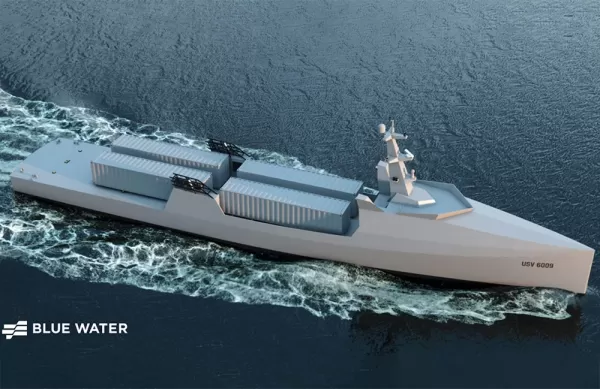
Blue Water Autonomy’s Liberty Class is a 190-foot steel autonomous ship. | Source: Blue Water AutonomyBoston-based technology and shipbuilding firm Blue Water Autonomy has secured a multiple-award contract with the Naval Oceanographic Office (NAVOCEA
U.S. Navy Selects Blue Water Autonomy for Deep-Sea Survey Missions
Blue Water Autonomy’s Liberty Class is a 190-foot steel autonomous ship. | Source: Blue Water AutonomyBoston-based technology and shipbuilding firm Blue Water Autonomy has secured a multiple-award contract with the Naval Oceanographic Office (NAVOCEA

2026 Latest Best Top-rated AI Text to Speech Tools for Online Courses are curated by XIX.AI based on rigorous real-world tests and weekly updated rankings. These powerful tools help creators deliver crystal-clear audio content effortlessly, boosting writing efficiency and streamlining course production. Check out the free vs paid comparison to find your perfect fit. Explore now to unlock your AI edge in online education.
10 tools
xix.ai

2026 Latest Best Top-Rated AI Blog Title Tools for Higher Click Through Rates! XIX.AI has carefully curated a powerful, game-changing collection of top tools that go through rigorous real-world tests. You’ll find a free vs paid comparison, weekly updated rankings, and detailed insights to help you boost your blog’s traffic efficiently. Must-try options are highlighted to help you unlock your AI edge. Explore now!
10 tools
xix.ai

2026 Latest Best Top-rated AI Task Routing Tools for Support Workflows! XIX.AI has curated a highly powerful game-changing collection of must-try solutions, all undergoing rigorous real-world tests and updated weekly. These tools streamline workflows, boost productivity, and help teams deliver faster, more efficient support. Explore now to discover your perfect tool and unlock your AI edge!
17 tools
xix.ai
2026 Latest Best Top-Rated AI Citation and Paper Summary Tools Curated by XIX.AI. Get powerful game-changing solutions for quick content creation, improved writing efficiency, and boosting productivity. We offer a free vs paid comparison along with real-world tests and weekly updated rankings to help you find the must-try tool that fits your needs perfectly. Explore now to Unlock your AI edge.
10 tools
xix.ai

2026 Latest Best Top-Rated AI Productivity Tools for Daily Work! XIX.AI has curated a powerful, game-changing selection based on rigorous weekly updated rankings and real-world tests. You’ll find must-try options that boost writing efficiency, streamline content creation, and help you overcome daily work challenges. Get a free vs paid comparison to find the perfect fit for your needs. Explore now to unlock your AI edge!
9 tools
xix.ai

2026 Latest Best Top-Rated AI Systematic Review Tools for Research Screening are here on XIX.AI! This curated collection includes powerful, game-changing solutions that go through rigorous real-world tests to deliver accurate results. We also offer a free vs paid comparison along with weekly updated rankings to help you find the must-try option that boosts your research efficiency significantly. Explore now to unlock your AI edge in academic work!
11 tools
xix.ai












