


 Home
HomeStudy: OpenAI Models Memorized Copyrighted Content
A recent study suggests that OpenAI may have indeed used copyrighted material to train some of its AI models, adding fuel to the ongoing legal battles the company faces. Authors, programmers, and other content creators have accused OpenAI of using their works—such as books and code—without permission to develop its AI models. While OpenAI has defended itself by claiming fair use, the plaintiffs argue that U.S. copyright law doesn't provide an exception for training data.
The study, a collaboration between researchers from the University of Washington, the University of Copenhagen, and Stanford, introduces a new technique for detecting "memorized" training data in models accessed through an API, like those from OpenAI. AI models essentially learn from vast amounts of data to recognize patterns, enabling them to create essays, images, and more. Although most outputs aren't direct copies of the training data, some inevitably are due to the learning process. For instance, image models have been known to reproduce movie screenshots, while language models have been caught essentially plagiarizing news articles.
The method described in the study focuses on "high-surprisal" words—words that are unusual in a given context. For example, in the sentence "Jack and I sat perfectly still with the radar humming," "radar" would be a high-surprisal word because it's less expected than words like "engine" or "radio" to precede "humming."
The researchers tested several OpenAI models, including GPT-4 and GPT-3.5, by removing high-surprisal words from excerpts of fiction books and New York Times articles and asking the models to predict these missing words. If the models accurately guessed the words, it suggested they had memorized the text during training.
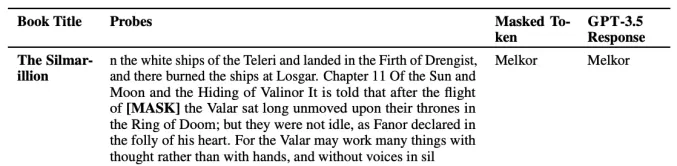
An example of having a model “guess” a high-surprisal word.Image Credits:OpenAI The results indicated that GPT-4 had likely memorized parts of popular fiction books, including those in the BookMIA dataset of copyrighted ebooks. It also appeared to have memorized some New York Times articles, though at a lower frequency.
Abhilasha Ravichander, a doctoral student at the University of Washington and co-author of the study, emphasized to TechCrunch that these findings highlight the "contentious data" that might have been used to train these models. "In order to have large language models that are trustworthy, we need to have models that we can probe and audit and examine scientifically," Ravichander stated. "Our work aims to provide a tool to probe large language models, but there is a real need for greater data transparency in the whole ecosystem."
OpenAI has pushed for more relaxed rules on using copyrighted data to develop AI models. Although the company has some content licensing agreements and offers opt-out options for copyright holders, it has lobbied various governments to establish "fair use" rules specifically for AI training.
Related article
 Sam Altman Sparks Debate Over AI's Deceleration
Listen onApple PodcastsListen onSpotifyOpenAI CEO Sam Altman recently suggested that it may be time to “pace the rate of AI development” to allow society to “harden around some of these new capability levels.”On the latest episode of TechCrunch’s Equ
OpenAI fights Apple trade secret lawsuit
OpenAI rebutted Apple’s trade secret allegations on Tuesday, arguing the lawsuit is unfounded.“We take these claims seriously but see no evidence supporting them,” OpenAI stated, as reported by Bloomberg’s Ed Ludlow on X. “We support fair competition
OpenAI robotics head Caitlin Kalinowski resigns over Pentagon partnership
OpenAI robotics leader Caitlin Kalinowski has stepped down following the company’s controversial partnership with the Department of Defense.“This wasn’t an easy call,” Kalinowski explained in a social media statement. “While AI plays a vital role in
Related Special Topic Recommendations
Education and Learning
Sam Altman Sparks Debate Over AI's Deceleration
Listen onApple PodcastsListen onSpotifyOpenAI CEO Sam Altman recently suggested that it may be time to “pace the rate of AI development” to allow society to “harden around some of these new capability levels.”On the latest episode of TechCrunch’s Equ
OpenAI fights Apple trade secret lawsuit
OpenAI rebutted Apple’s trade secret allegations on Tuesday, arguing the lawsuit is unfounded.“We take these claims seriously but see no evidence supporting them,” OpenAI stated, as reported by Bloomberg’s Ed Ludlow on X. “We support fair competition
OpenAI robotics head Caitlin Kalinowski resigns over Pentagon partnership
OpenAI robotics leader Caitlin Kalinowski has stepped down following the company’s controversial partnership with the Department of Defense.“This wasn’t an easy call,” Kalinowski explained in a social media statement. “While AI plays a vital role in
Related Special Topic Recommendations
Education and Learning
 AI Study Tools for Homework and Exam Prep
2026 Latest Best AI Study Tools for Homework and Exam Prep! XIX.AI curates a top-rated list of powerful, game-changing tools that help students boost productivity, streamline homework completion, and ace exams through real-world tests. Get a free vs paid comparison, detailed rankings, and must-try options to unlock your AI edge. Explore now!
 10 tools
 xix.ai
Music composition
AI Vocal Demo Tools for Songwriters, Hooks, Toplines, and Multilingual Draft Sessions
xix.ai
Music composition
AI Vocal Demo Tools for Songwriters, Hooks, Toplines, and Multilingual Draft Sessions
2026 Latest Best AI Vocal Demo Tools for Songwriters, Hook Creators, and Multi-Language Content Teams! XIX.AI has curated a top-rated list of powerful game-changing tools that go through rigorous real-world tests. You’ll find detailed free vs paid comparison data, comprehensive rankings, and must-try options to help you boost writing efficiency and unlock your creative potential. Explore now to discover your perfect tool for all your content needs!
9 tools
xix.ai
Business
Best AI Competitive Research Tools for Small Businesses
2026 Latest Best Top-rated AI Competitive Research Tools for Small Businesses! XIX.AI has curated a highly powerful game-changing collection, updated weekly with rigorous real-world tests and detailed rankings. You can find a comprehensive free vs paid comparison to help you identify the must-try tools that boost your productivity and give you a competitive edge. Explore now to discover your perfect tool!
9 tools
xix.ai
Image editing
Photoshop AI Retouch Tools for Ecommerce Apparel, Skin Cleanup, and Color Consistency
2026 Latest Best Photoshop AI retouch tools for ecommerce apparel, skin cleanup, and color consistency! This top-rated curated list features powerful game-changing solutions that help you boost writing efficiency, streamline content creation, and achieve perfect visual results effortlessly. Each tool has undergone real-world tests through weekly updated rankings, complete with free vs paid comparison details. Backed by XIX.AI, it’s the must-try guide for anyone aiming to unlock your AI edge. Explore now!
10 tools
xix.ai
Prompt
Best AI Prompt Libraries for ChatGPT Workflows
2026 Latest Best Top-Rated AI Prompt Libraries for optimizing all types of ChatGPT workflows. XIX.AI has curated a powerful, game-changing collection that goes through rigorous real-world tests to ensure top performance. You can find detailed free vs paid comparisons and expert rankings to help you choose the must-try tools that boost your productivity and unlock your AI edge. Explore now!
11 tools
xix.ai
Education and Learning
AI Quiz Builder Platforms for Teachers, Tutors, and Cohort-Based Learning Programs
2026 Latest Best AI Quiz Builder Platforms for Teachers, Tutors, and Cohort-Based Learning Programs! XIX.AI has curated a top-rated list of powerful game-changing tools that go through real-world tests to deliver accurate rankings. These must-try platforms help boost writing efficiency, streamline content creation, and simplify quiz design across all learning scenarios. Explore now to discover your perfect tool for unlocking your AI edge in teaching!
13 tools
xix.ai

 Comments (34)
0/500
Comments (34)
0/500
![DouglasScott]()
So OpenAI basically trained on copyrighted books and code without permission? Shocking absolutely no one. 😅 The real question is whether courts will actually make them pay damages or just slap a 'please don't do that again' fine. Either way, creators deserve better than being data fodder for billion-dollar models.
![JackAllen]()
这篇文章提到的版权问题确实让人担忧,以后AI生成的内容会不会都带着'侵权'的标签?想想就觉得挺讽刺的,毕竟这些模型训练数据不透明,普通用户根本不知道输出里夹带了什么'私货'。希望有更严格的管理办法吧。
![WilliamGonzalez]()
This is wild! OpenAI might’ve gobbled up copyrighted stuff to train their models? I’m not shocked, but it’s kinda shady. Hope those authors and coders get some justice! 😤
![GregoryBaker]()
This is wild! OpenAI might've trained their models on copyrighted stuff? 😳 I wonder how many books and code snippets got swept up in that data vacuum. Ethics in AI is such a messy topic right now.
![JohnGarcia]()
Me sorprendió un poco que OpenAI podría haber usado material con derechos de autor para entrenar sus modelos. Es un poco decepcionante, pero supongo que es el salvaje oeste allá en el mundo de la IA. 🤔 ¿Quizás deberían ser más cuidadosos la próxima vez?
![TimothyMitchell]()
OpenAIが著作権付きの資料を使ってAIを訓練しているという研究は本当に驚きですね!クリエイターにとっては残念ですが、AIの訓練方法について知るのは面白いです。もっと透明性が必要かもしれませんね?🤔
A recent study suggests that OpenAI may have indeed used copyrighted material to train some of its AI models, adding fuel to the ongoing legal battles the company faces. Authors, programmers, and other content creators have accused OpenAI of using their works—such as books and code—without permission to develop its AI models. While OpenAI has defended itself by claiming fair use, the plaintiffs argue that U.S. copyright law doesn't provide an exception for training data.
The study, a collaboration between researchers from the University of Washington, the University of Copenhagen, and Stanford, introduces a new technique for detecting "memorized" training data in models accessed through an API, like those from OpenAI. AI models essentially learn from vast amounts of data to recognize patterns, enabling them to create essays, images, and more. Although most outputs aren't direct copies of the training data, some inevitably are due to the learning process. For instance, image models have been known to reproduce movie screenshots, while language models have been caught essentially plagiarizing news articles.
The method described in the study focuses on "high-surprisal" words—words that are unusual in a given context. For example, in the sentence "Jack and I sat perfectly still with the radar humming," "radar" would be a high-surprisal word because it's less expected than words like "engine" or "radio" to precede "humming."
The researchers tested several OpenAI models, including GPT-4 and GPT-3.5, by removing high-surprisal words from excerpts of fiction books and New York Times articles and asking the models to predict these missing words. If the models accurately guessed the words, it suggested they had memorized the text during training.
Abhilasha Ravichander, a doctoral student at the University of Washington and co-author of the study, emphasized to TechCrunch that these findings highlight the "contentious data" that might have been used to train these models. "In order to have large language models that are trustworthy, we need to have models that we can probe and audit and examine scientifically," Ravichander stated. "Our work aims to provide a tool to probe large language models, but there is a real need for greater data transparency in the whole ecosystem."
OpenAI has pushed for more relaxed rules on using copyrighted data to develop AI models. Although the company has some content licensing agreements and offers opt-out options for copyright holders, it has lobbied various governments to establish "fair use" rules specifically for AI training.








 Sam Altman Sparks Debate Over AI's Deceleration
Listen onApple PodcastsListen onSpotifyOpenAI CEO Sam Altman recently suggested that it may be time to “pace the rate of AI development” to allow society to “harden around some of these new capability levels.”On the latest episode of TechCrunch’s Equ
Sam Altman Sparks Debate Over AI's Deceleration
Listen onApple PodcastsListen onSpotifyOpenAI CEO Sam Altman recently suggested that it may be time to “pace the rate of AI development” to allow society to “harden around some of these new capability levels.”On the latest episode of TechCrunch’s Equ
 OpenAI fights Apple trade secret lawsuit
OpenAI rebutted Apple’s trade secret allegations on Tuesday, arguing the lawsuit is unfounded.“We take these claims seriously but see no evidence supporting them,” OpenAI stated, as reported by Bloomberg’s Ed Ludlow on X. “We support fair competition
OpenAI fights Apple trade secret lawsuit
OpenAI rebutted Apple’s trade secret allegations on Tuesday, arguing the lawsuit is unfounded.“We take these claims seriously but see no evidence supporting them,” OpenAI stated, as reported by Bloomberg’s Ed Ludlow on X. “We support fair competition
 OpenAI robotics head Caitlin Kalinowski resigns over Pentagon partnership
OpenAI robotics leader Caitlin Kalinowski has stepped down following the company’s controversial partnership with the Department of Defense.“This wasn’t an easy call,” Kalinowski explained in a social media statement. “While AI plays a vital role in
OpenAI robotics head Caitlin Kalinowski resigns over Pentagon partnership
OpenAI robotics leader Caitlin Kalinowski has stepped down following the company’s controversial partnership with the Department of Defense.“This wasn’t an easy call,” Kalinowski explained in a social media statement. “While AI plays a vital role in

2026 Latest Best AI Study Tools for Homework and Exam Prep! XIX.AI curates a top-rated list of powerful, game-changing tools that help students boost productivity, streamline homework completion, and ace exams through real-world tests. Get a free vs paid comparison, detailed rankings, and must-try options to unlock your AI edge. Explore now!
10 tools
xix.ai

2026 Latest Best AI Vocal Demo Tools for Songwriters, Hook Creators, and Multi-Language Content Teams! XIX.AI has curated a top-rated list of powerful game-changing tools that go through rigorous real-world tests. You’ll find detailed free vs paid comparison data, comprehensive rankings, and must-try options to help you boost writing efficiency and unlock your creative potential. Explore now to discover your perfect tool for all your content needs!
9 tools
xix.ai

2026 Latest Best Top-rated AI Competitive Research Tools for Small Businesses! XIX.AI has curated a highly powerful game-changing collection, updated weekly with rigorous real-world tests and detailed rankings. You can find a comprehensive free vs paid comparison to help you identify the must-try tools that boost your productivity and give you a competitive edge. Explore now to discover your perfect tool!
9 tools
xix.ai

2026 Latest Best Photoshop AI retouch tools for ecommerce apparel, skin cleanup, and color consistency! This top-rated curated list features powerful game-changing solutions that help you boost writing efficiency, streamline content creation, and achieve perfect visual results effortlessly. Each tool has undergone real-world tests through weekly updated rankings, complete with free vs paid comparison details. Backed by XIX.AI, it’s the must-try guide for anyone aiming to unlock your AI edge. Explore now!
10 tools
xix.ai
2026 Latest Best Top-Rated AI Prompt Libraries for optimizing all types of ChatGPT workflows. XIX.AI has curated a powerful, game-changing collection that goes through rigorous real-world tests to ensure top performance. You can find detailed free vs paid comparisons and expert rankings to help you choose the must-try tools that boost your productivity and unlock your AI edge. Explore now!
11 tools
xix.ai
2026 Latest Best AI Quiz Builder Platforms for Teachers, Tutors, and Cohort-Based Learning Programs! XIX.AI has curated a top-rated list of powerful game-changing tools that go through real-world tests to deliver accurate rankings. These must-try platforms help boost writing efficiency, streamline content creation, and simplify quiz design across all learning scenarios. Explore now to discover your perfect tool for unlocking your AI edge in teaching!
13 tools
xix.ai

So OpenAI basically trained on copyrighted books and code without permission? Shocking absolutely no one. 😅 The real question is whether courts will actually make them pay damages or just slap a 'please don't do that again' fine. Either way, creators deserve better than being data fodder for billion-dollar models.
这篇文章提到的版权问题确实让人担忧,以后AI生成的内容会不会都带着'侵权'的标签?想想就觉得挺讽刺的,毕竟这些模型训练数据不透明,普通用户根本不知道输出里夹带了什么'私货'。希望有更严格的管理办法吧。
This is wild! OpenAI might’ve gobbled up copyrighted stuff to train their models? I’m not shocked, but it’s kinda shady. Hope those authors and coders get some justice! 😤
This is wild! OpenAI might've trained their models on copyrighted stuff? 😳 I wonder how many books and code snippets got swept up in that data vacuum. Ethics in AI is such a messy topic right now.
Me sorprendió un poco que OpenAI podría haber usado material con derechos de autor para entrenar sus modelos. Es un poco decepcionante, pero supongo que es el salvaje oeste allá en el mundo de la IA. 🤔 ¿Quizás deberían ser más cuidadosos la próxima vez?
OpenAIが著作権付きの資料を使ってAIを訓練しているという研究は本当に驚きですね!クリエイターにとっては残念ですが、AIの訓練方法について知るのは面白いです。もっと透明性が必要かもしれませんね?🤔












