


 Home
HomeRobots 'see' touch via color-changing tactile sensor
A robot touches a coin, sensing its fine details. Credit: Queen Mary University of London
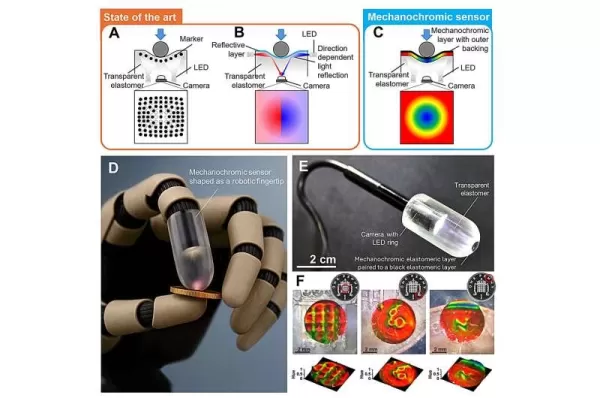
Engineers at Queen Mary University of London have developed a new color-changing tactile sensor that enables robots to "see" and feel touch in real time. The concept was created by Giacomo Sasso, a postdoctoral researcher at the School of Engineering and Materials Science, and works by converting invisible forces into dynamic color patterns. This allows high-resolution maps of contact, strain, and pressure to appear instantly.
The research is published in the journal Science Advances.
When pressure is applied to a soft sensing surface, the material produces spatially varying structural colors that a standard camera can capture immediately, eliminating the need for complex reconstruction algorithms.
From factory floors to surgery
This technology enables a robotic gripper to assemble microscale components with the precision required in manufacturing, where every subtle change in force becomes visible in real time. It also has potential in healthcare, where an external prosthetic limb could gain a richer sense of touch during delicate daily or clinical tasks.
At the same time, surgical systems could distinguish healthy from abnormal tissue by reading fine pressure signatures directly through the material's color response.
Sensing built into the material
Unlike traditional tactile sensors, this new system embeds sensing directly into the material itself. Mechanical interactions are transformed into color fields that a low-cost USB camera can read in real time. The work has already produced results demonstrating the first real-time solution in this field.
"You wouldn't guess how much information is generated when your finger presses a light switch. A human hand contains more than 10,000 mechanoreceptors to do the job, yet touch sensing remains one of the major challenges in robotics," said Sasso.
"We were pleased to capture the finger ridges, as no existing technology can reproduce such sensor density at a comparable scale and simplicity. The key idea behind this project was to think outside the box: instead of embedding dense and overengineered sensor arrays, sensing is moved into the material itself, where mechanical cues are directly transformed into color fields and captured using a simple, low-cost USB camera." This produces rich pressure maps while simplifying the system architecture.
Co-authors from the University of Florence, University of Trieste, and University of Trento in Italy agree that "What is particularly powerful is that the information is already in the light signal. You are no longer reconstructing touch—you are observing it directly," said Professor James Busfield.
Solving a long-standing trade-off
The idea emerged from the need to overcome a persistent trade-off in vision-based tactile sensing: High-resolution systems typically require heavy computational pipelines to reconstruct contact geometry, introducing latency, while faster systems often sacrifice spatial detail.
The collaboration between Professor Federico Carpi from the University of Florence and Busfield merges the research worlds of soft robotics and materials science. Building on years of work on stretchable sensors and polymer characterization, the team has progressively advanced the ability to interface mechanical compliance with functional sensing.
Within this framework, mechanochromic materials represent a new direction: Instead of relying on highly engineered microelectronics to interpret deformation (taxels), the material itself becomes the sensing medium, directly encoding mechanical interaction into visible optical signals.
Related article
 U.S. Stocks Hit Historic Milestone as AI and Aerospace Giants Prepare for Trillion-Dollar Debut
Elon Musk, Sam Altman, and Dario Amodei, three titans of the technology sector, are advancing toward initial public offerings for their respective ventures. With SpaceX, OpenAI, and Anthropic—three industry behemoths nearing trillion-dollar valuation
Swedish AI Startup Lovable Eyes $13.2 Billion Valuation After Major Funding Round
As AI-driven coding tools gain traction, Swedish startup Lovable has secured a major funding round. The company aims to raise $3 billion, potentially boosting its valuation to $13.2 billion—double the $6.6 billion recorded last December. Menlo Ventur
Google Tests Remy AI Agent for Gemini as Focus Shifts to User Control
According to Business Insider, Google is testing Remy, a new AI personal agent for Gemini. This tool aims to execute tasks on behalf of users, streamlining both professional workflows and daily routines.Currently, Remy is undergoing testing in an int
Related Special Topic Recommendations
Data Analysis
U.S. Stocks Hit Historic Milestone as AI and Aerospace Giants Prepare for Trillion-Dollar Debut
Elon Musk, Sam Altman, and Dario Amodei, three titans of the technology sector, are advancing toward initial public offerings for their respective ventures. With SpaceX, OpenAI, and Anthropic—three industry behemoths nearing trillion-dollar valuation
Swedish AI Startup Lovable Eyes $13.2 Billion Valuation After Major Funding Round
As AI-driven coding tools gain traction, Swedish startup Lovable has secured a major funding round. The company aims to raise $3 billion, potentially boosting its valuation to $13.2 billion—double the $6.6 billion recorded last December. Menlo Ventur
Google Tests Remy AI Agent for Gemini as Focus Shifts to User Control
According to Business Insider, Google is testing Remy, a new AI personal agent for Gemini. This tool aims to execute tasks on behalf of users, streamlining both professional workflows and daily routines.Currently, Remy is undergoing testing in an int
Related Special Topic Recommendations
Data Analysis
 Best AI Anomaly Detection Tools for KPI Monitoring across SaaS and Ecommerce Teams
2026 Latest Best Top-rated AI Anomaly Detection Tools for KPI Monitoring in SaaS and Ecommerce teams! XIX.AI has curated a powerful, game-changing collection based on rigorous real-world tests and weekly updated rankings. You’ll find detailed free vs paid comparison insights to help you identify the must-try solution that boosts productivity and unlocks your AI edge. Explore now!
 10 tools
 xix.ai
writing
Best AI Outline Generators for Long-Form SEO Articles
xix.ai
writing
Best AI Outline Generators for Long-Form SEO Articles
2026 Latest Best Top-Rated AI Outline Generators for Long-Form SEO Articles, meticulously curated by XIX.AI. These powerful tools offer game-changing assistance in creating high-quality content quickly, boosting writing efficiency significantly. Get a free vs paid comparison along with real-world tests and detailed rankings to help you find the must-try option that suits your needs. Explore now to unlock your AI edge.
8 tools
xix.ai
Education and Learning
AI Study Tools for Homework and Exam Prep
2026 Latest Best AI Study Tools for Homework and Exam Prep! XIX.AI curates a top-rated list of powerful, game-changing tools that help students boost productivity, streamline homework completion, and ace exams through real-world tests. Get a free vs paid comparison, detailed rankings, and must-try options to unlock your AI edge. Explore now!
10 tools
xix.ai
Music composition
AI Vocal Demo Tools for Songwriters, Hooks, Toplines, and Multilingual Draft Sessions
2026 Latest Best AI Vocal Demo Tools for Songwriters, Hook Creators, and Multi-Language Content Teams! XIX.AI has curated a top-rated list of powerful game-changing tools that go through rigorous real-world tests. You’ll find detailed free vs paid comparison data, comprehensive rankings, and must-try options to help you boost writing efficiency and unlock your creative potential. Explore now to discover your perfect tool for all your content needs!
9 tools
xix.ai
Business
Best AI Competitive Research Tools for Small Businesses
2026 Latest Best Top-rated AI Competitive Research Tools for Small Businesses! XIX.AI has curated a highly powerful game-changing collection, updated weekly with rigorous real-world tests and detailed rankings. You can find a comprehensive free vs paid comparison to help you identify the must-try tools that boost your productivity and give you a competitive edge. Explore now to discover your perfect tool!
9 tools
xix.ai
Image editing
Photoshop AI Retouch Tools for Ecommerce Apparel, Skin Cleanup, and Color Consistency
2026 Latest Best Photoshop AI retouch tools for ecommerce apparel, skin cleanup, and color consistency! This top-rated curated list features powerful game-changing solutions that help you boost writing efficiency, streamline content creation, and achieve perfect visual results effortlessly. Each tool has undergone real-world tests through weekly updated rankings, complete with free vs paid comparison details. Backed by XIX.AI, it’s the must-try guide for anyone aiming to unlock your AI edge. Explore now!
10 tools
xix.ai

 Comments (1)
0/500
Comments (1)
0/500
![KennethLee]()
Wait, so the robot can literally see what it's touching? That's like giving it a superpower. But honestly, I'm more curious about how they keep the color-changing material from wearing out after a thousand touches. Also, imagine if this tech gets into cheap toys—kids would love a teddy bear that changes color when you hug it. 😄
A robot touches a coin, sensing its fine details. Credit: Queen Mary University of London
Engineers at Queen Mary University of London have developed a new color-changing tactile sensor that enables robots to "see" and feel touch in real time. The concept was created by Giacomo Sasso, a postdoctoral researcher at the School of Engineering and Materials Science, and works by converting invisible forces into dynamic color patterns. This allows high-resolution maps of contact, strain, and pressure to appear instantly.
The research is published in the journal Science Advances.
When pressure is applied to a soft sensing surface, the material produces spatially varying structural colors that a standard camera can capture immediately, eliminating the need for complex reconstruction algorithms.
From factory floors to surgery
This technology enables a robotic gripper to assemble microscale components with the precision required in manufacturing, where every subtle change in force becomes visible in real time. It also has potential in healthcare, where an external prosthetic limb could gain a richer sense of touch during delicate daily or clinical tasks.
At the same time, surgical systems could distinguish healthy from abnormal tissue by reading fine pressure signatures directly through the material's color response.
Sensing built into the material
Unlike traditional tactile sensors, this new system embeds sensing directly into the material itself. Mechanical interactions are transformed into color fields that a low-cost USB camera can read in real time. The work has already produced results demonstrating the first real-time solution in this field.
"You wouldn't guess how much information is generated when your finger presses a light switch. A human hand contains more than 10,000 mechanoreceptors to do the job, yet touch sensing remains one of the major challenges in robotics," said Sasso.
"We were pleased to capture the finger ridges, as no existing technology can reproduce such sensor density at a comparable scale and simplicity. The key idea behind this project was to think outside the box: instead of embedding dense and overengineered sensor arrays, sensing is moved into the material itself, where mechanical cues are directly transformed into color fields and captured using a simple, low-cost USB camera." This produces rich pressure maps while simplifying the system architecture.
Co-authors from the University of Florence, University of Trieste, and University of Trento in Italy agree that "What is particularly powerful is that the information is already in the light signal. You are no longer reconstructing touch—you are observing it directly," said Professor James Busfield.
Solving a long-standing trade-off
The idea emerged from the need to overcome a persistent trade-off in vision-based tactile sensing: High-resolution systems typically require heavy computational pipelines to reconstruct contact geometry, introducing latency, while faster systems often sacrifice spatial detail.
The collaboration between Professor Federico Carpi from the University of Florence and Busfield merges the research worlds of soft robotics and materials science. Building on years of work on stretchable sensors and polymer characterization, the team has progressively advanced the ability to interface mechanical compliance with functional sensing.
Within this framework, mechanochromic materials represent a new direction: Instead of relying on highly engineered microelectronics to interpret deformation (taxels), the material itself becomes the sensing medium, directly encoding mechanical interaction into visible optical signals.








 U.S. Stocks Hit Historic Milestone as AI and Aerospace Giants Prepare for Trillion-Dollar Debut
Elon Musk, Sam Altman, and Dario Amodei, three titans of the technology sector, are advancing toward initial public offerings for their respective ventures. With SpaceX, OpenAI, and Anthropic—three industry behemoths nearing trillion-dollar valuation
U.S. Stocks Hit Historic Milestone as AI and Aerospace Giants Prepare for Trillion-Dollar Debut
Elon Musk, Sam Altman, and Dario Amodei, three titans of the technology sector, are advancing toward initial public offerings for their respective ventures. With SpaceX, OpenAI, and Anthropic—three industry behemoths nearing trillion-dollar valuation
 Swedish AI Startup Lovable Eyes $13.2 Billion Valuation After Major Funding Round
As AI-driven coding tools gain traction, Swedish startup Lovable has secured a major funding round. The company aims to raise $3 billion, potentially boosting its valuation to $13.2 billion—double the $6.6 billion recorded last December. Menlo Ventur
Google Tests Remy AI Agent for Gemini as Focus Shifts to User Control
According to Business Insider, Google is testing Remy, a new AI personal agent for Gemini. This tool aims to execute tasks on behalf of users, streamlining both professional workflows and daily routines.Currently, Remy is undergoing testing in an int
Swedish AI Startup Lovable Eyes $13.2 Billion Valuation After Major Funding Round
As AI-driven coding tools gain traction, Swedish startup Lovable has secured a major funding round. The company aims to raise $3 billion, potentially boosting its valuation to $13.2 billion—double the $6.6 billion recorded last December. Menlo Ventur
Google Tests Remy AI Agent for Gemini as Focus Shifts to User Control
According to Business Insider, Google is testing Remy, a new AI personal agent for Gemini. This tool aims to execute tasks on behalf of users, streamlining both professional workflows and daily routines.Currently, Remy is undergoing testing in an int

2026 Latest Best Top-rated AI Anomaly Detection Tools for KPI Monitoring in SaaS and Ecommerce teams! XIX.AI has curated a powerful, game-changing collection based on rigorous real-world tests and weekly updated rankings. You’ll find detailed free vs paid comparison insights to help you identify the must-try solution that boosts productivity and unlocks your AI edge. Explore now!
10 tools
xix.ai

2026 Latest Best Top-Rated AI Outline Generators for Long-Form SEO Articles, meticulously curated by XIX.AI. These powerful tools offer game-changing assistance in creating high-quality content quickly, boosting writing efficiency significantly. Get a free vs paid comparison along with real-world tests and detailed rankings to help you find the must-try option that suits your needs. Explore now to unlock your AI edge.
8 tools
xix.ai

2026 Latest Best AI Study Tools for Homework and Exam Prep! XIX.AI curates a top-rated list of powerful, game-changing tools that help students boost productivity, streamline homework completion, and ace exams through real-world tests. Get a free vs paid comparison, detailed rankings, and must-try options to unlock your AI edge. Explore now!
10 tools
xix.ai

2026 Latest Best AI Vocal Demo Tools for Songwriters, Hook Creators, and Multi-Language Content Teams! XIX.AI has curated a top-rated list of powerful game-changing tools that go through rigorous real-world tests. You’ll find detailed free vs paid comparison data, comprehensive rankings, and must-try options to help you boost writing efficiency and unlock your creative potential. Explore now to discover your perfect tool for all your content needs!
9 tools
xix.ai

2026 Latest Best Top-rated AI Competitive Research Tools for Small Businesses! XIX.AI has curated a highly powerful game-changing collection, updated weekly with rigorous real-world tests and detailed rankings. You can find a comprehensive free vs paid comparison to help you identify the must-try tools that boost your productivity and give you a competitive edge. Explore now to discover your perfect tool!
9 tools
xix.ai

2026 Latest Best Photoshop AI retouch tools for ecommerce apparel, skin cleanup, and color consistency! This top-rated curated list features powerful game-changing solutions that help you boost writing efficiency, streamline content creation, and achieve perfect visual results effortlessly. Each tool has undergone real-world tests through weekly updated rankings, complete with free vs paid comparison details. Backed by XIX.AI, it’s the must-try guide for anyone aiming to unlock your AI edge. Explore now!
10 tools
xix.ai

Wait, so the robot can literally see what it's touching? That's like giving it a superpower. But honestly, I'm more curious about how they keep the color-changing material from wearing out after a thousand touches. Also, imagine if this tech gets into cheap toys—kids would love a teddy bear that changes color when you hug it. 😄












