


 Home
HomeLess Is More: How Retrieving Fewer Documents Enhances AI Responses
Retrieval-Augmented Generation (RAG) is an innovative approach to building AI systems, combining a language model with an external knowledge source to enhance accuracy and reduce factual errors. In essence, the AI searches for relevant documents related to a user's query and uses this information to generate a more precise response. This method has gained recognition for its ability to keep large language models (LLMs) grounded in real data, minimizing the risk of hallucinations.
You might assume that providing an AI with more documents would lead to better-informed answers. However, a recent study from the Hebrew University of Jerusalem suggests otherwise: when it comes to feeding information to an AI, less can indeed be more.
Fewer Documents, Better Answers
The study delved into how the number of documents provided to a RAG system impacts its performance. The researchers maintained a consistent total text length, adjusting the document count from 20 down to 2-4 relevant ones and expanding these to match the original text volume. This allowed them to isolate the effect of document quantity on performance.
Using the MuSiQue dataset, which includes trivia questions paired with Wikipedia paragraphs, they found that AI models often performed better with fewer documents. Accuracy improved by up to 10% (measured by F1 score) when the system focused on just a few key documents rather than a broad collection. This trend held across various open-source language models, such as Meta's Llama, with Qwen-2 being the notable exception, maintaining its performance with multiple documents.
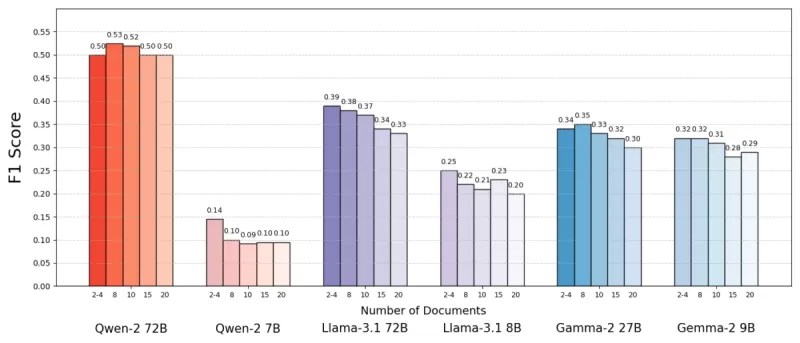 Source: Levy et al.
This surprising result challenges the common belief that more information always helps. Even with the same amount of text, the presence of multiple documents seemed to complicate the AI's task, introducing more noise than signal.
Why Less Can Be More in RAG
The "less is more" principle makes sense when we consider how AI models process information. With fewer, more relevant documents, the AI can focus on the essential context without distractions, much like a student studying the most pertinent material.
In the study, models performed better when given only the documents directly relevant to the answer, as this cleaner, focused context made it easier to extract the correct information. Conversely, when the AI had to sift through many documents, it often struggled with the mix of relevant and irrelevant content. Similar but unrelated documents could mislead the model, increasing the risk of hallucinations.
Interestingly, the study found that the AI could more easily ignore obviously irrelevant documents than those subtly off-topic. This suggests that realistic distractors are more confusing than random ones. By limiting documents to only the necessary ones, we reduce the likelihood of setting such traps.
Additionally, using fewer documents lowers the computational overhead, making the system more efficient and cost-effective. This approach not only improves accuracy but also enhances the overall performance of the RAG system.
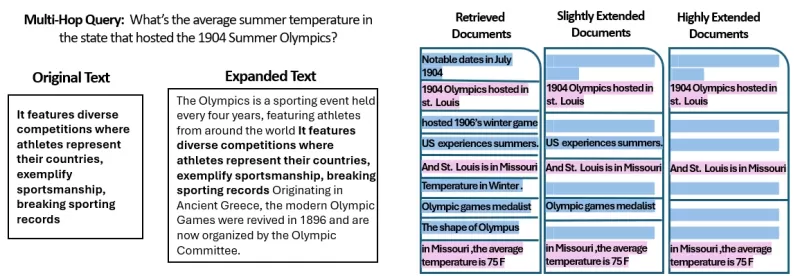 Source: Levy et al.
Rethinking RAG: Future Directions
These findings have significant implications for the design of future AI systems that rely on external knowledge. It suggests that focusing on the quality and relevance of retrieved documents, rather than their quantity, could enhance performance. The study's authors advocate for retrieval methods that balance relevance and diversity, ensuring comprehensive coverage without overwhelming the model with extraneous text.
Future research may explore better retriever systems or re-rankers to identify truly valuable documents and improve how language models handle multiple sources. Enhancing the models themselves, as seen with Qwen-2, could also provide insights into making them more robust to diverse inputs.
As AI systems develop larger context windows, the ability to process more text at once becomes less critical than ensuring the text is relevant and curated. The study, titled "More Documents, Same Length," underscores the importance of focusing on the most pertinent information to improve AI accuracy and efficiency.
In conclusion, this research challenges our assumptions about data input in AI systems. By carefully selecting fewer, better documents, we can create smarter, leaner RAG systems that deliver more accurate and trustworthy answers.
Related article
 Google Tests Remy AI Agent for Gemini as Focus Shifts to User Control
According to Business Insider, Google is testing Remy, a new AI personal agent for Gemini. This tool aims to execute tasks on behalf of users, streamlining both professional workflows and daily routines.Currently, Remy is undergoing testing in an int
How to fix Core Web Vitals for better SEO rankings
Streamline Report Card Comments with AI ToolsIntroductionAI Tools for Generating Report Card CommentsMagic SchoolAlmanac AIChat GPTUsing Magic School to Generate Report Card CommentsLogging into Magic SchoolSelecting the Report Card Comments ToolCust
Slackbot Becomes an AI Agent
Slackbot, the automated assistant embedded in Salesforce’s corporate messaging platform Slack, is evolving into an AI agent. Salesforce CTO Parker Harris envisions it achieving viral status comparable to OpenAI’s ChatGPT.The cloud software giant laun
Related Special Topic Recommendations
writing
Google Tests Remy AI Agent for Gemini as Focus Shifts to User Control
According to Business Insider, Google is testing Remy, a new AI personal agent for Gemini. This tool aims to execute tasks on behalf of users, streamlining both professional workflows and daily routines.Currently, Remy is undergoing testing in an int
How to fix Core Web Vitals for better SEO rankings
Streamline Report Card Comments with AI ToolsIntroductionAI Tools for Generating Report Card CommentsMagic SchoolAlmanac AIChat GPTUsing Magic School to Generate Report Card CommentsLogging into Magic SchoolSelecting the Report Card Comments ToolCust
Slackbot Becomes an AI Agent
Slackbot, the automated assistant embedded in Salesforce’s corporate messaging platform Slack, is evolving into an AI agent. Salesforce CTO Parker Harris envisions it achieving viral status comparable to OpenAI’s ChatGPT.The cloud software giant laun
Related Special Topic Recommendations
writing
 Best AI Outline Generators for Long-Form SEO Articles
2026 Latest Best Top-Rated AI Outline Generators for Long-Form SEO Articles, meticulously curated by XIX.AI. These powerful tools offer game-changing assistance in creating high-quality content quickly, boosting writing efficiency significantly. Get a free vs paid comparison along with real-world tests and detailed rankings to help you find the must-try option that suits your needs. Explore now to unlock your AI edge.
 8 tools
 xix.ai
Education and Learning
AI Study Tools for Homework and Exam Prep
xix.ai
Education and Learning
AI Study Tools for Homework and Exam Prep
2026 Latest Best AI Study Tools for Homework and Exam Prep! XIX.AI curates a top-rated list of powerful, game-changing tools that help students boost productivity, streamline homework completion, and ace exams through real-world tests. Get a free vs paid comparison, detailed rankings, and must-try options to unlock your AI edge. Explore now!
10 tools
xix.ai
Music composition
AI Vocal Demo Tools for Songwriters, Hooks, Toplines, and Multilingual Draft Sessions
2026 Latest Best AI Vocal Demo Tools for Songwriters, Hook Creators, and Multi-Language Content Teams! XIX.AI has curated a top-rated list of powerful game-changing tools that go through rigorous real-world tests. You’ll find detailed free vs paid comparison data, comprehensive rankings, and must-try options to help you boost writing efficiency and unlock your creative potential. Explore now to discover your perfect tool for all your content needs!
9 tools
xix.ai
Business
Best AI Competitive Research Tools for Small Businesses
2026 Latest Best Top-rated AI Competitive Research Tools for Small Businesses! XIX.AI has curated a highly powerful game-changing collection, updated weekly with rigorous real-world tests and detailed rankings. You can find a comprehensive free vs paid comparison to help you identify the must-try tools that boost your productivity and give you a competitive edge. Explore now to discover your perfect tool!
9 tools
xix.ai
Image editing
Photoshop AI Retouch Tools for Ecommerce Apparel, Skin Cleanup, and Color Consistency
2026 Latest Best Photoshop AI retouch tools for ecommerce apparel, skin cleanup, and color consistency! This top-rated curated list features powerful game-changing solutions that help you boost writing efficiency, streamline content creation, and achieve perfect visual results effortlessly. Each tool has undergone real-world tests through weekly updated rankings, complete with free vs paid comparison details. Backed by XIX.AI, it’s the must-try guide for anyone aiming to unlock your AI edge. Explore now!
10 tools
xix.ai
Prompt
Best AI Prompt Libraries for ChatGPT Workflows
2026 Latest Best Top-Rated AI Prompt Libraries for optimizing all types of ChatGPT workflows. XIX.AI has curated a powerful, game-changing collection that goes through rigorous real-world tests to ensure top performance. You can find detailed free vs paid comparisons and expert rankings to help you choose the must-try tools that boost your productivity and unlock your AI edge. Explore now!
11 tools
xix.ai

 Comments (51)
0/500
Comments (51)
0/500
![LarryMartin]()
이런 연구 결과는 RAG 시스템을 최적화하는 데 정말 중요한 인사이트를 주는 것 같아요. 가끔 검색된 문서가 너무 많으면 AI가 오히려 핵심 내용을 놓치고 산만해지는 걸 본 적 있는데, '적게 가져올수록 더 좋다'는 아이디어가 실제 적용에서 얼마나 효과적일지 궁금해지네요. 프로젝트에 한 번 적용해 봐야겠어요! 👍
![BillyEvans]()
Interesante enfoque. A veces menos es más, y en la IA parece no ser diferente. Me pregunto si esa reducción de documentos también podría acelerar las respuestas o si hay algún riesgo de perder contexto clave. 🤔
![BruceClark]()
これ、AIが情報を少なく検索した方が精度が上がるって話?逆説的で面白いな。むしろ情報が多いとAIが混乱しちゃうんだ。人間も情報多すぎると迷うし、AIも同じなのかも。ちょっとリラックスしたなこれ。🤔
![FrankSmith]()
이거 꽤 흥미롭네요. 문서를 적게 검색할수록 AI 답변이 더 좋아진다고? 🤔 우리 팀 RAG 시스템에 적용해볼까... 그런데 이러면 검색 정밀도가 더 중요해지겠는데, 실제로 구현하기 꽤 까다롭지 않을까?
![LarryWilliams]()
La RAG est révolutionnaire, mais je me demande si limiter les documents récupérés pourrait parfois manquer des infos cruciales 🤔. Perso, j'opterais pour un juste milieu entre précision et exhaustivité !
![BruceBrown]()
This article on RAG is super intriguing! Fewer documents leading to better AI responses? Mind blown 🤯. Makes me wonder how this could streamline chatbots for customer service. Anyone tried this yet?
Retrieval-Augmented Generation (RAG) is an innovative approach to building AI systems, combining a language model with an external knowledge source to enhance accuracy and reduce factual errors. In essence, the AI searches for relevant documents related to a user's query and uses this information to generate a more precise response. This method has gained recognition for its ability to keep large language models (LLMs) grounded in real data, minimizing the risk of hallucinations.
You might assume that providing an AI with more documents would lead to better-informed answers. However, a recent study from the Hebrew University of Jerusalem suggests otherwise: when it comes to feeding information to an AI, less can indeed be more.
Fewer Documents, Better Answers
The study delved into how the number of documents provided to a RAG system impacts its performance. The researchers maintained a consistent total text length, adjusting the document count from 20 down to 2-4 relevant ones and expanding these to match the original text volume. This allowed them to isolate the effect of document quantity on performance.
Using the MuSiQue dataset, which includes trivia questions paired with Wikipedia paragraphs, they found that AI models often performed better with fewer documents. Accuracy improved by up to 10% (measured by F1 score) when the system focused on just a few key documents rather than a broad collection. This trend held across various open-source language models, such as Meta's Llama, with Qwen-2 being the notable exception, maintaining its performance with multiple documents.
Source: Levy et al.
This surprising result challenges the common belief that more information always helps. Even with the same amount of text, the presence of multiple documents seemed to complicate the AI's task, introducing more noise than signal.
Why Less Can Be More in RAG
The "less is more" principle makes sense when we consider how AI models process information. With fewer, more relevant documents, the AI can focus on the essential context without distractions, much like a student studying the most pertinent material.
In the study, models performed better when given only the documents directly relevant to the answer, as this cleaner, focused context made it easier to extract the correct information. Conversely, when the AI had to sift through many documents, it often struggled with the mix of relevant and irrelevant content. Similar but unrelated documents could mislead the model, increasing the risk of hallucinations.
Interestingly, the study found that the AI could more easily ignore obviously irrelevant documents than those subtly off-topic. This suggests that realistic distractors are more confusing than random ones. By limiting documents to only the necessary ones, we reduce the likelihood of setting such traps.
Additionally, using fewer documents lowers the computational overhead, making the system more efficient and cost-effective. This approach not only improves accuracy but also enhances the overall performance of the RAG system.
Source: Levy et al.
Rethinking RAG: Future Directions
These findings have significant implications for the design of future AI systems that rely on external knowledge. It suggests that focusing on the quality and relevance of retrieved documents, rather than their quantity, could enhance performance. The study's authors advocate for retrieval methods that balance relevance and diversity, ensuring comprehensive coverage without overwhelming the model with extraneous text.
Future research may explore better retriever systems or re-rankers to identify truly valuable documents and improve how language models handle multiple sources. Enhancing the models themselves, as seen with Qwen-2, could also provide insights into making them more robust to diverse inputs.
As AI systems develop larger context windows, the ability to process more text at once becomes less critical than ensuring the text is relevant and curated. The study, titled "More Documents, Same Length," underscores the importance of focusing on the most pertinent information to improve AI accuracy and efficiency.
In conclusion, this research challenges our assumptions about data input in AI systems. By carefully selecting fewer, better documents, we can create smarter, leaner RAG systems that deliver more accurate and trustworthy answers.







 Google Tests Remy AI Agent for Gemini as Focus Shifts to User Control
According to Business Insider, Google is testing Remy, a new AI personal agent for Gemini. This tool aims to execute tasks on behalf of users, streamlining both professional workflows and daily routines.Currently, Remy is undergoing testing in an int
Google Tests Remy AI Agent for Gemini as Focus Shifts to User Control
According to Business Insider, Google is testing Remy, a new AI personal agent for Gemini. This tool aims to execute tasks on behalf of users, streamlining both professional workflows and daily routines.Currently, Remy is undergoing testing in an int
 How to fix Core Web Vitals for better SEO rankings
Streamline Report Card Comments with AI ToolsIntroductionAI Tools for Generating Report Card CommentsMagic SchoolAlmanac AIChat GPTUsing Magic School to Generate Report Card CommentsLogging into Magic SchoolSelecting the Report Card Comments ToolCust
How to fix Core Web Vitals for better SEO rankings
Streamline Report Card Comments with AI ToolsIntroductionAI Tools for Generating Report Card CommentsMagic SchoolAlmanac AIChat GPTUsing Magic School to Generate Report Card CommentsLogging into Magic SchoolSelecting the Report Card Comments ToolCust
 Slackbot Becomes an AI Agent
Slackbot, the automated assistant embedded in Salesforce’s corporate messaging platform Slack, is evolving into an AI agent. Salesforce CTO Parker Harris envisions it achieving viral status comparable to OpenAI’s ChatGPT.The cloud software giant laun
Slackbot Becomes an AI Agent
Slackbot, the automated assistant embedded in Salesforce’s corporate messaging platform Slack, is evolving into an AI agent. Salesforce CTO Parker Harris envisions it achieving viral status comparable to OpenAI’s ChatGPT.The cloud software giant laun

2026 Latest Best Top-Rated AI Outline Generators for Long-Form SEO Articles, meticulously curated by XIX.AI. These powerful tools offer game-changing assistance in creating high-quality content quickly, boosting writing efficiency significantly. Get a free vs paid comparison along with real-world tests and detailed rankings to help you find the must-try option that suits your needs. Explore now to unlock your AI edge.
8 tools
xix.ai

2026 Latest Best AI Study Tools for Homework and Exam Prep! XIX.AI curates a top-rated list of powerful, game-changing tools that help students boost productivity, streamline homework completion, and ace exams through real-world tests. Get a free vs paid comparison, detailed rankings, and must-try options to unlock your AI edge. Explore now!
10 tools
xix.ai

2026 Latest Best AI Vocal Demo Tools for Songwriters, Hook Creators, and Multi-Language Content Teams! XIX.AI has curated a top-rated list of powerful game-changing tools that go through rigorous real-world tests. You’ll find detailed free vs paid comparison data, comprehensive rankings, and must-try options to help you boost writing efficiency and unlock your creative potential. Explore now to discover your perfect tool for all your content needs!
9 tools
xix.ai

2026 Latest Best Top-rated AI Competitive Research Tools for Small Businesses! XIX.AI has curated a highly powerful game-changing collection, updated weekly with rigorous real-world tests and detailed rankings. You can find a comprehensive free vs paid comparison to help you identify the must-try tools that boost your productivity and give you a competitive edge. Explore now to discover your perfect tool!
9 tools
xix.ai

2026 Latest Best Photoshop AI retouch tools for ecommerce apparel, skin cleanup, and color consistency! This top-rated curated list features powerful game-changing solutions that help you boost writing efficiency, streamline content creation, and achieve perfect visual results effortlessly. Each tool has undergone real-world tests through weekly updated rankings, complete with free vs paid comparison details. Backed by XIX.AI, it’s the must-try guide for anyone aiming to unlock your AI edge. Explore now!
10 tools
xix.ai
2026 Latest Best Top-Rated AI Prompt Libraries for optimizing all types of ChatGPT workflows. XIX.AI has curated a powerful, game-changing collection that goes through rigorous real-world tests to ensure top performance. You can find detailed free vs paid comparisons and expert rankings to help you choose the must-try tools that boost your productivity and unlock your AI edge. Explore now!
11 tools
xix.ai

이런 연구 결과는 RAG 시스템을 최적화하는 데 정말 중요한 인사이트를 주는 것 같아요. 가끔 검색된 문서가 너무 많으면 AI가 오히려 핵심 내용을 놓치고 산만해지는 걸 본 적 있는데, '적게 가져올수록 더 좋다'는 아이디어가 실제 적용에서 얼마나 효과적일지 궁금해지네요. 프로젝트에 한 번 적용해 봐야겠어요! 👍
Interesante enfoque. A veces menos es más, y en la IA parece no ser diferente. Me pregunto si esa reducción de documentos también podría acelerar las respuestas o si hay algún riesgo de perder contexto clave. 🤔
これ、AIが情報を少なく検索した方が精度が上がるって話?逆説的で面白いな。むしろ情報が多いとAIが混乱しちゃうんだ。人間も情報多すぎると迷うし、AIも同じなのかも。ちょっとリラックスしたなこれ。🤔
이거 꽤 흥미롭네요. 문서를 적게 검색할수록 AI 답변이 더 좋아진다고? 🤔 우리 팀 RAG 시스템에 적용해볼까... 그런데 이러면 검색 정밀도가 더 중요해지겠는데, 실제로 구현하기 꽤 까다롭지 않을까?
La RAG est révolutionnaire, mais je me demande si limiter les documents récupérés pourrait parfois manquer des infos cruciales 🤔. Perso, j'opterais pour un juste milieu entre précision et exhaustivité !
This article on RAG is super intriguing! Fewer documents leading to better AI responses? Mind blown 🤯. Makes me wonder how this could streamline chatbots for customer service. Anyone tried this yet?












