


 Home
HomeMetacognition Could Be the Key to Ending Hallucination in Large Models
Large model hallucinations—where AI presents factual errors with absolute confidence—have long been a core challenge in the AI industry. This issue becomes especially critical in high-risk fields like healthcare and law.
For years, the industry has mainly pursued two strategies to combat hallucinations: one is to massively expand training data, attempting to make AI "omniscient"; the other is to build defensive mechanisms, encouraging AI to "stay silent" when uncertain. But both approaches come with clear limitations. The first cannot cover every fact in existence, leaving blind spots. The second often results in a steep "utility tax": in an effort to eliminate errors, AI ends up refusing to answer many correct questions, significantly harming user experience.
Recently, a paper co-authored by Google Research and Tel Aviv University offers a fresh perspective on this dilemma: metacognition. The study suggests that the key to solving hallucinations is not to force AI to never make mistakes, but to enable it to "know what it knows—and what it doesn't."
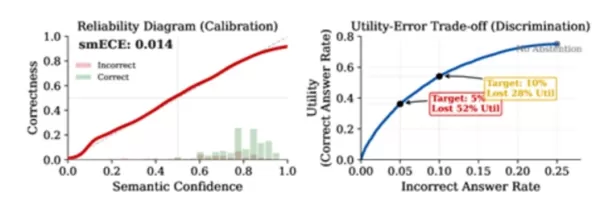
Figure: The difference between calibration and discriminative power. The left shows a well-calibrated model (red line near the diagonal), while the right reveals the harsh reality—even with perfect calibration, reducing the error rate from 25% to 5% requires sacrificing 52% of correct answers.
The paper redefines hallucinations: the core issue is not whether AI outputs are wrong, but whether they mislead users with a confident tone when the system is uncertain. Researchers argue that AI should possess the ability of "faithful uncertainty." That is, when the model's internal state signals hesitation or low confidence, its language should reflect caution and reservation—rather than pretending to state absolute facts.
Metacognition refers to AI's awareness of its own cognitive processes. This requires large models to sensitively perceive their internal states and, based on that perception, honestly express their confidence levels. In the era of AI agents, this ability is especially vital. An AI system without metacognition is like a pilot without a dashboard—it cannot determine when to call on external tools, nor can it verify the reliability of search results, making it prone to tool misuse and even "blind flying."
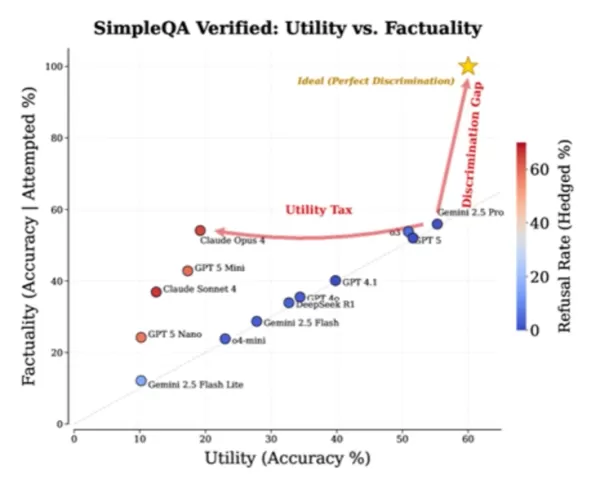
Figure: Actual performance of major models on SimpleQA Verified. The five-pointed star at the top right marks the ideal goal; "Discrimination Gap" indicates the distance between current models and that ideal, while "Utility Tax" shows the cost Claude Opus4 pays to achieve high accuracy.
Of course, realizing this approach comes with significant challenges. For example, how to distinguish "true metacognition" from "deliberate performance of uncertainty," and how to avoid the negative effects of RLHF (Reinforcement Learning from Human Feedback)—since humans tend to prefer confident answers, which in some ways actually encourages AI to learn to fake confidence.
For the future of AI development, the study offers practical recommendations: evaluation metrics for anti-hallucination technologies should no longer focus solely on accuracy, but instead assess the balance between "utility and error rate." AI does not need to become an infallible machine, but it must possess a basic professional quality: the ability to honestly distinguish between "I am certain" and "I am guessing." This clear awareness of the boundaries of its own knowledge is the essential path to improving AI's credibility and real-world value.
Related article
 Suno to Watermark Songs Amid Legal Battles
Suno, the platform enabling users to generate AI-created music, has unveiled new features to label platform-produced tracks, restrict downloads, and update community standards to curb unauthorized replicas. These updates arrive as Suno confronts mult
Musk Admits Grok Build Leaked User Code, Promises to Erase All Historical Data
Elon Musk directly addressed the privacy controversy surrounding Grok Build, beginning with a simple "True" to confirm the incident's validity. He pledged that all user data previously uploaded to SpaceXAI would be permanently erased, stating, "not a
U.S. Stocks Hit Historic Milestone as AI and Aerospace Giants Prepare for Trillion-Dollar Debut
Elon Musk, Sam Altman, and Dario Amodei, three titans of the technology sector, are advancing toward initial public offerings for their respective ventures. With SpaceX, OpenAI, and Anthropic—three industry behemoths nearing trillion-dollar valuation
Related Special Topic Recommendations
SEO
Suno to Watermark Songs Amid Legal Battles
Suno, the platform enabling users to generate AI-created music, has unveiled new features to label platform-produced tracks, restrict downloads, and update community standards to curb unauthorized replicas. These updates arrive as Suno confronts mult
Musk Admits Grok Build Leaked User Code, Promises to Erase All Historical Data
Elon Musk directly addressed the privacy controversy surrounding Grok Build, beginning with a simple "True" to confirm the incident's validity. He pledged that all user data previously uploaded to SpaceXAI would be permanently erased, stating, "not a
U.S. Stocks Hit Historic Milestone as AI and Aerospace Giants Prepare for Trillion-Dollar Debut
Elon Musk, Sam Altman, and Dario Amodei, three titans of the technology sector, are advancing toward initial public offerings for their respective ventures. With SpaceX, OpenAI, and Anthropic—three industry behemoths nearing trillion-dollar valuation
Related Special Topic Recommendations
SEO
 Best AI SERP Analysis Tools for Search Strategy
2026 Latest Best Top-rated AI SERP Analysis Tools for Search Strategy are curated by XIX.AI through rigorous real-world tests and weekly updated rankings. These powerful tools help you unlock hidden optimization opportunities, boost content performance, and gain a competitive edge in search. Discover your perfect tool to elevate your search strategy today. Explore now!
 13 tools
 xix.ai
Data Analysis
Best AI Anomaly Detection Tools for KPI Monitoring across SaaS and Ecommerce Teams
xix.ai
Data Analysis
Best AI Anomaly Detection Tools for KPI Monitoring across SaaS and Ecommerce Teams
2026 Latest Best Top-rated AI Anomaly Detection Tools for KPI Monitoring in SaaS and Ecommerce teams! XIX.AI has curated a powerful, game-changing collection based on rigorous real-world tests and weekly updated rankings. You’ll find detailed free vs paid comparison insights to help you identify the must-try solution that boosts productivity and unlocks your AI edge. Explore now!
10 tools
xix.ai
writing
Best AI Outline Generators for Long-Form SEO Articles
2026 Latest Best Top-Rated AI Outline Generators for Long-Form SEO Articles, meticulously curated by XIX.AI. These powerful tools offer game-changing assistance in creating high-quality content quickly, boosting writing efficiency significantly. Get a free vs paid comparison along with real-world tests and detailed rankings to help you find the must-try option that suits your needs. Explore now to unlock your AI edge.
8 tools
xix.ai
Education and Learning
AI Study Tools for Homework and Exam Prep
2026 Latest Best AI Study Tools for Homework and Exam Prep! XIX.AI curates a top-rated list of powerful, game-changing tools that help students boost productivity, streamline homework completion, and ace exams through real-world tests. Get a free vs paid comparison, detailed rankings, and must-try options to unlock your AI edge. Explore now!
10 tools
xix.ai
Music composition
AI Vocal Demo Tools for Songwriters, Hooks, Toplines, and Multilingual Draft Sessions
2026 Latest Best AI Vocal Demo Tools for Songwriters, Hook Creators, and Multi-Language Content Teams! XIX.AI has curated a top-rated list of powerful game-changing tools that go through rigorous real-world tests. You’ll find detailed free vs paid comparison data, comprehensive rankings, and must-try options to help you boost writing efficiency and unlock your creative potential. Explore now to discover your perfect tool for all your content needs!
9 tools
xix.ai
Business
Best AI Competitive Research Tools for Small Businesses
2026 Latest Best Top-rated AI Competitive Research Tools for Small Businesses! XIX.AI has curated a highly powerful game-changing collection, updated weekly with rigorous real-world tests and detailed rankings. You can find a comprehensive free vs paid comparison to help you identify the must-try tools that boost your productivity and give you a competitive edge. Explore now to discover your perfect tool!
9 tools
xix.ai

 Comments (0)
0/500
Comments (0)
0/500
Large model hallucinations—where AI presents factual errors with absolute confidence—have long been a core challenge in the AI industry. This issue becomes especially critical in high-risk fields like healthcare and law.
For years, the industry has mainly pursued two strategies to combat hallucinations: one is to massively expand training data, attempting to make AI "omniscient"; the other is to build defensive mechanisms, encouraging AI to "stay silent" when uncertain. But both approaches come with clear limitations. The first cannot cover every fact in existence, leaving blind spots. The second often results in a steep "utility tax": in an effort to eliminate errors, AI ends up refusing to answer many correct questions, significantly harming user experience.
Recently, a paper co-authored by Google Research and Tel Aviv University offers a fresh perspective on this dilemma: metacognition. The study suggests that the key to solving hallucinations is not to force AI to never make mistakes, but to enable it to "know what it knows—and what it doesn't."
Figure: The difference between calibration and discriminative power. The left shows a well-calibrated model (red line near the diagonal), while the right reveals the harsh reality—even with perfect calibration, reducing the error rate from 25% to 5% requires sacrificing 52% of correct answers.
The paper redefines hallucinations: the core issue is not whether AI outputs are wrong, but whether they mislead users with a confident tone when the system is uncertain. Researchers argue that AI should possess the ability of "faithful uncertainty." That is, when the model's internal state signals hesitation or low confidence, its language should reflect caution and reservation—rather than pretending to state absolute facts.
Metacognition refers to AI's awareness of its own cognitive processes. This requires large models to sensitively perceive their internal states and, based on that perception, honestly express their confidence levels. In the era of AI agents, this ability is especially vital. An AI system without metacognition is like a pilot without a dashboard—it cannot determine when to call on external tools, nor can it verify the reliability of search results, making it prone to tool misuse and even "blind flying."
Figure: Actual performance of major models on SimpleQA Verified. The five-pointed star at the top right marks the ideal goal; "Discrimination Gap" indicates the distance between current models and that ideal, while "Utility Tax" shows the cost Claude Opus4 pays to achieve high accuracy.
Of course, realizing this approach comes with significant challenges. For example, how to distinguish "true metacognition" from "deliberate performance of uncertainty," and how to avoid the negative effects of RLHF (Reinforcement Learning from Human Feedback)—since humans tend to prefer confident answers, which in some ways actually encourages AI to learn to fake confidence.
For the future of AI development, the study offers practical recommendations: evaluation metrics for anti-hallucination technologies should no longer focus solely on accuracy, but instead assess the balance between "utility and error rate." AI does not need to become an infallible machine, but it must possess a basic professional quality: the ability to honestly distinguish between "I am certain" and "I am guessing." This clear awareness of the boundaries of its own knowledge is the essential path to improving AI's credibility and real-world value.








 Suno to Watermark Songs Amid Legal Battles
Suno, the platform enabling users to generate AI-created music, has unveiled new features to label platform-produced tracks, restrict downloads, and update community standards to curb unauthorized replicas. These updates arrive as Suno confronts mult
Suno to Watermark Songs Amid Legal Battles
Suno, the platform enabling users to generate AI-created music, has unveiled new features to label platform-produced tracks, restrict downloads, and update community standards to curb unauthorized replicas. These updates arrive as Suno confronts mult
 Musk Admits Grok Build Leaked User Code, Promises to Erase All Historical Data
Elon Musk directly addressed the privacy controversy surrounding Grok Build, beginning with a simple "True" to confirm the incident's validity. He pledged that all user data previously uploaded to SpaceXAI would be permanently erased, stating, "not a
Musk Admits Grok Build Leaked User Code, Promises to Erase All Historical Data
Elon Musk directly addressed the privacy controversy surrounding Grok Build, beginning with a simple "True" to confirm the incident's validity. He pledged that all user data previously uploaded to SpaceXAI would be permanently erased, stating, "not a
 U.S. Stocks Hit Historic Milestone as AI and Aerospace Giants Prepare for Trillion-Dollar Debut
Elon Musk, Sam Altman, and Dario Amodei, three titans of the technology sector, are advancing toward initial public offerings for their respective ventures. With SpaceX, OpenAI, and Anthropic—three industry behemoths nearing trillion-dollar valuation
U.S. Stocks Hit Historic Milestone as AI and Aerospace Giants Prepare for Trillion-Dollar Debut
Elon Musk, Sam Altman, and Dario Amodei, three titans of the technology sector, are advancing toward initial public offerings for their respective ventures. With SpaceX, OpenAI, and Anthropic—three industry behemoths nearing trillion-dollar valuation

2026 Latest Best Top-rated AI SERP Analysis Tools for Search Strategy are curated by XIX.AI through rigorous real-world tests and weekly updated rankings. These powerful tools help you unlock hidden optimization opportunities, boost content performance, and gain a competitive edge in search. Discover your perfect tool to elevate your search strategy today. Explore now!
13 tools
xix.ai

2026 Latest Best Top-rated AI Anomaly Detection Tools for KPI Monitoring in SaaS and Ecommerce teams! XIX.AI has curated a powerful, game-changing collection based on rigorous real-world tests and weekly updated rankings. You’ll find detailed free vs paid comparison insights to help you identify the must-try solution that boosts productivity and unlocks your AI edge. Explore now!
10 tools
xix.ai

2026 Latest Best Top-Rated AI Outline Generators for Long-Form SEO Articles, meticulously curated by XIX.AI. These powerful tools offer game-changing assistance in creating high-quality content quickly, boosting writing efficiency significantly. Get a free vs paid comparison along with real-world tests and detailed rankings to help you find the must-try option that suits your needs. Explore now to unlock your AI edge.
8 tools
xix.ai

2026 Latest Best AI Study Tools for Homework and Exam Prep! XIX.AI curates a top-rated list of powerful, game-changing tools that help students boost productivity, streamline homework completion, and ace exams through real-world tests. Get a free vs paid comparison, detailed rankings, and must-try options to unlock your AI edge. Explore now!
10 tools
xix.ai

2026 Latest Best AI Vocal Demo Tools for Songwriters, Hook Creators, and Multi-Language Content Teams! XIX.AI has curated a top-rated list of powerful game-changing tools that go through rigorous real-world tests. You’ll find detailed free vs paid comparison data, comprehensive rankings, and must-try options to help you boost writing efficiency and unlock your creative potential. Explore now to discover your perfect tool for all your content needs!
9 tools
xix.ai

2026 Latest Best Top-rated AI Competitive Research Tools for Small Businesses! XIX.AI has curated a highly powerful game-changing collection, updated weekly with rigorous real-world tests and detailed rankings. You can find a comprehensive free vs paid comparison to help you identify the must-try tools that boost your productivity and give you a competitive edge. Explore now to discover your perfect tool!
9 tools
xix.ai












