


 Home
Home
What are Finance Solvers and how do they help in mastering loans for smart decisions in 2025?
Mastering loan management is essential for financial well-being. Grasping the details of interest rates, repayment plans, and total costs empowers you to make smarter financial choices. Tools like financial solvers demystify these calculations, putting you in control of your financial journey. This guide explores the core principles of loan finance, equipping you with the knowledge and tools to handle your debt confidently.
Key Points
Financial solvers are indispensable for clarifying loan terms.
Critical variables are the number of payments, interest rate, present value, and payment amount.
Cash flow sign convention is fundamental: outflows are negative, inflows are positive.
Practical examples demonstrate effective use of financial solvers.
Knowing the total repayment and interest cost is crucial for sound financial planning.
Understanding Loan Basics with Finance Solvers
What is a Finance Solver?
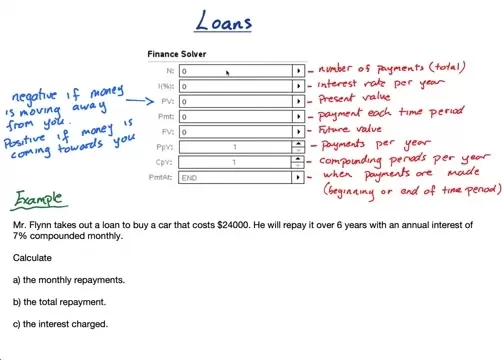
A financial solver is a powerful tool, typically found in calculators or spreadsheet software, designed to simplify intricate financial calculations, particularly for loans and investments. You input known variables to solve for an unknown, giving you a clear view of your financial commitments or potential gains.
Instead of manually working through complex formulas, a financial solver automates the process, minimizing errors and saving time. For anyone managing loans, mortgages, or investments, learning to use a financial solver is a highly valuable skill that boosts financial literacy.
Using a financial solver gives you a much clearer picture of your loan obligations, especially regarding interest. It's important to choose a solver that lets you input all your loan details, so you can get the information needed to fully understand the commitment you're making.
Key variables managed by a financial solver include:
- N (Number of Payments): The total payments over the loan's lifetime.
- I (%) (Interest Rate): The annual interest rate, entered as a percentage.
- PV (Present Value): The loan's current value or the initial amount borrowed. Note the sign conventions below.
- PMT (Payment): The amount of each periodic payment. Solvers are often used to find this value.
- FV (Future Value): The loan's value at the term's end. For a fully repaid loan, this is usually zero.
- P/Y (Payments per Year): How many payments are made annually (e.g., 12 for monthly).
- C/Y (Compounding Periods per Year): How often interest is compounded annually, which may differ from the payment frequency.
- PMT: END or BEGIN: Specifies if payments are made at the end or start of each period.
The sign convention in a financial solver is vital for accurate results. Remember this rule: money leaving you is negative, money coming to you is positive. When taking out a loan, the present value (PV) is positive because the funds are received. Your payment amounts (PMT) will be negative, representing money flowing out. Conversely, for an investment, you would enter the PV as negative and future returns as positive.
For instance, a video example states Mr. Flynn is taking a loan, meaning money comes to him—a positive value. His repayments are money moving away from him—a negative value.
Practical Example: Mr. Flynn's Car Loan
Let's walk through a detailed example of using a financial solver for a typical loan. Mr. Flynn is financing a car purchase. Here's how to analyze the problem and input the data:
The Scenario: Mr. Flynn is taking out a car loan for $24,000
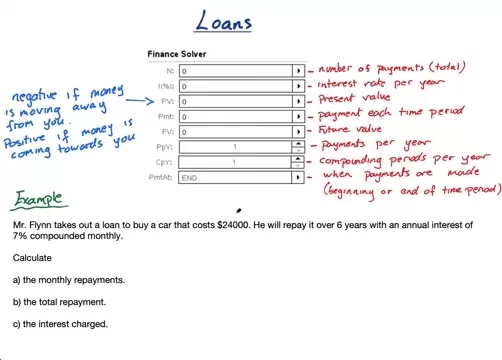
. He will repay it over 6 years at an annual interest rate of 7%, compounded monthly.
Here's the financial solver setup:
- N (Number of Payments): Monthly payments over 6 years: N = 6 years * 12 months/year = 72.
- I (%) (Interest Rate): The annual rate is 7%.
- PV (Present Value): Mr. Flynn receives $24,000 now, so PV = $24,000 (positive).
- PMT (Payment): This is our unknown to calculate.
- FV (Future Value): Loan fully repaid, so FV = 0.
- P/Y (Payments per Year): Monthly payments, so P/Y = 12.
- C/Y (Compounding Periods per Year): Interest compounded monthly, so C/Y = 12.
- PMT: END or BEGIN: Assuming end-of-month payments, select END.
After entering these values, the solver computes the PMT (Payment). The result, a negative number representing money paid out, is $409.18. This gives you the monthly payment and helps determine total repayments. Understanding how different loans, like payday loans, affect credit ratings can help you avoid pitfalls and make wiser financial decisions.
Following these steps ensures accuracy and a solid grasp of the loan terms. Always verify your inputs and the solver's sign conventions to avoid misinterpreting the results.
Calculating Total Repayment and Interest Charged
Once you have the monthly payment, calculating the total cost of the loan is simple. This is key for budgeting and understanding the full borrowing expense.
Total Repayment: Multiply the monthly payment by the number of payments. In our example: Total Repayment = $409.18 * 72 = $29,461. So, Mr. Flynn will repay a total of $29,461 over six years.
Total Interest Charged: Subtract the original loan amount from the total repayment: Total Interest = $29,461 - $24,000 = $5,461. Therefore, $5,461 is the interest paid over the loan's life.
Understanding these numbers reveals the true cost of borrowing, going beyond the initial principal. This essential insight helps with informed decision-making and comparing different loan offers.
How to Use a Finance Solver
Step-by-Step Guide to Financial Freedom
Mastering a financial solver unlocks deeper financial understanding. Follow these steps to use it effectively for loan calculations:
- Accessing the Finance Solver:
- Calculators: Many financial calculators have built-in TVM (Time Value of Money) or Finance functions.
- Spreadsheets: Software like Excel or Google Sheets uses functions like PV, FV, PMT, RATE, and NPER.
- Online Calculators: Numerous free financial solvers are available online with a quick search.
- Identifying Key Variables: Clearly define all known values:
- Loan amount (Present Value, PV)
- Interest rate (I%)
- Loan term (Number of Payments, N)
- Future Value (FV, often 0 for loans)
- Payment frequency (P/Y)
- Compounding frequency (C/Y)
- Entering the Data: Input values accurately, respecting the sign conventions for cash flow.
- Solving for the Unknown: Designate the value you need to find (e.g., monthly payment) and command the solver to calculate it, usually by selecting the field and pressing 'Compute'.
- Interpreting the Results: Review the output carefully, noting the sign and units of the result.
- Verifying the Outcome: Double-check inputs and calculation logic. Compare with other sources to ensure the result is reasonable.
Pros and Cons of Using Finance Solvers for Loan Management
Pros
Simplifies complex financial math.
Minimizes calculation errors versus manual methods.
Saves significant time and effort.
Provides clear insights into loan terms.
Makes comparing different loan options easier.
Cons
Depends on accurate data entry.
Features may be limited by the specific tool.
Risk of over-reliance without understanding core principles.
Interpreting results requires some financial knowledge.
May not factor in additional costs like fees or taxes.
Frequently Asked Questions
What is the significance of the sign convention in a finance solver?
The sign convention is critical for accuracy. Inflows (money received) are positive, and outflows (money paid) are negative. Consistency here is essential for correct results.
How do I find the annual interest rate?
The annual interest rate should be explicitly stated in your loan agreement. If it's not clear, reconsider the offer. Also, confirm whether the rate is fixed or variable.
What if I want to solve something the tool does not have a specific function for?
You can often manipulate the variables to derive the needed answer or use alternative financial calculation methods.
Related Questions
How can I improve my financial literacy?
Improving financial literacy is a multifaceted journey of education, practice, and ongoing learning. Start with educational resources like online courses, workshops, and books covering budgeting, saving, investing, and debt management from reputable sources. Apply this knowledge actively by creating a budget, tracking expenses, and setting financial goals using apps or spreadsheets. Begin investing early, even with small sums, to learn about markets, risk, and compound growth through brokerage accounts or low-cost index funds. Stay informed by following trusted financial news and experts, being wary of biased sources. Seek personalized advice from qualified financial advisors for complex decisions. Remember, financial literacy is a continuous journey of learning and improvement.
Related article
 Apple, Google Partner With Anthropic to Address 27-Year-Old Vulnerability via Glass Wing Protection
As artificial intelligence advances rapidly in code generation and logical reasoning, the cybersecurity landscape faces unprecedented challenges. Recently, the prominent AI startup Anthropic officially launched a cross-industry collaboration called *
OpenAI Chief Scientist Addresses AI Reasoning Transparency Debate: Complexity Steady, No Sudden Jump
On September 2, Jakub Pachocki, OpenAI’s Chief Scientist, addressed public concerns on X regarding the AI model Astra, clarifying claims that it operates without oversight and lacks transparent reasoning.Why the Controversy Erupted: Deep Recurrence O
U.S. Navy Selects Blue Water Autonomy for Deep-Sea Survey Missions
Blue Water Autonomy’s Liberty Class is a 190-foot steel autonomous ship. | Source: Blue Water AutonomyBoston-based technology and shipbuilding firm Blue Water Autonomy has secured a multiple-award contract with the Naval Oceanographic Office (NAVOCEA
Related Special Topic Recommendations
Text-to-speech
Apple, Google Partner With Anthropic to Address 27-Year-Old Vulnerability via Glass Wing Protection
As artificial intelligence advances rapidly in code generation and logical reasoning, the cybersecurity landscape faces unprecedented challenges. Recently, the prominent AI startup Anthropic officially launched a cross-industry collaboration called *
OpenAI Chief Scientist Addresses AI Reasoning Transparency Debate: Complexity Steady, No Sudden Jump
On September 2, Jakub Pachocki, OpenAI’s Chief Scientist, addressed public concerns on X regarding the AI model Astra, clarifying claims that it operates without oversight and lacks transparent reasoning.Why the Controversy Erupted: Deep Recurrence O
U.S. Navy Selects Blue Water Autonomy for Deep-Sea Survey Missions
Blue Water Autonomy’s Liberty Class is a 190-foot steel autonomous ship. | Source: Blue Water AutonomyBoston-based technology and shipbuilding firm Blue Water Autonomy has secured a multiple-award contract with the Naval Oceanographic Office (NAVOCEA
Related Special Topic Recommendations
Text-to-speech
 Best AI Text to Speech Tools for Online Courses
2026 Latest Best Top-rated AI Text to Speech Tools for Online Courses are curated by XIX.AI based on rigorous real-world tests and weekly updated rankings. These powerful tools help creators deliver crystal-clear audio content effortlessly, boosting writing efficiency and streamlining course production. Check out the free vs paid comparison to find your perfect fit. Explore now to unlock your AI edge in online education.
 10 tools
 xix.ai
writing
AI Blog Title Tools for Higher Click Through Rates
xix.ai
writing
AI Blog Title Tools for Higher Click Through Rates
2026 Latest Best Top-Rated AI Blog Title Tools for Higher Click Through Rates! XIX.AI has carefully curated a powerful, game-changing collection of top tools that go through rigorous real-world tests. You’ll find a free vs paid comparison, weekly updated rankings, and detailed insights to help you boost your blog’s traffic efficiently. Must-try options are highlighted to help you unlock your AI edge. Explore now!
10 tools
xix.ai
automation
Best AI Task Routing Tools for Support Workflows
2026 Latest Best Top-rated AI Task Routing Tools for Support Workflows! XIX.AI has curated a highly powerful game-changing collection of must-try solutions, all undergoing rigorous real-world tests and updated weekly. These tools streamline workflows, boost productivity, and help teams deliver faster, more efficient support. Explore now to discover your perfect tool and unlock your AI edge!
17 tools
xix.ai
Academic Research
AI Citation and Paper Summary Tools
2026 Latest Best Top-Rated AI Citation and Paper Summary Tools Curated by XIX.AI. Get powerful game-changing solutions for quick content creation, improved writing efficiency, and boosting productivity. We offer a free vs paid comparison along with real-world tests and weekly updated rankings to help you find the must-try tool that fits your needs perfectly. Explore now to Unlock your AI edge.
10 tools
xix.ai
Productivity
Best AI Productivity Tools for Daily Work
2026 Latest Best Top-Rated AI Productivity Tools for Daily Work! XIX.AI has curated a powerful, game-changing selection based on rigorous weekly updated rankings and real-world tests. You’ll find must-try options that boost writing efficiency, streamline content creation, and help you overcome daily work challenges. Get a free vs paid comparison to find the perfect fit for your needs. Explore now to unlock your AI edge!
9 tools
xix.ai
Academic Research
AI Systematic Review Tools for Research Screening
2026 Latest Best Top-Rated AI Systematic Review Tools for Research Screening are here on XIX.AI! This curated collection includes powerful, game-changing solutions that go through rigorous real-world tests to deliver accurate results. We also offer a free vs paid comparison along with weekly updated rankings to help you find the must-try option that boosts your research efficiency significantly. Explore now to unlock your AI edge in academic work!
11 tools
xix.ai

 Comments (1)
0/500
Comments (1)
0/500
![PaulMartínez]()
Die Erklärung zu Finance Solvern ist echt hilfreich! Endlich verstehe ich, wie ich verschiedene Kreditoptionen vergleichen kann. Die Tools scheinen komplexe Berechnungen wie Zinseszins oder unterschiedliche Tilgungspläne einfach darzustellen. Das nimmt die Angst vor langfristigen Finanzentscheidungen. Werde das mal für meinen geplanten Autokauf testen! 🚗💸
Mastering loan management is essential for financial well-being. Grasping the details of interest rates, repayment plans, and total costs empowers you to make smarter financial choices. Tools like financial solvers demystify these calculations, putting you in control of your financial journey. This guide explores the core principles of loan finance, equipping you with the knowledge and tools to handle your debt confidently.
Key Points
Financial solvers are indispensable for clarifying loan terms.
Critical variables are the number of payments, interest rate, present value, and payment amount.
Cash flow sign convention is fundamental: outflows are negative, inflows are positive.
Practical examples demonstrate effective use of financial solvers.
Knowing the total repayment and interest cost is crucial for sound financial planning.
Understanding Loan Basics with Finance Solvers
What is a Finance Solver?
A financial solver is a powerful tool, typically found in calculators or spreadsheet software, designed to simplify intricate financial calculations, particularly for loans and investments. You input known variables to solve for an unknown, giving you a clear view of your financial commitments or potential gains.
Instead of manually working through complex formulas, a financial solver automates the process, minimizing errors and saving time. For anyone managing loans, mortgages, or investments, learning to use a financial solver is a highly valuable skill that boosts financial literacy.
Using a financial solver gives you a much clearer picture of your loan obligations, especially regarding interest. It's important to choose a solver that lets you input all your loan details, so you can get the information needed to fully understand the commitment you're making.
Key variables managed by a financial solver include:
- N (Number of Payments): The total payments over the loan's lifetime.
- I (%) (Interest Rate): The annual interest rate, entered as a percentage.
- PV (Present Value): The loan's current value or the initial amount borrowed. Note the sign conventions below.
- PMT (Payment): The amount of each periodic payment. Solvers are often used to find this value.
- FV (Future Value): The loan's value at the term's end. For a fully repaid loan, this is usually zero.
- P/Y (Payments per Year): How many payments are made annually (e.g., 12 for monthly).
- C/Y (Compounding Periods per Year): How often interest is compounded annually, which may differ from the payment frequency.
- PMT: END or BEGIN: Specifies if payments are made at the end or start of each period.
The sign convention in a financial solver is vital for accurate results. Remember this rule: money leaving you is negative, money coming to you is positive. When taking out a loan, the present value (PV) is positive because the funds are received. Your payment amounts (PMT) will be negative, representing money flowing out. Conversely, for an investment, you would enter the PV as negative and future returns as positive.
For instance, a video example states Mr. Flynn is taking a loan, meaning money comes to him—a positive value. His repayments are money moving away from him—a negative value.
Practical Example: Mr. Flynn's Car Loan
Let's walk through a detailed example of using a financial solver for a typical loan. Mr. Flynn is financing a car purchase. Here's how to analyze the problem and input the data:
The Scenario: Mr. Flynn is taking out a car loan for $24,000
. He will repay it over 6 years at an annual interest rate of 7%, compounded monthly.
Here's the financial solver setup:
- N (Number of Payments): Monthly payments over 6 years: N = 6 years * 12 months/year = 72.
- I (%) (Interest Rate): The annual rate is 7%.
- PV (Present Value): Mr. Flynn receives $24,000 now, so PV = $24,000 (positive).
- PMT (Payment): This is our unknown to calculate.
- FV (Future Value): Loan fully repaid, so FV = 0.
- P/Y (Payments per Year): Monthly payments, so P/Y = 12.
- C/Y (Compounding Periods per Year): Interest compounded monthly, so C/Y = 12.
- PMT: END or BEGIN: Assuming end-of-month payments, select END.
After entering these values, the solver computes the PMT (Payment). The result, a negative number representing money paid out, is $409.18. This gives you the monthly payment and helps determine total repayments. Understanding how different loans, like payday loans, affect credit ratings can help you avoid pitfalls and make wiser financial decisions.
Following these steps ensures accuracy and a solid grasp of the loan terms. Always verify your inputs and the solver's sign conventions to avoid misinterpreting the results.
Calculating Total Repayment and Interest Charged
Once you have the monthly payment, calculating the total cost of the loan is simple. This is key for budgeting and understanding the full borrowing expense.
Total Repayment: Multiply the monthly payment by the number of payments. In our example: Total Repayment = $409.18 * 72 = $29,461. So, Mr. Flynn will repay a total of $29,461 over six years.
Total Interest Charged: Subtract the original loan amount from the total repayment: Total Interest = $29,461 - $24,000 = $5,461. Therefore, $5,461 is the interest paid over the loan's life.
Understanding these numbers reveals the true cost of borrowing, going beyond the initial principal. This essential insight helps with informed decision-making and comparing different loan offers.
How to Use a Finance Solver
Step-by-Step Guide to Financial Freedom
Mastering a financial solver unlocks deeper financial understanding. Follow these steps to use it effectively for loan calculations:
- Accessing the Finance Solver:
- Calculators: Many financial calculators have built-in TVM (Time Value of Money) or Finance functions.
- Spreadsheets: Software like Excel or Google Sheets uses functions like PV, FV, PMT, RATE, and NPER.
- Online Calculators: Numerous free financial solvers are available online with a quick search.
- Identifying Key Variables: Clearly define all known values:
- Loan amount (Present Value, PV)
- Interest rate (I%)
- Loan term (Number of Payments, N)
- Future Value (FV, often 0 for loans)
- Payment frequency (P/Y)
- Compounding frequency (C/Y)
- Entering the Data: Input values accurately, respecting the sign conventions for cash flow.
- Solving for the Unknown: Designate the value you need to find (e.g., monthly payment) and command the solver to calculate it, usually by selecting the field and pressing 'Compute'.
- Interpreting the Results: Review the output carefully, noting the sign and units of the result.
- Verifying the Outcome: Double-check inputs and calculation logic. Compare with other sources to ensure the result is reasonable.
Pros and Cons of Using Finance Solvers for Loan Management
Pros
Simplifies complex financial math.
Minimizes calculation errors versus manual methods.
Saves significant time and effort.
Provides clear insights into loan terms.
Makes comparing different loan options easier.
Cons
Depends on accurate data entry.
Features may be limited by the specific tool.
Risk of over-reliance without understanding core principles.
Interpreting results requires some financial knowledge.
May not factor in additional costs like fees or taxes.
Frequently Asked Questions
What is the significance of the sign convention in a finance solver?
The sign convention is critical for accuracy. Inflows (money received) are positive, and outflows (money paid) are negative. Consistency here is essential for correct results.
How do I find the annual interest rate?
The annual interest rate should be explicitly stated in your loan agreement. If it's not clear, reconsider the offer. Also, confirm whether the rate is fixed or variable.
What if I want to solve something the tool does not have a specific function for?
You can often manipulate the variables to derive the needed answer or use alternative financial calculation methods.
Related Questions
How can I improve my financial literacy?
Improving financial literacy is a multifaceted journey of education, practice, and ongoing learning. Start with educational resources like online courses, workshops, and books covering budgeting, saving, investing, and debt management from reputable sources. Apply this knowledge actively by creating a budget, tracking expenses, and setting financial goals using apps or spreadsheets. Begin investing early, even with small sums, to learn about markets, risk, and compound growth through brokerage accounts or low-cost index funds. Stay informed by following trusted financial news and experts, being wary of biased sources. Seek personalized advice from qualified financial advisors for complex decisions. Remember, financial literacy is a continuous journey of learning and improvement.








 Apple, Google Partner With Anthropic to Address 27-Year-Old Vulnerability via Glass Wing Protection
As artificial intelligence advances rapidly in code generation and logical reasoning, the cybersecurity landscape faces unprecedented challenges. Recently, the prominent AI startup Anthropic officially launched a cross-industry collaboration called *
Apple, Google Partner With Anthropic to Address 27-Year-Old Vulnerability via Glass Wing Protection
As artificial intelligence advances rapidly in code generation and logical reasoning, the cybersecurity landscape faces unprecedented challenges. Recently, the prominent AI startup Anthropic officially launched a cross-industry collaboration called *
 OpenAI Chief Scientist Addresses AI Reasoning Transparency Debate: Complexity Steady, No Sudden Jump
On September 2, Jakub Pachocki, OpenAI’s Chief Scientist, addressed public concerns on X regarding the AI model Astra, clarifying claims that it operates without oversight and lacks transparent reasoning.Why the Controversy Erupted: Deep Recurrence O
OpenAI Chief Scientist Addresses AI Reasoning Transparency Debate: Complexity Steady, No Sudden Jump
On September 2, Jakub Pachocki, OpenAI’s Chief Scientist, addressed public concerns on X regarding the AI model Astra, clarifying claims that it operates without oversight and lacks transparent reasoning.Why the Controversy Erupted: Deep Recurrence O
 U.S. Navy Selects Blue Water Autonomy for Deep-Sea Survey Missions
Blue Water Autonomy’s Liberty Class is a 190-foot steel autonomous ship. | Source: Blue Water AutonomyBoston-based technology and shipbuilding firm Blue Water Autonomy has secured a multiple-award contract with the Naval Oceanographic Office (NAVOCEA
U.S. Navy Selects Blue Water Autonomy for Deep-Sea Survey Missions
Blue Water Autonomy’s Liberty Class is a 190-foot steel autonomous ship. | Source: Blue Water AutonomyBoston-based technology and shipbuilding firm Blue Water Autonomy has secured a multiple-award contract with the Naval Oceanographic Office (NAVOCEA

2026 Latest Best Top-rated AI Text to Speech Tools for Online Courses are curated by XIX.AI based on rigorous real-world tests and weekly updated rankings. These powerful tools help creators deliver crystal-clear audio content effortlessly, boosting writing efficiency and streamlining course production. Check out the free vs paid comparison to find your perfect fit. Explore now to unlock your AI edge in online education.
10 tools
xix.ai

2026 Latest Best Top-Rated AI Blog Title Tools for Higher Click Through Rates! XIX.AI has carefully curated a powerful, game-changing collection of top tools that go through rigorous real-world tests. You’ll find a free vs paid comparison, weekly updated rankings, and detailed insights to help you boost your blog’s traffic efficiently. Must-try options are highlighted to help you unlock your AI edge. Explore now!
10 tools
xix.ai

2026 Latest Best Top-rated AI Task Routing Tools for Support Workflows! XIX.AI has curated a highly powerful game-changing collection of must-try solutions, all undergoing rigorous real-world tests and updated weekly. These tools streamline workflows, boost productivity, and help teams deliver faster, more efficient support. Explore now to discover your perfect tool and unlock your AI edge!
17 tools
xix.ai

2026 Latest Best Top-Rated AI Citation and Paper Summary Tools Curated by XIX.AI. Get powerful game-changing solutions for quick content creation, improved writing efficiency, and boosting productivity. We offer a free vs paid comparison along with real-world tests and weekly updated rankings to help you find the must-try tool that fits your needs perfectly. Explore now to Unlock your AI edge.
10 tools
xix.ai

2026 Latest Best Top-Rated AI Productivity Tools for Daily Work! XIX.AI has curated a powerful, game-changing selection based on rigorous weekly updated rankings and real-world tests. You’ll find must-try options that boost writing efficiency, streamline content creation, and help you overcome daily work challenges. Get a free vs paid comparison to find the perfect fit for your needs. Explore now to unlock your AI edge!
9 tools
xix.ai

2026 Latest Best Top-Rated AI Systematic Review Tools for Research Screening are here on XIX.AI! This curated collection includes powerful, game-changing solutions that go through rigorous real-world tests to deliver accurate results. We also offer a free vs paid comparison along with weekly updated rankings to help you find the must-try option that boosts your research efficiency significantly. Explore now to unlock your AI edge in academic work!
11 tools
xix.ai

Die Erklärung zu Finance Solvern ist echt hilfreich! Endlich verstehe ich, wie ich verschiedene Kreditoptionen vergleichen kann. Die Tools scheinen komplexe Berechnungen wie Zinseszins oder unterschiedliche Tilgungspläne einfach darzustellen. Das nimmt die Angst vor langfristigen Finanzentscheidungen. Werde das mal für meinen geplanten Autokauf testen! 🚗💸












