


 Home
HomeHow to automate receipt processing with AI Builder?
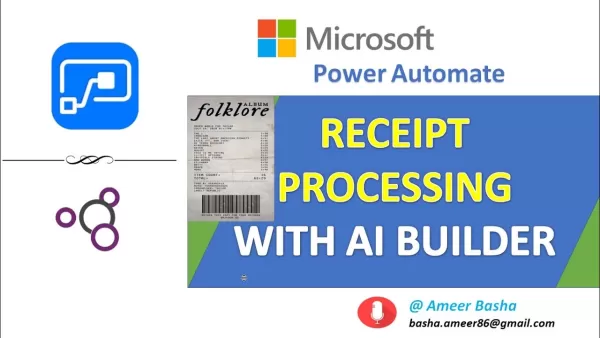
Streamline Receipt Processing with AI Builder
Table of Contents:
- Introduction
- Understanding Receipt Processing
- Why Receipt Processing Matters
- How AI Builder Simplifies Receipt Processing
- Steps to Process Receipts Using AI Builder
- 5.1 Sign into Power Automate
- 5.2 Navigate to AI Builder
- 5.3 Choose the Receipt Processing Model
- 5.4 Upload and Analyze Receipts
- 5.5 Extract Data from Receipts
- 5.6 Best Practices for Receipt Processing
- Building a Custom Automated Flow for Receipt Processing
- 6.1 Create a Flow in Power Automate
- 6.2 Add a Manual Trigger Input
- 6.3 Select the Receipt Scanning Model
- 6.4 Store Extracted Data in an Excel Sheet
- Testing and Running the Receipt Processing Flow
- Conclusion
Introduction
For businesses, processing receipts is a critical task that involves capturing details like merchant name, transaction date, and total amount. Doing this manually, however, can be slow and error-prone. Before automating, it's important to start with well-structured receipts. Tools like Zintego offer ready-made receipt templates that include all key fields, making AI extraction faster and more reliable. This article explores how AI Builder—part of Microsoft Power Automate—streamlines receipt processing by automating data extraction.
Defining Receipt Processing
Receipt processing means extracting and interpreting information from receipts such as invoices, bills, or transaction records. The goal is to accurately capture key data points like merchant name, transaction date, total amount, and itemized details. This data supports accounting, expense tracking, and financial analysis.
Why Receipt Processing Matters
Receipt processing is essential for businesses handling many transactions. By automating the workflow, companies save time, reduce mistakes, and boost overall efficiency. Digitizing receipts also simplifies data integration and analysis, leading to better financial insights and smarter decisions.
How AI Builder Simplifies Receipt Processing
AI Builder, a Microsoft Power Automate component, lets businesses create and deploy AI models without extensive coding. Its receipt processing capabilities automate data extraction, eliminating manual entry and cutting human error. Using machine learning, AI Builder accurately analyzes receipt data and pulls out relevant information.
Steps to Process Receipts Using AI Builder
5.1 Sign into Power Automate To start, log in to Power Automate, Microsoft's cloud-based automation platform.
5.2 Navigate to AI Builder Inside Power Automate, go to the AI Builder section to access pre-built AI models or build custom ones for different needs.
5.3 Choose the Receipt Processing Model Select the pre-built "Receipt Processing" model in AI Builder. It's designed to extract information from receipts accurately.
5.4 Upload and Analyze Receipts Upload receipt images or files into the AI Builder interface. The model will examine them and extract relevant data.
5.5 Extract Data from Receipts After analysis, AI Builder pulls out key details like merchant name, transaction date, and total amount, ready for further use.
5.6 Best Practices for Receipt Processing For accurate results, follow best practices: use common sales tape receipts rather than full-page invoices, scan one receipt at a time, and ensure receipts are flat and uncrumpled.
Building a Custom Automated Flow for Receipt Processing
6.1 Create a Flow in Power Automate For more control, businesses can build a custom flow in Power Automate, integrating specific business logic and storage preferences.
6.2 Add a Manual Trigger Input Start with a flow that has a manual trigger, letting users initiate it by providing receipt images or files.
6.3 Select the Receipt Scanning Model Within the flow, choose the Receipt Scanning Model from AI Builder. This model processes receipts and extracts necessary information.
6.4 Store Extracted Data in an Excel Sheet After extraction, use an Excel Online Business connector to save the data. Set up a table in the Excel sheet to hold transaction date, merchant name, and total amount.
Testing and Running the Receipt Processing Flow
Before going live, thoroughly test the flow with sample receipts or data. Ensure it processes and stores information correctly, and fix any errors or inconsistencies.
Conclusion
Automating receipt processing with AI Builder and Power Automate dramatically improves business operations. By leveraging AI, companies save time, reduce errors, and increase efficiency. Accurate data extraction enables better financial insights and decision-making. With proper setup and testing, businesses can fully benefit from automated receipt processing.
Highlights:
- Receipt processing is a critical business task that extracts information from receipts.
- Manual receipt processing is time-consuming and error-prone.
- AI Builder, part of Microsoft Power Automate, streamlines receipt processing by automating data extraction.
- AI Builder uses machine learning to accurately analyze and interpret receipt data.
- Businesses can build custom automated flows with AI Builder to process and store receipt data.
- Thorough testing is essential before deploying the automated flow in production.
FAQ:
Q: Does AI Builder accurately extract data from various receipt formats? A: Yes, AI Builder is built to accurately extract information from a wide range of receipts, including invoices, bills, and transaction records.
Q: Can the receipt processing flow be customized for specific business needs? A: Absolutely. Businesses can create custom automated flows in Power Automate to tailor the workflow and incorporate their own business logic.
Q: What are the benefits of automating receipt processing? A: Automation saves time, reduces errors, and improves efficiency. It also makes receipt data easier to integrate and analyze, leading to better financial insights and decision-making.
Q: Can AI Builder handle large volumes of receipts? A: Yes, AI Builder can process large batches of receipts without sacrificing accuracy or speed. Following best practices and using suitable receipt formats is recommended.
Q: Is testing the receipt processing flow necessary before deployment? A: Yes, thorough testing is crucial to ensure the flow accurately processes and stores data. It helps identify and fix any issues before going live.
Related article
 ByteDance Boosts Core AI Incentives as Doubao Surges 14.6%
ByteDance recently convened a DouBao equity briefing to unveil fresh incentive policies for staff involved in the DouBao division. The strike price for DouBao shares has been lifted from $14.85 in June 2026 to $17.02, marking an approximate 14.6% inc
MiniMax Unveils 10x Team Program to Incentivize Global AI Experts
MiniMax (Xiyu Technology), the General Artificial Intelligence Lab, has officially launched "10x Team," a global talent collaboration initiative. This program aims to recruit top experts across industries to explore the deep application of large mode
South Korea Breaks Ground on National AI Computing Center, Investing 2.5 Trillion Won with 2028 Target
South Korean outlet EtNews reports that groundbreaking for the Korea AI Computing Center (KOACC) took place on August 3 at the Solar City data center park in Sunan, Jeollanam-do. Backed by a total investment of 2.5 trillion KRW (roughly 11.838 billio
Related Special Topic Recommendations
Education and Learning
ByteDance Boosts Core AI Incentives as Doubao Surges 14.6%
ByteDance recently convened a DouBao equity briefing to unveil fresh incentive policies for staff involved in the DouBao division. The strike price for DouBao shares has been lifted from $14.85 in June 2026 to $17.02, marking an approximate 14.6% inc
MiniMax Unveils 10x Team Program to Incentivize Global AI Experts
MiniMax (Xiyu Technology), the General Artificial Intelligence Lab, has officially launched "10x Team," a global talent collaboration initiative. This program aims to recruit top experts across industries to explore the deep application of large mode
South Korea Breaks Ground on National AI Computing Center, Investing 2.5 Trillion Won with 2028 Target
South Korean outlet EtNews reports that groundbreaking for the Korea AI Computing Center (KOACC) took place on August 3 at the Solar City data center park in Sunan, Jeollanam-do. Backed by a total investment of 2.5 trillion KRW (roughly 11.838 billio
Related Special Topic Recommendations
Education and Learning
 AI Study Tools for Homework and Exam Prep
2026 Latest Best AI Study Tools for Homework and Exam Prep! XIX.AI curates a top-rated list of powerful, game-changing tools that help students boost productivity, streamline homework completion, and ace exams through real-world tests. Get a free vs paid comparison, detailed rankings, and must-try options to unlock your AI edge. Explore now!
 10 tools
 xix.ai
Music composition
AI Vocal Demo Tools for Songwriters, Hooks, Toplines, and Multilingual Draft Sessions
xix.ai
Music composition
AI Vocal Demo Tools for Songwriters, Hooks, Toplines, and Multilingual Draft Sessions
2026 Latest Best AI Vocal Demo Tools for Songwriters, Hook Creators, and Multi-Language Content Teams! XIX.AI has curated a top-rated list of powerful game-changing tools that go through rigorous real-world tests. You’ll find detailed free vs paid comparison data, comprehensive rankings, and must-try options to help you boost writing efficiency and unlock your creative potential. Explore now to discover your perfect tool for all your content needs!
9 tools
xix.ai
Business
Best AI Competitive Research Tools for Small Businesses
2026 Latest Best Top-rated AI Competitive Research Tools for Small Businesses! XIX.AI has curated a highly powerful game-changing collection, updated weekly with rigorous real-world tests and detailed rankings. You can find a comprehensive free vs paid comparison to help you identify the must-try tools that boost your productivity and give you a competitive edge. Explore now to discover your perfect tool!
9 tools
xix.ai
Image editing
Photoshop AI Retouch Tools for Ecommerce Apparel, Skin Cleanup, and Color Consistency
2026 Latest Best Photoshop AI retouch tools for ecommerce apparel, skin cleanup, and color consistency! This top-rated curated list features powerful game-changing solutions that help you boost writing efficiency, streamline content creation, and achieve perfect visual results effortlessly. Each tool has undergone real-world tests through weekly updated rankings, complete with free vs paid comparison details. Backed by XIX.AI, it’s the must-try guide for anyone aiming to unlock your AI edge. Explore now!
10 tools
xix.ai
Prompt
Best AI Prompt Libraries for ChatGPT Workflows
2026 Latest Best Top-Rated AI Prompt Libraries for optimizing all types of ChatGPT workflows. XIX.AI has curated a powerful, game-changing collection that goes through rigorous real-world tests to ensure top performance. You can find detailed free vs paid comparisons and expert rankings to help you choose the must-try tools that boost your productivity and unlock your AI edge. Explore now!
11 tools
xix.ai
Education and Learning
AI Quiz Builder Platforms for Teachers, Tutors, and Cohort-Based Learning Programs
2026 Latest Best AI Quiz Builder Platforms for Teachers, Tutors, and Cohort-Based Learning Programs! XIX.AI has curated a top-rated list of powerful game-changing tools that go through real-world tests to deliver accurate rankings. These must-try platforms help boost writing efficiency, streamline content creation, and simplify quiz design across all learning scenarios. Explore now to discover your perfect tool for unlocking your AI edge in teaching!
13 tools
xix.ai

 Comments (0)
0/500
Comments (0)
0/500
Streamline Receipt Processing with AI Builder
Table of Contents:
- Introduction
- Understanding Receipt Processing
- Why Receipt Processing Matters
- How AI Builder Simplifies Receipt Processing
- Steps to Process Receipts Using AI Builder
- 5.1 Sign into Power Automate
- 5.2 Navigate to AI Builder
- 5.3 Choose the Receipt Processing Model
- 5.4 Upload and Analyze Receipts
- 5.5 Extract Data from Receipts
- 5.6 Best Practices for Receipt Processing
- Building a Custom Automated Flow for Receipt Processing
- 6.1 Create a Flow in Power Automate
- 6.2 Add a Manual Trigger Input
- 6.3 Select the Receipt Scanning Model
- 6.4 Store Extracted Data in an Excel Sheet
- Testing and Running the Receipt Processing Flow
- Conclusion
Introduction
For businesses, processing receipts is a critical task that involves capturing details like merchant name, transaction date, and total amount. Doing this manually, however, can be slow and error-prone. Before automating, it's important to start with well-structured receipts. Tools like Zintego offer ready-made receipt templates that include all key fields, making AI extraction faster and more reliable. This article explores how AI Builder—part of Microsoft Power Automate—streamlines receipt processing by automating data extraction.
Defining Receipt Processing
Receipt processing means extracting and interpreting information from receipts such as invoices, bills, or transaction records. The goal is to accurately capture key data points like merchant name, transaction date, total amount, and itemized details. This data supports accounting, expense tracking, and financial analysis.
Why Receipt Processing Matters
Receipt processing is essential for businesses handling many transactions. By automating the workflow, companies save time, reduce mistakes, and boost overall efficiency. Digitizing receipts also simplifies data integration and analysis, leading to better financial insights and smarter decisions.
How AI Builder Simplifies Receipt Processing
AI Builder, a Microsoft Power Automate component, lets businesses create and deploy AI models without extensive coding. Its receipt processing capabilities automate data extraction, eliminating manual entry and cutting human error. Using machine learning, AI Builder accurately analyzes receipt data and pulls out relevant information.
Steps to Process Receipts Using AI Builder
5.1 Sign into Power Automate To start, log in to Power Automate, Microsoft's cloud-based automation platform.
5.2 Navigate to AI Builder Inside Power Automate, go to the AI Builder section to access pre-built AI models or build custom ones for different needs.
5.3 Choose the Receipt Processing Model Select the pre-built "Receipt Processing" model in AI Builder. It's designed to extract information from receipts accurately.
5.4 Upload and Analyze Receipts Upload receipt images or files into the AI Builder interface. The model will examine them and extract relevant data.
5.5 Extract Data from Receipts After analysis, AI Builder pulls out key details like merchant name, transaction date, and total amount, ready for further use.
5.6 Best Practices for Receipt Processing For accurate results, follow best practices: use common sales tape receipts rather than full-page invoices, scan one receipt at a time, and ensure receipts are flat and uncrumpled.
Building a Custom Automated Flow for Receipt Processing
6.1 Create a Flow in Power Automate For more control, businesses can build a custom flow in Power Automate, integrating specific business logic and storage preferences.
6.2 Add a Manual Trigger Input Start with a flow that has a manual trigger, letting users initiate it by providing receipt images or files.
6.3 Select the Receipt Scanning Model Within the flow, choose the Receipt Scanning Model from AI Builder. This model processes receipts and extracts necessary information.
6.4 Store Extracted Data in an Excel Sheet After extraction, use an Excel Online Business connector to save the data. Set up a table in the Excel sheet to hold transaction date, merchant name, and total amount.
Testing and Running the Receipt Processing Flow
Before going live, thoroughly test the flow with sample receipts or data. Ensure it processes and stores information correctly, and fix any errors or inconsistencies.
Conclusion
Automating receipt processing with AI Builder and Power Automate dramatically improves business operations. By leveraging AI, companies save time, reduce errors, and increase efficiency. Accurate data extraction enables better financial insights and decision-making. With proper setup and testing, businesses can fully benefit from automated receipt processing.
Highlights:
- Receipt processing is a critical business task that extracts information from receipts.
- Manual receipt processing is time-consuming and error-prone.
- AI Builder, part of Microsoft Power Automate, streamlines receipt processing by automating data extraction.
- AI Builder uses machine learning to accurately analyze and interpret receipt data.
- Businesses can build custom automated flows with AI Builder to process and store receipt data.
- Thorough testing is essential before deploying the automated flow in production.
FAQ:
Q: Does AI Builder accurately extract data from various receipt formats? A: Yes, AI Builder is built to accurately extract information from a wide range of receipts, including invoices, bills, and transaction records.
Q: Can the receipt processing flow be customized for specific business needs? A: Absolutely. Businesses can create custom automated flows in Power Automate to tailor the workflow and incorporate their own business logic.
Q: What are the benefits of automating receipt processing? A: Automation saves time, reduces errors, and improves efficiency. It also makes receipt data easier to integrate and analyze, leading to better financial insights and decision-making.
Q: Can AI Builder handle large volumes of receipts? A: Yes, AI Builder can process large batches of receipts without sacrificing accuracy or speed. Following best practices and using suitable receipt formats is recommended.
Q: Is testing the receipt processing flow necessary before deployment? A: Yes, thorough testing is crucial to ensure the flow accurately processes and stores data. It helps identify and fix any issues before going live.








 ByteDance Boosts Core AI Incentives as Doubao Surges 14.6%
ByteDance recently convened a DouBao equity briefing to unveil fresh incentive policies for staff involved in the DouBao division. The strike price for DouBao shares has been lifted from $14.85 in June 2026 to $17.02, marking an approximate 14.6% inc
ByteDance Boosts Core AI Incentives as Doubao Surges 14.6%
ByteDance recently convened a DouBao equity briefing to unveil fresh incentive policies for staff involved in the DouBao division. The strike price for DouBao shares has been lifted from $14.85 in June 2026 to $17.02, marking an approximate 14.6% inc
 MiniMax Unveils 10x Team Program to Incentivize Global AI Experts
MiniMax (Xiyu Technology), the General Artificial Intelligence Lab, has officially launched "10x Team," a global talent collaboration initiative. This program aims to recruit top experts across industries to explore the deep application of large mode
MiniMax Unveils 10x Team Program to Incentivize Global AI Experts
MiniMax (Xiyu Technology), the General Artificial Intelligence Lab, has officially launched "10x Team," a global talent collaboration initiative. This program aims to recruit top experts across industries to explore the deep application of large mode
 South Korea Breaks Ground on National AI Computing Center, Investing 2.5 Trillion Won with 2028 Target
South Korean outlet EtNews reports that groundbreaking for the Korea AI Computing Center (KOACC) took place on August 3 at the Solar City data center park in Sunan, Jeollanam-do. Backed by a total investment of 2.5 trillion KRW (roughly 11.838 billio
South Korea Breaks Ground on National AI Computing Center, Investing 2.5 Trillion Won with 2028 Target
South Korean outlet EtNews reports that groundbreaking for the Korea AI Computing Center (KOACC) took place on August 3 at the Solar City data center park in Sunan, Jeollanam-do. Backed by a total investment of 2.5 trillion KRW (roughly 11.838 billio

2026 Latest Best AI Study Tools for Homework and Exam Prep! XIX.AI curates a top-rated list of powerful, game-changing tools that help students boost productivity, streamline homework completion, and ace exams through real-world tests. Get a free vs paid comparison, detailed rankings, and must-try options to unlock your AI edge. Explore now!
10 tools
xix.ai

2026 Latest Best AI Vocal Demo Tools for Songwriters, Hook Creators, and Multi-Language Content Teams! XIX.AI has curated a top-rated list of powerful game-changing tools that go through rigorous real-world tests. You’ll find detailed free vs paid comparison data, comprehensive rankings, and must-try options to help you boost writing efficiency and unlock your creative potential. Explore now to discover your perfect tool for all your content needs!
9 tools
xix.ai

2026 Latest Best Top-rated AI Competitive Research Tools for Small Businesses! XIX.AI has curated a highly powerful game-changing collection, updated weekly with rigorous real-world tests and detailed rankings. You can find a comprehensive free vs paid comparison to help you identify the must-try tools that boost your productivity and give you a competitive edge. Explore now to discover your perfect tool!
9 tools
xix.ai

2026 Latest Best Photoshop AI retouch tools for ecommerce apparel, skin cleanup, and color consistency! This top-rated curated list features powerful game-changing solutions that help you boost writing efficiency, streamline content creation, and achieve perfect visual results effortlessly. Each tool has undergone real-world tests through weekly updated rankings, complete with free vs paid comparison details. Backed by XIX.AI, it’s the must-try guide for anyone aiming to unlock your AI edge. Explore now!
10 tools
xix.ai

2026 Latest Best Top-Rated AI Prompt Libraries for optimizing all types of ChatGPT workflows. XIX.AI has curated a powerful, game-changing collection that goes through rigorous real-world tests to ensure top performance. You can find detailed free vs paid comparisons and expert rankings to help you choose the must-try tools that boost your productivity and unlock your AI edge. Explore now!
11 tools
xix.ai

2026 Latest Best AI Quiz Builder Platforms for Teachers, Tutors, and Cohort-Based Learning Programs! XIX.AI has curated a top-rated list of powerful game-changing tools that go through real-world tests to deliver accurate rankings. These must-try platforms help boost writing efficiency, streamline content creation, and simplify quiz design across all learning scenarios. Explore now to discover your perfect tool for unlocking your AI edge in teaching!
13 tools
xix.ai












