


 Home
HomeGoogle DeepMind's TIPSv2: AI That Truly Understands Images, Not Just Glances
AI image understanding currently has a core limitation.
When asked "What is in this picture?" it can provide a detailed response. However, asking "Where is the panda's left hind leg?" leads to vague answers. This is not a flaw in any specific model but a persistent issue across the entire visual-language large model domain: strong global understanding but weak local localization.
Google DeepMind introduced TIPSv2 in their latest paper, specifically designed to address this challenging problem.
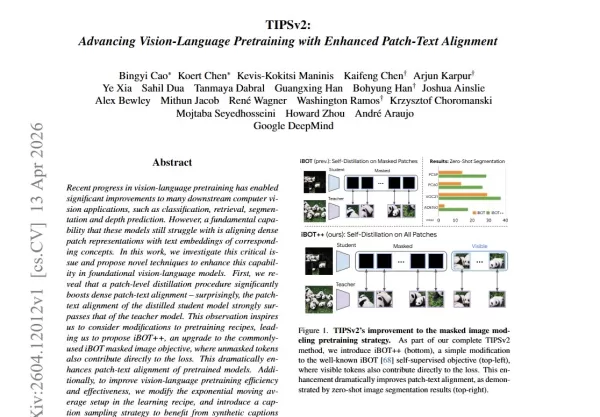
The research team observed a counterintuitive finding: in fine-grained segmentation tasks, smaller student models frequently outperform larger teacher models. This happens because distillation removes the masking mechanism, compelling the model to learn every detail of the entire image, creating a form of "full-area supervision." Motivated by this insight, TIPSv2 introduced three key enhancements.
First, iBOT++. Traditional pre-training only computes loss for masked regions, leaving visible areas in a neglected state that causes local semantics to drift. iBOT++ requires the model to provide precise supervision over all visible areas, effectively upgrading the task from a "puzzle game" to "carefully reading the entire text." This single improvement boosted zero-shot segmentation performance by 14.1 percentage points.
Second, Head-only EMA. Traditional self-supervised training requires keeping two nearly identical large models in memory, which is highly resource-intensive. TIPSv2 discovered that the image-text contrastive loss alone is enough to stabilize the backbone network, so EMA only needs to be applied to the final projection head, eliminating the need to duplicate the backbone. This reduces the training parameter count by about 42%, making it faster with almost no performance drop.
Third, multi-granularity text pairing. During training, short web descriptions, medium-detail descriptions, and long descriptions generated by Gemini are randomly mixed and fed into the model, alternating between easy and hard tasks. This prevents the model from coasting on simple tasks while ensuring no details are overlooked.
The final results are compelling. TIPSv2 underwent frozen evaluation across nine tasks and 20 authoritative datasets. Zero-shot semantic segmentation achieved a new industry benchmark, while image-text retrieval and classification outperformed comparison models with 56% more parameters. Pure visual tasks also placed among the top performers.
The code and model weights for TIPSv2 are fully open-sourced. For teams working in medical imaging, autonomous driving, industrial inspection, and other domains that demand high-precision image understanding, this solution is well worth a close look.
Paper: https://www.alphaxiv.org/abs/2604.12012
Related article
 Suno to Watermark Songs Amid Legal Battles
Suno, the platform enabling users to generate AI-created music, has unveiled new features to label platform-produced tracks, restrict downloads, and update community standards to curb unauthorized replicas. These updates arrive as Suno confronts mult
Musk Admits Grok Build Leaked User Code, Promises to Erase All Historical Data
Elon Musk directly addressed the privacy controversy surrounding Grok Build, beginning with a simple "True" to confirm the incident's validity. He pledged that all user data previously uploaded to SpaceXAI would be permanently erased, stating, "not a
U.S. Stocks Hit Historic Milestone as AI and Aerospace Giants Prepare for Trillion-Dollar Debut
Elon Musk, Sam Altman, and Dario Amodei, three titans of the technology sector, are advancing toward initial public offerings for their respective ventures. With SpaceX, OpenAI, and Anthropic—three industry behemoths nearing trillion-dollar valuation
Related Special Topic Recommendations
SEO
Suno to Watermark Songs Amid Legal Battles
Suno, the platform enabling users to generate AI-created music, has unveiled new features to label platform-produced tracks, restrict downloads, and update community standards to curb unauthorized replicas. These updates arrive as Suno confronts mult
Musk Admits Grok Build Leaked User Code, Promises to Erase All Historical Data
Elon Musk directly addressed the privacy controversy surrounding Grok Build, beginning with a simple "True" to confirm the incident's validity. He pledged that all user data previously uploaded to SpaceXAI would be permanently erased, stating, "not a
U.S. Stocks Hit Historic Milestone as AI and Aerospace Giants Prepare for Trillion-Dollar Debut
Elon Musk, Sam Altman, and Dario Amodei, three titans of the technology sector, are advancing toward initial public offerings for their respective ventures. With SpaceX, OpenAI, and Anthropic—three industry behemoths nearing trillion-dollar valuation
Related Special Topic Recommendations
SEO
 Best AI SERP Analysis Tools for Search Strategy
2026 Latest Best Top-rated AI SERP Analysis Tools for Search Strategy are curated by XIX.AI through rigorous real-world tests and weekly updated rankings. These powerful tools help you unlock hidden optimization opportunities, boost content performance, and gain a competitive edge in search. Discover your perfect tool to elevate your search strategy today. Explore now!
 13 tools
 xix.ai
Data Analysis
Best AI Anomaly Detection Tools for KPI Monitoring across SaaS and Ecommerce Teams
xix.ai
Data Analysis
Best AI Anomaly Detection Tools for KPI Monitoring across SaaS and Ecommerce Teams
2026 Latest Best Top-rated AI Anomaly Detection Tools for KPI Monitoring in SaaS and Ecommerce teams! XIX.AI has curated a powerful, game-changing collection based on rigorous real-world tests and weekly updated rankings. You’ll find detailed free vs paid comparison insights to help you identify the must-try solution that boosts productivity and unlocks your AI edge. Explore now!
10 tools
xix.ai
writing
Best AI Outline Generators for Long-Form SEO Articles
2026 Latest Best Top-Rated AI Outline Generators for Long-Form SEO Articles, meticulously curated by XIX.AI. These powerful tools offer game-changing assistance in creating high-quality content quickly, boosting writing efficiency significantly. Get a free vs paid comparison along with real-world tests and detailed rankings to help you find the must-try option that suits your needs. Explore now to unlock your AI edge.
8 tools
xix.ai
Education and Learning
AI Study Tools for Homework and Exam Prep
2026 Latest Best AI Study Tools for Homework and Exam Prep! XIX.AI curates a top-rated list of powerful, game-changing tools that help students boost productivity, streamline homework completion, and ace exams through real-world tests. Get a free vs paid comparison, detailed rankings, and must-try options to unlock your AI edge. Explore now!
10 tools
xix.ai
Music composition
AI Vocal Demo Tools for Songwriters, Hooks, Toplines, and Multilingual Draft Sessions
2026 Latest Best AI Vocal Demo Tools for Songwriters, Hook Creators, and Multi-Language Content Teams! XIX.AI has curated a top-rated list of powerful game-changing tools that go through rigorous real-world tests. You’ll find detailed free vs paid comparison data, comprehensive rankings, and must-try options to help you boost writing efficiency and unlock your creative potential. Explore now to discover your perfect tool for all your content needs!
9 tools
xix.ai
Business
Best AI Competitive Research Tools for Small Businesses
2026 Latest Best Top-rated AI Competitive Research Tools for Small Businesses! XIX.AI has curated a highly powerful game-changing collection, updated weekly with rigorous real-world tests and detailed rankings. You can find a comprehensive free vs paid comparison to help you identify the must-try tools that boost your productivity and give you a competitive edge. Explore now to discover your perfect tool!
9 tools
xix.ai

 Comments (0)
0/500
Comments (0)
0/500
AI image understanding currently has a core limitation.
When asked "What is in this picture?" it can provide a detailed response. However, asking "Where is the panda's left hind leg?" leads to vague answers. This is not a flaw in any specific model but a persistent issue across the entire visual-language large model domain: strong global understanding but weak local localization.
Google DeepMind introduced TIPSv2 in their latest paper, specifically designed to address this challenging problem.
The research team observed a counterintuitive finding: in fine-grained segmentation tasks, smaller student models frequently outperform larger teacher models. This happens because distillation removes the masking mechanism, compelling the model to learn every detail of the entire image, creating a form of "full-area supervision." Motivated by this insight, TIPSv2 introduced three key enhancements.
First, iBOT++. Traditional pre-training only computes loss for masked regions, leaving visible areas in a neglected state that causes local semantics to drift. iBOT++ requires the model to provide precise supervision over all visible areas, effectively upgrading the task from a "puzzle game" to "carefully reading the entire text." This single improvement boosted zero-shot segmentation performance by 14.1 percentage points.
Second, Head-only EMA. Traditional self-supervised training requires keeping two nearly identical large models in memory, which is highly resource-intensive. TIPSv2 discovered that the image-text contrastive loss alone is enough to stabilize the backbone network, so EMA only needs to be applied to the final projection head, eliminating the need to duplicate the backbone. This reduces the training parameter count by about 42%, making it faster with almost no performance drop.
Third, multi-granularity text pairing. During training, short web descriptions, medium-detail descriptions, and long descriptions generated by Gemini are randomly mixed and fed into the model, alternating between easy and hard tasks. This prevents the model from coasting on simple tasks while ensuring no details are overlooked.
The final results are compelling. TIPSv2 underwent frozen evaluation across nine tasks and 20 authoritative datasets. Zero-shot semantic segmentation achieved a new industry benchmark, while image-text retrieval and classification outperformed comparison models with 56% more parameters. Pure visual tasks also placed among the top performers.
The code and model weights for TIPSv2 are fully open-sourced. For teams working in medical imaging, autonomous driving, industrial inspection, and other domains that demand high-precision image understanding, this solution is well worth a close look.
Paper: https://www.alphaxiv.org/abs/2604.12012








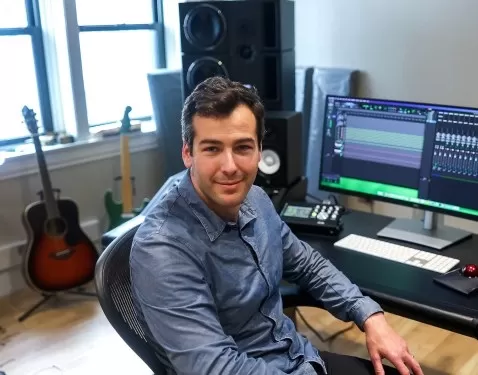 Suno to Watermark Songs Amid Legal Battles
Suno, the platform enabling users to generate AI-created music, has unveiled new features to label platform-produced tracks, restrict downloads, and update community standards to curb unauthorized replicas. These updates arrive as Suno confronts mult
Suno to Watermark Songs Amid Legal Battles
Suno, the platform enabling users to generate AI-created music, has unveiled new features to label platform-produced tracks, restrict downloads, and update community standards to curb unauthorized replicas. These updates arrive as Suno confronts mult
 Musk Admits Grok Build Leaked User Code, Promises to Erase All Historical Data
Elon Musk directly addressed the privacy controversy surrounding Grok Build, beginning with a simple "True" to confirm the incident's validity. He pledged that all user data previously uploaded to SpaceXAI would be permanently erased, stating, "not a
Musk Admits Grok Build Leaked User Code, Promises to Erase All Historical Data
Elon Musk directly addressed the privacy controversy surrounding Grok Build, beginning with a simple "True" to confirm the incident's validity. He pledged that all user data previously uploaded to SpaceXAI would be permanently erased, stating, "not a
 U.S. Stocks Hit Historic Milestone as AI and Aerospace Giants Prepare for Trillion-Dollar Debut
Elon Musk, Sam Altman, and Dario Amodei, three titans of the technology sector, are advancing toward initial public offerings for their respective ventures. With SpaceX, OpenAI, and Anthropic—three industry behemoths nearing trillion-dollar valuation
U.S. Stocks Hit Historic Milestone as AI and Aerospace Giants Prepare for Trillion-Dollar Debut
Elon Musk, Sam Altman, and Dario Amodei, three titans of the technology sector, are advancing toward initial public offerings for their respective ventures. With SpaceX, OpenAI, and Anthropic—three industry behemoths nearing trillion-dollar valuation

2026 Latest Best Top-rated AI SERP Analysis Tools for Search Strategy are curated by XIX.AI through rigorous real-world tests and weekly updated rankings. These powerful tools help you unlock hidden optimization opportunities, boost content performance, and gain a competitive edge in search. Discover your perfect tool to elevate your search strategy today. Explore now!
13 tools
xix.ai
2026 Latest Best Top-rated AI Anomaly Detection Tools for KPI Monitoring in SaaS and Ecommerce teams! XIX.AI has curated a powerful, game-changing collection based on rigorous real-world tests and weekly updated rankings. You’ll find detailed free vs paid comparison insights to help you identify the must-try solution that boosts productivity and unlocks your AI edge. Explore now!
10 tools
xix.ai

2026 Latest Best Top-Rated AI Outline Generators for Long-Form SEO Articles, meticulously curated by XIX.AI. These powerful tools offer game-changing assistance in creating high-quality content quickly, boosting writing efficiency significantly. Get a free vs paid comparison along with real-world tests and detailed rankings to help you find the must-try option that suits your needs. Explore now to unlock your AI edge.
8 tools
xix.ai

2026 Latest Best AI Study Tools for Homework and Exam Prep! XIX.AI curates a top-rated list of powerful, game-changing tools that help students boost productivity, streamline homework completion, and ace exams through real-world tests. Get a free vs paid comparison, detailed rankings, and must-try options to unlock your AI edge. Explore now!
10 tools
xix.ai

2026 Latest Best AI Vocal Demo Tools for Songwriters, Hook Creators, and Multi-Language Content Teams! XIX.AI has curated a top-rated list of powerful game-changing tools that go through rigorous real-world tests. You’ll find detailed free vs paid comparison data, comprehensive rankings, and must-try options to help you boost writing efficiency and unlock your creative potential. Explore now to discover your perfect tool for all your content needs!
9 tools
xix.ai

2026 Latest Best Top-rated AI Competitive Research Tools for Small Businesses! XIX.AI has curated a highly powerful game-changing collection, updated weekly with rigorous real-world tests and detailed rankings. You can find a comprehensive free vs paid comparison to help you identify the must-try tools that boost your productivity and give you a competitive edge. Explore now to discover your perfect tool!
9 tools
xix.ai












