


 Home
HomeHow to build custom AI apps with Glif's no-code workflow in 2025?
Eager to build your own AI-powered applications without any coding? Glif.app provides a unique platform where users can design and share custom AI tools. This innovative website utilizes AI workflows, offering a user-friendly interface to create, personalize, and distribute your inventions. Discover how Glif enables you to craft unique AI apps and become part of a growing creator network.
Key Points
Glif.app enables anyone to build AI applications using intuitive, no-code workflows.
Users can tailor AI apps to meet their specific requirements.
The platform encourages a collaborative community for sharing AI app creations (known as glyphs).
Glif offers 20 complimentary credits each day for generating AI applications.
AI models are employed to refine user prompts, leading to superior image generation.
Glif's interface makes AI app development accessible to all skill levels.
Understanding Glif: AI App Creation Made Simple
What is Glif.app?
Glif.app is a no-code platform built to empower individuals to create their own AI applications.
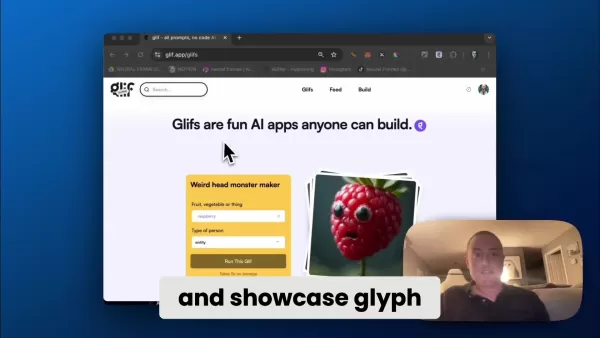
It utilizes AI workflows, enabling users to build custom AI apps, referred to as 'glyphs,' without programming expertise. The platform nurtures a community where creators share their apps, allowing others to use and adapt them, fostering a collaborative space for AI innovation. Glif.app simplifies complex AI development, making it approachable for a wider audience, including artists, educators, and enthusiasts. Its core mission is to democratize AI, ensuring anyone with an idea can realize it, irrespective of technical background.
The website provides various tools and templates, but its true strength lies in its flexibility and ease of use. Whether you aim to generate custom images, craft unique memes, or design personalized characters, Glif supplies the necessary tools. All this is achieved through an intuitive interface that hides technical complexities, letting users concentrate on creativity and vision.
The Power of No-Code AI
The no-code movement is transforming software development, and Glif.app leads this trend in the AI domain. By removing the need for traditional coding, the platform opens AI development to a broader audience. This democratization of AI offers several significant advantages:
- Increased Accessibility: People without technical skills can now build AI apps, encouraging innovation from diverse perspectives.
- Rapid Prototyping: No-code platforms allow for quick iteration and experimentation. Users can swiftly prototype ideas and test concepts without the time and resource investment of traditional coding.
- Enhanced Creativity: By eliminating technical hurdles, users can focus on the creative aspects of AI app development, leading to more inventive solutions.
- Cost-Effectiveness: No-code development can substantially lower costs, making AI accessible to small businesses and independent creators. Glif.app provides a platform for building powerful AI tools without significant expense.
Getting Started with Glif: A Step-by-Step Guide
Navigating the Glif Interface
The Glif interface is crafted to be intuitive and straightforward.
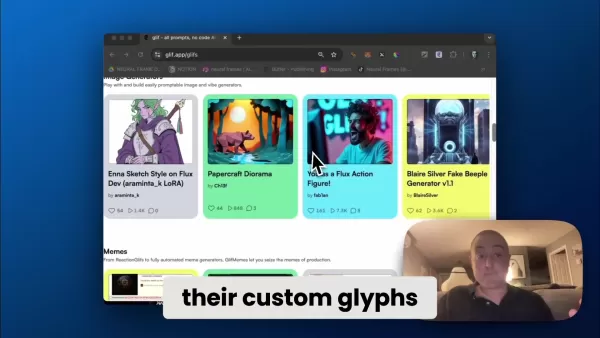
When you visit the site, you'll see a clean layout with easy access to primary features. Key areas include:
- Search Bar: Quickly locate existing glyphs and AI apps made by the community.
- Gifs: Browse a collection of AI apps created and shared by other users. This is an excellent source for inspiration and new ideas.
- Feed: Stay current with the latest activity and creations from the Glif community.
- Build: Access the AI App Builder to create your own custom glyphs. This is where you'll spend most of your development time.
To start creating your AI app, click the 'Build' tab. This leads to the development environment where you design your glyph. The 'Build' interface features a visual workflow editor, letting you connect different AI blocks to construct complex applications.
The Build section
- A field labeled 'Untitled Glif' for naming your creation.
- A 'Description' field. Describe your glif's purpose and what users will experience.
- Blocks that can be added, offering various AI-driven tasks to build your glif.
- A Gif Testing Area to trial your glif after creation.
This section is where you construct and evaluate your AI creation.
Building Your First AI App: A Skateboard Deck Designer Example
Let's walk through a practical example: creating a Skateboard Deck Designer. This app will let users input design preferences to generate a custom skateboard deck graphic using AI.
Step 1: Setting Up the Project
Click the 'Build' tab to enter the AI App Builder.
Name your Glif by selecting 'Untitled Glif'. For this example, use 'Skateboard Deck Creator'.
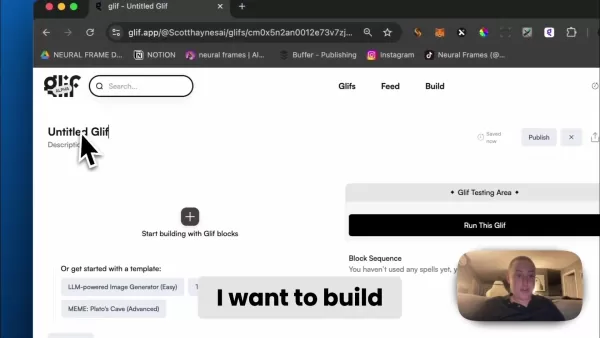
Provide a description.
Step 2: Adding a User Prompt
- To collect user input, add a 'Text Input' block. This lets users enter their design ideas.
- Label this block 'userprompt'.
- Change the default prompt from 'What ice cream flavor do you like?' to 'Describe your ideal skateboard design.'
Step 3: Enhancing the User Prompt
- Add a 'Text Generator (LLM)' block.
- Connect the userprompt block to the Text Generator block by clicking and dragging.
- Select your preferred model. Claude 3.5 is a common choice.
- Craft a prompt to improve the image generation: 'Generate an image of a skateboard deck from a top-down perspective. Ensure the USERPROMPT is a highly detailed graphic covering the entire deck. The background should contrast sharply with the deck to emphasize the design.'
Step 4: Generating the Image
- Add an 'Image Generator' block to your workflow. This block creates an image based on the refined prompt.
- Populate the field by clicking the plus button on the text generator. The AI will automatically use the enhanced prompt here.
Step 5: Testing and Publishing
- Test your AI app. Each run costs 4 credits, and you receive 20 free runs daily.
You've now created your glif! It can be shared with the community for others to use.
How to Use Glif
Running a Gif
Once a Gif is created and published, it's available for anyone to run and generate similar images with different prompts.
Using a Gif is straightforward:
- Find a Gif you wish to use.
- Enter a text prompt describing your desired image. The specifics will vary by Gif.
- Click the 'Run This Gif' button, and the AI model will handle the rest.
Sharing your Gif
Publishing your Gifs lets others use them, with proper attribution to you. Follow these steps:
- Locate the glif in your profile.
- Next to the name and description, click the Publish button.
- Other users can now discover and utilize your Gif. Enjoy!
Evaluating Glif: Weighing the Pros
and Cons
Pros
User-friendly no-code interface.
Community-oriented platform for sharing and collaboration.
Free daily credits for AI app generation.
Customizable AI models.
AI-assisted prompt refinement.
Cons
Functionality is limited compared to custom coding.
Reliance on the platform's predefined AI blocks.
The daily free credit allowance can be restrictive for heavy usage.
Core Features of Glif: Unleashing AI Potential
Key Features
Glif includes a set of features designed to streamline and enhance AI app development:
- No-Code Interface: Glif's visual workflow editor enables AI app creation without coding.
- AI Workflow Blocks: The platform offers pre-built AI blocks (text input, image generation, etc.) that can be linked to build sophisticated applications.
- Community Sharing: Glif promotes a community where users share their AI app creations (glyphs), encouraging collaboration.
- Customizable AI Models: Users can choose from various AI models to power their apps, customizing performance and output.
- Free Credits: Glif provides 20 free credits each day, allowing for cost-free experimentation.
- AI-Powered Prompt Enhancement: The platform uses AI to improve user prompts, resulting in higher-quality image generation.
Exploring the Diverse Use Cases of Glif
Practical Applications
Glif's adaptability suits a wide array of applications:
- Custom Image Generation: Produce unique images for social media, marketing, or personal use.
- Meme Creation: Design personalized memes with AI-generated content.
- Character Design: Develop distinctive characters for games, stories, or animations.
- Educational Tools: Create interactive educational resources using AI.
- Artistic Exploration: Experiment with AI to produce novel art forms and creative expressions.
Frequently Asked Questions About Glif
What is Glif?
Glif is a no-code AI app builder that enables anyone to create custom AI applications without programming. It uses AI workflows, allowing users to build and share their creations within a community.
How much does Glif cost?
Glif has a free tier providing 20 credits per day, sufficient to explore most functions. Paid upgrades are available for higher usage.
What kind of things can I make on Glif?
The possibilities are vast, limited only by your imagination! The Glif community has already demonstrated incredible creativity with meme generators, character creators, and more. If you can conceive it, you can likely build it.
Related Questions on No-Code AI App Development
What other platforms are available for no-code AI?
While Glif offers a distinctive approach, other platforms also support no-code AI app development. These include: Obviously.ai: An automated machine learning platform for business predictions. CreateML: Apple's framework for building custom machine learning models. Lobe: Microsoft's user-friendly tool for training AI models. Each platform has unique strengths for different use cases. Exploring multiple options is recommended to find your ideal fit.
Related article
 South Korea Breaks Ground on National AI Computing Center, Investing 2.5 Trillion Won with 2028 Target
South Korean outlet EtNews reports that groundbreaking for the Korea AI Computing Center (KOACC) took place on August 3 at the Solar City data center park in Sunan, Jeollanam-do. Backed by a total investment of 2.5 trillion KRW (roughly 11.838 billio
Six Tech Giants Back Linux Foundation With $12.5M to Tackle AI Vulnerability Noise
To tackle the flood of low-quality security reports produced by AI automation tools, six major tech companies—Anthropic, Amazon (AWS), GitHub, Google, Microsoft, and OpenAI—have collectively contributed $12.5 million in funding to Linux Foundation in
Musk Considered Leaving OpenAI to His Kids as Altman Testifies
This morning, OpenAI CEO Sam Altman took the stand to address former co-founder Elon Musk’s lawsuit challenging the company’s corporate structure.When asked about Musk’s claim that other founders “stole a charity” by launching a for-profit subsidiary
Related Special Topic Recommendations
Music composition
South Korea Breaks Ground on National AI Computing Center, Investing 2.5 Trillion Won with 2028 Target
South Korean outlet EtNews reports that groundbreaking for the Korea AI Computing Center (KOACC) took place on August 3 at the Solar City data center park in Sunan, Jeollanam-do. Backed by a total investment of 2.5 trillion KRW (roughly 11.838 billio
Six Tech Giants Back Linux Foundation With $12.5M to Tackle AI Vulnerability Noise
To tackle the flood of low-quality security reports produced by AI automation tools, six major tech companies—Anthropic, Amazon (AWS), GitHub, Google, Microsoft, and OpenAI—have collectively contributed $12.5 million in funding to Linux Foundation in
Musk Considered Leaving OpenAI to His Kids as Altman Testifies
This morning, OpenAI CEO Sam Altman took the stand to address former co-founder Elon Musk’s lawsuit challenging the company’s corporate structure.When asked about Musk’s claim that other founders “stole a charity” by launching a for-profit subsidiary
Related Special Topic Recommendations
Music composition
 AI Vocal Demo Tools for Songwriters, Hooks, Toplines, and Multilingual Draft Sessions
2026 Latest Best AI Vocal Demo Tools for Songwriters, Hook Creators, and Multi-Language Content Teams! XIX.AI has curated a top-rated list of powerful game-changing tools that go through rigorous real-world tests. You’ll find detailed free vs paid comparison data, comprehensive rankings, and must-try options to help you boost writing efficiency and unlock your creative potential. Explore now to discover your perfect tool for all your content needs!
 9 tools
 xix.ai
Business
Best AI Competitive Research Tools for Small Businesses
xix.ai
Business
Best AI Competitive Research Tools for Small Businesses
2026 Latest Best Top-rated AI Competitive Research Tools for Small Businesses! XIX.AI has curated a highly powerful game-changing collection, updated weekly with rigorous real-world tests and detailed rankings. You can find a comprehensive free vs paid comparison to help you identify the must-try tools that boost your productivity and give you a competitive edge. Explore now to discover your perfect tool!
9 tools
xix.ai
Image editing
Photoshop AI Retouch Tools for Ecommerce Apparel, Skin Cleanup, and Color Consistency
2026 Latest Best Photoshop AI retouch tools for ecommerce apparel, skin cleanup, and color consistency! This top-rated curated list features powerful game-changing solutions that help you boost writing efficiency, streamline content creation, and achieve perfect visual results effortlessly. Each tool has undergone real-world tests through weekly updated rankings, complete with free vs paid comparison details. Backed by XIX.AI, it’s the must-try guide for anyone aiming to unlock your AI edge. Explore now!
10 tools
xix.ai
Prompt
Best AI Prompt Libraries for ChatGPT Workflows
2026 Latest Best Top-Rated AI Prompt Libraries for optimizing all types of ChatGPT workflows. XIX.AI has curated a powerful, game-changing collection that goes through rigorous real-world tests to ensure top performance. You can find detailed free vs paid comparisons and expert rankings to help you choose the must-try tools that boost your productivity and unlock your AI edge. Explore now!
11 tools
xix.ai
Education and Learning
AI Quiz Builder Platforms for Teachers, Tutors, and Cohort-Based Learning Programs
2026 Latest Best AI Quiz Builder Platforms for Teachers, Tutors, and Cohort-Based Learning Programs! XIX.AI has curated a top-rated list of powerful game-changing tools that go through real-world tests to deliver accurate rankings. These must-try platforms help boost writing efficiency, streamline content creation, and simplify quiz design across all learning scenarios. Explore now to discover your perfect tool for unlocking your AI edge in teaching!
13 tools
xix.ai
code
AI Pull Request Review Tools for GitHub Teams Handling Refactors, Bugs, and Security Gaps
2026 Latest Best AI Pull Request Review Tools for GitHub Teams are here on XIX.AI! This top-rated curated list showcases powerful game-changing solutions that streamline refactoring, bug fixing, and security gap detection across all team workflows. Enjoy a free vs paid comparison along with real-world tests and detailed rankings to help you find the perfect tool that boosts productivity significantly. Explore now to unlock your AI edge!
12 tools
xix.ai

 Comments (1)
0/500
Comments (1)
0/500
![DonaldGonzález]()
Glifって、まったくコード書かずにAIアプリが作れるの?2025年はもうエンジニアじゃなくてもプロトタイプ作れる時代になるんだね。個人的に広告ツールを作ってみようかな。でも、無料プランの制限や将来的な料金上昇がちょっと心配…これって本当にノンプログラマー向け?🤔
Eager to build your own AI-powered applications without any coding? Glif.app provides a unique platform where users can design and share custom AI tools. This innovative website utilizes AI workflows, offering a user-friendly interface to create, personalize, and distribute your inventions. Discover how Glif enables you to craft unique AI apps and become part of a growing creator network.
Key Points
Glif.app enables anyone to build AI applications using intuitive, no-code workflows.
Users can tailor AI apps to meet their specific requirements.
The platform encourages a collaborative community for sharing AI app creations (known as glyphs).
Glif offers 20 complimentary credits each day for generating AI applications.
AI models are employed to refine user prompts, leading to superior image generation.
Glif's interface makes AI app development accessible to all skill levels.
Understanding Glif: AI App Creation Made Simple
What is Glif.app?
Glif.app is a no-code platform built to empower individuals to create their own AI applications.
It utilizes AI workflows, enabling users to build custom AI apps, referred to as 'glyphs,' without programming expertise. The platform nurtures a community where creators share their apps, allowing others to use and adapt them, fostering a collaborative space for AI innovation. Glif.app simplifies complex AI development, making it approachable for a wider audience, including artists, educators, and enthusiasts. Its core mission is to democratize AI, ensuring anyone with an idea can realize it, irrespective of technical background.
The website provides various tools and templates, but its true strength lies in its flexibility and ease of use. Whether you aim to generate custom images, craft unique memes, or design personalized characters, Glif supplies the necessary tools. All this is achieved through an intuitive interface that hides technical complexities, letting users concentrate on creativity and vision.
The Power of No-Code AI
The no-code movement is transforming software development, and Glif.app leads this trend in the AI domain. By removing the need for traditional coding, the platform opens AI development to a broader audience. This democratization of AI offers several significant advantages:
- Increased Accessibility: People without technical skills can now build AI apps, encouraging innovation from diverse perspectives.
- Rapid Prototyping: No-code platforms allow for quick iteration and experimentation. Users can swiftly prototype ideas and test concepts without the time and resource investment of traditional coding.
- Enhanced Creativity: By eliminating technical hurdles, users can focus on the creative aspects of AI app development, leading to more inventive solutions.
- Cost-Effectiveness: No-code development can substantially lower costs, making AI accessible to small businesses and independent creators. Glif.app provides a platform for building powerful AI tools without significant expense.
Getting Started with Glif: A Step-by-Step Guide
Navigating the Glif Interface
The Glif interface is crafted to be intuitive and straightforward.
When you visit the site, you'll see a clean layout with easy access to primary features. Key areas include:
- Search Bar: Quickly locate existing glyphs and AI apps made by the community.
- Gifs: Browse a collection of AI apps created and shared by other users. This is an excellent source for inspiration and new ideas.
- Feed: Stay current with the latest activity and creations from the Glif community.
- Build: Access the AI App Builder to create your own custom glyphs. This is where you'll spend most of your development time.
To start creating your AI app, click the 'Build' tab. This leads to the development environment where you design your glyph. The 'Build' interface features a visual workflow editor, letting you connect different AI blocks to construct complex applications.
The Build section
- A field labeled 'Untitled Glif' for naming your creation.
- A 'Description' field. Describe your glif's purpose and what users will experience.
- Blocks that can be added, offering various AI-driven tasks to build your glif.
- A Gif Testing Area to trial your glif after creation.
This section is where you construct and evaluate your AI creation.
Building Your First AI App: A Skateboard Deck Designer Example
Let's walk through a practical example: creating a Skateboard Deck Designer. This app will let users input design preferences to generate a custom skateboard deck graphic using AI.
Step 1: Setting Up the Project
Click the 'Build' tab to enter the AI App Builder.
Name your Glif by selecting 'Untitled Glif'. For this example, use 'Skateboard Deck Creator'.
Provide a description.
Step 2: Adding a User Prompt
- To collect user input, add a 'Text Input' block. This lets users enter their design ideas.
- Label this block 'userprompt'.
- Change the default prompt from 'What ice cream flavor do you like?' to 'Describe your ideal skateboard design.'
Step 3: Enhancing the User Prompt
- Add a 'Text Generator (LLM)' block.
- Connect the userprompt block to the Text Generator block by clicking and dragging.
- Select your preferred model. Claude 3.5 is a common choice.
- Craft a prompt to improve the image generation: 'Generate an image of a skateboard deck from a top-down perspective. Ensure the USERPROMPT is a highly detailed graphic covering the entire deck. The background should contrast sharply with the deck to emphasize the design.'
Step 4: Generating the Image
- Add an 'Image Generator' block to your workflow. This block creates an image based on the refined prompt.
- Populate the field by clicking the plus button on the text generator. The AI will automatically use the enhanced prompt here.
Step 5: Testing and Publishing
- Test your AI app. Each run costs 4 credits, and you receive 20 free runs daily.
You've now created your glif! It can be shared with the community for others to use.
How to Use Glif
Running a Gif
Once a Gif is created and published, it's available for anyone to run and generate similar images with different prompts.
Using a Gif is straightforward:
- Find a Gif you wish to use.
- Enter a text prompt describing your desired image. The specifics will vary by Gif.
- Click the 'Run This Gif' button, and the AI model will handle the rest.
Sharing your Gif
Publishing your Gifs lets others use them, with proper attribution to you. Follow these steps:
- Locate the glif in your profile.
- Next to the name and description, click the Publish button.
- Other users can now discover and utilize your Gif. Enjoy!
Evaluating Glif: Weighing the Pros
and Cons
Pros
User-friendly no-code interface.
Community-oriented platform for sharing and collaboration.
Free daily credits for AI app generation.
Customizable AI models.
AI-assisted prompt refinement.
Cons
Functionality is limited compared to custom coding.
Reliance on the platform's predefined AI blocks.
The daily free credit allowance can be restrictive for heavy usage.
Core Features of Glif: Unleashing AI Potential
Key Features
Glif includes a set of features designed to streamline and enhance AI app development:
- No-Code Interface: Glif's visual workflow editor enables AI app creation without coding.
- AI Workflow Blocks: The platform offers pre-built AI blocks (text input, image generation, etc.) that can be linked to build sophisticated applications.
- Community Sharing: Glif promotes a community where users share their AI app creations (glyphs), encouraging collaboration.
- Customizable AI Models: Users can choose from various AI models to power their apps, customizing performance and output.
- Free Credits: Glif provides 20 free credits each day, allowing for cost-free experimentation.
- AI-Powered Prompt Enhancement: The platform uses AI to improve user prompts, resulting in higher-quality image generation.
Exploring the Diverse Use Cases of Glif
Practical Applications
Glif's adaptability suits a wide array of applications:
- Custom Image Generation: Produce unique images for social media, marketing, or personal use.
- Meme Creation: Design personalized memes with AI-generated content.
- Character Design: Develop distinctive characters for games, stories, or animations.
- Educational Tools: Create interactive educational resources using AI.
- Artistic Exploration: Experiment with AI to produce novel art forms and creative expressions.
Frequently Asked Questions About Glif
What is Glif?
Glif is a no-code AI app builder that enables anyone to create custom AI applications without programming. It uses AI workflows, allowing users to build and share their creations within a community.
How much does Glif cost?
Glif has a free tier providing 20 credits per day, sufficient to explore most functions. Paid upgrades are available for higher usage.
What kind of things can I make on Glif?
The possibilities are vast, limited only by your imagination! The Glif community has already demonstrated incredible creativity with meme generators, character creators, and more. If you can conceive it, you can likely build it.
Related Questions on No-Code AI App Development
What other platforms are available for no-code AI?
While Glif offers a distinctive approach, other platforms also support no-code AI app development. These include: Obviously.ai: An automated machine learning platform for business predictions. CreateML: Apple's framework for building custom machine learning models. Lobe: Microsoft's user-friendly tool for training AI models. Each platform has unique strengths for different use cases. Exploring multiple options is recommended to find your ideal fit.








 South Korea Breaks Ground on National AI Computing Center, Investing 2.5 Trillion Won with 2028 Target
South Korean outlet EtNews reports that groundbreaking for the Korea AI Computing Center (KOACC) took place on August 3 at the Solar City data center park in Sunan, Jeollanam-do. Backed by a total investment of 2.5 trillion KRW (roughly 11.838 billio
South Korea Breaks Ground on National AI Computing Center, Investing 2.5 Trillion Won with 2028 Target
South Korean outlet EtNews reports that groundbreaking for the Korea AI Computing Center (KOACC) took place on August 3 at the Solar City data center park in Sunan, Jeollanam-do. Backed by a total investment of 2.5 trillion KRW (roughly 11.838 billio
 Six Tech Giants Back Linux Foundation With $12.5M to Tackle AI Vulnerability Noise
To tackle the flood of low-quality security reports produced by AI automation tools, six major tech companies—Anthropic, Amazon (AWS), GitHub, Google, Microsoft, and OpenAI—have collectively contributed $12.5 million in funding to Linux Foundation in
Six Tech Giants Back Linux Foundation With $12.5M to Tackle AI Vulnerability Noise
To tackle the flood of low-quality security reports produced by AI automation tools, six major tech companies—Anthropic, Amazon (AWS), GitHub, Google, Microsoft, and OpenAI—have collectively contributed $12.5 million in funding to Linux Foundation in
 Musk Considered Leaving OpenAI to His Kids as Altman Testifies
This morning, OpenAI CEO Sam Altman took the stand to address former co-founder Elon Musk’s lawsuit challenging the company’s corporate structure.When asked about Musk’s claim that other founders “stole a charity” by launching a for-profit subsidiary
Musk Considered Leaving OpenAI to His Kids as Altman Testifies
This morning, OpenAI CEO Sam Altman took the stand to address former co-founder Elon Musk’s lawsuit challenging the company’s corporate structure.When asked about Musk’s claim that other founders “stole a charity” by launching a for-profit subsidiary

2026 Latest Best AI Vocal Demo Tools for Songwriters, Hook Creators, and Multi-Language Content Teams! XIX.AI has curated a top-rated list of powerful game-changing tools that go through rigorous real-world tests. You’ll find detailed free vs paid comparison data, comprehensive rankings, and must-try options to help you boost writing efficiency and unlock your creative potential. Explore now to discover your perfect tool for all your content needs!
9 tools
xix.ai

2026 Latest Best Top-rated AI Competitive Research Tools for Small Businesses! XIX.AI has curated a highly powerful game-changing collection, updated weekly with rigorous real-world tests and detailed rankings. You can find a comprehensive free vs paid comparison to help you identify the must-try tools that boost your productivity and give you a competitive edge. Explore now to discover your perfect tool!
9 tools
xix.ai

2026 Latest Best Photoshop AI retouch tools for ecommerce apparel, skin cleanup, and color consistency! This top-rated curated list features powerful game-changing solutions that help you boost writing efficiency, streamline content creation, and achieve perfect visual results effortlessly. Each tool has undergone real-world tests through weekly updated rankings, complete with free vs paid comparison details. Backed by XIX.AI, it’s the must-try guide for anyone aiming to unlock your AI edge. Explore now!
10 tools
xix.ai

2026 Latest Best Top-Rated AI Prompt Libraries for optimizing all types of ChatGPT workflows. XIX.AI has curated a powerful, game-changing collection that goes through rigorous real-world tests to ensure top performance. You can find detailed free vs paid comparisons and expert rankings to help you choose the must-try tools that boost your productivity and unlock your AI edge. Explore now!
11 tools
xix.ai

2026 Latest Best AI Quiz Builder Platforms for Teachers, Tutors, and Cohort-Based Learning Programs! XIX.AI has curated a top-rated list of powerful game-changing tools that go through real-world tests to deliver accurate rankings. These must-try platforms help boost writing efficiency, streamline content creation, and simplify quiz design across all learning scenarios. Explore now to discover your perfect tool for unlocking your AI edge in teaching!
13 tools
xix.ai
2026 Latest Best AI Pull Request Review Tools for GitHub Teams are here on XIX.AI! This top-rated curated list showcases powerful game-changing solutions that streamline refactoring, bug fixing, and security gap detection across all team workflows. Enjoy a free vs paid comparison along with real-world tests and detailed rankings to help you find the perfect tool that boosts productivity significantly. Explore now to unlock your AI edge!
12 tools
xix.ai

Glifって、まったくコード書かずにAIアプリが作れるの?2025年はもうエンジニアじゃなくてもプロトタイプ作れる時代になるんだね。個人的に広告ツールを作ってみようかな。でも、無料プランの制限や将来的な料金上昇がちょっと心配…これって本当にノンプログラマー向け?🤔












