


 Home
HomeDesignArena creators raise $7.9 million to bring taste to AI models
According to co-founder Grace Li, the venture launched just weeks before her 2025 graduation, when a small group of college peers attempted to build an AI-powered game engine. While the models could generate functional games, none were genuinely enjoyable, prompting a critical question: how do you predict whether a game will be fun?
They concluded that human judgment is irreplaceable, leading them to brainstorm scalable methods for gathering honest user feedback.
This effort evolved into DesignArena, an AI tool now utilized by 5.3 million users globally. The founders discovered that numerous AI companies were seeking scalable user feedback and were willing to pay for access.
“It addressed a critical bottleneck for many models aiming to improve in the design space,” Li explains. “Within a week, we secured our first major partnership with a leading AI lab, and the rest is history.”
On Monday, Intelligence, the company behind DesignArena, announced a $7.9 million seed funding round led by Index Ventures, with additional investments from Conviction (Sarah Guo and Mike Vernal), A*, Valkyrie, and other investors.
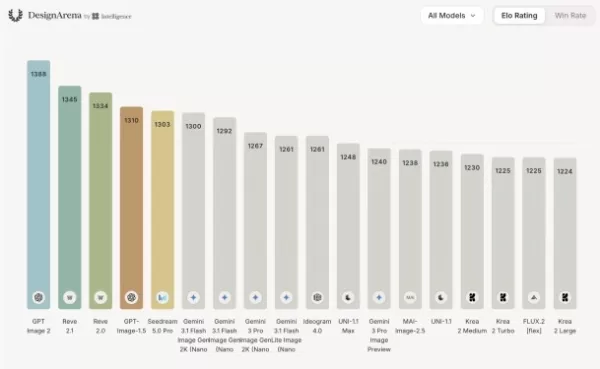
For individual users, DesignArena functions similarly to a sophisticated model router. Users enter prompts into a ChatGPT-style interface, selecting from dropdowns for websites, images, and various other visual formats. After specifying the request, format, and style, users are presented with “A vs. B” comparisons to rank outputs from best to worst.
While useful for individuals, the platform’s true value lies in its enterprise segment, where AI models use it as a source of instant, continuous feedback for media generation. Users typically do not care which specific models they are ranking; they simply seek the highest quality output, making their rankings a vital indicator of user preferences.
Li states that this service is highly valuable to leading AI labs, noting that the platform currently generates $60 million in annual recurring revenue (ARR), establishing itself as a crucial source of human-led evaluation data for the AI sector.
Crucially, users must log in to access outputs, allowing Intelligence to track how preferences shift across different regions and over time. (Li observes that web dashboards in Asia often favor a more maximalist design aesthetic.) These insights complement automated benchmarks, which, despite their scale, are vulnerable to manipulation or gaming, as highlighted by the recent Hugging Face security incident.
However, crowdsourced human feedback is not guaranteed to be a winning market. Less than a year after its launch, Yupp shut down earlier this year despite raising $33 million from a16z crypto’s Chris Dixon. Although Yupp attracted several leading models as clients and claimed over 1.3 million users, it failed to establish a sustainable long-term business.
Nevertheless, other startups focusing on human evaluation are thriving. LM Arena, which applies a similar approach to text-based responses, raised $150 million in a Series A round in January, just four months after officially launching its paid product.
Related article
 U.S. Stocks Hit Historic Milestone as AI and Aerospace Giants Prepare for Trillion-Dollar Debut
Elon Musk, Sam Altman, and Dario Amodei, three titans of the technology sector, are advancing toward initial public offerings for their respective ventures. With SpaceX, OpenAI, and Anthropic—three industry behemoths nearing trillion-dollar valuation
Swedish AI Startup Lovable Eyes $13.2 Billion Valuation After Major Funding Round
As AI-driven coding tools gain traction, Swedish startup Lovable has secured a major funding round. The company aims to raise $3 billion, potentially boosting its valuation to $13.2 billion—double the $6.6 billion recorded last December. Menlo Ventur
Google Tests Remy AI Agent for Gemini as Focus Shifts to User Control
According to Business Insider, Google is testing Remy, a new AI personal agent for Gemini. This tool aims to execute tasks on behalf of users, streamlining both professional workflows and daily routines.Currently, Remy is undergoing testing in an int
Related Special Topic Recommendations
SEO
U.S. Stocks Hit Historic Milestone as AI and Aerospace Giants Prepare for Trillion-Dollar Debut
Elon Musk, Sam Altman, and Dario Amodei, three titans of the technology sector, are advancing toward initial public offerings for their respective ventures. With SpaceX, OpenAI, and Anthropic—three industry behemoths nearing trillion-dollar valuation
Swedish AI Startup Lovable Eyes $13.2 Billion Valuation After Major Funding Round
As AI-driven coding tools gain traction, Swedish startup Lovable has secured a major funding round. The company aims to raise $3 billion, potentially boosting its valuation to $13.2 billion—double the $6.6 billion recorded last December. Menlo Ventur
Google Tests Remy AI Agent for Gemini as Focus Shifts to User Control
According to Business Insider, Google is testing Remy, a new AI personal agent for Gemini. This tool aims to execute tasks on behalf of users, streamlining both professional workflows and daily routines.Currently, Remy is undergoing testing in an int
Related Special Topic Recommendations
SEO
 Best AI SERP Analysis Tools for Search Strategy
2026 Latest Best Top-rated AI SERP Analysis Tools for Search Strategy are curated by XIX.AI through rigorous real-world tests and weekly updated rankings. These powerful tools help you unlock hidden optimization opportunities, boost content performance, and gain a competitive edge in search. Discover your perfect tool to elevate your search strategy today. Explore now!
 13 tools
 xix.ai
Data Analysis
Best AI Anomaly Detection Tools for KPI Monitoring across SaaS and Ecommerce Teams
xix.ai
Data Analysis
Best AI Anomaly Detection Tools for KPI Monitoring across SaaS and Ecommerce Teams
2026 Latest Best Top-rated AI Anomaly Detection Tools for KPI Monitoring in SaaS and Ecommerce teams! XIX.AI has curated a powerful, game-changing collection based on rigorous real-world tests and weekly updated rankings. You’ll find detailed free vs paid comparison insights to help you identify the must-try solution that boosts productivity and unlocks your AI edge. Explore now!
10 tools
xix.ai
writing
Best AI Outline Generators for Long-Form SEO Articles
2026 Latest Best Top-Rated AI Outline Generators for Long-Form SEO Articles, meticulously curated by XIX.AI. These powerful tools offer game-changing assistance in creating high-quality content quickly, boosting writing efficiency significantly. Get a free vs paid comparison along with real-world tests and detailed rankings to help you find the must-try option that suits your needs. Explore now to unlock your AI edge.
8 tools
xix.ai
Education and Learning
AI Study Tools for Homework and Exam Prep
2026 Latest Best AI Study Tools for Homework and Exam Prep! XIX.AI curates a top-rated list of powerful, game-changing tools that help students boost productivity, streamline homework completion, and ace exams through real-world tests. Get a free vs paid comparison, detailed rankings, and must-try options to unlock your AI edge. Explore now!
10 tools
xix.ai
Music composition
AI Vocal Demo Tools for Songwriters, Hooks, Toplines, and Multilingual Draft Sessions
2026 Latest Best AI Vocal Demo Tools for Songwriters, Hook Creators, and Multi-Language Content Teams! XIX.AI has curated a top-rated list of powerful game-changing tools that go through rigorous real-world tests. You’ll find detailed free vs paid comparison data, comprehensive rankings, and must-try options to help you boost writing efficiency and unlock your creative potential. Explore now to discover your perfect tool for all your content needs!
9 tools
xix.ai
Business
Best AI Competitive Research Tools for Small Businesses
2026 Latest Best Top-rated AI Competitive Research Tools for Small Businesses! XIX.AI has curated a highly powerful game-changing collection, updated weekly with rigorous real-world tests and detailed rankings. You can find a comprehensive free vs paid comparison to help you identify the must-try tools that boost your productivity and give you a competitive edge. Explore now to discover your perfect tool!
9 tools
xix.ai

 Comments (0)
0/500
Comments (0)
0/500
According to co-founder Grace Li, the venture launched just weeks before her 2025 graduation, when a small group of college peers attempted to build an AI-powered game engine. While the models could generate functional games, none were genuinely enjoyable, prompting a critical question: how do you predict whether a game will be fun?
They concluded that human judgment is irreplaceable, leading them to brainstorm scalable methods for gathering honest user feedback.
This effort evolved into DesignArena, an AI tool now utilized by 5.3 million users globally. The founders discovered that numerous AI companies were seeking scalable user feedback and were willing to pay for access.
“It addressed a critical bottleneck for many models aiming to improve in the design space,” Li explains. “Within a week, we secured our first major partnership with a leading AI lab, and the rest is history.”
On Monday, Intelligence, the company behind DesignArena, announced a $7.9 million seed funding round led by Index Ventures, with additional investments from Conviction (Sarah Guo and Mike Vernal), A*, Valkyrie, and other investors.
For individual users, DesignArena functions similarly to a sophisticated model router. Users enter prompts into a ChatGPT-style interface, selecting from dropdowns for websites, images, and various other visual formats. After specifying the request, format, and style, users are presented with “A vs. B” comparisons to rank outputs from best to worst.
While useful for individuals, the platform’s true value lies in its enterprise segment, where AI models use it as a source of instant, continuous feedback for media generation. Users typically do not care which specific models they are ranking; they simply seek the highest quality output, making their rankings a vital indicator of user preferences.
Li states that this service is highly valuable to leading AI labs, noting that the platform currently generates $60 million in annual recurring revenue (ARR), establishing itself as a crucial source of human-led evaluation data for the AI sector.
Crucially, users must log in to access outputs, allowing Intelligence to track how preferences shift across different regions and over time. (Li observes that web dashboards in Asia often favor a more maximalist design aesthetic.) These insights complement automated benchmarks, which, despite their scale, are vulnerable to manipulation or gaming, as highlighted by the recent Hugging Face security incident.
However, crowdsourced human feedback is not guaranteed to be a winning market. Less than a year after its launch, Yupp shut down earlier this year despite raising $33 million from a16z crypto’s Chris Dixon. Although Yupp attracted several leading models as clients and claimed over 1.3 million users, it failed to establish a sustainable long-term business.
Nevertheless, other startups focusing on human evaluation are thriving. LM Arena, which applies a similar approach to text-based responses, raised $150 million in a Series A round in January, just four months after officially launching its paid product.








 U.S. Stocks Hit Historic Milestone as AI and Aerospace Giants Prepare for Trillion-Dollar Debut
Elon Musk, Sam Altman, and Dario Amodei, three titans of the technology sector, are advancing toward initial public offerings for their respective ventures. With SpaceX, OpenAI, and Anthropic—three industry behemoths nearing trillion-dollar valuation
U.S. Stocks Hit Historic Milestone as AI and Aerospace Giants Prepare for Trillion-Dollar Debut
Elon Musk, Sam Altman, and Dario Amodei, three titans of the technology sector, are advancing toward initial public offerings for their respective ventures. With SpaceX, OpenAI, and Anthropic—three industry behemoths nearing trillion-dollar valuation
 Swedish AI Startup Lovable Eyes $13.2 Billion Valuation After Major Funding Round
As AI-driven coding tools gain traction, Swedish startup Lovable has secured a major funding round. The company aims to raise $3 billion, potentially boosting its valuation to $13.2 billion—double the $6.6 billion recorded last December. Menlo Ventur
Google Tests Remy AI Agent for Gemini as Focus Shifts to User Control
According to Business Insider, Google is testing Remy, a new AI personal agent for Gemini. This tool aims to execute tasks on behalf of users, streamlining both professional workflows and daily routines.Currently, Remy is undergoing testing in an int
Swedish AI Startup Lovable Eyes $13.2 Billion Valuation After Major Funding Round
As AI-driven coding tools gain traction, Swedish startup Lovable has secured a major funding round. The company aims to raise $3 billion, potentially boosting its valuation to $13.2 billion—double the $6.6 billion recorded last December. Menlo Ventur
Google Tests Remy AI Agent for Gemini as Focus Shifts to User Control
According to Business Insider, Google is testing Remy, a new AI personal agent for Gemini. This tool aims to execute tasks on behalf of users, streamlining both professional workflows and daily routines.Currently, Remy is undergoing testing in an int

2026 Latest Best Top-rated AI SERP Analysis Tools for Search Strategy are curated by XIX.AI through rigorous real-world tests and weekly updated rankings. These powerful tools help you unlock hidden optimization opportunities, boost content performance, and gain a competitive edge in search. Discover your perfect tool to elevate your search strategy today. Explore now!
13 tools
xix.ai

2026 Latest Best Top-rated AI Anomaly Detection Tools for KPI Monitoring in SaaS and Ecommerce teams! XIX.AI has curated a powerful, game-changing collection based on rigorous real-world tests and weekly updated rankings. You’ll find detailed free vs paid comparison insights to help you identify the must-try solution that boosts productivity and unlocks your AI edge. Explore now!
10 tools
xix.ai

2026 Latest Best Top-Rated AI Outline Generators for Long-Form SEO Articles, meticulously curated by XIX.AI. These powerful tools offer game-changing assistance in creating high-quality content quickly, boosting writing efficiency significantly. Get a free vs paid comparison along with real-world tests and detailed rankings to help you find the must-try option that suits your needs. Explore now to unlock your AI edge.
8 tools
xix.ai

2026 Latest Best AI Study Tools for Homework and Exam Prep! XIX.AI curates a top-rated list of powerful, game-changing tools that help students boost productivity, streamline homework completion, and ace exams through real-world tests. Get a free vs paid comparison, detailed rankings, and must-try options to unlock your AI edge. Explore now!
10 tools
xix.ai

2026 Latest Best AI Vocal Demo Tools for Songwriters, Hook Creators, and Multi-Language Content Teams! XIX.AI has curated a top-rated list of powerful game-changing tools that go through rigorous real-world tests. You’ll find detailed free vs paid comparison data, comprehensive rankings, and must-try options to help you boost writing efficiency and unlock your creative potential. Explore now to discover your perfect tool for all your content needs!
9 tools
xix.ai

2026 Latest Best Top-rated AI Competitive Research Tools for Small Businesses! XIX.AI has curated a highly powerful game-changing collection, updated weekly with rigorous real-world tests and detailed rankings. You can find a comprehensive free vs paid comparison to help you identify the must-try tools that boost your productivity and give you a competitive edge. Explore now to discover your perfect tool!
9 tools
xix.ai












