


 Home
HomeDeep Cogito's LLMs Outperform Similar-Sized Models Using IDA
Deep Cogito, a San Francisco-based company, is making waves in the AI community with its latest release of open large language models (LLMs). These models, which come in various sizes ranging from 3 billion to 70 billion parameters, are not just another set of AI tools; they're a bold step towards what the company calls "general superintelligence." Deep Cogito claims that each of their models outperforms the leading open models of similar sizes, including those from LLAMA, DeepSeek, and Qwen, across most standard benchmarks. It's quite a claim, but what's even more impressive is that their 70B model has reportedly outshone the recently released Llama 4 109B Mixture-of-Experts (MoE) model.
Iterated Distillation and Amplification (IDA)
At the heart of Deep Cogito's breakthrough is a new training approach they call Iterated Distillation and Amplification (IDA). This method is described as "a scalable and efficient alignment strategy for general superintelligence using iterative self-improvement." It's designed to push past the limitations of traditional LLM training, where the model's intelligence often hits a ceiling defined by larger "overseer" models or human curators.
The IDA process revolves around two key steps that are repeated over and over:
- Amplification: This step uses more computational power to help the model come up with better solutions or capabilities, much like advanced reasoning techniques.
- Distillation: Here, the model internalizes these improved capabilities, refining its parameters.
Deep Cogito argues that this creates a "positive feedback loop," allowing the model's intelligence to grow more directly with the computational resources and the efficiency of the IDA process itself, rather than being limited by an overseer's intelligence.
The company points to historical successes like AlphaGo, emphasizing that "Advanced Reasoning and Iterative Self-Improvement" were crucial. IDA, they claim, brings these elements into LLM training. They also tout the efficiency of IDA, noting that their team, though small, managed to develop these models in just about 75 days. When compared to other methods like Reinforcement Learning from Human Feedback (RLHF) or standard distillation from larger models, IDA is said to offer better scalability.
As proof, Deep Cogito highlights how their 70B model outperforms both Llama 3.3 70B (distilled from a 405B model) and Llama 4 Scout 109B (distilled from a 2T parameter model).
Capabilities and Performance of Deep Cogito Models
The new Cogito models, which build upon Llama and Qwen checkpoints, are tailored for coding, function calling, and agentic applications. A standout feature is their dual functionality: "Each model can answer directly (standard LLM), or self-reflect before answering (like reasoning models)." This mirrors capabilities seen in models like Claude 3.5. However, Deep Cogito mentions they haven't focused on very long reasoning chains, prioritizing faster answers and the efficiency of distilling shorter chains.
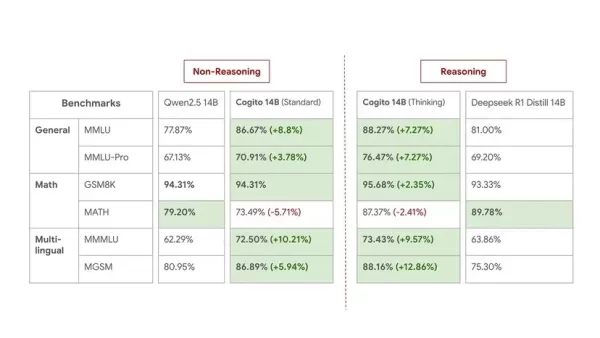
The company has shared extensive benchmark results, comparing their Cogito models against size-equivalent state-of-the-art open models in both direct and reasoning modes. Across a range of benchmarks like MMLU, MMLU-Pro, ARC, GSM8K, and MATH, and across different model sizes (3B, 8B, 14B, 32B, 70B), the Cogito models generally show significant performance improvements. For example, the Cogito 70B model scores 91.73% on MMLU in standard mode, a +6.40% improvement over Llama 3.3 70B, and 91.00% in thinking mode, a +4.40% boost over Deepseek R1 Distill 70B. Livebench scores also reflect these gains.
Here are benchmarks of 14B models for a medium-sized comparison:
While Deep Cogito acknowledges that benchmarks don't fully capture real-world utility, they remain confident in the practical performance of their models. This release is considered a preview, with the company stating they are "still in the early stages of this scaling curve." They plan to release improved checkpoints for the current sizes and introduce larger MoE models (109B, 400B, 671B) in the coming weeks and months. All future models will also be open-source.
Related article
 Ollie bets privacy focus to win AI assistant race
To be genuinely helpful, an AI assistant must understand its user deeply. Ollie, a personal assistant designed for daily life, operates on the premise that this doesn’t require surrendering your data or compromising your privacy.While certain enterpr
How AI LIVE: London Will Explore AI & Industrial Automation
The summit will convene C-suite executives from around the globe to address pressing challenges in global industries, ranging from AI-driven disruption to economic volatility.AI LIVE: The London Summit will gather over 2,000 international leaders und
Anthropic Enters AI Legal Tech Market as Competition Intensifies
Anthropic unveiled a suite of new chatbot capabilities on Tuesday, aimed at delivering automated support to legal practices. These enhancements expand upon Claude for Legal, the firm-specific platform introduced earlier this year, by adding specializ
Related Special Topic Recommendations
Education and Learning
Ollie bets privacy focus to win AI assistant race
To be genuinely helpful, an AI assistant must understand its user deeply. Ollie, a personal assistant designed for daily life, operates on the premise that this doesn’t require surrendering your data or compromising your privacy.While certain enterpr
How AI LIVE: London Will Explore AI & Industrial Automation
The summit will convene C-suite executives from around the globe to address pressing challenges in global industries, ranging from AI-driven disruption to economic volatility.AI LIVE: The London Summit will gather over 2,000 international leaders und
Anthropic Enters AI Legal Tech Market as Competition Intensifies
Anthropic unveiled a suite of new chatbot capabilities on Tuesday, aimed at delivering automated support to legal practices. These enhancements expand upon Claude for Legal, the firm-specific platform introduced earlier this year, by adding specializ
Related Special Topic Recommendations
Education and Learning
 AI Study Tools for Homework and Exam Prep
2026 Latest Best AI Study Tools for Homework and Exam Prep! XIX.AI curates a top-rated list of powerful, game-changing tools that help students boost productivity, streamline homework completion, and ace exams through real-world tests. Get a free vs paid comparison, detailed rankings, and must-try options to unlock your AI edge. Explore now!
 10 tools
 xix.ai
Music composition
AI Vocal Demo Tools for Songwriters, Hooks, Toplines, and Multilingual Draft Sessions
xix.ai
Music composition
AI Vocal Demo Tools for Songwriters, Hooks, Toplines, and Multilingual Draft Sessions
2026 Latest Best AI Vocal Demo Tools for Songwriters, Hook Creators, and Multi-Language Content Teams! XIX.AI has curated a top-rated list of powerful game-changing tools that go through rigorous real-world tests. You’ll find detailed free vs paid comparison data, comprehensive rankings, and must-try options to help you boost writing efficiency and unlock your creative potential. Explore now to discover your perfect tool for all your content needs!
9 tools
xix.ai
Business
Best AI Competitive Research Tools for Small Businesses
2026 Latest Best Top-rated AI Competitive Research Tools for Small Businesses! XIX.AI has curated a highly powerful game-changing collection, updated weekly with rigorous real-world tests and detailed rankings. You can find a comprehensive free vs paid comparison to help you identify the must-try tools that boost your productivity and give you a competitive edge. Explore now to discover your perfect tool!
9 tools
xix.ai
Image editing
Photoshop AI Retouch Tools for Ecommerce Apparel, Skin Cleanup, and Color Consistency
2026 Latest Best Photoshop AI retouch tools for ecommerce apparel, skin cleanup, and color consistency! This top-rated curated list features powerful game-changing solutions that help you boost writing efficiency, streamline content creation, and achieve perfect visual results effortlessly. Each tool has undergone real-world tests through weekly updated rankings, complete with free vs paid comparison details. Backed by XIX.AI, it’s the must-try guide for anyone aiming to unlock your AI edge. Explore now!
10 tools
xix.ai
Prompt
Best AI Prompt Libraries for ChatGPT Workflows
2026 Latest Best Top-Rated AI Prompt Libraries for optimizing all types of ChatGPT workflows. XIX.AI has curated a powerful, game-changing collection that goes through rigorous real-world tests to ensure top performance. You can find detailed free vs paid comparisons and expert rankings to help you choose the must-try tools that boost your productivity and unlock your AI edge. Explore now!
11 tools
xix.ai
Education and Learning
AI Quiz Builder Platforms for Teachers, Tutors, and Cohort-Based Learning Programs
2026 Latest Best AI Quiz Builder Platforms for Teachers, Tutors, and Cohort-Based Learning Programs! XIX.AI has curated a top-rated list of powerful game-changing tools that go through real-world tests to deliver accurate rankings. These must-try platforms help boost writing efficiency, streamline content creation, and simplify quiz design across all learning scenarios. Explore now to discover your perfect tool for unlocking your AI edge in teaching!
13 tools
xix.ai

 Comments (29)
0/500
Comments (29)
0/500
![FrankMoore]()
看起来这家叫做Deep Cogito的新公司有点门道。IDA架构?之前没听说过这个技术,好奇跟MoE比怎么样。要是能出个小点的模型让大家体验一下就好了,毕竟现在动辄几十B参数量,普通开发者根本玩不起。希望别只是实验室数据漂亮,实际应用打折扣。
![HenryJackson]()
このモデルの性能、ほかの同サイズのモデルより優れてるの?IDAの手法が効いてるのかな。個人的には倫理的な側面も気になるけど、オープンソースなのはすごく良いと思う👍 実際に使ってみたい!
![RoyWhite]()
Deep Cogito's LLMs sound like a game-changer! Outperforming models of similar size with IDA is no small feat. Curious to see how these stack up in real-world tasks. 🚀
![PaulThomas]()
Super cool to see Deep Cogito pushing the boundaries with their LLMs! 😎 Those parameter sizes are wild—wonder how they stack up in real-world tasks?
![GregoryCarter]()
LLM от Deep Cogito впечатляют, но приложение могло бы иметь лучший UI. Навигация по разным размерам моделей немного неуклюжая. Тем не менее, производительность на высшем уровне, особенно с технологией IDA. Обязательно стоит посмотреть, если вы интересуетесь ИИ и хотите увидеть, что возможно с большими языковыми моделями! 🤖💡
![EricRoberts]()
ディープコギトのLLMは印象的ですが、アプリのUIがもう少し改善されると良いですね。モデルサイズをナビゲートするのが少しぎこちないです。それでも、パフォーマンスは最高で、特にIDAテクノロジーとの組み合わせが素晴らしいです。AIに興味があるなら、大規模言語モデルの可能性を見る価値がありますよ!🤖💡
Deep Cogito, a San Francisco-based company, is making waves in the AI community with its latest release of open large language models (LLMs). These models, which come in various sizes ranging from 3 billion to 70 billion parameters, are not just another set of AI tools; they're a bold step towards what the company calls "general superintelligence." Deep Cogito claims that each of their models outperforms the leading open models of similar sizes, including those from LLAMA, DeepSeek, and Qwen, across most standard benchmarks. It's quite a claim, but what's even more impressive is that their 70B model has reportedly outshone the recently released Llama 4 109B Mixture-of-Experts (MoE) model.
Iterated Distillation and Amplification (IDA)
At the heart of Deep Cogito's breakthrough is a new training approach they call Iterated Distillation and Amplification (IDA). This method is described as "a scalable and efficient alignment strategy for general superintelligence using iterative self-improvement." It's designed to push past the limitations of traditional LLM training, where the model's intelligence often hits a ceiling defined by larger "overseer" models or human curators.
The IDA process revolves around two key steps that are repeated over and over:
- Amplification: This step uses more computational power to help the model come up with better solutions or capabilities, much like advanced reasoning techniques.
- Distillation: Here, the model internalizes these improved capabilities, refining its parameters.
Deep Cogito argues that this creates a "positive feedback loop," allowing the model's intelligence to grow more directly with the computational resources and the efficiency of the IDA process itself, rather than being limited by an overseer's intelligence.
The company points to historical successes like AlphaGo, emphasizing that "Advanced Reasoning and Iterative Self-Improvement" were crucial. IDA, they claim, brings these elements into LLM training. They also tout the efficiency of IDA, noting that their team, though small, managed to develop these models in just about 75 days. When compared to other methods like Reinforcement Learning from Human Feedback (RLHF) or standard distillation from larger models, IDA is said to offer better scalability.
As proof, Deep Cogito highlights how their 70B model outperforms both Llama 3.3 70B (distilled from a 405B model) and Llama 4 Scout 109B (distilled from a 2T parameter model).
Capabilities and Performance of Deep Cogito Models
The new Cogito models, which build upon Llama and Qwen checkpoints, are tailored for coding, function calling, and agentic applications. A standout feature is their dual functionality: "Each model can answer directly (standard LLM), or self-reflect before answering (like reasoning models)." This mirrors capabilities seen in models like Claude 3.5. However, Deep Cogito mentions they haven't focused on very long reasoning chains, prioritizing faster answers and the efficiency of distilling shorter chains.
The company has shared extensive benchmark results, comparing their Cogito models against size-equivalent state-of-the-art open models in both direct and reasoning modes. Across a range of benchmarks like MMLU, MMLU-Pro, ARC, GSM8K, and MATH, and across different model sizes (3B, 8B, 14B, 32B, 70B), the Cogito models generally show significant performance improvements. For example, the Cogito 70B model scores 91.73% on MMLU in standard mode, a +6.40% improvement over Llama 3.3 70B, and 91.00% in thinking mode, a +4.40% boost over Deepseek R1 Distill 70B. Livebench scores also reflect these gains.
Here are benchmarks of 14B models for a medium-sized comparison:
While Deep Cogito acknowledges that benchmarks don't fully capture real-world utility, they remain confident in the practical performance of their models. This release is considered a preview, with the company stating they are "still in the early stages of this scaling curve." They plan to release improved checkpoints for the current sizes and introduce larger MoE models (109B, 400B, 671B) in the coming weeks and months. All future models will also be open-source.








 Ollie bets privacy focus to win AI assistant race
To be genuinely helpful, an AI assistant must understand its user deeply. Ollie, a personal assistant designed for daily life, operates on the premise that this doesn’t require surrendering your data or compromising your privacy.While certain enterpr
Ollie bets privacy focus to win AI assistant race
To be genuinely helpful, an AI assistant must understand its user deeply. Ollie, a personal assistant designed for daily life, operates on the premise that this doesn’t require surrendering your data or compromising your privacy.While certain enterpr
 How AI LIVE: London Will Explore AI & Industrial Automation
The summit will convene C-suite executives from around the globe to address pressing challenges in global industries, ranging from AI-driven disruption to economic volatility.AI LIVE: The London Summit will gather over 2,000 international leaders und
How AI LIVE: London Will Explore AI & Industrial Automation
The summit will convene C-suite executives from around the globe to address pressing challenges in global industries, ranging from AI-driven disruption to economic volatility.AI LIVE: The London Summit will gather over 2,000 international leaders und
 Anthropic Enters AI Legal Tech Market as Competition Intensifies
Anthropic unveiled a suite of new chatbot capabilities on Tuesday, aimed at delivering automated support to legal practices. These enhancements expand upon Claude for Legal, the firm-specific platform introduced earlier this year, by adding specializ
Anthropic Enters AI Legal Tech Market as Competition Intensifies
Anthropic unveiled a suite of new chatbot capabilities on Tuesday, aimed at delivering automated support to legal practices. These enhancements expand upon Claude for Legal, the firm-specific platform introduced earlier this year, by adding specializ

2026 Latest Best AI Study Tools for Homework and Exam Prep! XIX.AI curates a top-rated list of powerful, game-changing tools that help students boost productivity, streamline homework completion, and ace exams through real-world tests. Get a free vs paid comparison, detailed rankings, and must-try options to unlock your AI edge. Explore now!
10 tools
xix.ai

2026 Latest Best AI Vocal Demo Tools for Songwriters, Hook Creators, and Multi-Language Content Teams! XIX.AI has curated a top-rated list of powerful game-changing tools that go through rigorous real-world tests. You’ll find detailed free vs paid comparison data, comprehensive rankings, and must-try options to help you boost writing efficiency and unlock your creative potential. Explore now to discover your perfect tool for all your content needs!
9 tools
xix.ai

2026 Latest Best Top-rated AI Competitive Research Tools for Small Businesses! XIX.AI has curated a highly powerful game-changing collection, updated weekly with rigorous real-world tests and detailed rankings. You can find a comprehensive free vs paid comparison to help you identify the must-try tools that boost your productivity and give you a competitive edge. Explore now to discover your perfect tool!
9 tools
xix.ai

2026 Latest Best Photoshop AI retouch tools for ecommerce apparel, skin cleanup, and color consistency! This top-rated curated list features powerful game-changing solutions that help you boost writing efficiency, streamline content creation, and achieve perfect visual results effortlessly. Each tool has undergone real-world tests through weekly updated rankings, complete with free vs paid comparison details. Backed by XIX.AI, it’s the must-try guide for anyone aiming to unlock your AI edge. Explore now!
10 tools
xix.ai

2026 Latest Best Top-Rated AI Prompt Libraries for optimizing all types of ChatGPT workflows. XIX.AI has curated a powerful, game-changing collection that goes through rigorous real-world tests to ensure top performance. You can find detailed free vs paid comparisons and expert rankings to help you choose the must-try tools that boost your productivity and unlock your AI edge. Explore now!
11 tools
xix.ai

2026 Latest Best AI Quiz Builder Platforms for Teachers, Tutors, and Cohort-Based Learning Programs! XIX.AI has curated a top-rated list of powerful game-changing tools that go through real-world tests to deliver accurate rankings. These must-try platforms help boost writing efficiency, streamline content creation, and simplify quiz design across all learning scenarios. Explore now to discover your perfect tool for unlocking your AI edge in teaching!
13 tools
xix.ai

看起来这家叫做Deep Cogito的新公司有点门道。IDA架构?之前没听说过这个技术,好奇跟MoE比怎么样。要是能出个小点的模型让大家体验一下就好了,毕竟现在动辄几十B参数量,普通开发者根本玩不起。希望别只是实验室数据漂亮,实际应用打折扣。
このモデルの性能、ほかの同サイズのモデルより優れてるの?IDAの手法が効いてるのかな。個人的には倫理的な側面も気になるけど、オープンソースなのはすごく良いと思う👍 実際に使ってみたい!
Deep Cogito's LLMs sound like a game-changer! Outperforming models of similar size with IDA is no small feat. Curious to see how these stack up in real-world tasks. 🚀
Super cool to see Deep Cogito pushing the boundaries with their LLMs! 😎 Those parameter sizes are wild—wonder how they stack up in real-world tasks?
LLM от Deep Cogito впечатляют, но приложение могло бы иметь лучший UI. Навигация по разным размерам моделей немного неуклюжая. Тем не менее, производительность на высшем уровне, особенно с технологией IDA. Обязательно стоит посмотреть, если вы интересуетесь ИИ и хотите увидеть, что возможно с большими языковыми моделями! 🤖💡
ディープコギトのLLMは印象的ですが、アプリのUIがもう少し改善されると良いですね。モデルサイズをナビゲートするのが少しぎこちないです。それでも、パフォーマンスは最高で、特にIDAテクノロジーとの組み合わせが素晴らしいです。AIに興味があるなら、大規模言語モデルの可能性を見る価値がありますよ!🤖💡












