


 Home
HomeCanva's AI assistant now calls on multiple tools to create designs
New AI platforms promise to let you describe a task, have the assistant plan it and use the right tools, while remembering your preferences for future use. This is particularly valuable for design professionals who need a predictable, automated workflow for creating content and media assets.
Canva embraces this approach in its latest Canva AI assistant, which uses its AI model to generate editable designs from text prompts. Users describe what they want, and the bot calls the necessary tools to produce several options. The assistant builds designs in layers, allowing users to adjust various elements of the final output as needed.
This update follows Canva's efforts to position its AI assistant at the core of user workflows, adding capabilities like image generation and website creation.
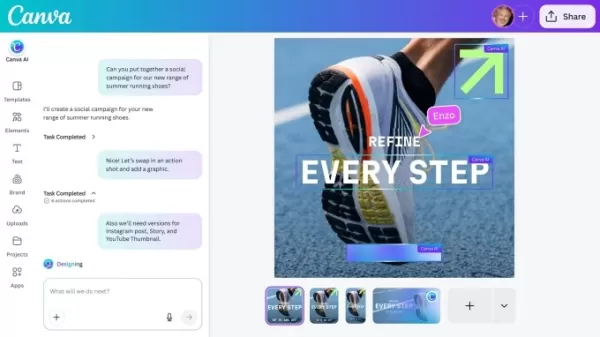
Image credit: CanvaImage credit:Canva
Canva's competitors are also pursuing similar goals. This week, Adobe launched a Firefly AI assistant that can use its various apps to perform tasks, and Figma last month integrated support for AI agents in its platforms using an MCP server.
Canva's co-founder and COO, Cliff Obrecht, noted that while many companies aim to consolidate workflows, businesses prefer to complete the final editing and publishing steps within Canva.
"Many small businesses begin and end their day within Canva, handling most of their workflows entirely here," Obrecht said. "We also work very well with Anthropic, Google, and OpenAI, so if someone uses agentic workflows in those products, they can call Canva, retrieve content, and bring it back to those LLMs. But they still need to complete the final mile of editing, collaboration, and deployment. That's where we truly excel," Obrecht added.
While a significant portion of Canva's revenue comes from individuals and small teams, its enterprise business is experiencing promising 100% year-over-year growth, Obrecht said. He added that the company, most recently valued at $42 billion according to PitchBook, will likely go public next year.
As part of this update, Canva is also adding integrations with Slack, Gmail, Google Drive, Calendar, and Zoom, allowing users to let the AI bot build context by reading emails, conversations, files, and meeting data. The company is also introducing a web research skill, enabling the AI bot to browse the internet to perform tasks.
The update also introduces scheduling, letting you instruct the AI bot to schedule repeatable tasks to run in the background. However, this feature will only create a draft for you to review and post.
Canva is also refining its existing AI tools. Its AI code generator can now import HTML, and users can use text prompts to describe the type of spreadsheets they want to generate.
The company reports that it has improved its AI models' efficiency, claiming its Lucid Origin image-generation model is now 5x faster and 30x cheaper, and its 12V image-to-video model is 7x faster and 17x cheaper.
Canva AI 2.0 launches in research preview this week, and the company plans to make it available to all users in the coming weeks.
Related article
 Ollie bets privacy focus to win AI assistant race
To be genuinely helpful, an AI assistant must understand its user deeply. Ollie, a personal assistant designed for daily life, operates on the premise that this doesn’t require surrendering your data or compromising your privacy.While certain enterpr
Viral AI Assistant Instinct Launches Dedicated Email Address
Instinct, the rapidly emerging AI assistant now valued at $2.5 billion, is launching a feature that empowers it to act more independently on behalf of users: every user now receives a dedicated Instinct email address.Founder Noah Shinn announced on T
AI Live: Rebuilding Workflows for the Future of Enterprise
AI LIVE: The London Summit takes place 20–21 October at Olympia, LondonLeaders from Ericsson and Adobe will address governance, scaling, and the future of enterprise AI at AI LIVE in LondonDeploying intelligent software is just the first step; AI age
Related Special Topic Recommendations
Text-to-speech
Ollie bets privacy focus to win AI assistant race
To be genuinely helpful, an AI assistant must understand its user deeply. Ollie, a personal assistant designed for daily life, operates on the premise that this doesn’t require surrendering your data or compromising your privacy.While certain enterpr
Viral AI Assistant Instinct Launches Dedicated Email Address
Instinct, the rapidly emerging AI assistant now valued at $2.5 billion, is launching a feature that empowers it to act more independently on behalf of users: every user now receives a dedicated Instinct email address.Founder Noah Shinn announced on T
AI Live: Rebuilding Workflows for the Future of Enterprise
AI LIVE: The London Summit takes place 20–21 October at Olympia, LondonLeaders from Ericsson and Adobe will address governance, scaling, and the future of enterprise AI at AI LIVE in LondonDeploying intelligent software is just the first step; AI age
Related Special Topic Recommendations
Text-to-speech
 Best AI Text to Speech Tools for Online Courses
2026 Latest Best Top-rated AI Text to Speech Tools for Online Courses are curated by XIX.AI based on rigorous real-world tests and weekly updated rankings. These powerful tools help creators deliver crystal-clear audio content effortlessly, boosting writing efficiency and streamlining course production. Check out the free vs paid comparison to find your perfect fit. Explore now to unlock your AI edge in online education.
 10 tools
 xix.ai
writing
AI Blog Title Tools for Higher Click Through Rates
xix.ai
writing
AI Blog Title Tools for Higher Click Through Rates
2026 Latest Best Top-Rated AI Blog Title Tools for Higher Click Through Rates! XIX.AI has carefully curated a powerful, game-changing collection of top tools that go through rigorous real-world tests. You’ll find a free vs paid comparison, weekly updated rankings, and detailed insights to help you boost your blog’s traffic efficiently. Must-try options are highlighted to help you unlock your AI edge. Explore now!
10 tools
xix.ai
automation
Best AI Task Routing Tools for Support Workflows
2026 Latest Best Top-rated AI Task Routing Tools for Support Workflows! XIX.AI has curated a highly powerful game-changing collection of must-try solutions, all undergoing rigorous real-world tests and updated weekly. These tools streamline workflows, boost productivity, and help teams deliver faster, more efficient support. Explore now to discover your perfect tool and unlock your AI edge!
17 tools
xix.ai
Academic Research
AI Citation and Paper Summary Tools
2026 Latest Best Top-Rated AI Citation and Paper Summary Tools Curated by XIX.AI. Get powerful game-changing solutions for quick content creation, improved writing efficiency, and boosting productivity. We offer a free vs paid comparison along with real-world tests and weekly updated rankings to help you find the must-try tool that fits your needs perfectly. Explore now to Unlock your AI edge.
10 tools
xix.ai
Productivity
Best AI Productivity Tools for Daily Work
2026 Latest Best Top-Rated AI Productivity Tools for Daily Work! XIX.AI has curated a powerful, game-changing selection based on rigorous weekly updated rankings and real-world tests. You’ll find must-try options that boost writing efficiency, streamline content creation, and help you overcome daily work challenges. Get a free vs paid comparison to find the perfect fit for your needs. Explore now to unlock your AI edge!
9 tools
xix.ai
Academic Research
AI Systematic Review Tools for Research Screening
2026 Latest Best Top-Rated AI Systematic Review Tools for Research Screening are here on XIX.AI! This curated collection includes powerful, game-changing solutions that go through rigorous real-world tests to deliver accurate results. We also offer a free vs paid comparison along with weekly updated rankings to help you find the must-try option that boosts your research efficiency significantly. Explore now to unlock your AI edge in academic work!
11 tools
xix.ai

 Comments (1)
0/500
Comments (1)
0/500
![PaulKing]()
Honestly, I'm both excited and a bit creeped out by Canva's new AI assistant. 😅 Like, sure, it'll save me from clicking through a million templates, but if the AI remembers my preferences and plans everything, where's the fun in designing? Feels like we're one step closer to robots making all the creative decisions. Hope they leave some room for human messiness.
New AI platforms promise to let you describe a task, have the assistant plan it and use the right tools, while remembering your preferences for future use. This is particularly valuable for design professionals who need a predictable, automated workflow for creating content and media assets.
Canva embraces this approach in its latest Canva AI assistant, which uses its AI model to generate editable designs from text prompts. Users describe what they want, and the bot calls the necessary tools to produce several options. The assistant builds designs in layers, allowing users to adjust various elements of the final output as needed.
This update follows Canva's efforts to position its AI assistant at the core of user workflows, adding capabilities like image generation and website creation.
Image credit: CanvaImage credit:Canva
Canva's competitors are also pursuing similar goals. This week, Adobe launched a Firefly AI assistant that can use its various apps to perform tasks, and Figma last month integrated support for AI agents in its platforms using an MCP server.
Canva's co-founder and COO, Cliff Obrecht, noted that while many companies aim to consolidate workflows, businesses prefer to complete the final editing and publishing steps within Canva.
"Many small businesses begin and end their day within Canva, handling most of their workflows entirely here," Obrecht said. "We also work very well with Anthropic, Google, and OpenAI, so if someone uses agentic workflows in those products, they can call Canva, retrieve content, and bring it back to those LLMs. But they still need to complete the final mile of editing, collaboration, and deployment. That's where we truly excel," Obrecht added.
While a significant portion of Canva's revenue comes from individuals and small teams, its enterprise business is experiencing promising 100% year-over-year growth, Obrecht said. He added that the company, most recently valued at $42 billion according to PitchBook, will likely go public next year.
As part of this update, Canva is also adding integrations with Slack, Gmail, Google Drive, Calendar, and Zoom, allowing users to let the AI bot build context by reading emails, conversations, files, and meeting data. The company is also introducing a web research skill, enabling the AI bot to browse the internet to perform tasks.
The update also introduces scheduling, letting you instruct the AI bot to schedule repeatable tasks to run in the background. However, this feature will only create a draft for you to review and post.
Canva is also refining its existing AI tools. Its AI code generator can now import HTML, and users can use text prompts to describe the type of spreadsheets they want to generate.
The company reports that it has improved its AI models' efficiency, claiming its Lucid Origin image-generation model is now 5x faster and 30x cheaper, and its 12V image-to-video model is 7x faster and 17x cheaper.
Canva AI 2.0 launches in research preview this week, and the company plans to make it available to all users in the coming weeks.








 Ollie bets privacy focus to win AI assistant race
To be genuinely helpful, an AI assistant must understand its user deeply. Ollie, a personal assistant designed for daily life, operates on the premise that this doesn’t require surrendering your data or compromising your privacy.While certain enterpr
Ollie bets privacy focus to win AI assistant race
To be genuinely helpful, an AI assistant must understand its user deeply. Ollie, a personal assistant designed for daily life, operates on the premise that this doesn’t require surrendering your data or compromising your privacy.While certain enterpr
 Viral AI Assistant Instinct Launches Dedicated Email Address
Instinct, the rapidly emerging AI assistant now valued at $2.5 billion, is launching a feature that empowers it to act more independently on behalf of users: every user now receives a dedicated Instinct email address.Founder Noah Shinn announced on T
Viral AI Assistant Instinct Launches Dedicated Email Address
Instinct, the rapidly emerging AI assistant now valued at $2.5 billion, is launching a feature that empowers it to act more independently on behalf of users: every user now receives a dedicated Instinct email address.Founder Noah Shinn announced on T
 AI Live: Rebuilding Workflows for the Future of Enterprise
AI LIVE: The London Summit takes place 20–21 October at Olympia, LondonLeaders from Ericsson and Adobe will address governance, scaling, and the future of enterprise AI at AI LIVE in LondonDeploying intelligent software is just the first step; AI age
AI Live: Rebuilding Workflows for the Future of Enterprise
AI LIVE: The London Summit takes place 20–21 October at Olympia, LondonLeaders from Ericsson and Adobe will address governance, scaling, and the future of enterprise AI at AI LIVE in LondonDeploying intelligent software is just the first step; AI age
2026 Latest Best Top-rated AI Text to Speech Tools for Online Courses are curated by XIX.AI based on rigorous real-world tests and weekly updated rankings. These powerful tools help creators deliver crystal-clear audio content effortlessly, boosting writing efficiency and streamlining course production. Check out the free vs paid comparison to find your perfect fit. Explore now to unlock your AI edge in online education.
10 tools
xix.ai
2026 Latest Best Top-Rated AI Blog Title Tools for Higher Click Through Rates! XIX.AI has carefully curated a powerful, game-changing collection of top tools that go through rigorous real-world tests. You’ll find a free vs paid comparison, weekly updated rankings, and detailed insights to help you boost your blog’s traffic efficiently. Must-try options are highlighted to help you unlock your AI edge. Explore now!
10 tools
xix.ai

2026 Latest Best Top-rated AI Task Routing Tools for Support Workflows! XIX.AI has curated a highly powerful game-changing collection of must-try solutions, all undergoing rigorous real-world tests and updated weekly. These tools streamline workflows, boost productivity, and help teams deliver faster, more efficient support. Explore now to discover your perfect tool and unlock your AI edge!
17 tools
xix.ai
2026 Latest Best Top-Rated AI Citation and Paper Summary Tools Curated by XIX.AI. Get powerful game-changing solutions for quick content creation, improved writing efficiency, and boosting productivity. We offer a free vs paid comparison along with real-world tests and weekly updated rankings to help you find the must-try tool that fits your needs perfectly. Explore now to Unlock your AI edge.
10 tools
xix.ai

2026 Latest Best Top-Rated AI Productivity Tools for Daily Work! XIX.AI has curated a powerful, game-changing selection based on rigorous weekly updated rankings and real-world tests. You’ll find must-try options that boost writing efficiency, streamline content creation, and help you overcome daily work challenges. Get a free vs paid comparison to find the perfect fit for your needs. Explore now to unlock your AI edge!
9 tools
xix.ai

2026 Latest Best Top-Rated AI Systematic Review Tools for Research Screening are here on XIX.AI! This curated collection includes powerful, game-changing solutions that go through rigorous real-world tests to deliver accurate results. We also offer a free vs paid comparison along with weekly updated rankings to help you find the must-try option that boosts your research efficiency significantly. Explore now to unlock your AI edge in academic work!
11 tools
xix.ai

Honestly, I'm both excited and a bit creeped out by Canva's new AI assistant. 😅 Like, sure, it'll save me from clicking through a million templates, but if the AI remembers my preferences and plans everything, where's the fun in designing? Feels like we're one step closer to robots making all the creative decisions. Hope they leave some room for human messiness.












