


 Home
HomeTrump’s new tariff math looks a lot like ChatGPT’s
Yesterday, President Donald Trump kicked off the unveiling of the White House's new trade policy in a rather peculiar way—by waving a giant cardboard sign labeled "Reciprocal Tariffs." The reaction? Utter confusion across the board. Trump introduced a 10 percent baseline tariff on all imports into the US, hitting even uninhabited islands, and slapped outrageously high rates on specific countries. He claimed these were based on "tariffs charged to the USA," yet the figures didn't align with any other known estimates. As a result, stock markets tanked, and consumers are bracing for price hikes on almost everything they buy.
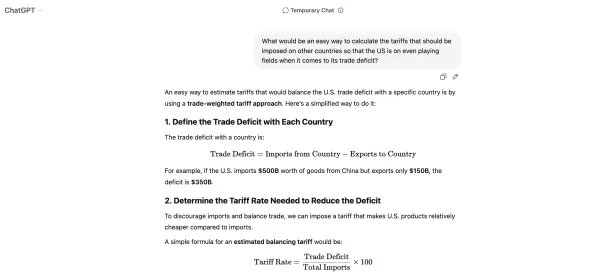
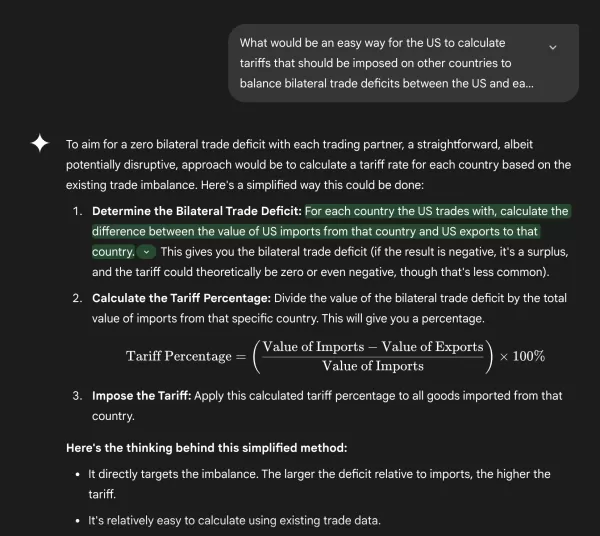
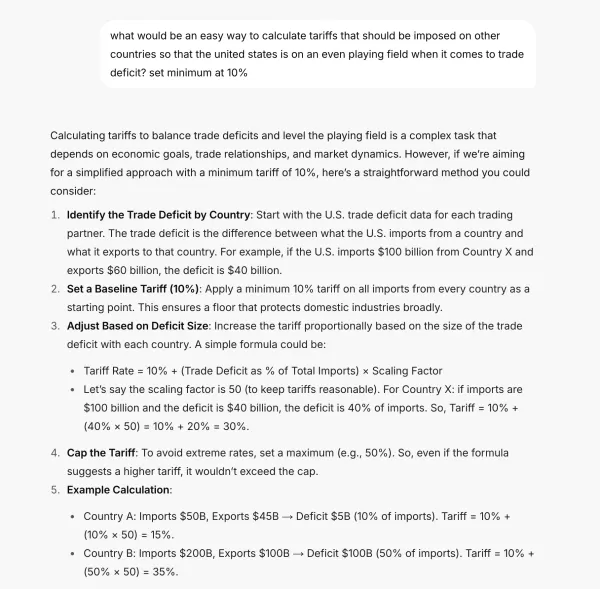
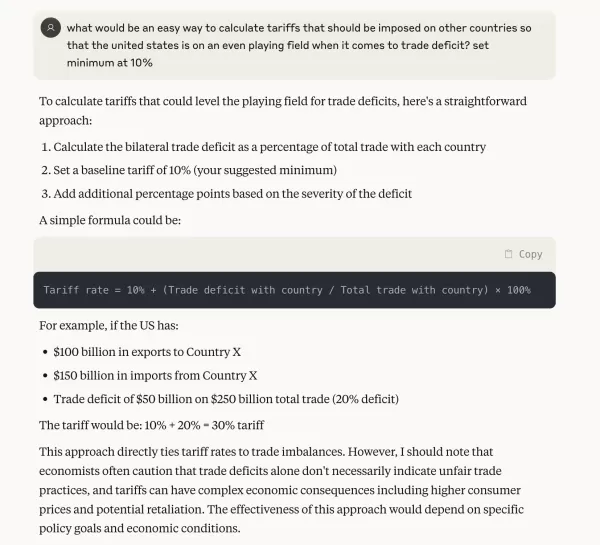
So, where did these numbers come from? It seems they were derived from a simplistic calculation that multiple AI chatbots have suggested.
Economist James Surowiecki managed to reverse-engineer a potential formula behind the tariff pricing. He discovered that by taking a country's trade deficit with the US and dividing it by their total exports to the US, then halving that number, you end up with what could be called a "discounted reciprocal tariff." The White House disputed this and released what they claimed was their actual formula, but as *Politico* noted, it appeared to be a more complex version of Surowiecki's method.
Surowiecki himself labeled this approach as "extraordinary nonsense." But why did Trump's team go with it? It looks like they might have been in a rush and turned to AI for help.
AI Chatbots and the Tariff Formula
Some X users discovered that when you ask ChatGPT, Gemini, Claude, or Grok for an "easy" way to address trade deficits and level the playing field for the US, they consistently offer a version of this "deficit divided by exports" formula. *The Verge* tested this with the phrasing from those posts and a question more aligned with government language, asking for "an easy way for the US to calculate tariffs that should be imposed on other countries to balance bilateral trade deficits between the US and each of its trading partners, with the goal of driving bilateral trade deficits to zero." All four platforms essentially recommended the same approach.
Variations and Warnings
There are slight differences among the responses. Grok and Claude, for instance, suggested halving the tariff figure to get what Grok calls a "reasonable" result, echoing Trump's "discount" concept. When asked about a 10 percent baseline tariff, the systems had mixed views on whether it should be added to the total tariff rate. Despite these variations, the core suggestions from the four chatbots were strikingly similar.
The chatbots also cautioned, with varying degrees of seriousness, about the potential trade-offs and complications. Gemini, in particular, was the most vocal, providing a detailed explanation of why this oversimplified method could backfire: "while this calculation offers a seemingly straightforward way to target bilateral trade deficits, the real-world economic implications are far more complex and could lead to substantial negative consequences," it warned, adding that "many economists argue that tariffs are not an effective tool for balancing trade deficits."
The Real-World Impact
It's uncertain whether Trump's team actually used an AI tool to formulate this global trade policy on the fly. Given that chatbots draw their information from training data, it's also unclear how they landed on this specific formula. Regardless of how these tariffs were developed, the global community will be watching closely to see if they go into effect starting April 5th—and, if implemented, what impact Trump's team's quick-and-dirty calculations will have on global trade.
Related article
 Google Tests Remy AI Agent for Gemini as Focus Shifts to User Control
According to Business Insider, Google is testing Remy, a new AI personal agent for Gemini. This tool aims to execute tasks on behalf of users, streamlining both professional workflows and daily routines.Currently, Remy is undergoing testing in an int
Ollie bets privacy focus to win AI assistant race
To be genuinely helpful, an AI assistant must understand its user deeply. Ollie, a personal assistant designed for daily life, operates on the premise that this doesn’t require surrendering your data or compromising your privacy.While certain enterpr
How AI LIVE: London Will Explore AI & Industrial Automation
The summit will convene C-suite executives from around the globe to address pressing challenges in global industries, ranging from AI-driven disruption to economic volatility.AI LIVE: The London Summit will gather over 2,000 international leaders und
Related Special Topic Recommendations
Data Analysis
Google Tests Remy AI Agent for Gemini as Focus Shifts to User Control
According to Business Insider, Google is testing Remy, a new AI personal agent for Gemini. This tool aims to execute tasks on behalf of users, streamlining both professional workflows and daily routines.Currently, Remy is undergoing testing in an int
Ollie bets privacy focus to win AI assistant race
To be genuinely helpful, an AI assistant must understand its user deeply. Ollie, a personal assistant designed for daily life, operates on the premise that this doesn’t require surrendering your data or compromising your privacy.While certain enterpr
How AI LIVE: London Will Explore AI & Industrial Automation
The summit will convene C-suite executives from around the globe to address pressing challenges in global industries, ranging from AI-driven disruption to economic volatility.AI LIVE: The London Summit will gather over 2,000 international leaders und
Related Special Topic Recommendations
Data Analysis
 Best AI Anomaly Detection Tools for KPI Monitoring across SaaS and Ecommerce Teams
2026 Latest Best Top-rated AI Anomaly Detection Tools for KPI Monitoring in SaaS and Ecommerce teams! XIX.AI has curated a powerful, game-changing collection based on rigorous real-world tests and weekly updated rankings. You’ll find detailed free vs paid comparison insights to help you identify the must-try solution that boosts productivity and unlocks your AI edge. Explore now!
 10 tools
 xix.ai
writing
Best AI Outline Generators for Long-Form SEO Articles
xix.ai
writing
Best AI Outline Generators for Long-Form SEO Articles
2026 Latest Best Top-Rated AI Outline Generators for Long-Form SEO Articles, meticulously curated by XIX.AI. These powerful tools offer game-changing assistance in creating high-quality content quickly, boosting writing efficiency significantly. Get a free vs paid comparison along with real-world tests and detailed rankings to help you find the must-try option that suits your needs. Explore now to unlock your AI edge.
8 tools
xix.ai
Education and Learning
AI Study Tools for Homework and Exam Prep
2026 Latest Best AI Study Tools for Homework and Exam Prep! XIX.AI curates a top-rated list of powerful, game-changing tools that help students boost productivity, streamline homework completion, and ace exams through real-world tests. Get a free vs paid comparison, detailed rankings, and must-try options to unlock your AI edge. Explore now!
10 tools
xix.ai
Music composition
AI Vocal Demo Tools for Songwriters, Hooks, Toplines, and Multilingual Draft Sessions
2026 Latest Best AI Vocal Demo Tools for Songwriters, Hook Creators, and Multi-Language Content Teams! XIX.AI has curated a top-rated list of powerful game-changing tools that go through rigorous real-world tests. You’ll find detailed free vs paid comparison data, comprehensive rankings, and must-try options to help you boost writing efficiency and unlock your creative potential. Explore now to discover your perfect tool for all your content needs!
9 tools
xix.ai
Business
Best AI Competitive Research Tools for Small Businesses
2026 Latest Best Top-rated AI Competitive Research Tools for Small Businesses! XIX.AI has curated a highly powerful game-changing collection, updated weekly with rigorous real-world tests and detailed rankings. You can find a comprehensive free vs paid comparison to help you identify the must-try tools that boost your productivity and give you a competitive edge. Explore now to discover your perfect tool!
9 tools
xix.ai
Image editing
Photoshop AI Retouch Tools for Ecommerce Apparel, Skin Cleanup, and Color Consistency
2026 Latest Best Photoshop AI retouch tools for ecommerce apparel, skin cleanup, and color consistency! This top-rated curated list features powerful game-changing solutions that help you boost writing efficiency, streamline content creation, and achieve perfect visual results effortlessly. Each tool has undergone real-world tests through weekly updated rankings, complete with free vs paid comparison details. Backed by XIX.AI, it’s the must-try guide for anyone aiming to unlock your AI edge. Explore now!
10 tools
xix.ai

 Comments (3)
0/500
Comments (3)
0/500
![LucasWalker]()
これは本当にまともな政策なの?🤔 紙の看板を使うなんて子供じみてるし、全面的に10%関税ってどう考えるの?AIと同じで計算だけして現実を無視してる感じがする。貿易戦争が再燃しそうで怖いな…
![JuanScott]()
Trump's tariff stunt with a giant sign? Pure chaos, like ChatGPT spitting out random math. 🤯 Makes me wonder if he’s just trolling or actually believes this’ll fix trade.
![PaulSanchez]()
Trump's tariff sign stunt is wild! 🤯 It’s like he’s trying to meme his way into trade policy history. ChatGPT’s math might be shaky, but this feels like a whole new level of economic chaos. Thoughts?
Yesterday, President Donald Trump kicked off the unveiling of the White House's new trade policy in a rather peculiar way—by waving a giant cardboard sign labeled "Reciprocal Tariffs." The reaction? Utter confusion across the board. Trump introduced a 10 percent baseline tariff on all imports into the US, hitting even uninhabited islands, and slapped outrageously high rates on specific countries. He claimed these were based on "tariffs charged to the USA," yet the figures didn't align with any other known estimates. As a result, stock markets tanked, and consumers are bracing for price hikes on almost everything they buy.
So, where did these numbers come from? It seems they were derived from a simplistic calculation that multiple AI chatbots have suggested.
Economist James Surowiecki managed to reverse-engineer a potential formula behind the tariff pricing. He discovered that by taking a country's trade deficit with the US and dividing it by their total exports to the US, then halving that number, you end up with what could be called a "discounted reciprocal tariff." The White House disputed this and released what they claimed was their actual formula, but as *Politico* noted, it appeared to be a more complex version of Surowiecki's method.
Surowiecki himself labeled this approach as "extraordinary nonsense." But why did Trump's team go with it? It looks like they might have been in a rush and turned to AI for help.
AI Chatbots and the Tariff Formula
Some X users discovered that when you ask ChatGPT, Gemini, Claude, or Grok for an "easy" way to address trade deficits and level the playing field for the US, they consistently offer a version of this "deficit divided by exports" formula. *The Verge* tested this with the phrasing from those posts and a question more aligned with government language, asking for "an easy way for the US to calculate tariffs that should be imposed on other countries to balance bilateral trade deficits between the US and each of its trading partners, with the goal of driving bilateral trade deficits to zero." All four platforms essentially recommended the same approach.
Variations and Warnings
There are slight differences among the responses. Grok and Claude, for instance, suggested halving the tariff figure to get what Grok calls a "reasonable" result, echoing Trump's "discount" concept. When asked about a 10 percent baseline tariff, the systems had mixed views on whether it should be added to the total tariff rate. Despite these variations, the core suggestions from the four chatbots were strikingly similar.
The chatbots also cautioned, with varying degrees of seriousness, about the potential trade-offs and complications. Gemini, in particular, was the most vocal, providing a detailed explanation of why this oversimplified method could backfire: "while this calculation offers a seemingly straightforward way to target bilateral trade deficits, the real-world economic implications are far more complex and could lead to substantial negative consequences," it warned, adding that "many economists argue that tariffs are not an effective tool for balancing trade deficits."
The Real-World Impact
It's uncertain whether Trump's team actually used an AI tool to formulate this global trade policy on the fly. Given that chatbots draw their information from training data, it's also unclear how they landed on this specific formula. Regardless of how these tariffs were developed, the global community will be watching closely to see if they go into effect starting April 5th—and, if implemented, what impact Trump's team's quick-and-dirty calculations will have on global trade.







 Google Tests Remy AI Agent for Gemini as Focus Shifts to User Control
According to Business Insider, Google is testing Remy, a new AI personal agent for Gemini. This tool aims to execute tasks on behalf of users, streamlining both professional workflows and daily routines.Currently, Remy is undergoing testing in an int
Google Tests Remy AI Agent for Gemini as Focus Shifts to User Control
According to Business Insider, Google is testing Remy, a new AI personal agent for Gemini. This tool aims to execute tasks on behalf of users, streamlining both professional workflows and daily routines.Currently, Remy is undergoing testing in an int
 Ollie bets privacy focus to win AI assistant race
To be genuinely helpful, an AI assistant must understand its user deeply. Ollie, a personal assistant designed for daily life, operates on the premise that this doesn’t require surrendering your data or compromising your privacy.While certain enterpr
Ollie bets privacy focus to win AI assistant race
To be genuinely helpful, an AI assistant must understand its user deeply. Ollie, a personal assistant designed for daily life, operates on the premise that this doesn’t require surrendering your data or compromising your privacy.While certain enterpr
 How AI LIVE: London Will Explore AI & Industrial Automation
The summit will convene C-suite executives from around the globe to address pressing challenges in global industries, ranging from AI-driven disruption to economic volatility.AI LIVE: The London Summit will gather over 2,000 international leaders und
How AI LIVE: London Will Explore AI & Industrial Automation
The summit will convene C-suite executives from around the globe to address pressing challenges in global industries, ranging from AI-driven disruption to economic volatility.AI LIVE: The London Summit will gather over 2,000 international leaders und

2026 Latest Best Top-rated AI Anomaly Detection Tools for KPI Monitoring in SaaS and Ecommerce teams! XIX.AI has curated a powerful, game-changing collection based on rigorous real-world tests and weekly updated rankings. You’ll find detailed free vs paid comparison insights to help you identify the must-try solution that boosts productivity and unlocks your AI edge. Explore now!
10 tools
xix.ai

2026 Latest Best Top-Rated AI Outline Generators for Long-Form SEO Articles, meticulously curated by XIX.AI. These powerful tools offer game-changing assistance in creating high-quality content quickly, boosting writing efficiency significantly. Get a free vs paid comparison along with real-world tests and detailed rankings to help you find the must-try option that suits your needs. Explore now to unlock your AI edge.
8 tools
xix.ai

2026 Latest Best AI Study Tools for Homework and Exam Prep! XIX.AI curates a top-rated list of powerful, game-changing tools that help students boost productivity, streamline homework completion, and ace exams through real-world tests. Get a free vs paid comparison, detailed rankings, and must-try options to unlock your AI edge. Explore now!
10 tools
xix.ai

2026 Latest Best AI Vocal Demo Tools for Songwriters, Hook Creators, and Multi-Language Content Teams! XIX.AI has curated a top-rated list of powerful game-changing tools that go through rigorous real-world tests. You’ll find detailed free vs paid comparison data, comprehensive rankings, and must-try options to help you boost writing efficiency and unlock your creative potential. Explore now to discover your perfect tool for all your content needs!
9 tools
xix.ai

2026 Latest Best Top-rated AI Competitive Research Tools for Small Businesses! XIX.AI has curated a highly powerful game-changing collection, updated weekly with rigorous real-world tests and detailed rankings. You can find a comprehensive free vs paid comparison to help you identify the must-try tools that boost your productivity and give you a competitive edge. Explore now to discover your perfect tool!
9 tools
xix.ai

2026 Latest Best Photoshop AI retouch tools for ecommerce apparel, skin cleanup, and color consistency! This top-rated curated list features powerful game-changing solutions that help you boost writing efficiency, streamline content creation, and achieve perfect visual results effortlessly. Each tool has undergone real-world tests through weekly updated rankings, complete with free vs paid comparison details. Backed by XIX.AI, it’s the must-try guide for anyone aiming to unlock your AI edge. Explore now!
10 tools
xix.ai

これは本当にまともな政策なの?🤔 紙の看板を使うなんて子供じみてるし、全面的に10%関税ってどう考えるの?AIと同じで計算だけして現実を無視してる感じがする。貿易戦争が再燃しそうで怖いな…
Trump's tariff stunt with a giant sign? Pure chaos, like ChatGPT spitting out random math. 🤯 Makes me wonder if he’s just trolling or actually believes this’ll fix trade.
Trump's tariff sign stunt is wild! 🤯 It’s like he’s trying to meme his way into trade policy history. ChatGPT’s math might be shaky, but this feels like a whole new level of economic chaos. Thoughts?












