


 Home
HomeTencent Hunyuan Unveils Hy-Memory: 45% More Memory, 35% Lower Token Cost
Long-term collaborative AI agents often experience a frustrating "three-week trajectory": the first week impresses, the second week brings unease as memory lapses and drifting understanding become apparent, and by the third week, they degrade into basic instant query tools. To address the challenges of fragmented memory and chaotic timelines in extended collaboration, Tencent Hunyuan today (May 28, 2026) launched Hy-Memory, a smart memory plugin built for long-term collaborative agents like Openclaw — Hy-Memory.
As the "second brain" of an agent, Hy-Memory outperforms mainstream frameworks on the authoritative public benchmarks LongMemEval and PersonaMem, thanks to three core technologies. Evaluation data shows that Hy-Memory reduces memory volume by over 70% while increasing per-memory information density by more than 45%; for long-context processing, token consumption drops by 35%, and memory update speed improves by 20%.
Three Core Technologies Reshaping the AI Memory Mechanism
Layer One: The Six-Level Memory Framework (Precise Placement)
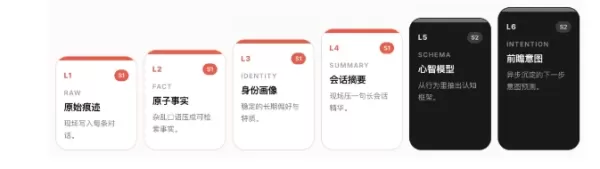
Hy-Memory avoids dumping all information into the vector database at once. Instead, it decomposes memory into six levels: L1 raw traces, L2 atomic facts, L3 identity profiles, L4 session summaries, L5 mental models, and L6 prospective intentions. It precisely invokes the relevant level based on user queries, streamlining prompts and preventing irrelevant text from diluting the model's attention.
Layer Two: The System1/System2 Dual Systems (Balancing Speed and Depth)
Memory processing is split into two independent channels: System1 (day shift mode) extracts facts and updates summaries (L1-L4) in real time, within one second of the user pressing enter, so the information is ready for the next conversation; System2 (night shift mode) runs asynchronously in the background, taking seconds to minutes to deeply consolidate the user's mental models and knowledge networks (L5-L6), making the agent smarter over time without blocking the main process.
Layer Three: The Evolutionary Chain Mechanism (Preserving Causal Traces)
This is Hy-Memory's secret weapon. When users change their views or habits, traditional systems either "overwrite the old with the new," losing historical experience, or "pile up disorderly," causing incorrect recall. Hy-Memory links new and old memories into an "evolutionary chain" via the supersedes pointer. Once any node in the chain is triggered, the entire evolutionary path unfolds automatically. The agent not only remembers the user's latest conclusion but also revisits the full evolution of their attitude, thereby avoiding past "pitfalls."
Extreme Performance and 5-Minute Rapid Deployment
For performance, Hy-Memory achieves ultra-fast write speeds comparable to mem0 (8 times faster than Graphiti), while using only one-third the number of memories. It uses local embedded storage by default, and no Docker deployment, external services, or Qdrant database are required, with data automatically persisted locally.
To adapt to different hardware and scenario needs, Hy-Memory offers Lite (Lightweight), Pro (Professional), and Ultra (Ultimate) configurations. These three tiers share the same SDK, and switching between them is seamless by simply changing switches. The project has officially launched, and users can find more guides through its official website or user documentation
Related article
 Suno to Watermark Songs Amid Legal Battles
Suno, the platform enabling users to generate AI-created music, has unveiled new features to label platform-produced tracks, restrict downloads, and update community standards to curb unauthorized replicas. These updates arrive as Suno confronts mult
Musk Admits Grok Build Leaked User Code, Promises to Erase All Historical Data
Elon Musk directly addressed the privacy controversy surrounding Grok Build, beginning with a simple "True" to confirm the incident's validity. He pledged that all user data previously uploaded to SpaceXAI would be permanently erased, stating, "not a
U.S. Stocks Hit Historic Milestone as AI and Aerospace Giants Prepare for Trillion-Dollar Debut
Elon Musk, Sam Altman, and Dario Amodei, three titans of the technology sector, are advancing toward initial public offerings for their respective ventures. With SpaceX, OpenAI, and Anthropic—three industry behemoths nearing trillion-dollar valuation
Related Special Topic Recommendations
SEO
Suno to Watermark Songs Amid Legal Battles
Suno, the platform enabling users to generate AI-created music, has unveiled new features to label platform-produced tracks, restrict downloads, and update community standards to curb unauthorized replicas. These updates arrive as Suno confronts mult
Musk Admits Grok Build Leaked User Code, Promises to Erase All Historical Data
Elon Musk directly addressed the privacy controversy surrounding Grok Build, beginning with a simple "True" to confirm the incident's validity. He pledged that all user data previously uploaded to SpaceXAI would be permanently erased, stating, "not a
U.S. Stocks Hit Historic Milestone as AI and Aerospace Giants Prepare for Trillion-Dollar Debut
Elon Musk, Sam Altman, and Dario Amodei, three titans of the technology sector, are advancing toward initial public offerings for their respective ventures. With SpaceX, OpenAI, and Anthropic—three industry behemoths nearing trillion-dollar valuation
Related Special Topic Recommendations
SEO
 Best AI SERP Analysis Tools for Search Strategy
2026 Latest Best Top-rated AI SERP Analysis Tools for Search Strategy are curated by XIX.AI through rigorous real-world tests and weekly updated rankings. These powerful tools help you unlock hidden optimization opportunities, boost content performance, and gain a competitive edge in search. Discover your perfect tool to elevate your search strategy today. Explore now!
 13 tools
 xix.ai
Data Analysis
Best AI Anomaly Detection Tools for KPI Monitoring across SaaS and Ecommerce Teams
xix.ai
Data Analysis
Best AI Anomaly Detection Tools for KPI Monitoring across SaaS and Ecommerce Teams
2026 Latest Best Top-rated AI Anomaly Detection Tools for KPI Monitoring in SaaS and Ecommerce teams! XIX.AI has curated a powerful, game-changing collection based on rigorous real-world tests and weekly updated rankings. You’ll find detailed free vs paid comparison insights to help you identify the must-try solution that boosts productivity and unlocks your AI edge. Explore now!
10 tools
xix.ai
writing
Best AI Outline Generators for Long-Form SEO Articles
2026 Latest Best Top-Rated AI Outline Generators for Long-Form SEO Articles, meticulously curated by XIX.AI. These powerful tools offer game-changing assistance in creating high-quality content quickly, boosting writing efficiency significantly. Get a free vs paid comparison along with real-world tests and detailed rankings to help you find the must-try option that suits your needs. Explore now to unlock your AI edge.
8 tools
xix.ai
Education and Learning
AI Study Tools for Homework and Exam Prep
2026 Latest Best AI Study Tools for Homework and Exam Prep! XIX.AI curates a top-rated list of powerful, game-changing tools that help students boost productivity, streamline homework completion, and ace exams through real-world tests. Get a free vs paid comparison, detailed rankings, and must-try options to unlock your AI edge. Explore now!
10 tools
xix.ai
Music composition
AI Vocal Demo Tools for Songwriters, Hooks, Toplines, and Multilingual Draft Sessions
2026 Latest Best AI Vocal Demo Tools for Songwriters, Hook Creators, and Multi-Language Content Teams! XIX.AI has curated a top-rated list of powerful game-changing tools that go through rigorous real-world tests. You’ll find detailed free vs paid comparison data, comprehensive rankings, and must-try options to help you boost writing efficiency and unlock your creative potential. Explore now to discover your perfect tool for all your content needs!
9 tools
xix.ai
Business
Best AI Competitive Research Tools for Small Businesses
2026 Latest Best Top-rated AI Competitive Research Tools for Small Businesses! XIX.AI has curated a highly powerful game-changing collection, updated weekly with rigorous real-world tests and detailed rankings. You can find a comprehensive free vs paid comparison to help you identify the must-try tools that boost your productivity and give you a competitive edge. Explore now to discover your perfect tool!
9 tools
xix.ai

 Comments (0)
0/500
Comments (0)
0/500
Long-term collaborative AI agents often experience a frustrating "three-week trajectory": the first week impresses, the second week brings unease as memory lapses and drifting understanding become apparent, and by the third week, they degrade into basic instant query tools. To address the challenges of fragmented memory and chaotic timelines in extended collaboration, Tencent Hunyuan today (May 28, 2026) launched Hy-Memory, a smart memory plugin built for long-term collaborative agents like Openclaw — Hy-Memory.
As the "second brain" of an agent, Hy-Memory outperforms mainstream frameworks on the authoritative public benchmarks LongMemEval and PersonaMem, thanks to three core technologies. Evaluation data shows that Hy-Memory reduces memory volume by over 70% while increasing per-memory information density by more than 45%; for long-context processing, token consumption drops by 35%, and memory update speed improves by 20%.
Three Core Technologies Reshaping the AI Memory Mechanism
Layer One: The Six-Level Memory Framework (Precise Placement)
Hy-Memory avoids dumping all information into the vector database at once. Instead, it decomposes memory into six levels: L1 raw traces, L2 atomic facts, L3 identity profiles, L4 session summaries, L5 mental models, and L6 prospective intentions. It precisely invokes the relevant level based on user queries, streamlining prompts and preventing irrelevant text from diluting the model's attention.
Layer Two: The System1/System2 Dual Systems (Balancing Speed and Depth)
Memory processing is split into two independent channels: System1 (day shift mode) extracts facts and updates summaries (L1-L4) in real time, within one second of the user pressing enter, so the information is ready for the next conversation; System2 (night shift mode) runs asynchronously in the background, taking seconds to minutes to deeply consolidate the user's mental models and knowledge networks (L5-L6), making the agent smarter over time without blocking the main process.
Layer Three: The Evolutionary Chain Mechanism (Preserving Causal Traces)
This is Hy-Memory's secret weapon. When users change their views or habits, traditional systems either "overwrite the old with the new," losing historical experience, or "pile up disorderly," causing incorrect recall. Hy-Memory links new and old memories into an "evolutionary chain" via the supersedes pointer. Once any node in the chain is triggered, the entire evolutionary path unfolds automatically. The agent not only remembers the user's latest conclusion but also revisits the full evolution of their attitude, thereby avoiding past "pitfalls."
Extreme Performance and 5-Minute Rapid Deployment
For performance, Hy-Memory achieves ultra-fast write speeds comparable to mem0 (8 times faster than Graphiti), while using only one-third the number of memories. It uses local embedded storage by default, and no Docker deployment, external services, or Qdrant database are required, with data automatically persisted locally.
To adapt to different hardware and scenario needs, Hy-Memory offers Lite (Lightweight), Pro (Professional), and Ultra (Ultimate) configurations. These three tiers share the same SDK, and switching between them is seamless by simply changing switches. The project has officially launched, and users can find more guides through its








 Suno to Watermark Songs Amid Legal Battles
Suno, the platform enabling users to generate AI-created music, has unveiled new features to label platform-produced tracks, restrict downloads, and update community standards to curb unauthorized replicas. These updates arrive as Suno confronts mult
Suno to Watermark Songs Amid Legal Battles
Suno, the platform enabling users to generate AI-created music, has unveiled new features to label platform-produced tracks, restrict downloads, and update community standards to curb unauthorized replicas. These updates arrive as Suno confronts mult
 Musk Admits Grok Build Leaked User Code, Promises to Erase All Historical Data
Elon Musk directly addressed the privacy controversy surrounding Grok Build, beginning with a simple "True" to confirm the incident's validity. He pledged that all user data previously uploaded to SpaceXAI would be permanently erased, stating, "not a
Musk Admits Grok Build Leaked User Code, Promises to Erase All Historical Data
Elon Musk directly addressed the privacy controversy surrounding Grok Build, beginning with a simple "True" to confirm the incident's validity. He pledged that all user data previously uploaded to SpaceXAI would be permanently erased, stating, "not a
 U.S. Stocks Hit Historic Milestone as AI and Aerospace Giants Prepare for Trillion-Dollar Debut
Elon Musk, Sam Altman, and Dario Amodei, three titans of the technology sector, are advancing toward initial public offerings for their respective ventures. With SpaceX, OpenAI, and Anthropic—three industry behemoths nearing trillion-dollar valuation
U.S. Stocks Hit Historic Milestone as AI and Aerospace Giants Prepare for Trillion-Dollar Debut
Elon Musk, Sam Altman, and Dario Amodei, three titans of the technology sector, are advancing toward initial public offerings for their respective ventures. With SpaceX, OpenAI, and Anthropic—three industry behemoths nearing trillion-dollar valuation

2026 Latest Best Top-rated AI SERP Analysis Tools for Search Strategy are curated by XIX.AI through rigorous real-world tests and weekly updated rankings. These powerful tools help you unlock hidden optimization opportunities, boost content performance, and gain a competitive edge in search. Discover your perfect tool to elevate your search strategy today. Explore now!
13 tools
xix.ai

2026 Latest Best Top-rated AI Anomaly Detection Tools for KPI Monitoring in SaaS and Ecommerce teams! XIX.AI has curated a powerful, game-changing collection based on rigorous real-world tests and weekly updated rankings. You’ll find detailed free vs paid comparison insights to help you identify the must-try solution that boosts productivity and unlocks your AI edge. Explore now!
10 tools
xix.ai

2026 Latest Best Top-Rated AI Outline Generators for Long-Form SEO Articles, meticulously curated by XIX.AI. These powerful tools offer game-changing assistance in creating high-quality content quickly, boosting writing efficiency significantly. Get a free vs paid comparison along with real-world tests and detailed rankings to help you find the must-try option that suits your needs. Explore now to unlock your AI edge.
8 tools
xix.ai

2026 Latest Best AI Study Tools for Homework and Exam Prep! XIX.AI curates a top-rated list of powerful, game-changing tools that help students boost productivity, streamline homework completion, and ace exams through real-world tests. Get a free vs paid comparison, detailed rankings, and must-try options to unlock your AI edge. Explore now!
10 tools
xix.ai

2026 Latest Best AI Vocal Demo Tools for Songwriters, Hook Creators, and Multi-Language Content Teams! XIX.AI has curated a top-rated list of powerful game-changing tools that go through rigorous real-world tests. You’ll find detailed free vs paid comparison data, comprehensive rankings, and must-try options to help you boost writing efficiency and unlock your creative potential. Explore now to discover your perfect tool for all your content needs!
9 tools
xix.ai

2026 Latest Best Top-rated AI Competitive Research Tools for Small Businesses! XIX.AI has curated a highly powerful game-changing collection, updated weekly with rigorous real-world tests and detailed rankings. You can find a comprehensive free vs paid comparison to help you identify the must-try tools that boost your productivity and give you a competitive edge. Explore now to discover your perfect tool!
9 tools
xix.ai












