


 Home
HomePlease provide the original article title?
Future-Proof Your AI Strategy: A Leadership Guide
- Overview
- What AI and Machine Learning Really Mean
- Why Data Powers Machine Learning
- The Next Phase of AI and Data Manipulation
- How AI Drives Business Transformation
- Where AI Falls Short and Why Human Qualities Matter
- Designing Systems for Human‑AI Collaboration
- Final Thoughts
- References
- Glossary
Artificial intelligence is reshaping how businesses operate, and leaders need a clear grasp of its implications to craft strategies that secure a competitive edge. Yet with the constant buzz and rapid progress in AI, it’s easy to get lost in complex jargon, struggle to keep pace with evolving technology, and struggle to deliver value quickly. This article cuts through the noise to give you the essential knowledge and a practical framework for making smart decisions about AI.
Understanding AI and Machine Learning
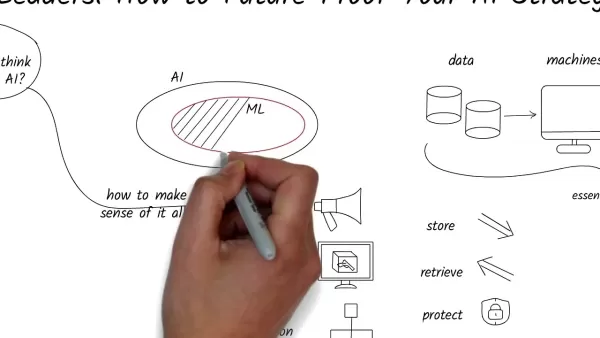
Most of what we call AI today is actually a subset known as machine learning (ML). ML uses data to train machines to build models that mimic human intelligence. With ML techniques, computers can learn to understand speech, recognize objects, classify data, make predictions, spot trends and patterns, and automate decisions. Generative AI, a branch of ML, creates content such as text and images, and tools like ChatGPT, Bard, Dall‑E, and Midjourney have captured widespread attention.
The Power of Data in Machine Learning
Everything in ML comes down to one thing: data. Machine learning is essentially about extracting insights from data using various techniques. Imagine having access to all the world’s data—what could you do with it? The answer is almost limitless. That’s exactly what ML systems do today. Instead of focusing on what AI can do, think about data itself and the possibilities it opens up, now and in the future.
When generative AI creates a new painting in the style of Van Gogh, it’s generating new data based on existing data. When an ML model predicts disease probability by analyzing patient symptoms, it identifies patterns learned from training data. When AI converts speech to text, it’s transforming one form of data into another. If you consider what you can achieve with data today or tomorrow, you’ll have a solid grasp of what AI can accomplish.
The Future of AI and Data Manipulation
In the future, we might generate entirely new DNA sequences to form stronger life forms. We could integrate data across different fields to spark innovations. We could analyze all data surrounding a single object, like a financial transaction or a person’s health. Once you realize that most current AI and ML is essentially data manipulation, you can imagine applying that concept across your business.
For example, when a customer interacts with your company, they shouldn’t have to fill out long forms—they should be able to speak naturally. Behind the scenes, data can be pulled together to answer their questions. As a leader, if you want to know how your company is performing this quarter, you should be able to ask and receive an answer in any format you prefer. In such scenarios, AI understands your query, translates it into code that accesses data through models, prioritizes answers based on context, converts the result into your desired format, and delivers it. That data may come from one or multiple sources in different formats.
The Role of AI in Business Transformation
A leader deciding how to integrate AI doesn’t need to understand generative AI or voice recognition inside out. What matters is understanding how data can be manipulated to improve the customer experience. After exploring these scenarios with peers, the leadership team can make collective decisions from a business vision standpoint, which technologists can then implement—provided assumptions like data availability are validated.
As you scale AI initiatives across products, compliance, intellectual property, data governance, and model risk can’t be afterthoughts. Working with AI legal specialists early helps operationalize responsible AI—drafting model‑use policies, negotiating vendor terms, and aligning systems with fast‑changing regulations—while still enabling innovation. Involve counsel from the start to embed risk controls into your roadmap and keep transformation momentum without regulatory surprises.
The Limitations of AI and the Importance of Human Qualities
When leaders ground AI decisions purely on data manipulation, it becomes clear what AI cannot do. Data cannot convey passion, empathy, feeling, love, or creativity that exists outside the dataset. Only humans can provide those qualities. And despite impressive advances in ML, we haven’t yet figured out how to infuse data with these human traits. Perhaps our approach to mimicking human intelligence has been wrong—it may not be about data at all, but about chemistry.
Building Processes and Systems for Human‑AI Collaboration
If leaders can clearly articulate AI’s possibilities using data as the foundation, they can accelerate their organization’s transformation by designing processes and systems where humans and AI complement each other. In a hospital setting, for instance, leaders can identify where AI and technology can contribute and where human involvement is most effective—meeting patient needs, upskilling employees, deploying the right technology, and building robust processes all aligned with the company’s vision.
Conclusion
AI is changing the business landscape, and leaders must fully understand its implications to craft strategies that give their companies a competitive advantage. By grasping the power of data in machine learning, the future of AI and data manipulation, AI’s role in business transformation, its limitations and the importance of human qualities, and how to build systems for human‑AI collaboration, leaders can make intelligent decisions about AI and future‑proof their strategy.
References
- "What Is Artificial Intelligence (AI)?" IBM. https://www.ibm.com/cloud/learn/what-is-artificial-intelligence
- "What Is Machine Learning?" AWS. https://aws.amazon.com/machine-learning/what-is-machine-learning/
- "Generative AI: The Next Step in AI's Evolution." Forbes. https://www.forbes.com/sites/forbestechcouncil/2021/03/08/generative-ai-the-next-step-in-ais-evolution/?sh=5d5c5c5c5c5c
- "The Future of AI: 10 Predictions for 2021 and Beyond." Forbes. https://www.forbes.com/sites/forbestechcouncil/2021/01/11/the-future-of-ai-10-predictions-for-2021-and-beyond/?sh=5d5c5c5c5c5c
- "The Role of AI in Business Transformation." Harvard Business Review. https://hbr.org/2021/03/the-role-of-ai-in-business-transformation
Glossary
- AI: Artificial Intelligence
- ML: Machine Learning
- DNA: Deoxyribonucleic Acid
Related article
 U.S. Stocks Hit Historic Milestone as AI and Aerospace Giants Prepare for Trillion-Dollar Debut
Elon Musk, Sam Altman, and Dario Amodei, three titans of the technology sector, are advancing toward initial public offerings for their respective ventures. With SpaceX, OpenAI, and Anthropic—three industry behemoths nearing trillion-dollar valuation
Swedish AI Startup Lovable Eyes $13.2 Billion Valuation After Major Funding Round
As AI-driven coding tools gain traction, Swedish startup Lovable has secured a major funding round. The company aims to raise $3 billion, potentially boosting its valuation to $13.2 billion—double the $6.6 billion recorded last December. Menlo Ventur
Google Tests Remy AI Agent for Gemini as Focus Shifts to User Control
According to Business Insider, Google is testing Remy, a new AI personal agent for Gemini. This tool aims to execute tasks on behalf of users, streamlining both professional workflows and daily routines.Currently, Remy is undergoing testing in an int
Related Special Topic Recommendations
Data Analysis
U.S. Stocks Hit Historic Milestone as AI and Aerospace Giants Prepare for Trillion-Dollar Debut
Elon Musk, Sam Altman, and Dario Amodei, three titans of the technology sector, are advancing toward initial public offerings for their respective ventures. With SpaceX, OpenAI, and Anthropic—three industry behemoths nearing trillion-dollar valuation
Swedish AI Startup Lovable Eyes $13.2 Billion Valuation After Major Funding Round
As AI-driven coding tools gain traction, Swedish startup Lovable has secured a major funding round. The company aims to raise $3 billion, potentially boosting its valuation to $13.2 billion—double the $6.6 billion recorded last December. Menlo Ventur
Google Tests Remy AI Agent for Gemini as Focus Shifts to User Control
According to Business Insider, Google is testing Remy, a new AI personal agent for Gemini. This tool aims to execute tasks on behalf of users, streamlining both professional workflows and daily routines.Currently, Remy is undergoing testing in an int
Related Special Topic Recommendations
Data Analysis
 Best AI Anomaly Detection Tools for KPI Monitoring across SaaS and Ecommerce Teams
2026 Latest Best Top-rated AI Anomaly Detection Tools for KPI Monitoring in SaaS and Ecommerce teams! XIX.AI has curated a powerful, game-changing collection based on rigorous real-world tests and weekly updated rankings. You’ll find detailed free vs paid comparison insights to help you identify the must-try solution that boosts productivity and unlocks your AI edge. Explore now!
 10 tools
 xix.ai
writing
Best AI Outline Generators for Long-Form SEO Articles
xix.ai
writing
Best AI Outline Generators for Long-Form SEO Articles
2026 Latest Best Top-Rated AI Outline Generators for Long-Form SEO Articles, meticulously curated by XIX.AI. These powerful tools offer game-changing assistance in creating high-quality content quickly, boosting writing efficiency significantly. Get a free vs paid comparison along with real-world tests and detailed rankings to help you find the must-try option that suits your needs. Explore now to unlock your AI edge.
8 tools
xix.ai
Education and Learning
AI Study Tools for Homework and Exam Prep
2026 Latest Best AI Study Tools for Homework and Exam Prep! XIX.AI curates a top-rated list of powerful, game-changing tools that help students boost productivity, streamline homework completion, and ace exams through real-world tests. Get a free vs paid comparison, detailed rankings, and must-try options to unlock your AI edge. Explore now!
10 tools
xix.ai
Music composition
AI Vocal Demo Tools for Songwriters, Hooks, Toplines, and Multilingual Draft Sessions
2026 Latest Best AI Vocal Demo Tools for Songwriters, Hook Creators, and Multi-Language Content Teams! XIX.AI has curated a top-rated list of powerful game-changing tools that go through rigorous real-world tests. You’ll find detailed free vs paid comparison data, comprehensive rankings, and must-try options to help you boost writing efficiency and unlock your creative potential. Explore now to discover your perfect tool for all your content needs!
9 tools
xix.ai
Business
Best AI Competitive Research Tools for Small Businesses
2026 Latest Best Top-rated AI Competitive Research Tools for Small Businesses! XIX.AI has curated a highly powerful game-changing collection, updated weekly with rigorous real-world tests and detailed rankings. You can find a comprehensive free vs paid comparison to help you identify the must-try tools that boost your productivity and give you a competitive edge. Explore now to discover your perfect tool!
9 tools
xix.ai
Image editing
Photoshop AI Retouch Tools for Ecommerce Apparel, Skin Cleanup, and Color Consistency
2026 Latest Best Photoshop AI retouch tools for ecommerce apparel, skin cleanup, and color consistency! This top-rated curated list features powerful game-changing solutions that help you boost writing efficiency, streamline content creation, and achieve perfect visual results effortlessly. Each tool has undergone real-world tests through weekly updated rankings, complete with free vs paid comparison details. Backed by XIX.AI, it’s the must-try guide for anyone aiming to unlock your AI edge. Explore now!
10 tools
xix.ai

 Comments (0)
0/500
Comments (0)
0/500
Future-Proof Your AI Strategy: A Leadership Guide
- Overview
- What AI and Machine Learning Really Mean
- Why Data Powers Machine Learning
- The Next Phase of AI and Data Manipulation
- How AI Drives Business Transformation
- Where AI Falls Short and Why Human Qualities Matter
- Designing Systems for Human‑AI Collaboration
- Final Thoughts
- References
- Glossary
Artificial intelligence is reshaping how businesses operate, and leaders need a clear grasp of its implications to craft strategies that secure a competitive edge. Yet with the constant buzz and rapid progress in AI, it’s easy to get lost in complex jargon, struggle to keep pace with evolving technology, and struggle to deliver value quickly. This article cuts through the noise to give you the essential knowledge and a practical framework for making smart decisions about AI.
Understanding AI and Machine Learning
Most of what we call AI today is actually a subset known as machine learning (ML). ML uses data to train machines to build models that mimic human intelligence. With ML techniques, computers can learn to understand speech, recognize objects, classify data, make predictions, spot trends and patterns, and automate decisions. Generative AI, a branch of ML, creates content such as text and images, and tools like ChatGPT, Bard, Dall‑E, and Midjourney have captured widespread attention.
The Power of Data in Machine Learning
Everything in ML comes down to one thing: data. Machine learning is essentially about extracting insights from data using various techniques. Imagine having access to all the world’s data—what could you do with it? The answer is almost limitless. That’s exactly what ML systems do today. Instead of focusing on what AI can do, think about data itself and the possibilities it opens up, now and in the future.
When generative AI creates a new painting in the style of Van Gogh, it’s generating new data based on existing data. When an ML model predicts disease probability by analyzing patient symptoms, it identifies patterns learned from training data. When AI converts speech to text, it’s transforming one form of data into another. If you consider what you can achieve with data today or tomorrow, you’ll have a solid grasp of what AI can accomplish.
The Future of AI and Data Manipulation
In the future, we might generate entirely new DNA sequences to form stronger life forms. We could integrate data across different fields to spark innovations. We could analyze all data surrounding a single object, like a financial transaction or a person’s health. Once you realize that most current AI and ML is essentially data manipulation, you can imagine applying that concept across your business.
For example, when a customer interacts with your company, they shouldn’t have to fill out long forms—they should be able to speak naturally. Behind the scenes, data can be pulled together to answer their questions. As a leader, if you want to know how your company is performing this quarter, you should be able to ask and receive an answer in any format you prefer. In such scenarios, AI understands your query, translates it into code that accesses data through models, prioritizes answers based on context, converts the result into your desired format, and delivers it. That data may come from one or multiple sources in different formats.
The Role of AI in Business Transformation
A leader deciding how to integrate AI doesn’t need to understand generative AI or voice recognition inside out. What matters is understanding how data can be manipulated to improve the customer experience. After exploring these scenarios with peers, the leadership team can make collective decisions from a business vision standpoint, which technologists can then implement—provided assumptions like data availability are validated.
As you scale AI initiatives across products, compliance, intellectual property, data governance, and model risk can’t be afterthoughts. Working with AI legal specialists early helps operationalize responsible AI—drafting model‑use policies, negotiating vendor terms, and aligning systems with fast‑changing regulations—while still enabling innovation. Involve counsel from the start to embed risk controls into your roadmap and keep transformation momentum without regulatory surprises.
The Limitations of AI and the Importance of Human Qualities
When leaders ground AI decisions purely on data manipulation, it becomes clear what AI cannot do. Data cannot convey passion, empathy, feeling, love, or creativity that exists outside the dataset. Only humans can provide those qualities. And despite impressive advances in ML, we haven’t yet figured out how to infuse data with these human traits. Perhaps our approach to mimicking human intelligence has been wrong—it may not be about data at all, but about chemistry.
Building Processes and Systems for Human‑AI Collaboration
If leaders can clearly articulate AI’s possibilities using data as the foundation, they can accelerate their organization’s transformation by designing processes and systems where humans and AI complement each other. In a hospital setting, for instance, leaders can identify where AI and technology can contribute and where human involvement is most effective—meeting patient needs, upskilling employees, deploying the right technology, and building robust processes all aligned with the company’s vision.
Conclusion
AI is changing the business landscape, and leaders must fully understand its implications to craft strategies that give their companies a competitive advantage. By grasping the power of data in machine learning, the future of AI and data manipulation, AI’s role in business transformation, its limitations and the importance of human qualities, and how to build systems for human‑AI collaboration, leaders can make intelligent decisions about AI and future‑proof their strategy.
References
- "What Is Artificial Intelligence (AI)?" IBM. https://www.ibm.com/cloud/learn/what-is-artificial-intelligence
- "What Is Machine Learning?" AWS. https://aws.amazon.com/machine-learning/what-is-machine-learning/
- "Generative AI: The Next Step in AI's Evolution." Forbes. https://www.forbes.com/sites/forbestechcouncil/2021/03/08/generative-ai-the-next-step-in-ais-evolution/?sh=5d5c5c5c5c5c
- "The Future of AI: 10 Predictions for 2021 and Beyond." Forbes. https://www.forbes.com/sites/forbestechcouncil/2021/01/11/the-future-of-ai-10-predictions-for-2021-and-beyond/?sh=5d5c5c5c5c5c
- "The Role of AI in Business Transformation." Harvard Business Review. https://hbr.org/2021/03/the-role-of-ai-in-business-transformation
Glossary
- AI: Artificial Intelligence
- ML: Machine Learning
- DNA: Deoxyribonucleic Acid








 U.S. Stocks Hit Historic Milestone as AI and Aerospace Giants Prepare for Trillion-Dollar Debut
Elon Musk, Sam Altman, and Dario Amodei, three titans of the technology sector, are advancing toward initial public offerings for their respective ventures. With SpaceX, OpenAI, and Anthropic—three industry behemoths nearing trillion-dollar valuation
U.S. Stocks Hit Historic Milestone as AI and Aerospace Giants Prepare for Trillion-Dollar Debut
Elon Musk, Sam Altman, and Dario Amodei, three titans of the technology sector, are advancing toward initial public offerings for their respective ventures. With SpaceX, OpenAI, and Anthropic—three industry behemoths nearing trillion-dollar valuation
 Swedish AI Startup Lovable Eyes $13.2 Billion Valuation After Major Funding Round
As AI-driven coding tools gain traction, Swedish startup Lovable has secured a major funding round. The company aims to raise $3 billion, potentially boosting its valuation to $13.2 billion—double the $6.6 billion recorded last December. Menlo Ventur
Google Tests Remy AI Agent for Gemini as Focus Shifts to User Control
According to Business Insider, Google is testing Remy, a new AI personal agent for Gemini. This tool aims to execute tasks on behalf of users, streamlining both professional workflows and daily routines.Currently, Remy is undergoing testing in an int
Swedish AI Startup Lovable Eyes $13.2 Billion Valuation After Major Funding Round
As AI-driven coding tools gain traction, Swedish startup Lovable has secured a major funding round. The company aims to raise $3 billion, potentially boosting its valuation to $13.2 billion—double the $6.6 billion recorded last December. Menlo Ventur
Google Tests Remy AI Agent for Gemini as Focus Shifts to User Control
According to Business Insider, Google is testing Remy, a new AI personal agent for Gemini. This tool aims to execute tasks on behalf of users, streamlining both professional workflows and daily routines.Currently, Remy is undergoing testing in an int

2026 Latest Best Top-rated AI Anomaly Detection Tools for KPI Monitoring in SaaS and Ecommerce teams! XIX.AI has curated a powerful, game-changing collection based on rigorous real-world tests and weekly updated rankings. You’ll find detailed free vs paid comparison insights to help you identify the must-try solution that boosts productivity and unlocks your AI edge. Explore now!
10 tools
xix.ai

2026 Latest Best Top-Rated AI Outline Generators for Long-Form SEO Articles, meticulously curated by XIX.AI. These powerful tools offer game-changing assistance in creating high-quality content quickly, boosting writing efficiency significantly. Get a free vs paid comparison along with real-world tests and detailed rankings to help you find the must-try option that suits your needs. Explore now to unlock your AI edge.
8 tools
xix.ai

2026 Latest Best AI Study Tools for Homework and Exam Prep! XIX.AI curates a top-rated list of powerful, game-changing tools that help students boost productivity, streamline homework completion, and ace exams through real-world tests. Get a free vs paid comparison, detailed rankings, and must-try options to unlock your AI edge. Explore now!
10 tools
xix.ai

2026 Latest Best AI Vocal Demo Tools for Songwriters, Hook Creators, and Multi-Language Content Teams! XIX.AI has curated a top-rated list of powerful game-changing tools that go through rigorous real-world tests. You’ll find detailed free vs paid comparison data, comprehensive rankings, and must-try options to help you boost writing efficiency and unlock your creative potential. Explore now to discover your perfect tool for all your content needs!
9 tools
xix.ai

2026 Latest Best Top-rated AI Competitive Research Tools for Small Businesses! XIX.AI has curated a highly powerful game-changing collection, updated weekly with rigorous real-world tests and detailed rankings. You can find a comprehensive free vs paid comparison to help you identify the must-try tools that boost your productivity and give you a competitive edge. Explore now to discover your perfect tool!
9 tools
xix.ai

2026 Latest Best Photoshop AI retouch tools for ecommerce apparel, skin cleanup, and color consistency! This top-rated curated list features powerful game-changing solutions that help you boost writing efficiency, streamline content creation, and achieve perfect visual results effortlessly. Each tool has undergone real-world tests through weekly updated rankings, complete with free vs paid comparison details. Backed by XIX.AI, it’s the must-try guide for anyone aiming to unlock your AI edge. Explore now!
10 tools
xix.ai












