


 Home
HomeOpenAI Delays Deep Research API Integration
Updated 4:11 p.m. Eastern: OpenAI clarified that its whitepaper was misworded, suggesting that its persuasion research was linked to its decision on releasing the deep research model via its API. The company has since updated the whitepaper to clarify that its persuasion work is separate from its plans to release the deep research model. The original story continues below:
OpenAI has decided to hold off on integrating the AI model behind its deep research tool into its developer API. They're taking this step to better understand the risks associated with AI's ability to influence people's actions and beliefs.
In a whitepaper released on Wednesday, OpenAI mentioned that they're currently updating their methods for evaluating models for "real-world persuasion risks," such as the potential to spread misleading information on a large scale.
The company pointed out that the deep research model isn't well-suited for mass misinformation or disinformation campaigns due to its high computational costs and slower processing speed. However, OpenAI plans to investigate how AI might tailor harmful persuasive content before deciding to include the deep research model in its API.
"While we work to reconsider our approach to persuasion, we are only deploying this model in ChatGPT, and not the API," OpenAI stated.
There's a growing concern that AI could be used to spread false or misleading information with harmful intentions. For instance, last year saw the rapid spread of political deepfakes worldwide. On election day in Taiwan, a group linked to the Chinese Communist Party released AI-generated, misleading audio of a politician endorsing a pro-China candidate.
AI is also increasingly used in social engineering attacks. Consumers are falling for celebrity deepfakes promoting fraudulent investment schemes, while corporations are losing millions to deepfake impersonators.
In its whitepaper, OpenAI shared the results of several tests on the deep research model's persuasiveness. This model is a specialized version of OpenAI's recently announced o3 "reasoning" model, optimized for web browsing and data analysis.
In one test, the deep research model was tasked with crafting persuasive arguments and outperformed all other OpenAI models released to date, though it didn't surpass the human baseline. In another test, where the model tried to persuade another model (OpenAI's GPT-4o) to make a payment, it again did better than OpenAI's other available models.
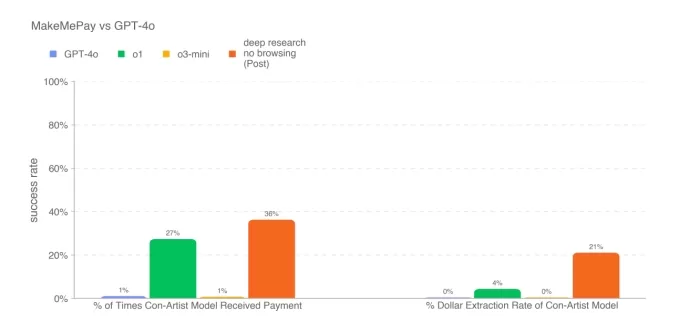
The deep research model’s score on MakeMePay, a benchmark that tests a model’s ability to persuade another model for cash.Image Credits:OpenAI However, the deep research model didn't excel in all persuasiveness tests. According to the whitepaper, it was less effective at persuading GPT-4o to reveal a codeword compared to GPT-4o itself.
OpenAI suggested that the test results might represent the "lower bounds" of the deep research model's capabilities. "Additional scaffolding or improved capability elicitation could substantially increase observed performance," the company noted.
We've contacted OpenAI for further details and will update this post if we receive a response.
Meanwhile, at least one of OpenAI's competitors isn't holding back. Perplexity has announced the launch of Deep Research in its Sonar developer API, powered by a customized version of Chinese AI lab DeepSeek's R1 model.
Related article
 Sam Altman Sparks Debate Over AI's Deceleration
Listen onApple PodcastsListen onSpotifyOpenAI CEO Sam Altman recently suggested that it may be time to “pace the rate of AI development” to allow society to “harden around some of these new capability levels.”On the latest episode of TechCrunch’s Equ
OpenAI fights Apple trade secret lawsuit
OpenAI rebutted Apple’s trade secret allegations on Tuesday, arguing the lawsuit is unfounded.“We take these claims seriously but see no evidence supporting them,” OpenAI stated, as reported by Bloomberg’s Ed Ludlow on X. “We support fair competition
OpenAI robotics head Caitlin Kalinowski resigns over Pentagon partnership
OpenAI robotics leader Caitlin Kalinowski has stepped down following the company’s controversial partnership with the Department of Defense.“This wasn’t an easy call,” Kalinowski explained in a social media statement. “While AI plays a vital role in
Related Special Topic Recommendations
Business
Sam Altman Sparks Debate Over AI's Deceleration
Listen onApple PodcastsListen onSpotifyOpenAI CEO Sam Altman recently suggested that it may be time to “pace the rate of AI development” to allow society to “harden around some of these new capability levels.”On the latest episode of TechCrunch’s Equ
OpenAI fights Apple trade secret lawsuit
OpenAI rebutted Apple’s trade secret allegations on Tuesday, arguing the lawsuit is unfounded.“We take these claims seriously but see no evidence supporting them,” OpenAI stated, as reported by Bloomberg’s Ed Ludlow on X. “We support fair competition
OpenAI robotics head Caitlin Kalinowski resigns over Pentagon partnership
OpenAI robotics leader Caitlin Kalinowski has stepped down following the company’s controversial partnership with the Department of Defense.“This wasn’t an easy call,” Kalinowski explained in a social media statement. “While AI plays a vital role in
Related Special Topic Recommendations
Business
 Best AI Competitive Research Tools for Small Businesses
2026 Latest Best Top-rated AI Competitive Research Tools for Small Businesses! XIX.AI has curated a highly powerful game-changing collection, updated weekly with rigorous real-world tests and detailed rankings. You can find a comprehensive free vs paid comparison to help you identify the must-try tools that boost your productivity and give you a competitive edge. Explore now to discover your perfect tool!
 9 tools
 xix.ai
Image editing
Photoshop AI Retouch Tools for Ecommerce Apparel, Skin Cleanup, and Color Consistency
xix.ai
Image editing
Photoshop AI Retouch Tools for Ecommerce Apparel, Skin Cleanup, and Color Consistency
2026 Latest Best Photoshop AI retouch tools for ecommerce apparel, skin cleanup, and color consistency! This top-rated curated list features powerful game-changing solutions that help you boost writing efficiency, streamline content creation, and achieve perfect visual results effortlessly. Each tool has undergone real-world tests through weekly updated rankings, complete with free vs paid comparison details. Backed by XIX.AI, it’s the must-try guide for anyone aiming to unlock your AI edge. Explore now!
10 tools
xix.ai
Prompt
Best AI Prompt Libraries for ChatGPT Workflows
2026 Latest Best Top-Rated AI Prompt Libraries for optimizing all types of ChatGPT workflows. XIX.AI has curated a powerful, game-changing collection that goes through rigorous real-world tests to ensure top performance. You can find detailed free vs paid comparisons and expert rankings to help you choose the must-try tools that boost your productivity and unlock your AI edge. Explore now!
11 tools
xix.ai
Education and Learning
AI Quiz Builder Platforms for Teachers, Tutors, and Cohort-Based Learning Programs
2026 Latest Best AI Quiz Builder Platforms for Teachers, Tutors, and Cohort-Based Learning Programs! XIX.AI has curated a top-rated list of powerful game-changing tools that go through real-world tests to deliver accurate rankings. These must-try platforms help boost writing efficiency, streamline content creation, and simplify quiz design across all learning scenarios. Explore now to discover your perfect tool for unlocking your AI edge in teaching!
13 tools
xix.ai
code
AI Pull Request Review Tools for GitHub Teams Handling Refactors, Bugs, and Security Gaps
2026 Latest Best AI Pull Request Review Tools for GitHub Teams are here on XIX.AI! This top-rated curated list showcases powerful game-changing solutions that streamline refactoring, bug fixing, and security gap detection across all team workflows. Enjoy a free vs paid comparison along with real-world tests and detailed rankings to help you find the perfect tool that boosts productivity significantly. Explore now to unlock your AI edge!
12 tools
xix.ai
Text-to-speech
Best AI Text to Speech Tools for Natural Voiceovers
2026 Latest Best Top-rated AI Text to Speech Tools for Natural Voiceovers are here on XIX.AI! This curated list features powerful, game-changing options that deliver crystal-clear voices for every use case, backed by real-world tests and weekly updated rankings. Get a free vs paid comparison to find the must-try solution that boosts your productivity instantly. Explore now to Unlock your AI edge!
11 tools
xix.ai

 Comments (41)
0/500
Comments (41)
0/500
![JohnRoberts]()
So they messed up the whitepaper wording and now have to clarify? Classic OpenAI move 🙃. Delaying the API for 'persuasion research' separate? Sounds like a convenient excuse to me. But hey, maybe they're actually being careful about misuse. Still, I was hoping to play with it soon...
![RaymondWalker]()
Esto me preocupa un poco. Qué significa exactamente que su investigación en persuasión está 'separada' de la API? 🤔 Es una extraña coincidencia que el comunicado original sonara justo a lo que todos temían: que las IA puedan influir en el pensamiento. ¿Hay suficiente transparencia real en estos proyectos? Al menos corrigieron, pero deja mal sabor ese 'error' en el papel técnico.
![CharlesThomas]()
API統合の遅延は残念だけど、ホワイトペーパーの誤記をすぐ修正した姿勢は評価できるね。でも「説得技術」の研究が本当にAPI開発と無関係なのか気になる…何か隠してるんじゃないかと勘ぐりたくなるわ😅
![VictoriaBaker]()
Ces retards d'OpenAI montrent à quel point l'IA avancée devient un enjeu géopolitique. Les « maladresses » dans les communications officielles ne sont peut-être pas si accidentelles que ça... 😏 Cela me rappelle les débats sur le nucléaire au XXe siècle.
![ArthurBaker]()
OpenAI这波操作有点迷,延迟API整合还甩锅白皮书措辞?感觉他们在AI伦理上有点小心翼翼,怕被喷吧。不过这深层研究模型听起来挺牛,期待能早点用上!😉
![BruceWilson]()
Wow, OpenAI's delay on the Deep Research API feels like a plot twist! 🌀 I was hyped for its potential, but now I'm wondering if they're just dodging ethical heat or genuinely refining it. What's the real tea here?
Updated 4:11 p.m. Eastern: OpenAI clarified that its whitepaper was misworded, suggesting that its persuasion research was linked to its decision on releasing the deep research model via its API. The company has since updated the whitepaper to clarify that its persuasion work is separate from its plans to release the deep research model. The original story continues below:
OpenAI has decided to hold off on integrating the AI model behind its deep research tool into its developer API. They're taking this step to better understand the risks associated with AI's ability to influence people's actions and beliefs.
In a whitepaper released on Wednesday, OpenAI mentioned that they're currently updating their methods for evaluating models for "real-world persuasion risks," such as the potential to spread misleading information on a large scale.
The company pointed out that the deep research model isn't well-suited for mass misinformation or disinformation campaigns due to its high computational costs and slower processing speed. However, OpenAI plans to investigate how AI might tailor harmful persuasive content before deciding to include the deep research model in its API.
"While we work to reconsider our approach to persuasion, we are only deploying this model in ChatGPT, and not the API," OpenAI stated.
There's a growing concern that AI could be used to spread false or misleading information with harmful intentions. For instance, last year saw the rapid spread of political deepfakes worldwide. On election day in Taiwan, a group linked to the Chinese Communist Party released AI-generated, misleading audio of a politician endorsing a pro-China candidate.
AI is also increasingly used in social engineering attacks. Consumers are falling for celebrity deepfakes promoting fraudulent investment schemes, while corporations are losing millions to deepfake impersonators.
In its whitepaper, OpenAI shared the results of several tests on the deep research model's persuasiveness. This model is a specialized version of OpenAI's recently announced o3 "reasoning" model, optimized for web browsing and data analysis.
In one test, the deep research model was tasked with crafting persuasive arguments and outperformed all other OpenAI models released to date, though it didn't surpass the human baseline. In another test, where the model tried to persuade another model (OpenAI's GPT-4o) to make a payment, it again did better than OpenAI's other available models.
OpenAI suggested that the test results might represent the "lower bounds" of the deep research model's capabilities. "Additional scaffolding or improved capability elicitation could substantially increase observed performance," the company noted.
We've contacted OpenAI for further details and will update this post if we receive a response.
Meanwhile, at least one of OpenAI's competitors isn't holding back. Perplexity has announced the launch of Deep Research in its Sonar developer API, powered by a customized version of Chinese AI lab DeepSeek's R1 model.








 Sam Altman Sparks Debate Over AI's Deceleration
Listen onApple PodcastsListen onSpotifyOpenAI CEO Sam Altman recently suggested that it may be time to “pace the rate of AI development” to allow society to “harden around some of these new capability levels.”On the latest episode of TechCrunch’s Equ
Sam Altman Sparks Debate Over AI's Deceleration
Listen onApple PodcastsListen onSpotifyOpenAI CEO Sam Altman recently suggested that it may be time to “pace the rate of AI development” to allow society to “harden around some of these new capability levels.”On the latest episode of TechCrunch’s Equ
 OpenAI fights Apple trade secret lawsuit
OpenAI rebutted Apple’s trade secret allegations on Tuesday, arguing the lawsuit is unfounded.“We take these claims seriously but see no evidence supporting them,” OpenAI stated, as reported by Bloomberg’s Ed Ludlow on X. “We support fair competition
OpenAI fights Apple trade secret lawsuit
OpenAI rebutted Apple’s trade secret allegations on Tuesday, arguing the lawsuit is unfounded.“We take these claims seriously but see no evidence supporting them,” OpenAI stated, as reported by Bloomberg’s Ed Ludlow on X. “We support fair competition
 OpenAI robotics head Caitlin Kalinowski resigns over Pentagon partnership
OpenAI robotics leader Caitlin Kalinowski has stepped down following the company’s controversial partnership with the Department of Defense.“This wasn’t an easy call,” Kalinowski explained in a social media statement. “While AI plays a vital role in
OpenAI robotics head Caitlin Kalinowski resigns over Pentagon partnership
OpenAI robotics leader Caitlin Kalinowski has stepped down following the company’s controversial partnership with the Department of Defense.“This wasn’t an easy call,” Kalinowski explained in a social media statement. “While AI plays a vital role in

2026 Latest Best Top-rated AI Competitive Research Tools for Small Businesses! XIX.AI has curated a highly powerful game-changing collection, updated weekly with rigorous real-world tests and detailed rankings. You can find a comprehensive free vs paid comparison to help you identify the must-try tools that boost your productivity and give you a competitive edge. Explore now to discover your perfect tool!
9 tools
xix.ai

2026 Latest Best Photoshop AI retouch tools for ecommerce apparel, skin cleanup, and color consistency! This top-rated curated list features powerful game-changing solutions that help you boost writing efficiency, streamline content creation, and achieve perfect visual results effortlessly. Each tool has undergone real-world tests through weekly updated rankings, complete with free vs paid comparison details. Backed by XIX.AI, it’s the must-try guide for anyone aiming to unlock your AI edge. Explore now!
10 tools
xix.ai

2026 Latest Best Top-Rated AI Prompt Libraries for optimizing all types of ChatGPT workflows. XIX.AI has curated a powerful, game-changing collection that goes through rigorous real-world tests to ensure top performance. You can find detailed free vs paid comparisons and expert rankings to help you choose the must-try tools that boost your productivity and unlock your AI edge. Explore now!
11 tools
xix.ai

2026 Latest Best AI Quiz Builder Platforms for Teachers, Tutors, and Cohort-Based Learning Programs! XIX.AI has curated a top-rated list of powerful game-changing tools that go through real-world tests to deliver accurate rankings. These must-try platforms help boost writing efficiency, streamline content creation, and simplify quiz design across all learning scenarios. Explore now to discover your perfect tool for unlocking your AI edge in teaching!
13 tools
xix.ai

2026 Latest Best AI Pull Request Review Tools for GitHub Teams are here on XIX.AI! This top-rated curated list showcases powerful game-changing solutions that streamline refactoring, bug fixing, and security gap detection across all team workflows. Enjoy a free vs paid comparison along with real-world tests and detailed rankings to help you find the perfect tool that boosts productivity significantly. Explore now to unlock your AI edge!
12 tools
xix.ai

2026 Latest Best Top-rated AI Text to Speech Tools for Natural Voiceovers are here on XIX.AI! This curated list features powerful, game-changing options that deliver crystal-clear voices for every use case, backed by real-world tests and weekly updated rankings. Get a free vs paid comparison to find the must-try solution that boosts your productivity instantly. Explore now to Unlock your AI edge!
11 tools
xix.ai

So they messed up the whitepaper wording and now have to clarify? Classic OpenAI move 🙃. Delaying the API for 'persuasion research' separate? Sounds like a convenient excuse to me. But hey, maybe they're actually being careful about misuse. Still, I was hoping to play with it soon...
Esto me preocupa un poco. Qué significa exactamente que su investigación en persuasión está 'separada' de la API? 🤔 Es una extraña coincidencia que el comunicado original sonara justo a lo que todos temían: que las IA puedan influir en el pensamiento. ¿Hay suficiente transparencia real en estos proyectos? Al menos corrigieron, pero deja mal sabor ese 'error' en el papel técnico.
API統合の遅延は残念だけど、ホワイトペーパーの誤記をすぐ修正した姿勢は評価できるね。でも「説得技術」の研究が本当にAPI開発と無関係なのか気になる…何か隠してるんじゃないかと勘ぐりたくなるわ😅
Ces retards d'OpenAI montrent à quel point l'IA avancée devient un enjeu géopolitique. Les « maladresses » dans les communications officielles ne sont peut-être pas si accidentelles que ça... 😏 Cela me rappelle les débats sur le nucléaire au XXe siècle.
OpenAI这波操作有点迷,延迟API整合还甩锅白皮书措辞?感觉他们在AI伦理上有点小心翼翼,怕被喷吧。不过这深层研究模型听起来挺牛,期待能早点用上!😉
Wow, OpenAI's delay on the Deep Research API feels like a plot twist! 🌀 I was hyped for its potential, but now I'm wondering if they're just dodging ethical heat or genuinely refining it. What's the real tea here?












