


 Home
HomeWhat is NVIDIA's vision for physical AI and robotics in 2025?
The field of artificial intelligence is rapidly advancing, extending its reach from purely digital spaces into the tangible, physical world. A leader in this frontier is NVIDIA with its vision for Physical AI. This concept seeks to equip robots and autonomous systems with the intelligence, efficiency, and adaptability needed for sophisticated real-world interaction. By harnessing advanced simulation and AI models, NVIDIA is building a foundation for a future where robots integrate seamlessly into daily life, tackling complex tasks and solving practical problems. This article examines NVIDIA's strategy, the core technologies enabling it, and the potential societal impact of Physical AI.
Key Points
Physical AI: Enables AI to comprehend and engage with the physical world through robotics.
Simulation as a Cornerstone: Leveraging high-fidelity simulation to train and validate AI models effectively.
GROOT: General Robot 00 Technology: NVIDIA's foundational project for developing general-purpose robots.
Physical APIs: Software interfaces that allow direct control and interaction with physical hardware.
Data Scarcity in Robotics: Simulation overcomes the challenge of limited real-world training data.
The Physical Turing Test: A benchmark assessing an AI's ability to interact with the physical world as naturally as a human.
RoboCASA Framework: A simulation environment for training robots on everyday household tasks.
The Shift Towards Digital Cousins: Utilizing generative physics engines as a flexible alternative to precise digital twins.
Nuclear Energy for Robotics: Advocating for clean, powerful energy sources to meet the demands of advanced robotics.
Revolutionizing Industries: Physical AI is poised to transform numerous sectors.
Understanding the Foundation: What is Physical AI?
Defining Physical AI
Physical AI marks a major evolution, moving AI from software into embodied systems like robots and machines. These systems can perceive their environment, reason based on physical laws, and take action to achieve goals. The objective is to grant robots the intelligence to operate in unstructured, real-world settings. NVIDIA’s Jim Fan encapsulates the goal: creating AI that genuinely understands and manipulates the physical world.
Central to this concept is the physical Turing test

. While the classic Turing test judges conversational intelligence, the physical version demands seamless interaction with the environment. Consider a robot cleaning after an event or cooking a meal—it must identify objects, navigate spaces, and complete these actions in a manner indistinguishable from a human. This requires robust perception, sophisticated planning, and precise motor control.
Physical AI merges powerful algorithms with robotics and automation, promising benefits like greater operational efficiency, improved safety, and enhanced adaptability across applications.
The Simulation Imperative: Overcoming Data Scarcity in Robotics
Data: The Fuel of AI
A primary obstacle in robotics AI is the scarcity of real-world data. Unlike domains with vast digital datasets, robotics relies on physical interaction data, which is costly and slow to gather. Jim Fan refers to the internet as "The fossil fuel of AI"
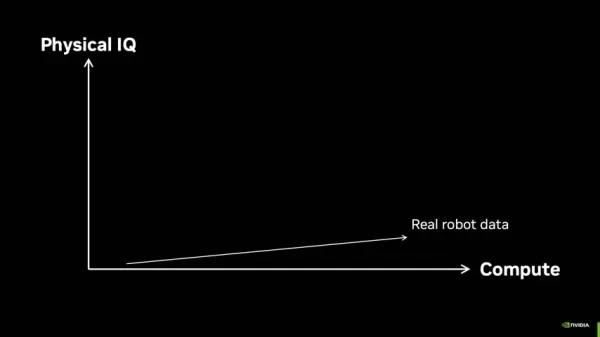
, highlighting how existing data fuels model training and advancement.
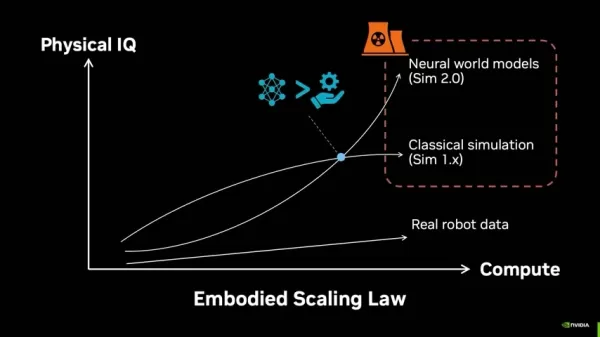
This data shortage impedes the development of reliable, generalizable robotic AI. NVIDIA's solution is to make high-fidelity simulation a fundamental component of Physical AI. Simulations create realistic virtual worlds where robots can train extensively, generating vast, cost-effective data in a controlled setting.
High-Fidelity Simulation: NVIDIA builds physically accurate virtual environments, allowing robots to learn and adapt to countless scenarios without real-world risks or expenses. These simulations incorporate realistic physics, lighting, and sensor models, enabling skill transfer to actual robots.
Domain Randomization: To build more robust AI, NVIDIA uses domain randomization. This technique varies simulation parameters—like gravity, friction, and lighting—exposing the AI to diverse conditions. It prevents overfitting to the simulation and improves the AI's ability to generalize to real-world complexity. Effective simulation requires both speed and diversity to approach reality.
RoboCASA: Training for Physical Turing Test
To this end, NVIDIA developed the RoboCASA framework
, which simulates home environments. By replicating everyday tasks, it trains general-purpose robots for real-world contexts.
RoboCASA offers high customizability to simplify AI training. A key feature is AI-generated environment textures, where an LLM creates XML code to detail 3D assets. This approach results in a highly customizable simulation platform.
Digital Twins and Digital Cousins
NVIDIA's simulation framework includes the concepts of digital twins and digital cousins
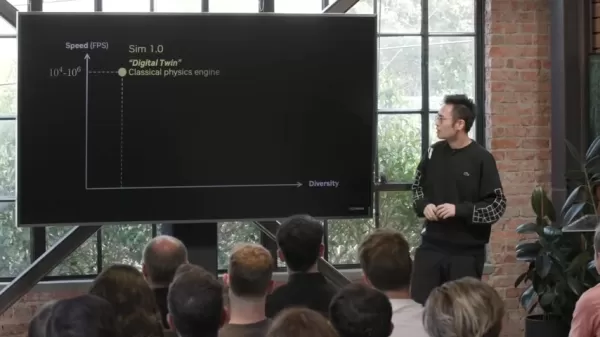
. A perfect digital twin mirrors its physical counterpart with one-to-one accuracy, which can be challenging. Often, generative physics models—or cousins—serve as a practical alternative.
Digital cousins are generative physics engines that may sacrifice some accuracy for speed. Their effectiveness relies heavily on the application of domain randomization.
Using Simulation Effectively: Key Principles
Simulation Principles
NVIDIA has established core principles for effective robotics AI training. First is the need to simulate the world 10,000 times faster than real-time. This acceleration allows robots to experience more scenarios and accelerates model iteration. The first million simulated worlds may seem similar, but unique challenges eventually arise, and it is in these edge cases that meaningful AI learning occurs.
Training happens within the simulation "matrix," after which knowledge is deployed in reality. The cost of gathering real-world training data is prohibitively high compared to generating simulated data.
Pricing for Physical AI Tools
Licensing and Open-Source Accessibility
NVIDIA sees open-source development as critical for Physical AI's future. Announced at the March GTC conference, future core models will be open source. This move aims to democratize the field, broaden access to Physical AI tools, and accelerate improvement through community collaboration. These models will continue to evolve with input from developers worldwide.
The Road Ahead: Advantages and Disadvantages of Physical AI
Pros
Significant efficiency improvements across multiple industries.
Enhanced safety in hazardous working conditions.
Improved adaptability in dynamic, unstructured environments.
Cost reduction through task automation.
AI training via simulation is more affordable than physical trials.
Cons
High initial investment for system development and deployment.
Substantial power consumption requirements.
AI systems often still require human oversight or intervention.
Potential risks associated with autonomous system failures or unintended behaviors.
Physical robot hardware can fatigue or fail before the AI software does.
Core Features of NVIDIA's Physical AI Ecosystem
Core Features for physical AI
The heart of NVIDIA's Physical AI strategy integrates simulation, high-fidelity models, and synthetic data, going beyond simple task execution.
The following sections detail these components, but a brief summary is provided here.
NVIDIA GROOT: General Robot 00 Technology
GROOT is NVIDIA's ambitious project to create general-purpose robots capable of diverse tasks. It involves building a unified AI platform for robotics, allowing developers to deploy models across different hardware. GROOT encompasses the necessary hardware, software, and AI models to power the next wave of intelligent robots.
Physical APIs: Bridging the Gap
NVIDIA envisions a future where software developers use standardized Physical APIs to control physical systems easily. Similar to software APIs abstracting complexity, Physical APIs would offer a consistent interface for robots, sensors, and actuators. This lets developers focus on building innovative applications without deep hardware expertise.
Revolutionizing Industries: Use Cases for Physical AI
Transforming Industries with Physical AI
Physical AI promises to transform numerous sectors, including:
- Manufacturing: Automating complex assembly to boost efficiency and cut costs.
- Logistics: Using autonomous vehicles and robots to streamline warehouses, optimize deliveries, and improve supply chains.
- Healthcare: Assisting in surgery, delivering supplies, and providing patient support.
- Agriculture: Automating crop monitoring, harvesting, and other farm tasks to increase yield and reduce labor.
- Retail: Assisting customers, managing stock, and handling transactions.
- Construction: Performing dangerous or repetitive jobs to enhance worker safety and speed up projects.
Each industry application relies on high-performance computing hardware.
Frequently Asked Questions
What is physical AI?
Physical AI is the integration of artificial intelligence into the physical world, enabling robots and autonomous systems to interact with their environment intelligently.
What is the physical Turing Test?
A benchmark designed to evaluate a robot's ability to perform physical tasks as competently as a human would.
What are the benefits of simulation and digital twins in robotics?
They provide a safe, cost-effective method to generate the massive datasets required for training robust robotic AI.
What is GROOT?
NVIDIA's initiative to develop a foundational platform for creating versatile, general-purpose robots.
Related Questions
What challenges does the future hold in AI development for robots?
Developing AI for robotics faces significant hurdles, including the enormous volume of data required for training, the scarcity of high-quality real-world data, and the high cost of acquiring it. These challenges compound the typical difficulties of AI development. A broader issue mentioned is that AI pretraining is beginning to exhaust readily available data sources.
Related article
 U.S. Stocks Hit Historic Milestone as AI and Aerospace Giants Prepare for Trillion-Dollar Debut
Elon Musk, Sam Altman, and Dario Amodei, three titans of the technology sector, are advancing toward initial public offerings for their respective ventures. With SpaceX, OpenAI, and Anthropic—three industry behemoths nearing trillion-dollar valuation
Swedish AI Startup Lovable Eyes $13.2 Billion Valuation After Major Funding Round
As AI-driven coding tools gain traction, Swedish startup Lovable has secured a major funding round. The company aims to raise $3 billion, potentially boosting its valuation to $13.2 billion—double the $6.6 billion recorded last December. Menlo Ventur
Google Tests Remy AI Agent for Gemini as Focus Shifts to User Control
According to Business Insider, Google is testing Remy, a new AI personal agent for Gemini. This tool aims to execute tasks on behalf of users, streamlining both professional workflows and daily routines.Currently, Remy is undergoing testing in an int
Related Special Topic Recommendations
SEO
U.S. Stocks Hit Historic Milestone as AI and Aerospace Giants Prepare for Trillion-Dollar Debut
Elon Musk, Sam Altman, and Dario Amodei, three titans of the technology sector, are advancing toward initial public offerings for their respective ventures. With SpaceX, OpenAI, and Anthropic—three industry behemoths nearing trillion-dollar valuation
Swedish AI Startup Lovable Eyes $13.2 Billion Valuation After Major Funding Round
As AI-driven coding tools gain traction, Swedish startup Lovable has secured a major funding round. The company aims to raise $3 billion, potentially boosting its valuation to $13.2 billion—double the $6.6 billion recorded last December. Menlo Ventur
Google Tests Remy AI Agent for Gemini as Focus Shifts to User Control
According to Business Insider, Google is testing Remy, a new AI personal agent for Gemini. This tool aims to execute tasks on behalf of users, streamlining both professional workflows and daily routines.Currently, Remy is undergoing testing in an int
Related Special Topic Recommendations
SEO
 Best AI SERP Analysis Tools for Search Strategy
2026 Latest Best Top-rated AI SERP Analysis Tools for Search Strategy are curated by XIX.AI through rigorous real-world tests and weekly updated rankings. These powerful tools help you unlock hidden optimization opportunities, boost content performance, and gain a competitive edge in search. Discover your perfect tool to elevate your search strategy today. Explore now!
 13 tools
 xix.ai
Data Analysis
Best AI Anomaly Detection Tools for KPI Monitoring across SaaS and Ecommerce Teams
xix.ai
Data Analysis
Best AI Anomaly Detection Tools for KPI Monitoring across SaaS and Ecommerce Teams
2026 Latest Best Top-rated AI Anomaly Detection Tools for KPI Monitoring in SaaS and Ecommerce teams! XIX.AI has curated a powerful, game-changing collection based on rigorous real-world tests and weekly updated rankings. You’ll find detailed free vs paid comparison insights to help you identify the must-try solution that boosts productivity and unlocks your AI edge. Explore now!
10 tools
xix.ai
writing
Best AI Outline Generators for Long-Form SEO Articles
2026 Latest Best Top-Rated AI Outline Generators for Long-Form SEO Articles, meticulously curated by XIX.AI. These powerful tools offer game-changing assistance in creating high-quality content quickly, boosting writing efficiency significantly. Get a free vs paid comparison along with real-world tests and detailed rankings to help you find the must-try option that suits your needs. Explore now to unlock your AI edge.
8 tools
xix.ai
Education and Learning
AI Study Tools for Homework and Exam Prep
2026 Latest Best AI Study Tools for Homework and Exam Prep! XIX.AI curates a top-rated list of powerful, game-changing tools that help students boost productivity, streamline homework completion, and ace exams through real-world tests. Get a free vs paid comparison, detailed rankings, and must-try options to unlock your AI edge. Explore now!
10 tools
xix.ai
Music composition
AI Vocal Demo Tools for Songwriters, Hooks, Toplines, and Multilingual Draft Sessions
2026 Latest Best AI Vocal Demo Tools for Songwriters, Hook Creators, and Multi-Language Content Teams! XIX.AI has curated a top-rated list of powerful game-changing tools that go through rigorous real-world tests. You’ll find detailed free vs paid comparison data, comprehensive rankings, and must-try options to help you boost writing efficiency and unlock your creative potential. Explore now to discover your perfect tool for all your content needs!
9 tools
xix.ai
Business
Best AI Competitive Research Tools for Small Businesses
2026 Latest Best Top-rated AI Competitive Research Tools for Small Businesses! XIX.AI has curated a highly powerful game-changing collection, updated weekly with rigorous real-world tests and detailed rankings. You can find a comprehensive free vs paid comparison to help you identify the must-try tools that boost your productivity and give you a competitive edge. Explore now to discover your perfect tool!
9 tools
xix.ai

 Comments (0)
0/500
Comments (0)
0/500
The field of artificial intelligence is rapidly advancing, extending its reach from purely digital spaces into the tangible, physical world. A leader in this frontier is NVIDIA with its vision for Physical AI. This concept seeks to equip robots and autonomous systems with the intelligence, efficiency, and adaptability needed for sophisticated real-world interaction. By harnessing advanced simulation and AI models, NVIDIA is building a foundation for a future where robots integrate seamlessly into daily life, tackling complex tasks and solving practical problems. This article examines NVIDIA's strategy, the core technologies enabling it, and the potential societal impact of Physical AI.
Key Points
Physical AI: Enables AI to comprehend and engage with the physical world through robotics.
Simulation as a Cornerstone: Leveraging high-fidelity simulation to train and validate AI models effectively.
GROOT: General Robot 00 Technology: NVIDIA's foundational project for developing general-purpose robots.
Physical APIs: Software interfaces that allow direct control and interaction with physical hardware.
Data Scarcity in Robotics: Simulation overcomes the challenge of limited real-world training data.
The Physical Turing Test: A benchmark assessing an AI's ability to interact with the physical world as naturally as a human.
RoboCASA Framework: A simulation environment for training robots on everyday household tasks.
The Shift Towards Digital Cousins: Utilizing generative physics engines as a flexible alternative to precise digital twins.
Nuclear Energy for Robotics: Advocating for clean, powerful energy sources to meet the demands of advanced robotics.
Revolutionizing Industries: Physical AI is poised to transform numerous sectors.
Understanding the Foundation: What is Physical AI?
Defining Physical AI
Physical AI marks a major evolution, moving AI from software into embodied systems like robots and machines. These systems can perceive their environment, reason based on physical laws, and take action to achieve goals. The objective is to grant robots the intelligence to operate in unstructured, real-world settings. NVIDIA’s Jim Fan encapsulates the goal: creating AI that genuinely understands and manipulates the physical world.
Central to this concept is the physical Turing test
. While the classic Turing test judges conversational intelligence, the physical version demands seamless interaction with the environment. Consider a robot cleaning after an event or cooking a meal—it must identify objects, navigate spaces, and complete these actions in a manner indistinguishable from a human. This requires robust perception, sophisticated planning, and precise motor control.
Physical AI merges powerful algorithms with robotics and automation, promising benefits like greater operational efficiency, improved safety, and enhanced adaptability across applications.
The Simulation Imperative: Overcoming Data Scarcity in Robotics
Data: The Fuel of AI
A primary obstacle in robotics AI is the scarcity of real-world data. Unlike domains with vast digital datasets, robotics relies on physical interaction data, which is costly and slow to gather. Jim Fan refers to the internet as "The fossil fuel of AI"
, highlighting how existing data fuels model training and advancement.
This data shortage impedes the development of reliable, generalizable robotic AI. NVIDIA's solution is to make high-fidelity simulation a fundamental component of Physical AI. Simulations create realistic virtual worlds where robots can train extensively, generating vast, cost-effective data in a controlled setting.
High-Fidelity Simulation: NVIDIA builds physically accurate virtual environments, allowing robots to learn and adapt to countless scenarios without real-world risks or expenses. These simulations incorporate realistic physics, lighting, and sensor models, enabling skill transfer to actual robots.
Domain Randomization: To build more robust AI, NVIDIA uses domain randomization. This technique varies simulation parameters—like gravity, friction, and lighting—exposing the AI to diverse conditions. It prevents overfitting to the simulation and improves the AI's ability to generalize to real-world complexity. Effective simulation requires both speed and diversity to approach reality.
RoboCASA: Training for Physical Turing Test
To this end, NVIDIA developed the RoboCASA framework
, which simulates home environments. By replicating everyday tasks, it trains general-purpose robots for real-world contexts.
RoboCASA offers high customizability to simplify AI training. A key feature is AI-generated environment textures, where an LLM creates XML code to detail 3D assets. This approach results in a highly customizable simulation platform.
Digital Twins and Digital Cousins
NVIDIA's simulation framework includes the concepts of digital twins and digital cousins
. A perfect digital twin mirrors its physical counterpart with one-to-one accuracy, which can be challenging. Often, generative physics models—or cousins—serve as a practical alternative.
Digital cousins are generative physics engines that may sacrifice some accuracy for speed. Their effectiveness relies heavily on the application of domain randomization.
Using Simulation Effectively: Key Principles
Simulation Principles
NVIDIA has established core principles for effective robotics AI training. First is the need to simulate the world 10,000 times faster than real-time. This acceleration allows robots to experience more scenarios and accelerates model iteration. The first million simulated worlds may seem similar, but unique challenges eventually arise, and it is in these edge cases that meaningful AI learning occurs.
Training happens within the simulation "matrix," after which knowledge is deployed in reality. The cost of gathering real-world training data is prohibitively high compared to generating simulated data.
Pricing for Physical AI Tools
Licensing and Open-Source Accessibility
NVIDIA sees open-source development as critical for Physical AI's future. Announced at the March GTC conference, future core models will be open source. This move aims to democratize the field, broaden access to Physical AI tools, and accelerate improvement through community collaboration. These models will continue to evolve with input from developers worldwide.
The Road Ahead: Advantages and Disadvantages of Physical AI
Pros
Significant efficiency improvements across multiple industries.
Enhanced safety in hazardous working conditions.
Improved adaptability in dynamic, unstructured environments.
Cost reduction through task automation.
AI training via simulation is more affordable than physical trials.
Cons
High initial investment for system development and deployment.
Substantial power consumption requirements.
AI systems often still require human oversight or intervention.
Potential risks associated with autonomous system failures or unintended behaviors.
Physical robot hardware can fatigue or fail before the AI software does.
Core Features of NVIDIA's Physical AI Ecosystem
Core Features for physical AI
The heart of NVIDIA's Physical AI strategy integrates simulation, high-fidelity models, and synthetic data, going beyond simple task execution.
The following sections detail these components, but a brief summary is provided here.
NVIDIA GROOT: General Robot 00 Technology
GROOT is NVIDIA's ambitious project to create general-purpose robots capable of diverse tasks. It involves building a unified AI platform for robotics, allowing developers to deploy models across different hardware. GROOT encompasses the necessary hardware, software, and AI models to power the next wave of intelligent robots.
Physical APIs: Bridging the Gap
NVIDIA envisions a future where software developers use standardized Physical APIs to control physical systems easily. Similar to software APIs abstracting complexity, Physical APIs would offer a consistent interface for robots, sensors, and actuators. This lets developers focus on building innovative applications without deep hardware expertise.
Revolutionizing Industries: Use Cases for Physical AI
Transforming Industries with Physical AI
Physical AI promises to transform numerous sectors, including:
- Manufacturing: Automating complex assembly to boost efficiency and cut costs.
- Logistics: Using autonomous vehicles and robots to streamline warehouses, optimize deliveries, and improve supply chains.
- Healthcare: Assisting in surgery, delivering supplies, and providing patient support.
- Agriculture: Automating crop monitoring, harvesting, and other farm tasks to increase yield and reduce labor.
- Retail: Assisting customers, managing stock, and handling transactions.
- Construction: Performing dangerous or repetitive jobs to enhance worker safety and speed up projects.
Each industry application relies on high-performance computing hardware.
Frequently Asked Questions
What is physical AI?
Physical AI is the integration of artificial intelligence into the physical world, enabling robots and autonomous systems to interact with their environment intelligently.
What is the physical Turing Test?
A benchmark designed to evaluate a robot's ability to perform physical tasks as competently as a human would.
What are the benefits of simulation and digital twins in robotics?
They provide a safe, cost-effective method to generate the massive datasets required for training robust robotic AI.
What is GROOT?
NVIDIA's initiative to develop a foundational platform for creating versatile, general-purpose robots.
Related Questions
What challenges does the future hold in AI development for robots?
Developing AI for robotics faces significant hurdles, including the enormous volume of data required for training, the scarcity of high-quality real-world data, and the high cost of acquiring it. These challenges compound the typical difficulties of AI development. A broader issue mentioned is that AI pretraining is beginning to exhaust readily available data sources.








 U.S. Stocks Hit Historic Milestone as AI and Aerospace Giants Prepare for Trillion-Dollar Debut
Elon Musk, Sam Altman, and Dario Amodei, three titans of the technology sector, are advancing toward initial public offerings for their respective ventures. With SpaceX, OpenAI, and Anthropic—three industry behemoths nearing trillion-dollar valuation
U.S. Stocks Hit Historic Milestone as AI and Aerospace Giants Prepare for Trillion-Dollar Debut
Elon Musk, Sam Altman, and Dario Amodei, three titans of the technology sector, are advancing toward initial public offerings for their respective ventures. With SpaceX, OpenAI, and Anthropic—three industry behemoths nearing trillion-dollar valuation
 Swedish AI Startup Lovable Eyes $13.2 Billion Valuation After Major Funding Round
As AI-driven coding tools gain traction, Swedish startup Lovable has secured a major funding round. The company aims to raise $3 billion, potentially boosting its valuation to $13.2 billion—double the $6.6 billion recorded last December. Menlo Ventur
Google Tests Remy AI Agent for Gemini as Focus Shifts to User Control
According to Business Insider, Google is testing Remy, a new AI personal agent for Gemini. This tool aims to execute tasks on behalf of users, streamlining both professional workflows and daily routines.Currently, Remy is undergoing testing in an int
Swedish AI Startup Lovable Eyes $13.2 Billion Valuation After Major Funding Round
As AI-driven coding tools gain traction, Swedish startup Lovable has secured a major funding round. The company aims to raise $3 billion, potentially boosting its valuation to $13.2 billion—double the $6.6 billion recorded last December. Menlo Ventur
Google Tests Remy AI Agent for Gemini as Focus Shifts to User Control
According to Business Insider, Google is testing Remy, a new AI personal agent for Gemini. This tool aims to execute tasks on behalf of users, streamlining both professional workflows and daily routines.Currently, Remy is undergoing testing in an int

2026 Latest Best Top-rated AI SERP Analysis Tools for Search Strategy are curated by XIX.AI through rigorous real-world tests and weekly updated rankings. These powerful tools help you unlock hidden optimization opportunities, boost content performance, and gain a competitive edge in search. Discover your perfect tool to elevate your search strategy today. Explore now!
13 tools
xix.ai

2026 Latest Best Top-rated AI Anomaly Detection Tools for KPI Monitoring in SaaS and Ecommerce teams! XIX.AI has curated a powerful, game-changing collection based on rigorous real-world tests and weekly updated rankings. You’ll find detailed free vs paid comparison insights to help you identify the must-try solution that boosts productivity and unlocks your AI edge. Explore now!
10 tools
xix.ai

2026 Latest Best Top-Rated AI Outline Generators for Long-Form SEO Articles, meticulously curated by XIX.AI. These powerful tools offer game-changing assistance in creating high-quality content quickly, boosting writing efficiency significantly. Get a free vs paid comparison along with real-world tests and detailed rankings to help you find the must-try option that suits your needs. Explore now to unlock your AI edge.
8 tools
xix.ai

2026 Latest Best AI Study Tools for Homework and Exam Prep! XIX.AI curates a top-rated list of powerful, game-changing tools that help students boost productivity, streamline homework completion, and ace exams through real-world tests. Get a free vs paid comparison, detailed rankings, and must-try options to unlock your AI edge. Explore now!
10 tools
xix.ai

2026 Latest Best AI Vocal Demo Tools for Songwriters, Hook Creators, and Multi-Language Content Teams! XIX.AI has curated a top-rated list of powerful game-changing tools that go through rigorous real-world tests. You’ll find detailed free vs paid comparison data, comprehensive rankings, and must-try options to help you boost writing efficiency and unlock your creative potential. Explore now to discover your perfect tool for all your content needs!
9 tools
xix.ai

2026 Latest Best Top-rated AI Competitive Research Tools for Small Businesses! XIX.AI has curated a highly powerful game-changing collection, updated weekly with rigorous real-world tests and detailed rankings. You can find a comprehensive free vs paid comparison to help you identify the must-try tools that boost your productivity and give you a competitive edge. Explore now to discover your perfect tool!
9 tools
xix.ai












