


 Home
Home
NVIDIA Open Sources Polar Framework for Zero-Barrier AI Coding Agent Evolution via Reinforcement Learning
On May 28, the NVIDIA research team open-sourced Polar, a reinforcement learning training framework. Its core innovation lies in seamlessly integrating existing mainstream code agents—such as Codex, Claude Code, and Qwen Code—into GRPO (Generalized Relative Policy Optimization) reinforcement learning training without requiring any changes to the original code.
I. Industry Pain Points: The Barrier to Agent Reinforcement Learning
As code agents evolve from simple single-step tasks to complex, long-running processes—such as warehouse-level code modifications or OS interactions—developers increasingly rely on mature execution frameworks (Harness). Yet, integrating these complex frameworks into traditional reinforcement learning infrastructure presents significant challenges:
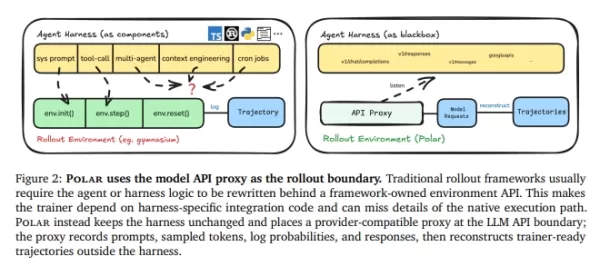
High Integration Cost: Traditional methods require rewriting code logic into standard environment interfaces such as env.init() and env.step(), a process that is extremely tedious.
Information Loss: During refactoring, critical details—such as tool calls, multi-turn dialogue context, or sub-agent collaboration logic—are often lost, preventing the model from receiving high-quality training signals.
II. Core Solution: Using the "Boundary" as the Training Entry Point
Polar eliminates the need to rewrite the execution framework. Instead, it treats the model API boundary as the training entry point.
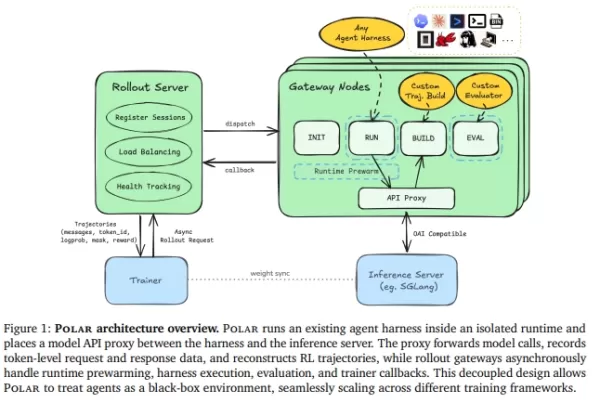
Black-box Processing: Polar places a transparent proxy (Gateway) between the code execution framework and the model inference server. Regardless of whether the agent uses APIs from Anthropic, OpenAI, or Google, Polar seamlessly intercepts and forwards requests.
Trace Reconstruction: While forwarding, Polar records real-time key data—such as prompts, sampled tokens, and log probabilities—and reconstructs it into the "trace" data needed by the reinforcement learning trainer.
Efficient Asynchronous Architecture: The system employs a Rollout Server for scheduling and persistence, while Gateway Nodes manage lifecycle and resource recycling. By leveraging a preheated buffer (READY buffer) and parallel task processing, it effectively eliminates long-tail tasks that could block GPU training.
III. Performance Leap: Transforming Code Agents
Experimental data shows that Polar, when combined with GRPO training, yields significant performance gains:
SWE-Bench Verified Benchmark Test: Using the same Qwen3.5-4B base model, performance varies across different code frameworks:
Codex Framework: The pass@1 score jumps from 3.8% to 26.4%—a surge of 594.74%.
Claude Code Framework: from 29.8% to 34.6%.
Pi Framework: from 34.2% to 40.4%.
Extreme Efficiency: After introducing the prefix_merging strategy, training wall-clock time is shortened by about 5.39 times compared to the traditional per-request mode, and GPU utilization rises from 20.4% to 87.7%.
Industry Commentary
The open-sourcing of NVIDIA's Polar essentially builds a "highway" for AI agents to enter reinforcement learning training. It not only enables researchers to train efficiently using massive open-source code frameworks but also lowers the GPU computing barrier through system-level optimization.
With Polar's growing popularity, developers no longer need to worry about "how to adapt models to training frameworks." In the future, the evolution of AI coding agents will become more standardized and efficient. This marks a shift in AI agent training from manual lab tuning to large-scale, systematic engineering production.
Paper URL: https://arxiv.org/pdf/2605.24220
Related article
 South Korea Breaks Ground on National AI Computing Center, Investing 2.5 Trillion Won with 2028 Target
South Korean outlet EtNews reports that groundbreaking for the Korea AI Computing Center (KOACC) took place on August 3 at the Solar City data center park in Sunan, Jeollanam-do. Backed by a total investment of 2.5 trillion KRW (roughly 11.838 billio
Six Tech Giants Back Linux Foundation With $12.5M to Tackle AI Vulnerability Noise
To tackle the flood of low-quality security reports produced by AI automation tools, six major tech companies—Anthropic, Amazon (AWS), GitHub, Google, Microsoft, and OpenAI—have collectively contributed $12.5 million in funding to Linux Foundation in
Musk Considered Leaving OpenAI to His Kids as Altman Testifies
This morning, OpenAI CEO Sam Altman took the stand to address former co-founder Elon Musk’s lawsuit challenging the company’s corporate structure.When asked about Musk’s claim that other founders “stole a charity” by launching a for-profit subsidiary
Related Special Topic Recommendations
Music composition
South Korea Breaks Ground on National AI Computing Center, Investing 2.5 Trillion Won with 2028 Target
South Korean outlet EtNews reports that groundbreaking for the Korea AI Computing Center (KOACC) took place on August 3 at the Solar City data center park in Sunan, Jeollanam-do. Backed by a total investment of 2.5 trillion KRW (roughly 11.838 billio
Six Tech Giants Back Linux Foundation With $12.5M to Tackle AI Vulnerability Noise
To tackle the flood of low-quality security reports produced by AI automation tools, six major tech companies—Anthropic, Amazon (AWS), GitHub, Google, Microsoft, and OpenAI—have collectively contributed $12.5 million in funding to Linux Foundation in
Musk Considered Leaving OpenAI to His Kids as Altman Testifies
This morning, OpenAI CEO Sam Altman took the stand to address former co-founder Elon Musk’s lawsuit challenging the company’s corporate structure.When asked about Musk’s claim that other founders “stole a charity” by launching a for-profit subsidiary
Related Special Topic Recommendations
Music composition
 AI Vocal Demo Tools for Songwriters, Hooks, Toplines, and Multilingual Draft Sessions
2026 Latest Best AI Vocal Demo Tools for Songwriters, Hook Creators, and Multi-Language Content Teams! XIX.AI has curated a top-rated list of powerful game-changing tools that go through rigorous real-world tests. You’ll find detailed free vs paid comparison data, comprehensive rankings, and must-try options to help you boost writing efficiency and unlock your creative potential. Explore now to discover your perfect tool for all your content needs!
 9 tools
 xix.ai
Business
Best AI Competitive Research Tools for Small Businesses
xix.ai
Business
Best AI Competitive Research Tools for Small Businesses
2026 Latest Best Top-rated AI Competitive Research Tools for Small Businesses! XIX.AI has curated a highly powerful game-changing collection, updated weekly with rigorous real-world tests and detailed rankings. You can find a comprehensive free vs paid comparison to help you identify the must-try tools that boost your productivity and give you a competitive edge. Explore now to discover your perfect tool!
9 tools
xix.ai
Image editing
Photoshop AI Retouch Tools for Ecommerce Apparel, Skin Cleanup, and Color Consistency
2026 Latest Best Photoshop AI retouch tools for ecommerce apparel, skin cleanup, and color consistency! This top-rated curated list features powerful game-changing solutions that help you boost writing efficiency, streamline content creation, and achieve perfect visual results effortlessly. Each tool has undergone real-world tests through weekly updated rankings, complete with free vs paid comparison details. Backed by XIX.AI, it’s the must-try guide for anyone aiming to unlock your AI edge. Explore now!
10 tools
xix.ai
Prompt
Best AI Prompt Libraries for ChatGPT Workflows
2026 Latest Best Top-Rated AI Prompt Libraries for optimizing all types of ChatGPT workflows. XIX.AI has curated a powerful, game-changing collection that goes through rigorous real-world tests to ensure top performance. You can find detailed free vs paid comparisons and expert rankings to help you choose the must-try tools that boost your productivity and unlock your AI edge. Explore now!
11 tools
xix.ai
Education and Learning
AI Quiz Builder Platforms for Teachers, Tutors, and Cohort-Based Learning Programs
2026 Latest Best AI Quiz Builder Platforms for Teachers, Tutors, and Cohort-Based Learning Programs! XIX.AI has curated a top-rated list of powerful game-changing tools that go through real-world tests to deliver accurate rankings. These must-try platforms help boost writing efficiency, streamline content creation, and simplify quiz design across all learning scenarios. Explore now to discover your perfect tool for unlocking your AI edge in teaching!
13 tools
xix.ai
code
AI Pull Request Review Tools for GitHub Teams Handling Refactors, Bugs, and Security Gaps
2026 Latest Best AI Pull Request Review Tools for GitHub Teams are here on XIX.AI! This top-rated curated list showcases powerful game-changing solutions that streamline refactoring, bug fixing, and security gap detection across all team workflows. Enjoy a free vs paid comparison along with real-world tests and detailed rankings to help you find the perfect tool that boosts productivity significantly. Explore now to unlock your AI edge!
12 tools
xix.ai

 Comments (1)
0/500
Comments (1)
0/500
![AlbertWalker]()
So NVIDIA just dropped Polar as open source? That's huge for AI coding agents - integrating Codex and Claude with reinforcement learning sounds like a game changer. But I wonder how much compute you'd need to actually train it effectively... 🤔
On May 28, the NVIDIA research team open-sourced Polar, a reinforcement learning training framework. Its core innovation lies in seamlessly integrating existing mainstream code agents—such as Codex, Claude Code, and Qwen Code—into GRPO (Generalized Relative Policy Optimization) reinforcement learning training without requiring any changes to the original code.
I. Industry Pain Points: The Barrier to Agent Reinforcement Learning
As code agents evolve from simple single-step tasks to complex, long-running processes—such as warehouse-level code modifications or OS interactions—developers increasingly rely on mature execution frameworks (Harness). Yet, integrating these complex frameworks into traditional reinforcement learning infrastructure presents significant challenges:
High Integration Cost: Traditional methods require rewriting code logic into standard environment interfaces such as env.init() and env.step(), a process that is extremely tedious.
Information Loss: During refactoring, critical details—such as tool calls, multi-turn dialogue context, or sub-agent collaboration logic—are often lost, preventing the model from receiving high-quality training signals.
II. Core Solution: Using the "Boundary" as the Training Entry Point
Polar eliminates the need to rewrite the execution framework. Instead, it treats the model API boundary as the training entry point.
Black-box Processing: Polar places a transparent proxy (Gateway) between the code execution framework and the model inference server. Regardless of whether the agent uses APIs from Anthropic, OpenAI, or Google, Polar seamlessly intercepts and forwards requests.
Trace Reconstruction: While forwarding, Polar records real-time key data—such as prompts, sampled tokens, and log probabilities—and reconstructs it into the "trace" data needed by the reinforcement learning trainer.
Efficient Asynchronous Architecture: The system employs a Rollout Server for scheduling and persistence, while Gateway Nodes manage lifecycle and resource recycling. By leveraging a preheated buffer (READY buffer) and parallel task processing, it effectively eliminates long-tail tasks that could block GPU training.
III. Performance Leap: Transforming Code Agents
Experimental data shows that Polar, when combined with GRPO training, yields significant performance gains:
SWE-Bench Verified Benchmark Test: Using the same Qwen3.5-4B base model, performance varies across different code frameworks:
Codex Framework: The pass@1 score jumps from 3.8% to 26.4%—a surge of 594.74%.
Claude Code Framework: from 29.8% to 34.6%.
Pi Framework: from 34.2% to 40.4%.
Extreme Efficiency: After introducing the prefix_merging strategy, training wall-clock time is shortened by about 5.39 times compared to the traditional per-request mode, and GPU utilization rises from 20.4% to 87.7%.
Industry Commentary
The open-sourcing of NVIDIA's Polar essentially builds a "highway" for AI agents to enter reinforcement learning training. It not only enables researchers to train efficiently using massive open-source code frameworks but also lowers the GPU computing barrier through system-level optimization.
With Polar's growing popularity, developers no longer need to worry about "how to adapt models to training frameworks." In the future, the evolution of AI coding agents will become more standardized and efficient. This marks a shift in AI agent training from manual lab tuning to large-scale, systematic engineering production.
Paper URL: https://arxiv.org/pdf/2605.24220








 South Korea Breaks Ground on National AI Computing Center, Investing 2.5 Trillion Won with 2028 Target
South Korean outlet EtNews reports that groundbreaking for the Korea AI Computing Center (KOACC) took place on August 3 at the Solar City data center park in Sunan, Jeollanam-do. Backed by a total investment of 2.5 trillion KRW (roughly 11.838 billio
South Korea Breaks Ground on National AI Computing Center, Investing 2.5 Trillion Won with 2028 Target
South Korean outlet EtNews reports that groundbreaking for the Korea AI Computing Center (KOACC) took place on August 3 at the Solar City data center park in Sunan, Jeollanam-do. Backed by a total investment of 2.5 trillion KRW (roughly 11.838 billio
 Six Tech Giants Back Linux Foundation With $12.5M to Tackle AI Vulnerability Noise
To tackle the flood of low-quality security reports produced by AI automation tools, six major tech companies—Anthropic, Amazon (AWS), GitHub, Google, Microsoft, and OpenAI—have collectively contributed $12.5 million in funding to Linux Foundation in
Six Tech Giants Back Linux Foundation With $12.5M to Tackle AI Vulnerability Noise
To tackle the flood of low-quality security reports produced by AI automation tools, six major tech companies—Anthropic, Amazon (AWS), GitHub, Google, Microsoft, and OpenAI—have collectively contributed $12.5 million in funding to Linux Foundation in
 Musk Considered Leaving OpenAI to His Kids as Altman Testifies
This morning, OpenAI CEO Sam Altman took the stand to address former co-founder Elon Musk’s lawsuit challenging the company’s corporate structure.When asked about Musk’s claim that other founders “stole a charity” by launching a for-profit subsidiary
Musk Considered Leaving OpenAI to His Kids as Altman Testifies
This morning, OpenAI CEO Sam Altman took the stand to address former co-founder Elon Musk’s lawsuit challenging the company’s corporate structure.When asked about Musk’s claim that other founders “stole a charity” by launching a for-profit subsidiary

2026 Latest Best AI Vocal Demo Tools for Songwriters, Hook Creators, and Multi-Language Content Teams! XIX.AI has curated a top-rated list of powerful game-changing tools that go through rigorous real-world tests. You’ll find detailed free vs paid comparison data, comprehensive rankings, and must-try options to help you boost writing efficiency and unlock your creative potential. Explore now to discover your perfect tool for all your content needs!
9 tools
xix.ai

2026 Latest Best Top-rated AI Competitive Research Tools for Small Businesses! XIX.AI has curated a highly powerful game-changing collection, updated weekly with rigorous real-world tests and detailed rankings. You can find a comprehensive free vs paid comparison to help you identify the must-try tools that boost your productivity and give you a competitive edge. Explore now to discover your perfect tool!
9 tools
xix.ai

2026 Latest Best Photoshop AI retouch tools for ecommerce apparel, skin cleanup, and color consistency! This top-rated curated list features powerful game-changing solutions that help you boost writing efficiency, streamline content creation, and achieve perfect visual results effortlessly. Each tool has undergone real-world tests through weekly updated rankings, complete with free vs paid comparison details. Backed by XIX.AI, it’s the must-try guide for anyone aiming to unlock your AI edge. Explore now!
10 tools
xix.ai

2026 Latest Best Top-Rated AI Prompt Libraries for optimizing all types of ChatGPT workflows. XIX.AI has curated a powerful, game-changing collection that goes through rigorous real-world tests to ensure top performance. You can find detailed free vs paid comparisons and expert rankings to help you choose the must-try tools that boost your productivity and unlock your AI edge. Explore now!
11 tools
xix.ai

2026 Latest Best AI Quiz Builder Platforms for Teachers, Tutors, and Cohort-Based Learning Programs! XIX.AI has curated a top-rated list of powerful game-changing tools that go through real-world tests to deliver accurate rankings. These must-try platforms help boost writing efficiency, streamline content creation, and simplify quiz design across all learning scenarios. Explore now to discover your perfect tool for unlocking your AI edge in teaching!
13 tools
xix.ai
2026 Latest Best AI Pull Request Review Tools for GitHub Teams are here on XIX.AI! This top-rated curated list showcases powerful game-changing solutions that streamline refactoring, bug fixing, and security gap detection across all team workflows. Enjoy a free vs paid comparison along with real-world tests and detailed rankings to help you find the perfect tool that boosts productivity significantly. Explore now to unlock your AI edge!
12 tools
xix.ai

So NVIDIA just dropped Polar as open source? That's huge for AI coding agents - integrating Codex and Claude with reinforcement learning sounds like a game changer. But I wonder how much compute you'd need to actually train it effectively... 🤔












