


 Home
HomeMeitun LongCat Launches LoHoSearch as BrowseComp Scores Drop Below 30%
Search agent capabilities have been largely defined by BrowseComp over the last year. Yet, this benchmark is losing its relevance — it drove model performance from 30% to 90% in just ten months, and its value is rapidly diminishing. On July 17, Meituan’s LongCat launched a more rigorous evaluation, LoHoSearch, designed to reignite meaningful progress in search agent development.
LoHoSearch’s challenges are not manually crafted but automatically generated from a Wikipedia knowledge graph containing 7.62 million entities. Because they are machine-generated, these tasks reach levels of search space and structural complexity that human annotators could never consistently replicate. In short, while previous benchmarks were limited by human-designed ceilings, LoHoSearch delegates question generation to the knowledge graph, effectively removing that upper bound.
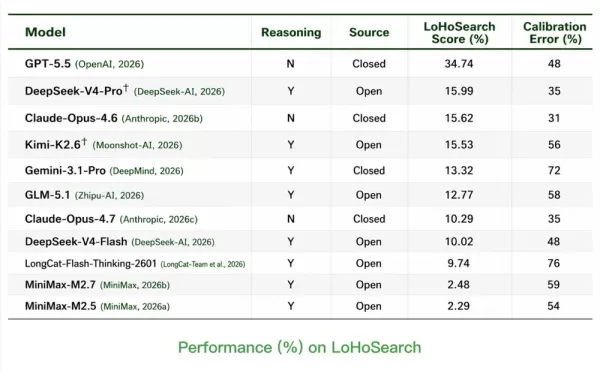
The results are stark. Among 11 leading models, the highest score reached only 34.74%, with the next three scoring between 15% and 16%. By contrast, these same models achieve approximately 90% on BrowseComp. This gap highlights the true limitations of current search agents. Notably, context strategies yield diminishing returns: the best context approach on LoHoSearch improved scores by just 6.8 percentage points, compared to 14 percentage points on BrowseComp. This suggests that relying on prompts and context engineering to bridge capability gaps is largely ineffective under this new benchmark.
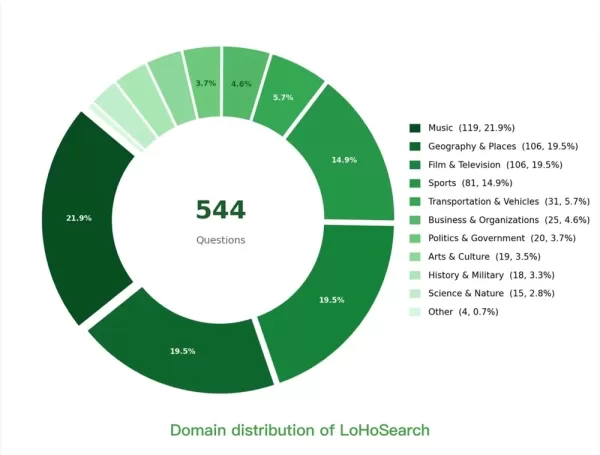
LoHoSearch comprises 544 questions spanning 11 domains, structured in tree and graph formats, and has been open-sourced. As older benchmarks plateau, the real challenges for search agents are just beginning, and LoHoSearch may soon become an essential evaluation standard.
Related article
 MiniMax Unveils H3 Multimodal Model, Cutting 15-Second 2K Audio-Visual Generation Costs to Under One-Third of Industry Standard
MiniMax has officially unveiled MiniMax H3, a general-purpose multimodal generation model designed to unify the understanding and creation of text, images, video, and audio. By bridging the historical divide between tasks and modalities in video gene
World Bank Urges Emerging Economies to Skip Big Models, Focus on Local Small Tools
The World Bank’s latest report charts a pragmatic course for developing economies: integrate artificial intelligence into public administration and commercial activities immediately, while tailoring existing solutions to local contexts. There is no n
OpenAI CEO Altman Cancels South Korea and Japan Visit Following the Birth of His Second Daughter
OpenAI CEO Sam Altman recently welcomed his second daughter, who was born prematurely, prompting the cancellation of his planned trip to South Korea and Japan scheduled for the 15th. While industry observers had speculated that the itinerary change m
Related Special Topic Recommendations
Design & Art
MiniMax Unveils H3 Multimodal Model, Cutting 15-Second 2K Audio-Visual Generation Costs to Under One-Third of Industry Standard
MiniMax has officially unveiled MiniMax H3, a general-purpose multimodal generation model designed to unify the understanding and creation of text, images, video, and audio. By bridging the historical divide between tasks and modalities in video gene
World Bank Urges Emerging Economies to Skip Big Models, Focus on Local Small Tools
The World Bank’s latest report charts a pragmatic course for developing economies: integrate artificial intelligence into public administration and commercial activities immediately, while tailoring existing solutions to local contexts. There is no n
OpenAI CEO Altman Cancels South Korea and Japan Visit Following the Birth of His Second Daughter
OpenAI CEO Sam Altman recently welcomed his second daughter, who was born prematurely, prompting the cancellation of his planned trip to South Korea and Japan scheduled for the 15th. While industry observers had speculated that the itinerary change m
Related Special Topic Recommendations
Design & Art
 Top AI Illustration Tools: Create Editorial Scenes and Cover Art Faster
2026 Latest Top-rated AI Illustration Tools: Our curated list features the best powerfully designed tools for creating stunning editorial scenes and eye-catching cover art quickly. Each option has gone through rigorous real-world tests, offering a free vs paid comparison to help you find the perfect match for your workflow. Try these must-try solutions today to unlock your AI edge and boost your creative productivity. Explore now at XIX.AI.
 10 tools
 xix.ai
Education and Learning
Top AI Tutors for Exam Prep: Practice Math, Science, and English
xix.ai
Education and Learning
Top AI Tutors for Exam Prep: Practice Math, Science, and English
2026 Latest Top-Rated Best AI Tutors for Exam Prep are here on XIX.AI! Our curated list features powerful game-changing tools that offer free vs paid comparison, real-world tests, and weekly updated rankings. They help boost your writing efficiency, simplify complex topic learning, and unlock your academic potential. Explore now to Discover your perfect exam prep tool and Start creating today to Unlock your AI edge!
10 tools
xix.ai
Finance
AI Budget Planning Tools for Personal Money Management
2026 Latest Best Top-Rated AI Budget Planning Tools for Personal Money Management are here on XIX.AI! This curated collection features powerful, game-changing solutions that help you conduct real-world tests, understand spending habits, and create personalized plans to boost productivity. Enjoy a free vs paid comparison along with detailed rankings. Must-try tools designed to simplify money management and unlock your AI edge. Explore now!
11 tools
xix.ai
Health & Wellness
AI Sleep Tracking Assistants: Improve Recovery with Better Bedtime Habits
2026 Latest Best Top-Rated AI Sleep Tracking Assistants curated for ultimate recovery. This fully updated weekly guide features powerful tools that deliver real-world tests, free vs paid comparison, and detailed rankings to help you find the must-try solution that boosts sleep quality and supports better bedtime habits. Explore now at XIX.AI to Unlock your AI edge.
10 tools
xix.ai
Data Analysis
AI SQL Copilots for Product and Revenue Analytics
2026 Latest Best Top-Rated AI SQL Copilots for Product and Revenue Analytics! XIX.AI has curated a powerful, game-changing collection of must-try tools that undergo real-world tests through weekly updated rankings. These tools help users boost productivity significantly by accelerating data analysis, streamlining complex queries, and generating accurate insights to drive smarter business decisions. Explore now to Discover your perfect tool for unlocking your AI edge!
14 tools
xix.ai
Education and Learning
Best AI Homework Helpers That Teach: Learn Concepts, Not Just Answers
2026 Latest Best Top-Rated AI Homework Helpers That Teach Core Concepts Not Just Answers Powerful Tools for Students Must-Try Curated List Weekly Updated Free vs Paid Comparison Real-World Tests Accurate Rankings to Help You Unlock Your Full Learning Potential Explore now to Discover your perfect tool for smarter studying.
10 tools
xix.ai

 Comments (0)
0/500
Comments (0)
0/500
Search agent capabilities have been largely defined by BrowseComp over the last year. Yet, this benchmark is losing its relevance — it drove model performance from 30% to 90% in just ten months, and its value is rapidly diminishing. On July 17, Meituan’s LongCat launched a more rigorous evaluation, LoHoSearch, designed to reignite meaningful progress in search agent development.
LoHoSearch’s challenges are not manually crafted but automatically generated from a Wikipedia knowledge graph containing 7.62 million entities. Because they are machine-generated, these tasks reach levels of search space and structural complexity that human annotators could never consistently replicate. In short, while previous benchmarks were limited by human-designed ceilings, LoHoSearch delegates question generation to the knowledge graph, effectively removing that upper bound.
The results are stark. Among 11 leading models, the highest score reached only 34.74%, with the next three scoring between 15% and 16%. By contrast, these same models achieve approximately 90% on BrowseComp. This gap highlights the true limitations of current search agents. Notably, context strategies yield diminishing returns: the best context approach on LoHoSearch improved scores by just 6.8 percentage points, compared to 14 percentage points on BrowseComp. This suggests that relying on prompts and context engineering to bridge capability gaps is largely ineffective under this new benchmark.
LoHoSearch comprises 544 questions spanning 11 domains, structured in tree and graph formats, and has been open-sourced. As older benchmarks plateau, the real challenges for search agents are just beginning, and LoHoSearch may soon become an essential evaluation standard.








 MiniMax Unveils H3 Multimodal Model, Cutting 15-Second 2K Audio-Visual Generation Costs to Under One-Third of Industry Standard
MiniMax has officially unveiled MiniMax H3, a general-purpose multimodal generation model designed to unify the understanding and creation of text, images, video, and audio. By bridging the historical divide between tasks and modalities in video gene
MiniMax Unveils H3 Multimodal Model, Cutting 15-Second 2K Audio-Visual Generation Costs to Under One-Third of Industry Standard
MiniMax has officially unveiled MiniMax H3, a general-purpose multimodal generation model designed to unify the understanding and creation of text, images, video, and audio. By bridging the historical divide between tasks and modalities in video gene
 World Bank Urges Emerging Economies to Skip Big Models, Focus on Local Small Tools
The World Bank’s latest report charts a pragmatic course for developing economies: integrate artificial intelligence into public administration and commercial activities immediately, while tailoring existing solutions to local contexts. There is no n
World Bank Urges Emerging Economies to Skip Big Models, Focus on Local Small Tools
The World Bank’s latest report charts a pragmatic course for developing economies: integrate artificial intelligence into public administration and commercial activities immediately, while tailoring existing solutions to local contexts. There is no n
 OpenAI CEO Altman Cancels South Korea and Japan Visit Following the Birth of His Second Daughter
OpenAI CEO Sam Altman recently welcomed his second daughter, who was born prematurely, prompting the cancellation of his planned trip to South Korea and Japan scheduled for the 15th. While industry observers had speculated that the itinerary change m
OpenAI CEO Altman Cancels South Korea and Japan Visit Following the Birth of His Second Daughter
OpenAI CEO Sam Altman recently welcomed his second daughter, who was born prematurely, prompting the cancellation of his planned trip to South Korea and Japan scheduled for the 15th. While industry observers had speculated that the itinerary change m

2026 Latest Top-rated AI Illustration Tools: Our curated list features the best powerfully designed tools for creating stunning editorial scenes and eye-catching cover art quickly. Each option has gone through rigorous real-world tests, offering a free vs paid comparison to help you find the perfect match for your workflow. Try these must-try solutions today to unlock your AI edge and boost your creative productivity. Explore now at XIX.AI.
10 tools
xix.ai

2026 Latest Top-Rated Best AI Tutors for Exam Prep are here on XIX.AI! Our curated list features powerful game-changing tools that offer free vs paid comparison, real-world tests, and weekly updated rankings. They help boost your writing efficiency, simplify complex topic learning, and unlock your academic potential. Explore now to Discover your perfect exam prep tool and Start creating today to Unlock your AI edge!
10 tools
xix.ai

2026 Latest Best Top-Rated AI Budget Planning Tools for Personal Money Management are here on XIX.AI! This curated collection features powerful, game-changing solutions that help you conduct real-world tests, understand spending habits, and create personalized plans to boost productivity. Enjoy a free vs paid comparison along with detailed rankings. Must-try tools designed to simplify money management and unlock your AI edge. Explore now!
11 tools
xix.ai

2026 Latest Best Top-Rated AI Sleep Tracking Assistants curated for ultimate recovery. This fully updated weekly guide features powerful tools that deliver real-world tests, free vs paid comparison, and detailed rankings to help you find the must-try solution that boosts sleep quality and supports better bedtime habits. Explore now at XIX.AI to Unlock your AI edge.
10 tools
xix.ai

2026 Latest Best Top-Rated AI SQL Copilots for Product and Revenue Analytics! XIX.AI has curated a powerful, game-changing collection of must-try tools that undergo real-world tests through weekly updated rankings. These tools help users boost productivity significantly by accelerating data analysis, streamlining complex queries, and generating accurate insights to drive smarter business decisions. Explore now to Discover your perfect tool for unlocking your AI edge!
14 tools
xix.ai

2026 Latest Best Top-Rated AI Homework Helpers That Teach Core Concepts Not Just Answers Powerful Tools for Students Must-Try Curated List Weekly Updated Free vs Paid Comparison Real-World Tests Accurate Rankings to Help You Unlock Your Full Learning Potential Explore now to Discover your perfect tool for smarter studying.
10 tools
xix.ai












