


 Home
HomeMeituan Open-Sources LongCat-Video-Avatar1.5, Outperforming Mainstream Closed Models
Meituan's LongCat large model team has officially open-sourced LongCat-Video-Avatar 1.5, a commercial-grade digital human video generation model. This version represents a full shift from open-source state-of-the-art to real-world commercial deployment, with major enhancements in lip sync, physical realism, long-video stability, multi-person interactions, and efficient inference.
Three Key Upgrades to Overcome Commercialization Hurdles
To make digital humans work reliably across various real-world applications, LongCat-Video-Avatar 1.5 tackles persistent problems like jitter, distortion, and high latency in traditional digital human videos through three holistic improvements:
Commercial-Grade Audio Encoding Upgrade
The model’s audio feature extraction encoder has been upgraded from Wav2Vec2 to Whisper-large. With more parameters and richer multilingual prior knowledge, it now captures subtle phoneme variations and speech rhythm. This improves lip synchronization for complex audio such as long sentences, fast speech, and singing, while also enabling natural coordination between facial expressions, head movements, and speech—significantly reducing frame skipping and identity drift in longer videos.
Robust Open-Domain Generalization via Multi-Stage Data Enhancement
To ensure stable performance across diverse subjects—real people, virtual idols, anime characters, and animals—the team developed a multi-stage data pipeline incorporating offline annotation and online validation, and introduced three targeted types of enhanced data:
Multi-Person Data: Using active speaker detection, it removes audio-visual ambiguity in multi-person scenes, accurately differentiating speakers from listeners.
Quiet Data: By selecting videos with no speech, the model learns natural micro-expressions during silent states, preventing unwanted mouth movements in non-speaking characters.
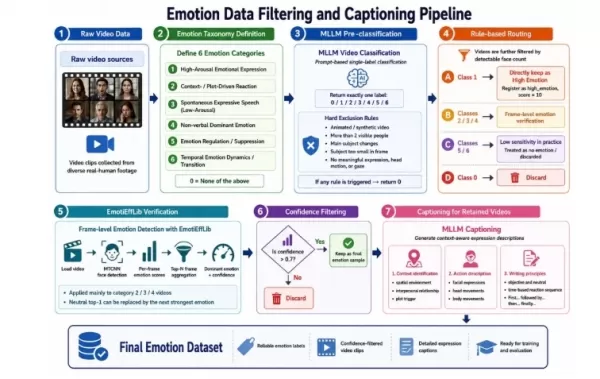
Emotion Data: Combined with frame-level emotion recognition filtering, it incorporates emotional variations, helping the model grasp the deep link between speech and facial expressions.
Hand Alignment and Temporal Continuity with GRPO
For use cases like e-commerce live streams and product demos where hands are frequently visible, the model introduces GRPO (Human Preference Alignment), which refines reward signals to the frame level and adds a first-frame hand detection mechanism. This substantially reduces common issues like hand distortion, local structural collapse, and inconsistent motion.
15× Faster Inference: Eliminating Costly Compute Requirements
Cost is another critical factor for commercial deployment. LongCat-Video-Avatar 1.5 uses DMD (Distributed Matching Distillation) technology, compressing the original 50-step generation process to just 8 steps. In addition, the team replaced the conventional three-model parallel setup with a single shared base model plus multiple LoRA adapters, dramatically reducing VRAM usage.
In real-world tests, the model delivers roughly 15× faster inference, generating a 10-second video in about one minute.
Benchmark Evaluation: Outperforming Top Industry Models
Using the EvalTalker benchmark, 770 evaluators and 10 domain experts performed structured quality analysis on videos from complex domains including news, education, and entertainment. The results show that LongCat-Video-Avatar 1.5 excels across several key metrics:
User Preference Win Rate: It beats Kling Avatar2.0 by 65.9%, OmniHuman-1.5 by 61.1%, and HeyGen by 54.3%.
Single and Multi-Person Scenario Scores: The single-person score reaches 3.336, well above competitors like HeyGen; the multi-person score is 2.730, significantly outperforming InfiniteTalk (2.339).
Video Stability: The subject deformation rate is only 23.1%, and background deformation rate is just 9.4%;the frame skipping rate is as low as 0.8%, the best among all compared models.
Audio-Visual Coordination: The face-body sync issue rate fell to 5.1%, and the lip sync issue rate dropped to 29.8%, both surpassing traditional commercial systems.
The Meituan LongCat large model team says that open-sourcing LongCat-Video-Avatar 1.5 is more than a version update—it's an invitation to the global developer and creator community. They hope this model will serve as a verifiable, improvable technical foundation, helping to push the real-world boundaries of digital human video applications.
Open Source Links:
Github: https://github.com/meituan-longcat/LongCat-Video
HuggingFace: https://huggingface.co/meituan-longcat/LongCat-Video-Avatar-1.5
Tech Report: https://github.com/meituan-longcat/LongCat-Video/blob/main/assets/LongCat-Video-Avatar-1.5-Tech-Report.pdf
Project Page: https://meigen-ai.github.io/LongCat-Video-Avatar-1.5-Page/
Modelscope: https://www.modelscope.cn/models/meituan-longcat/LongCat-Video-Avatar-1.5/summary
Related article
 Suno to Watermark Songs Amid Legal Battles
Suno, the platform enabling users to generate AI-created music, has unveiled new features to label platform-produced tracks, restrict downloads, and update community standards to curb unauthorized replicas. These updates arrive as Suno confronts mult
Musk Admits Grok Build Leaked User Code, Promises to Erase All Historical Data
Elon Musk directly addressed the privacy controversy surrounding Grok Build, beginning with a simple "True" to confirm the incident's validity. He pledged that all user data previously uploaded to SpaceXAI would be permanently erased, stating, "not a
U.S. Stocks Hit Historic Milestone as AI and Aerospace Giants Prepare for Trillion-Dollar Debut
Elon Musk, Sam Altman, and Dario Amodei, three titans of the technology sector, are advancing toward initial public offerings for their respective ventures. With SpaceX, OpenAI, and Anthropic—three industry behemoths nearing trillion-dollar valuation
Related Special Topic Recommendations
SEO
Suno to Watermark Songs Amid Legal Battles
Suno, the platform enabling users to generate AI-created music, has unveiled new features to label platform-produced tracks, restrict downloads, and update community standards to curb unauthorized replicas. These updates arrive as Suno confronts mult
Musk Admits Grok Build Leaked User Code, Promises to Erase All Historical Data
Elon Musk directly addressed the privacy controversy surrounding Grok Build, beginning with a simple "True" to confirm the incident's validity. He pledged that all user data previously uploaded to SpaceXAI would be permanently erased, stating, "not a
U.S. Stocks Hit Historic Milestone as AI and Aerospace Giants Prepare for Trillion-Dollar Debut
Elon Musk, Sam Altman, and Dario Amodei, three titans of the technology sector, are advancing toward initial public offerings for their respective ventures. With SpaceX, OpenAI, and Anthropic—three industry behemoths nearing trillion-dollar valuation
Related Special Topic Recommendations
SEO
 Best AI SERP Analysis Tools for Search Strategy
2026 Latest Best Top-rated AI SERP Analysis Tools for Search Strategy are curated by XIX.AI through rigorous real-world tests and weekly updated rankings. These powerful tools help you unlock hidden optimization opportunities, boost content performance, and gain a competitive edge in search. Discover your perfect tool to elevate your search strategy today. Explore now!
 13 tools
 xix.ai
Data Analysis
Best AI Anomaly Detection Tools for KPI Monitoring across SaaS and Ecommerce Teams
xix.ai
Data Analysis
Best AI Anomaly Detection Tools for KPI Monitoring across SaaS and Ecommerce Teams
2026 Latest Best Top-rated AI Anomaly Detection Tools for KPI Monitoring in SaaS and Ecommerce teams! XIX.AI has curated a powerful, game-changing collection based on rigorous real-world tests and weekly updated rankings. You’ll find detailed free vs paid comparison insights to help you identify the must-try solution that boosts productivity and unlocks your AI edge. Explore now!
10 tools
xix.ai
writing
Best AI Outline Generators for Long-Form SEO Articles
2026 Latest Best Top-Rated AI Outline Generators for Long-Form SEO Articles, meticulously curated by XIX.AI. These powerful tools offer game-changing assistance in creating high-quality content quickly, boosting writing efficiency significantly. Get a free vs paid comparison along with real-world tests and detailed rankings to help you find the must-try option that suits your needs. Explore now to unlock your AI edge.
8 tools
xix.ai
Education and Learning
AI Study Tools for Homework and Exam Prep
2026 Latest Best AI Study Tools for Homework and Exam Prep! XIX.AI curates a top-rated list of powerful, game-changing tools that help students boost productivity, streamline homework completion, and ace exams through real-world tests. Get a free vs paid comparison, detailed rankings, and must-try options to unlock your AI edge. Explore now!
10 tools
xix.ai
Music composition
AI Vocal Demo Tools for Songwriters, Hooks, Toplines, and Multilingual Draft Sessions
2026 Latest Best AI Vocal Demo Tools for Songwriters, Hook Creators, and Multi-Language Content Teams! XIX.AI has curated a top-rated list of powerful game-changing tools that go through rigorous real-world tests. You’ll find detailed free vs paid comparison data, comprehensive rankings, and must-try options to help you boost writing efficiency and unlock your creative potential. Explore now to discover your perfect tool for all your content needs!
9 tools
xix.ai
Business
Best AI Competitive Research Tools for Small Businesses
2026 Latest Best Top-rated AI Competitive Research Tools for Small Businesses! XIX.AI has curated a highly powerful game-changing collection, updated weekly with rigorous real-world tests and detailed rankings. You can find a comprehensive free vs paid comparison to help you identify the must-try tools that boost your productivity and give you a competitive edge. Explore now to discover your perfect tool!
9 tools
xix.ai

 Comments (0)
0/500
Comments (0)
0/500
Meituan's LongCat large model team has officially open-sourced LongCat-Video-Avatar 1.5, a commercial-grade digital human video generation model. This version represents a full shift from open-source state-of-the-art to real-world commercial deployment, with major enhancements in lip sync, physical realism, long-video stability, multi-person interactions, and efficient inference.
Three Key Upgrades to Overcome Commercialization Hurdles
To make digital humans work reliably across various real-world applications, LongCat-Video-Avatar 1.5 tackles persistent problems like jitter, distortion, and high latency in traditional digital human videos through three holistic improvements:
Commercial-Grade Audio Encoding Upgrade
The model’s audio feature extraction encoder has been upgraded from Wav2Vec2 to Whisper-large. With more parameters and richer multilingual prior knowledge, it now captures subtle phoneme variations and speech rhythm. This improves lip synchronization for complex audio such as long sentences, fast speech, and singing, while also enabling natural coordination between facial expressions, head movements, and speech—significantly reducing frame skipping and identity drift in longer videos.
Robust Open-Domain Generalization via Multi-Stage Data Enhancement
To ensure stable performance across diverse subjects—real people, virtual idols, anime characters, and animals—the team developed a multi-stage data pipeline incorporating offline annotation and online validation, and introduced three targeted types of enhanced data:
Multi-Person Data: Using active speaker detection, it removes audio-visual ambiguity in multi-person scenes, accurately differentiating speakers from listeners.
Quiet Data: By selecting videos with no speech, the model learns natural micro-expressions during silent states, preventing unwanted mouth movements in non-speaking characters.
Emotion Data: Combined with frame-level emotion recognition filtering, it incorporates emotional variations, helping the model grasp the deep link between speech and facial expressions.
Hand Alignment and Temporal Continuity with GRPO
For use cases like e-commerce live streams and product demos where hands are frequently visible, the model introduces GRPO (Human Preference Alignment), which refines reward signals to the frame level and adds a first-frame hand detection mechanism. This substantially reduces common issues like hand distortion, local structural collapse, and inconsistent motion.
15× Faster Inference: Eliminating Costly Compute Requirements
Cost is another critical factor for commercial deployment. LongCat-Video-Avatar 1.5 uses DMD (Distributed Matching Distillation) technology, compressing the original 50-step generation process to just 8 steps. In addition, the team replaced the conventional three-model parallel setup with a single shared base model plus multiple LoRA adapters, dramatically reducing VRAM usage.
In real-world tests, the model delivers roughly 15× faster inference, generating a 10-second video in about one minute.
Benchmark Evaluation: Outperforming Top Industry Models
Using the EvalTalker benchmark, 770 evaluators and 10 domain experts performed structured quality analysis on videos from complex domains including news, education, and entertainment. The results show that LongCat-Video-Avatar 1.5 excels across several key metrics:
User Preference Win Rate: It beats Kling Avatar2.0 by 65.9%, OmniHuman-1.5 by 61.1%, and HeyGen by 54.3%.
Single and Multi-Person Scenario Scores: The single-person score reaches 3.336, well above competitors like HeyGen; the multi-person score is 2.730, significantly outperforming InfiniteTalk (2.339).
Video Stability: The subject deformation rate is only 23.1%, and background deformation rate is just 9.4%;the frame skipping rate is as low as 0.8%, the best among all compared models.
Audio-Visual Coordination: The face-body sync issue rate fell to 5.1%, and the lip sync issue rate dropped to 29.8%, both surpassing traditional commercial systems.
The Meituan LongCat large model team says that open-sourcing LongCat-Video-Avatar 1.5 is more than a version update—it's an invitation to the global developer and creator community. They hope this model will serve as a verifiable, improvable technical foundation, helping to push the real-world boundaries of digital human video applications.
Open Source Links:
Github: https://github.com/meituan-longcat/LongCat-Video
HuggingFace: https://huggingface.co/meituan-longcat/LongCat-Video-Avatar-1.5
Tech Report: https://github.com/meituan-longcat/LongCat-Video/blob/main/assets/LongCat-Video-Avatar-1.5-Tech-Report.pdf
Project Page: https://meigen-ai.github.io/LongCat-Video-Avatar-1.5-Page/
Modelscope: https://www.modelscope.cn/models/meituan-longcat/LongCat-Video-Avatar-1.5/summary








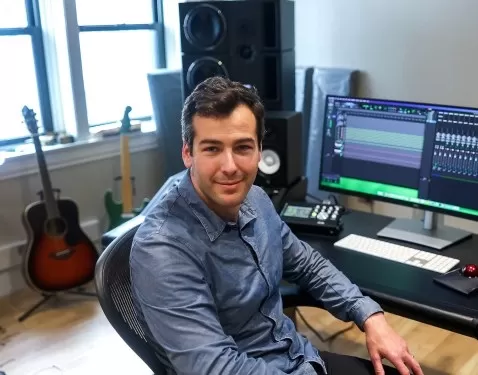 Suno to Watermark Songs Amid Legal Battles
Suno, the platform enabling users to generate AI-created music, has unveiled new features to label platform-produced tracks, restrict downloads, and update community standards to curb unauthorized replicas. These updates arrive as Suno confronts mult
Suno to Watermark Songs Amid Legal Battles
Suno, the platform enabling users to generate AI-created music, has unveiled new features to label platform-produced tracks, restrict downloads, and update community standards to curb unauthorized replicas. These updates arrive as Suno confronts mult
 Musk Admits Grok Build Leaked User Code, Promises to Erase All Historical Data
Elon Musk directly addressed the privacy controversy surrounding Grok Build, beginning with a simple "True" to confirm the incident's validity. He pledged that all user data previously uploaded to SpaceXAI would be permanently erased, stating, "not a
Musk Admits Grok Build Leaked User Code, Promises to Erase All Historical Data
Elon Musk directly addressed the privacy controversy surrounding Grok Build, beginning with a simple "True" to confirm the incident's validity. He pledged that all user data previously uploaded to SpaceXAI would be permanently erased, stating, "not a
 U.S. Stocks Hit Historic Milestone as AI and Aerospace Giants Prepare for Trillion-Dollar Debut
Elon Musk, Sam Altman, and Dario Amodei, three titans of the technology sector, are advancing toward initial public offerings for their respective ventures. With SpaceX, OpenAI, and Anthropic—three industry behemoths nearing trillion-dollar valuation
U.S. Stocks Hit Historic Milestone as AI and Aerospace Giants Prepare for Trillion-Dollar Debut
Elon Musk, Sam Altman, and Dario Amodei, three titans of the technology sector, are advancing toward initial public offerings for their respective ventures. With SpaceX, OpenAI, and Anthropic—three industry behemoths nearing trillion-dollar valuation

2026 Latest Best Top-rated AI SERP Analysis Tools for Search Strategy are curated by XIX.AI through rigorous real-world tests and weekly updated rankings. These powerful tools help you unlock hidden optimization opportunities, boost content performance, and gain a competitive edge in search. Discover your perfect tool to elevate your search strategy today. Explore now!
13 tools
xix.ai
2026 Latest Best Top-rated AI Anomaly Detection Tools for KPI Monitoring in SaaS and Ecommerce teams! XIX.AI has curated a powerful, game-changing collection based on rigorous real-world tests and weekly updated rankings. You’ll find detailed free vs paid comparison insights to help you identify the must-try solution that boosts productivity and unlocks your AI edge. Explore now!
10 tools
xix.ai

2026 Latest Best Top-Rated AI Outline Generators for Long-Form SEO Articles, meticulously curated by XIX.AI. These powerful tools offer game-changing assistance in creating high-quality content quickly, boosting writing efficiency significantly. Get a free vs paid comparison along with real-world tests and detailed rankings to help you find the must-try option that suits your needs. Explore now to unlock your AI edge.
8 tools
xix.ai

2026 Latest Best AI Study Tools for Homework and Exam Prep! XIX.AI curates a top-rated list of powerful, game-changing tools that help students boost productivity, streamline homework completion, and ace exams through real-world tests. Get a free vs paid comparison, detailed rankings, and must-try options to unlock your AI edge. Explore now!
10 tools
xix.ai

2026 Latest Best AI Vocal Demo Tools for Songwriters, Hook Creators, and Multi-Language Content Teams! XIX.AI has curated a top-rated list of powerful game-changing tools that go through rigorous real-world tests. You’ll find detailed free vs paid comparison data, comprehensive rankings, and must-try options to help you boost writing efficiency and unlock your creative potential. Explore now to discover your perfect tool for all your content needs!
9 tools
xix.ai

2026 Latest Best Top-rated AI Competitive Research Tools for Small Businesses! XIX.AI has curated a highly powerful game-changing collection, updated weekly with rigorous real-world tests and detailed rankings. You can find a comprehensive free vs paid comparison to help you identify the must-try tools that boost your productivity and give you a competitive edge. Explore now to discover your perfect tool!
9 tools
xix.ai












